Microbio Lab Final Practical
 Call Kai
 Learn
 Practice Test
 Spaced Repetition
 Match
 Flashcards
 Knowt Play
1/105

Earn XP
Description and Tags
Review for BIOL 2042 UNT 2026
106 Terms
What are the steps of PCR? What happens in each step?
Polymerase Chain Reaction (PCR) involves three main steps: 1) Denaturation: Heating the PCR mixture to separate the DNA strands, 2) Annealing: Cooling the mixture for primers to bind to the target DNA sequences, 3) Extension: Raising the temperature again for DNA polymerase to synthesize new DNA strands.
What is the purpose of PCR?
The purpose of PCR is to amplify a specific DNA segment, making millions of copies from a small initial sample.
What is Taq polymerase and from which organism we get it from?
Taq polymerase is a heat-stable DNA polymerase used in PCR, isolated from the thermophilic bacterium Thermus aquaticus.
What are primers? What primers were used for the 16S rRNA?
Primers are short DNA sequences that initiate DNA synthesis during PCR. For the 16S rRNA, E coli primers were used.
What is dNTPS? What is the function of them?
dNTPs, or deoxynucleotide triphosphates, are the building blocks of DNA used in PCR. Their function is to provide the necessary nucleotides for the synthesis of new DNA strands during the amplification process.
What are the components of PCR Buffer compositions?
PCR buffer compositions typically include a salt, such as potassium chloride (KCl), a pH stabilizer like Tris-HCl, and sometimes a detergent like Tween-20. These components help maintain the optimal conditions for the activity of DNA polymerase during the PCR process.
Give two PCR applications.
cloning and genetic testing.
What does PCR stand for?
Polymerase Chain Reaction
What is the name of this equipment? (Small rectangle screen, squiarish with lid)
Thermocycler

Give the result for test tube “A”. What is the principle behind this result?
Positive for Citrate test. Alkaline byproducts cause pH to rise and change color.

What is the name of indicator present in tube B
Bromothymol Blue

Result of test tube C? Principle?
Negative for urea test. Yellow not pink. If urease is present, breaks down urea to ammonia and changes pH to become magenta. (very high)

Name of indicator in tube D?
Phenol red (pH indicator)
Name 2 organisms considered a “safe relative" and was used in micro 2042 labs.
Escherichia coli and Pseudomonas putida
Why are we looking for new antibiotics against ESKAPE pathogens?
these bacteria frequently evade existing drugs, cause severe hospital infections, and face a shrinking treatment pipeline
What is the purpose of preparing a master plate?
To create and observe isolated colonies for later testing.
Why choose so many isolates for master plate?
Maximizes chances of finding microbe that produces antibiotics.
On what basis did you pick the soil isolates for making the master plates?
Distinct colony morphology and growth separation.
Why are ESKAPE organisms not used in the tiny earth project? Name the ESKAPE pathogens.
They are very dangerous to humans. They are:
Enterococcus faecium
Staphylococcus aureus
Klebsiella pneumoniae
Acinetobacter baumannii
Pseudomonas aeruginosa
Enterobacter species
Define ESKAPE pathogen and safe-relative organism.
An ESKAPE pathogen is one of six high-priority, often multidrug-resistant bacteria that cause severe hospital-acquired infections and "escape" common antibiotics. A safe-relative organism is a closely related, non-pathogenic (or lower-risk) microbe used as a surrogate in teaching or screening labs to safely study or test against ESKAPE-like traits.
Principle behind oxidase test?
detects whether bacteria produce cytochrome oxidase
Name of indicator used to develop oxidase test?
Kovacs reagent
A. Which organism is positive for oxidase test?
B. Which is negative?
A. P Putida
B. E. coli
Which of the swabs has positive results? E or F
Whichever has smth on it.
Name the bacteria used in bacteriophage experiment.
Streptomyces

A. Calculate the titer of the sample in plate A
B. Calculate the titer of the sample in plate B.
Use #Plaques/dilution factor
What is plaque? What kind of plaques are formed in lytic and lysogenic cycle?
visible zone caused by viral infection and cell destruction. Lytic is clear, lysogenic is cloudy.
Define coliphage and bacteriophage.
A bacteriophage is a virus that infects bacteria, while a coliphage is a type of bacteriophage that specifically infects Escherichia coli (E. coli) and related coliform bacteria
What does PFU stand for? What does it mean by obligate intracellular parasite?
PFU stands for plaque-forming unit, and an obligate intracellular parasite is a microorganism or virus that cannot reproduce outside of a living host cell.
A the integration of viral DNA in the host DNA occurs in _____cycle
B. The host cells are damaged after viral replication in _______ cycle.
Lysogenic; Lytic
Lytic cycle 5 phases?
The lytic cycle has five phases: attachment, penetration, biosynthesis, maturation, and release (lysis
How to cross out an error during documenting in lab notebook?
Straight line throug then put correction?!?! Idk
Why do we use cycloheximide in the media?
Prevent unwanted fungal growth.
Write 3 lab etiquettes you shold follow while working in the lab?
Wear PPE, Don't eat food or drink, Report broken glass to TA immediately.
Give example of proper PPE during Tiny Earth project.
Wearing coat and goggles.
Give 3 examples of aseptic techniques that need to be followed.
proper hand hygiene, using sterile barriers and gloves, and dont cross contaminate while handling something.
What should you do if you have a small spill on table vs large one?
Clean it with sterile methods; Alert TA and clean based on situation.
What percentage of ethanol and bleach are used in the lab as a disinfectant?
maybe 70% ethanol; 0.5%
How are you going to label a petri dish? Why?
key details on bottom plate edge, in case lid is lost and to see the contents.
What should be written in teh label of a test tube or petri dish?
Contents, Name/Initials, Table #, Section #
A. Reagents in the Voges-Proskauer test used is/are __
B. In Methyl red test:
A: alpha napthol and KOH
B: Methyl red pH indicator
We test _____ end product of glucose metabolism with methyl red test and ____ end product of glucose metabolism with Voges Proskauer test.
idk man

Interpret the results for this test tube C then D.
C: Positive Indol
D: Positive Indol and Sulfide
What is the name of the primary stain, decolorizer, and counter stain used in this staining? What are the functions of each? (NO context yeahhh)
Crystal Violet, Iodine Treatment, Safranin

A: Identify staining tech used in microscope E. Gram nature of the organism?
B: Name bacteria Genus and species used to prepare this stain in lab
idk :(

A: Gram nature of organism in microscope F? (Morphology and Gram reaction)
idkkk

Identify organism (Genus) under microscope A. B?
no clue, no info given
Characteristics of cyanobacteria? Are they prokaryotic or eukaryotic?
Oxygenic photosynthetic (in thylakoids) bacteria, unicellular,
filamentous
⚫ Habitat
⚫ Some fix nitrogen in heterocysts (important fertilizer providers)
N2 NH4+
⚫ Great contribution in evolution and ecological changes and the
beginning of life
(prokaryotic)

Identify the organisms A, B, C.
T. cruzi, Blepharisma, Amoeba
For T cruzi, blepharisma, and amoeba: What domain do these organisms belong to?
Protozoa
What are the two stages of Protozoa? which one is active, and which one is dormant?
Trophozoite active; Cyst dormant.
Four classes of Protozoa depending on motility?
Amoebae, flagellates, ciliates, and sporozoa.
What shold you do first when you break glassware in the lab?
Alert the ta ig.
Name the indicator of glucose/lactose fermentation
Phenol red
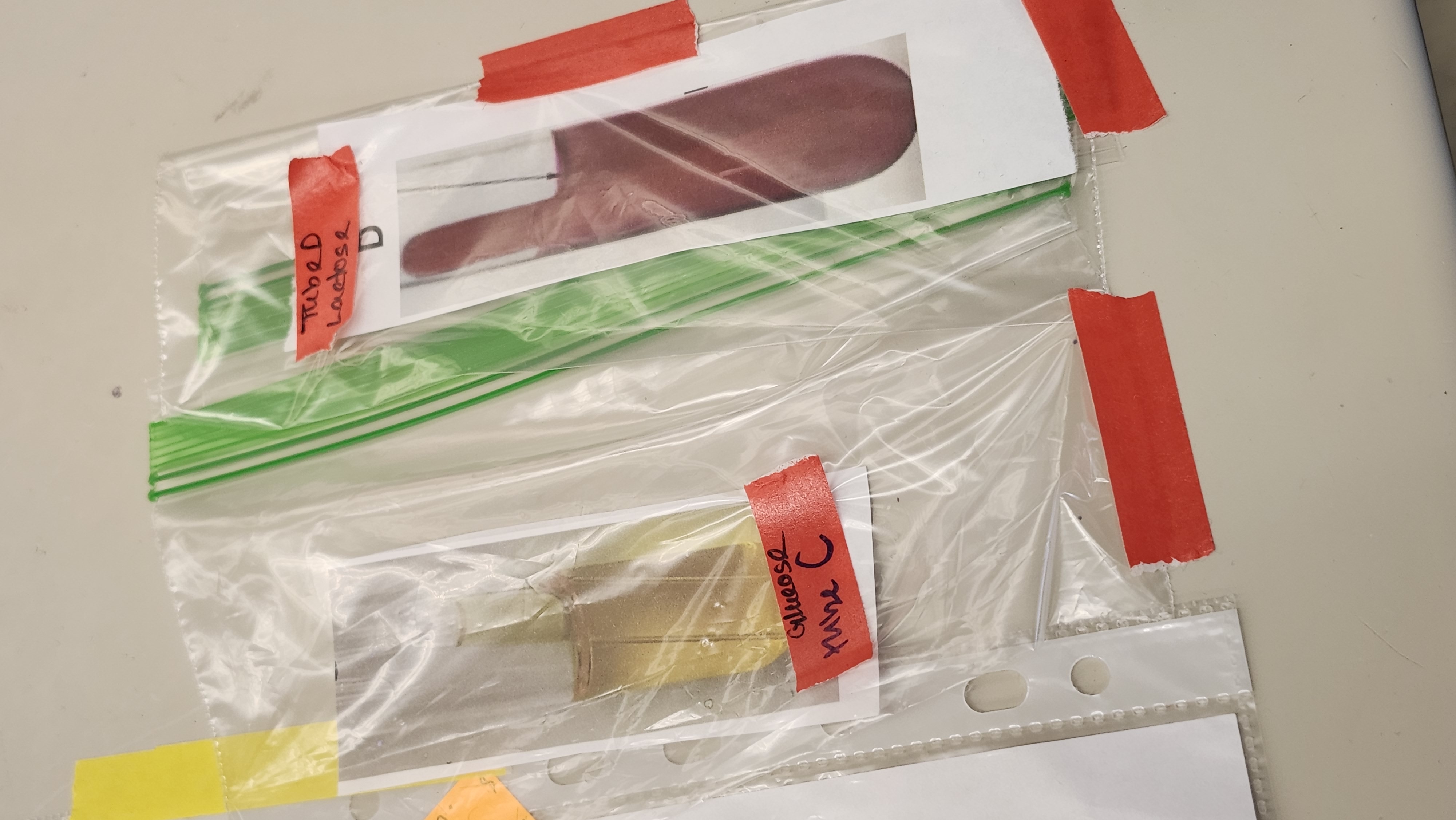
A: Identify result for glucose test in tube C. Principle behind this result?
B: What about lactose test in D. Principle?
C: Name of the small tube in tube C and D? Function?
A. Negative, detects mixed acids. Gas production though
B. idkk ig negative
C. Durham tube, traps gas confirming fermentation from bacteria
Identify the organism from the given tuebs and chart.
E coli? Not sure man
Purpsoe of gel electrophoresis?
To separate and identify fragements of DNA, RNA, or protein for comparison.
What is agarose? How does agarose work during gel electrophoresis?
Porous gel matrix. It separates molecules by size as electric current pulls them through, where smaller fragments move faster than larger ones.
What is the use of TBE (Tris Borate EDTA)
Buffer solution or conducting current.
Function of the Gel green dye used in electrophoresis?
To make bands visible
What's the purpose of using loading and tracking buffer? (two reasons)
Keeping samples in well, and migration tracking.
DNA ladder?
solution of known lengths used as reference in gel electrophoresis.
DNA gragments separate based on what three features during gel electrophoresis:
size, charge, shape
What direction does DNA travel? What charge is DNA itself?
To positive, bc dna is negative
What is pandemic? Give example of disease that is pandemic?
Then Epidemic and then sporadic.
Disease outbreak that spreads across multiple countries, Covid 19; Epidemic is sudden spike in disease cases within a region or community, Ebola outbreak in west africa. Sporatic occurs infrequently and irregularly in isolated cases, rabies or tetanus.
Name organism used as pathogen in plate A in epidemiology experiment. Normal microbiota?
Serratia marscescens; e. coli
What is the purpose of epidemiological studies?
To look at how diseases happen, spread, and affect different people.
Function of CDC?
To control disease and injury globally
What is MMWR?
Morbidity and Mortality Weekly report, provides timely public information.
Name one example of algae usage in microbiology lab.
producing agar
Give two characteristics of algae. In which domain does algae belong to?
Eukarya. Photosynthetic, lack plant structures like roots or stems.
Study of algae is called ____ Give two importances of algae.
Phycology; Oxygen production and food goods stabilization.
1 mL = ___ microliter. 20 microL = ____ mL.
1000; 0.02

Identify the items and their functions.
Inoculation needles for tiny specific amounts. inoculationl oop spreads across agar surfaces. Bunsen burner starter ignites flame. L shaped glass hockey rod spreads liquid samples evently across agar plates.
Pseudomonas putida PAW 15 requires ____ for growth
Leucine
Name of the media where conjugation is established?
M-tol
Phenotype of Pseudomonas putida PAW 15? what about 503CA? Phenotype of daughter cells?
Leu- Tol+. Leu+ Tol- Daughter cells + for both.
Role of pilus? What is a plasmid?
pilus is a hair‑like protein structure on bacteria that helps them stick to surfaces or other cells and transfer genetic material, while a plasmid is a small, extra DNA molecule inside a cell that can copy itself and carry useful genes like antibiotic resistance
Name the plasmid responsible for degrading toluic acid.
TOL plasmid? i think.
Which one is a donor, and which one is a recipient strain in conjugation experiment?
the donor strain gives DNA (typically carrying a conjugative plasmid like the F factor and transfer machinery), and the recipient strain receives that DNA
Auxotroph vs prototroph?
Prototrophs can synthesize all essential growth compounds on their own from basic nutrients, while auxotrophs cannot make one or more specific essential compounds (like an amino acid or vitamin) and must get them from their environment
Why are these people famous: Alexander Fleming, Paul Ehrlich, Selman Waksman, Alma Whiffen.
Alexander Fleming discovered penicillin, the first widely used antibiotic, Paul Ehrlich developed the concept of chemotherapy and the “magic bullet” treatment for syphilis, Selman Waksman led the discovery of streptomycin, the first effective antibiotic for tuberculosis, and Alma Whiffen is recognized for her pioneering work in microbiology and public health research
Antagonism and how to detect?
One organism inhibits another. Detected via zone of inhibition
How and why is antibiotic resistance a concern?
Antibiotic resistance makes infections harder to treat.
How does antibiotic resistance arise?
Genetic mutations or transfer of resistance genes.
Define antibiotics and what are the ideal antibiotics to use?
Antibiotics kill or inhibit bacteria. Ideal: Selectively toxic with minimal side effects.
Give 5 modes of actions of antibiotics.
Inhibit cell wall, protein, DNA/RNA, folic acid synthesis, damage cell membrane
60% of antibiotics are produced by which bacteria?
Streptomyces
Why do antibiotics kill bacteria and not us?
They are selectively toxic for bacterial structures not found in humans
Difference between horizontal gene transfer and vertical.
DNA transferred between organisms vs passed from parent to offspring.
What did we use to lyse the cells? What are the ingredients of this buffer? What are the functions of each ingredient?
TEN/SDS lysis buffer; Tris maintains pH, EDTA inhibits nucleases, and NaOH helps denature DNA/proteins, and SDS breaks cell membranes.
Which organism was lysed by this buffer? Which strain of Acinetobacter spp. was transformed?
Lysed: Acinetobacter ADP1 (wild type) Transformed: Acinetobacter ADP6 (mutant)
A. Which plate has shown that transformation had occurred, D, E, F, or G?
B. What is teh name of the media which shows that transformation had occurred?
Need plates to identify. B: Minimal medium containing POB as carbon source.
Serial dilutions are amde from a broth culture of Shigella boydii to determine the number of bacteria in the culture. Following the dilation series the bacteria were plated, and colonies were counted.
FINAL: 10^-6, 10^-7, 10^-8
Number of colonies: 264, 28, 2
Calculate VCN in the original S. boydii culture:
2.64 × 10^8
Dilution factors of each tube? Just know how to calculate per tube.
Yes i can do dilution factors
Put the following number into scientific notation: 82000
8.2 × 10 ^ 4
Why are samples sent for DNA sequencing?
To find the exact nucleotide sequence for identification and comparison.
What is nucleotide BLAST?
A bioinformatics tool Basic Local Alignment Search tool.
What is the purpose of performing the BLAST analysis
A tool for matching nucleotides with a database to identify sequences.
What is E value, Query coverage and % of identity?
E‑value estimates how many alignments this good would occur by chance, query coverage shows what fraction of your sequence is aligned, and percent identity measures how similar the aligned region is.