ECON 101 Lesson 20
 Call Kai
 Learn
 Practice Test
 Spaced Repetition
 Match
 Flashcards
 Knowt Play
1/48

There's no tags or description
Looks like no tags are added yet.
49 Terms
Poverty rate
The share of people whose income falls below a defined poverty threshold.
Official Poverty Measure (OPM)
The traditional U.S. poverty measure. It compares a family’s pre-tax cash income with a poverty threshold and does not fully account for taxes, many government benefits, or certain expenses.
Supplemental Poverty Measure (SPM)
A broader poverty measure that counts some government benefits and subtracts expenses such as taxes, medical costs, and work-related costs.
Relative poverty
Having income below a set share—often half—of the country’s median income after taxes and transfers.
Income inequality
How unevenly income is distributed among people or households. The U.S. Gini index rose from 0.397 in 1967 to 0.490 in 2025.
Quintile shares
The portions of total income received by each fifth of households, ranked from lowest to highest income.
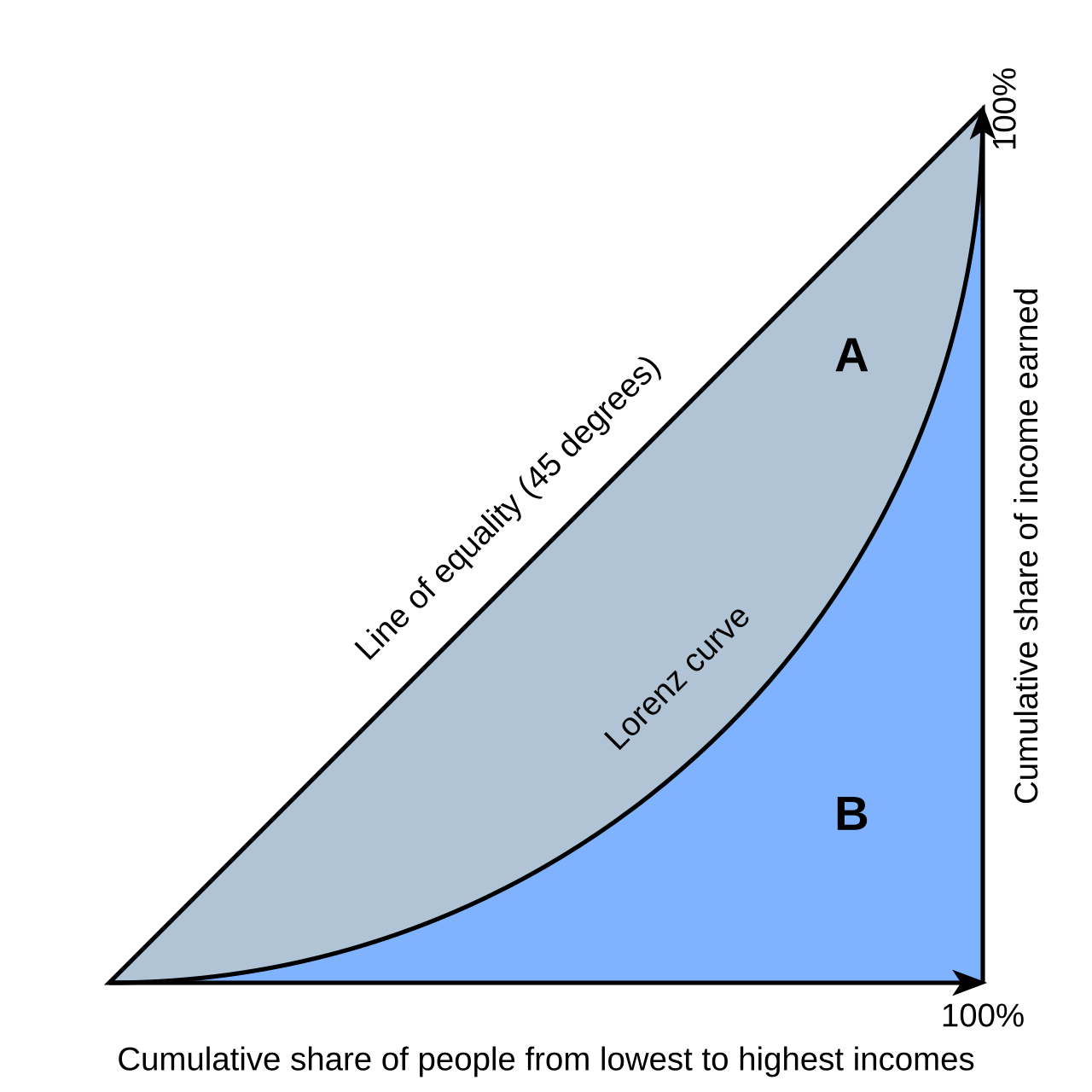
Lorenz curve
A graph comparing the cumulative share of households with their cumulative share of income. The farther it bows from perfect equality, the greater the inequality.
Gini index
A measure of inequality based on the Lorenz curve. 0 means perfect equality; 1 means maximum inequality.

Wealth
The value of a household’s assets minus its debts. Wealth is more concentrated than income.
Income share vs. income level
An income share is a group’s portion of total income; an income level is the actual amount of income the group receives.
Skill-biased technology
New technologies raise demand for highly skilled workers, increasing their pay relative to workers with less in-demand skills.
Globalization and trade
Global competition can put downward pressure on wages in some industries while benefiting businesses and workers with specialized skills or capital.
Weaker labor institutions
Declining union influence and worker bargaining power can make it harder for workers to secure higher wages.
Winner-take-all markets
Markets in which a small number of top performers or firms earn a disproportionately large share of rewards.
Tax policy
Tax rules affect how much income and wealth people keep after taxes, influencing the distribution of resources.
Compounding wealth
Wealth generates returns, and reinvested returns can generate more returns, allowing wealth to grow over time.
Social safety net
Government programs that support people facing poverty, unemployment, disability, or other financial hardship.
Means-tested program
A program limited to people who meet income or other financial eligibility requirements. Examples include Medicaid, SNAP, SSI, and housing assistance.
Monetary (cash) transfer
A benefit paid directly as money that recipients can generally use as they choose. Examples include SSI, TANF cash assistance, and Social Security benefits.
In-kind transfer
Assistance provided as a specific good or service rather than unrestricted cash. Examples include SNAP food benefits, Medicaid coverage, and housing assistance.
Refundable tax credit
A tax credit that can result in a payment even if it exceeds the recipient’s income taxes owed. Examples include the EITC and Child Tax Credit.
Redistribution
Government policies that change how resources are distributed, mainly through taxes, transfers, and public benefits.
Utilitarianism
The view that policy should maximize total well-being, or utility, in society.
Equity–efficiency trade-off
The tension between distributing resources more equally and preserving incentives to work, save, invest, and produce.
Progressive tax
A tax system in which people with higher incomes pay a higher share of their income in taxes.
Marginal tax rate
The tax rate applied to the next or additional dollar of income, not necessarily the rate applied to all income.
Social insurance
Government programs that protect people against major risks, usually through broad eligibility and contributions such as payroll taxes. Eligibility does not depend only on low income.
Social Security
A social insurance program that provides retirement benefits.
Social Security Disability Insurance (SSDI)
A social insurance program that provides benefits to eligible workers who become disabled.
Medicare
Public health coverage primarily for older adults and some people with disabilities.
Unemployment insurance
Temporary income support for eligible workers who lose their jobs.
Workers’ compensation
Benefits for eligible workers with job-related injuries or illnesses.
Arguments for social insurance
It protects people against risks they may not be able to manage alone, spreads risk across many people, and provides broad protection.
Arguments against social insurance
It requires taxes or contributions, may reduce incentives to work or save in some cases, and can be costly or poorly targeted.
Insurance
A system that pools contributions from many people to help cover costs when losses or events affect some members.
Adverse selection
When people who expect higher costs are more likely to buy insurance, potentially raising premiums and driving lower-risk people out of the market.
Moral hazard
When insurance changes behavior because the insured person does not pay the full cost of an additional service or risk.
Asymmetric information
A situation in which one party has more or better information than another. In health care, providers may know more than patients about conditions and treatments.
Externality
A cost or benefit of an activity that affects people who are not directly involved. Vaccination, for example, can benefit others by reducing disease spread.
Market failure in health care
A situation in which private markets alone may not provide care efficiently or accessibly, partly because of information problems, externalities, insurance-market issues, and high costs.
Employment-based health insurance
Health coverage obtained through an employer. Group coverage can help people obtain insurance, but coverage may depend on keeping a particular job.
Job lock
Staying in a job mainly to keep its health insurance rather than moving to a better-fitting job or leaving work.
Single-payer system
A system in which one public payer finances health care for the covered population, even if private providers deliver the care.
Two-tier system
A system with public coverage alongside private coverage, often allowing people to access private care in addition to public care.
Insurance mandate
A requirement that people obtain health insurance, often intended to keep a broad mix of people—including healthier people—in insurance pools.
Affordable Care Act (ACA)
A U.S. health-care law intended to expand coverage, protect consumers, and control costs while improving quality.
ACA objective: Expand coverage
The ACA expanded access to insurance through measures such as marketplaces, subsidies, and expanded eligibility for public coverage.
ACA objective: Protect consumers
The ACA set rules for insurance plans and limited certain ways insurers could deny or restrict coverage.
ACA objective: Control costs and improve quality
The ACA encouraged changes intended to make health care more efficient and improve its quality.