chem exam 2 :3
 Call Kai
 Learn
Learn Practice Test
 Spaced Repetition
 Match
Match Flashcards
 Knowt Play
1/200

There's no tags or description
Looks like no tags are added yet.
Name | Mastery | Learn | Test | Matching | Spaced | Call with Kai | Chat |
|---|
No analytics yet
Send a link to your students to track their progress
201 Terms
Aufbau Principle
electrons occupy lowest energy orbital when in ground state
What columns are s-orbitals in?
1-2 (including helium)
2 ways to describe occupied orbitals
Electron configurations and orbital diagrams
Electron configurations
Tell energy level (n), orbital level (s,p,d,f, uses L), and number of electrons in each energy+orbital block (written as superscripts). Does not convey electron spin, all orbitals included
Orbital diagrams
Orbitals drawn as lines/boxes with labels!!! Electrons drawn as arrows (full or half). Indicates electron spin
2 properties followed when electrons fill orbitals
The Pauli Exclusion Principle,
The Pauli Exclusion Principle
Two electrons in an atom can’t have the same 4 quantum numbers. 2 electrons max in 1 orbital, must have opposing spins
Hund’s Rule
When filling degenerate orbitals, electrons fill them one time first, must have parallel spins
Lose the least energy
Degenerate orbitals
Same energy levels
Aufbau equation relationship w/ hund’s rule
Hund’s rule: application of aufbau’s principle. Electron minimizes repulsions +energy by not sharing an orbital until forced. Parallel spins (in degenerate orbitals) can exchange positions without any electrons lost → stabilizing effect.
Where do gained electrons go?
Go to lowest energy level
Where do you remove an electron?
Highest energy level available
Idk what to name this card
All orbitals have same energy in the same level
Two types of electrons
Valence and core electrons
Valence electrons
Responsible for chemical bonding + atom ionization
Main group elements
S+P orbitals
Where are valence electrons in main group elements?
In highest/outermost n level
Where are valence electrons in transition metals?
In outermost s (E-level n) and d orbitals (E level n-1)
Core electrons
All electrons not valence electrons
When can you use abbreviated electron configurations?
Elements after neon
Coulomb’s Law
gives the P.E. btwn two charged particles based on their charges and distance from eachother
Coulomb’s Law formula
Charges: (q1, qz)
Distance: r

When is potential energy positive in Coulumb’s law?
When charges are similar
Shows repulsion
More energy needed to hold position as distance decreases
When is potential energy negative in Coulumb’s law?
When charges are opposite
Shows attraction
More attraction as r decreases
How are PE and distance related?
Closer together = higher PE
Farther = less
How is PE affected when value of charges increases
PE increases with magnitude of charges
Shielding
electrons attracted to nucleus, repulsed by other electrons. Affects valence electron attraction, they are shielded by core electrons btwn valence electrons and nucleus.
Makes valence electrons easier to remove/add
Valence electrons don’t shield each other.
Effective Nuclear Charge (Zeff)
The attraction to the nucleus a valence electron actually experiences considering shielding done by core electrons
Zeff formula

Periodic trend of Zeff
Increases as you go to the right
First ionization energy periodic trend
decreases as you go to the right
Orbital Penetration
Attraction to nucleus a valence electron would experience if it was closer to nucleus than core electron
No longer shielded by core electrons
Zeff: no subtraction of core electrons
Atomic Radius periodic trend
Increases down a column, decreases left to right (because of Zeff, stronger attraction decreases radii)
Atomic Radius
a set of average bonding radii of an element
Always smaller than nonbonding radius
Approx. bond length of (z) covalently bonded atoms is the sum of their atomic radii
Nonbonding radius
½ the distance between two nucli in adjacent atoms in a solid state
Bonding radius
Metals: ½ the distance between two nuclei of atoms next to each other in a crystal
Nonmetals: ½ the distance between two nuclei of bonded atoms
Nonbonding radius formula

Atomic radius trends for main group elements
Down a column: radius increases (n increases, larger orbitals occupied)
Across a row: Radius decrease because Zeff
Atomic radius trends for transition metals
Down first two rows of a column: Radius increases
Across a row: Decreases for first few elements, then becomes constant
Ionic Radii periodic trend
Cations: Lose electrons, stronger attraction with other electrons, cations much smaller than neutral atoms. No change in protons
Anions: Gain electrons, Strong repulsion with valence electrons, anions larger than neutral atom. No change in Zeff
Ionization Energy periodic trend
Across a row: IE generally increases (stronger attraction to nucleus)
Down a Column: IE decreases (n increases → valence less attracted)
Ionization Energy
Energy required to remove an electron from atom in a gaseous state
PE always positive, need energy to overcome attraction w/ proton and electron
Ie = sum of two IE of elements
Step-wise format
IE exceptions for going across a row
Pi<s, due to less orbital penetration of p-orbitals into the nuclear region, higher E level for p orbitals (look at spin diagram, paired spins)
p4<p3 because p4 elements have a higher E paired electron removed
Other IE trends
Electron Affinity (EA)
The E change of an atom/ion associated with gaining an electron in the gaseous state (anion stuff)
Energy released because new attraction, PE lowered
Electron affinity Periodic Trend
Down a column: No definite trend for all families
Relatively more + for alkali metals
Added electrons goes into higher n level orbital that is farther from nucleus
Across a row: Generally becomes more negative (more energy released)
Added electrons, higher Zeff going across period
Nonmetals obtain noble gas electron config. when electrons added → most negative EA
Exception for Electron affinity when going across a row
p³>p²: Less to add an electron to elements in column starting with N because p-orbitals are half-filled, causing the added electrons to be spin paired (forced to share orbital)
Metallic characteristics
Good conductors of heat, electricity
Malleable, ductile
Tend to lose electrons (Less IE) (cations)
Nonmetals
Poor conductors
Tend to gain electrons (less EA, more negative) (anions)
Metallic character periodic trend
Down a column - metal character increases
Across a row - metal character decreases
Magnitude
The size of a value
Does magnitude of PE increase or decrease as values of charges increase?
Increase
Are sublevels of n of s,p,d orbitals degenerate?
No
Cr column electron configuration
CR and Mo prefer half-filled d-orbital, leaving a half-filled s-orbitals
D and p half-filled orbitals typically stable
Because change in energy between 4d orbitals is less than the repulsion of energy paired in s-orbital
Cu column electron configuration
(Cu, Ag, Au) Prefer full d-orbital and half-filled s orbital
Difference in energy btwn s and d orbitals are still smaller than repulsions of electrons paired in d orbital vs. s orbital
Transition metal electron configurations
Fill n s-orbitals first, then n-1 d orbitals second
Remember hund’s rule
Magnetic properties of atoms + ions
Magnetic field created with moving electric charges → result of electron spin unless it orbital is spin-paired (full)
2 types of magnetic atoms/ions
Paramagnetic, Diamagnetic
Paramagnetic
Atom or ion w/ any unpaired electron
Result: particle is attracted to an external magnetic field
Electrons not cancelled out by another pair
Diamagnetic
An atom/ion as all electrons paired
Particle is not attracted to external magnetic field
Electrons cancelled out by another pair
Copper electron configuration
4s^1 3d^10
Which electron do you remove in a transition metal?
The electron with the highest n value (disregard energy values)
Molecules
Any group of 2 or more atoms bonded together
Compounds
Type of molecule, made of 2 or more elements
Homonuclear
Same atom
Column 1 category of periodic table
Alkali metals (-1)
Column 2 category of periodic table
Alkaline Earth metals
Column 18 category of periodic table
Noble Gases (-1)
Column 17 category of periodic table
Halogens
Column 16 category of periodic table
Chalcogens (-2)
Chemical bonds
a force that holds atoms together
Occurs due to attraction w/ charged particles
Valence electron of 1 atom attracted to nucleus of 1 atom
When does chemical bonding occur?
Only forms if attractive forces > repulsive forces
Nonmetal characteristics
Varied properties
Conduction of heat/electricity: Poor
Tend to gain electrons
Metalloid characteristics
Distinct properties
Conduction of heat/electricity: Semi
Metal characteristics
Conduction of heat/electricity: Good
Tend to lose electrons
2 types of Chemical bonds
Ionic, Covalent
Ionic bonds
Metal+nonmetal bond
Transfer of electrons
Opposite charged electrons attract each other (columb’s law)
Covalent bonds
2 or more nonmetals
Share electrons
Result of difficulty of removing electrons from nonmetals (high IE)
Attracted to both atom’s nuclei (lower PE, columbs law)

Where are nonmetals and metalloids on periodic table?

Are metals cations or anions?
Cations
Are nonmetals cations or anions?
Anions
Ionic compound
Composed of a lattice (3D array, several atoms) of alternating cations and anions in a solid state
Formula unit
Smallest electrically neutral collection of ions
Ex. CaCl2 (Ca+2 and Cl-, have two Cl- to make the compound neutral)
Molecular Compounds
Discrete, neutral molecules
No ions !!!!!!!!!!!!!!!!!92731456738294576483294857648392
Represented with chemical formulas
Indicates no. of each type of atom for specific compound
Empirical Formula
Give the relative # of atoms of each element (simplest ratio)
Molecular formula
Gives actual # of atoms of each element
Structural Formula
Represents how the atoms are bonded and/or geometry of molecule
Three types of structural formulas
Line formula, condensed structural formula, organic condensed line formulas
Line formula
Represent covalent bonds as lines btwn 2 atoms
1 line = 2 electrons
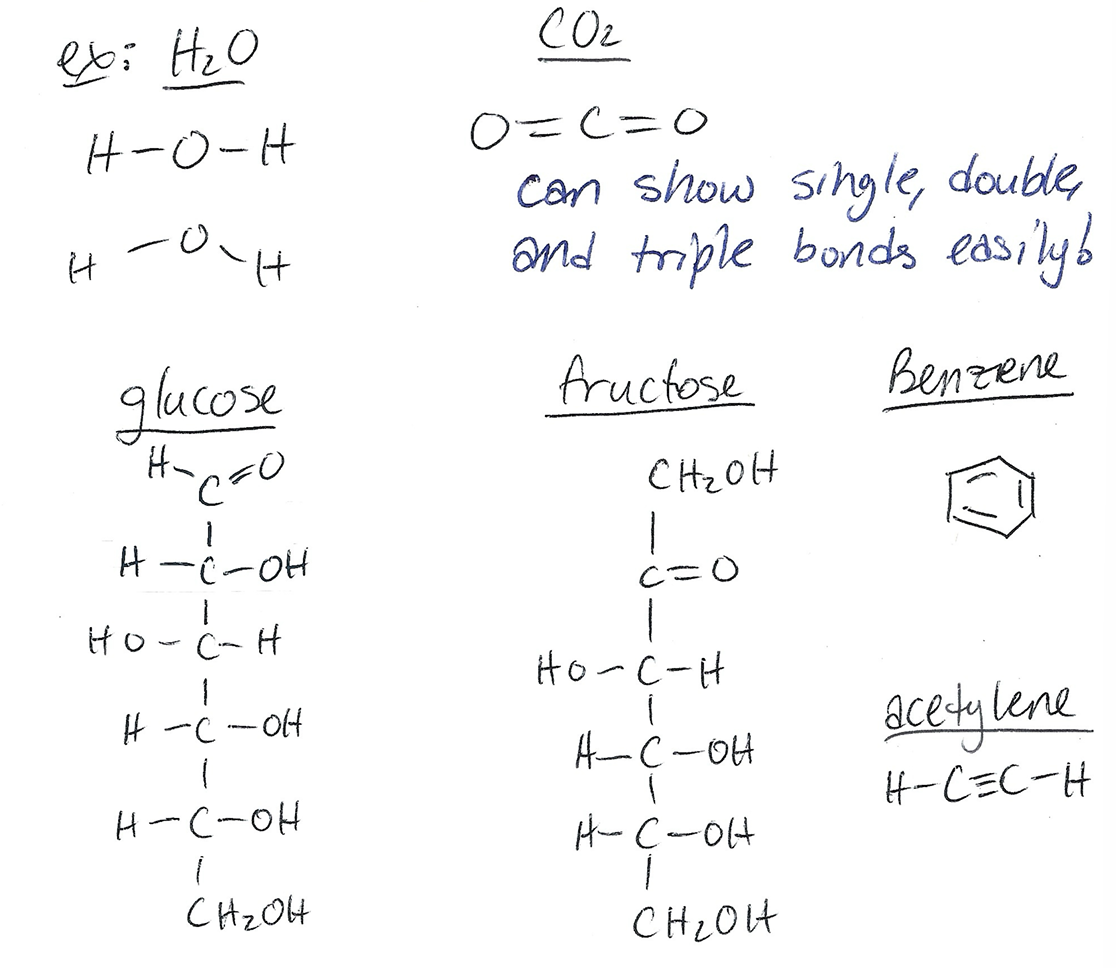
Condensed Structural Formulas
Give chemical formula w/o bond lines
indicate how atoms are connected w/in the formula

Organic Condensed Line formulas
Depict C atoms as terminal pt./vertice.
Omit H bonded to C
C has 4 bonds in total (can be single, double bonds….)

2 types of masses from a molecule’s chemical formula/formula unit
Formula mass, Molar mass
Formula mass (Amu)
avg. mass of molecule
Add up atomic masses of all elements in compound
Molar Mass (MM)
The mass (g) of 1 mol of a compound as defined by formula unit
Add up molar mass of all elements in compound (g/mol)
Mass percent composition
(element g/mol you want to find / total MM) x100

Molar relationship w/ elements and compounds
No. of moles of each element in 1 mol of compound

2 types of compounds
Ionic+Molecular
Type I metals
Always know charge (Alkali metals+earth metals, +1 and +2) and Al, Zn, Ag
Zn charge
+2
Ag charge
+1