A level Chem 3.10 Aromatic Chemistry
 Call Kai
 Learn
 Practice Test
 Spaced Repetition
 Match
 Flashcards
 Knowt Play
1/14

Earn XP
Description and Tags
15 Terms
State, in terms of its bonding, why benzene is more stable than cyclohexa-1,3,5-triene (1)
Outer electron from p-orbital at each carbon atom is delocalised to form central ring which is very stable (1)

Complete the equation for the reaction in Step 2 (1)
6 [H] … +2H2O (1)

Paracetamol is a medicine commonly used to relieve mild pain. Traditionally, paracetamol has been made industrially in a three-step synthesis from phenol.
In Step 3 other aromatic products are formed as well as paracetamol. Draw the structure of one of these other aromatic products (2)
(1)


Data about the hydrogenation of cyclohexene and of benzene are given.
Explain the bonding in and the shape of a benzene molecule. Compare the stability of benzene with that of the hypothetical cyclohexa-1,3,5-triene molecule. Use the data in your answer. (6)
Level 3 5-6 marks All stages are covered and the explanation of each stage is generally correct and virtually complete.
Stage 1 Bonding
each C has three covalent bonds
Spare delocalised electrons in a p orbital overlap
Stage 2 Shape
planar
hexagon/6 carbon ring
C-C bonds equal in length / C-C bond lengths between single and double bond
Stage 3 Stability
Expected ∆Ho hydrogenation of cyclohexatriene = –360 kJ mol–1
∆Ho hydrogenation benzene (is less exothermic) by 152 kJ mol-1
Benzene lower in energy than cyclohexatriene
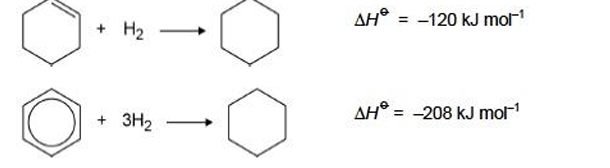
Data about the hydrogenation of cyclohexene and of benzene are given.
The enthalpy of hydrogenation of cyclohexa-1,3-diene is not exactly double that of cyclohexene. Suggest a value for the enthalpy of hydrogenation of cyclohexa-1,3-diene and justify your value. (3)
Value within range –239 to –121 (1)
Double bonds separated by one single bond/alternating (1)
Allows some delocalisation (1)
The product of step 1 was purified by recrystallisation as follows. The crude product was dissolved in the minimum quantity of hot water and the hot solution was filtered through a hot filter funnel into a conical flask. This filtration removed any insoluble impurities. The flask was left to cool to room temperature. The crystals formed were filtered off using a Buchner funnel and a clean cork was used to compress the crystals in the funnel. A little cold water was then poured through the crystals. After a few minutes, the crystals were removed from the funnel and weighed. A small sample was then used to find the melting point.
Give a reason why the minimum quantity of hot water was used (1)
to ensure crystals would form on cooling (1)
The product of step 1 was purified by recrystallisation as follows. The crude product was dissolved in the minimum quantity of hot water and the hot solution was filtered through a hot filter funnel into a conical flask. This filtration removed any insoluble impurities. The flask was left to cool to room temperature. The crystals formed were filtered off using a Buchner funnel and a clean cork was used to compress the crystals in the funnel. A little cold water was then poured through the crystals. After a few minutes, the crystals were removed from the funnel and weighed. A small sample was then used to find the melting point.
Explain why the flask was cooled to room temperature before the crystals were filtered off (1)
Yield lower if warm / solubility higher if warm
The product of step 1 was purified by recrystallisation as follows. The crude product was dissolved in the minimum quantity of hot water and the hot solution was filtered through a hot filter funnel into a conical flask. This filtration removed any insoluble impurities. The flask was left to cool to room temperature. The crystals formed were filtered off using a Buchner funnel and a clean cork was used to compress the crystals in the funnel. A little cold water was then poured through the crystals. After a few minutes, the crystals were removed from the funnel and weighed. A small sample was then used to find the melting point.
Explain why the crystals were compressed in the funnel (1)
Air passes through the sample not just round it (1) (drying)
The product of step 1 was purified by recrystallisation as follows. The crude product was dissolved in the minimum quantity of hot water and the hot solution was filtered through a hot filter funnel into a conical flask. This filtration removed any insoluble impurities. The flask was left to cool to room temperature. The crystals formed were filtered off using a Buchner funnel and a clean cork was used to compress the crystals in the funnel. A little cold water was then poured through the crystals. After a few minutes, the crystals were removed from the funnel and weighed. A small sample was then used to find the melting point.
The melting point of the sample in part (b) was found to be slightly lower than a data-book value. Suggest the most likely impurity to have caused this low value and an improvement to the method so that a more accurate value for the melting point would be obtained. (2)
Water (1)
Press the sample of crystals between filter papers (1)

Suggest the type of reaction occurring in step 3 (1)
Hydrolysis
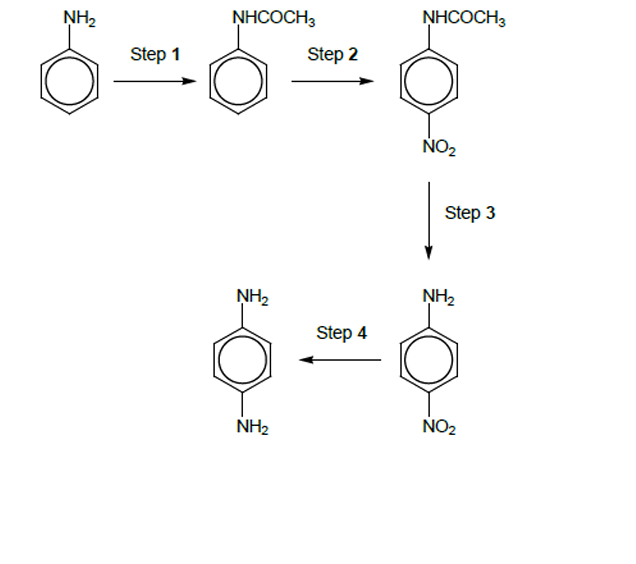
identify the reagents used in step 4 (1)
Sn/HCl (1)

Two steps in the synthesis of an aromatic amine are shown.
State a possible use for the amine formed in Step 2. (1)
Manufacture of dyes/surfacetants/fabric softeners (1)

This question is about the reaction scheme shown.
Name the reagent for step 4
State a necessary condition for step 4 (2)
Chlorine (1)
UV light (1)

Amine A is formed in step 2 and amine B is formed in step 5
Explain why the yield of B in step 5 is less than the yield of A in step 2 (2)
In step 5 further substitution may occur/gives other amine products (1)
In step 2 only one amine is produced (1)

Amine A is formed in step 2 and amine B is formed in step 5
Explain why amine B is a stronger base than amine A (2)
In B alkyl group is electron donating OR positive inductive effect (1)
lone pair on N more available (1)