AOC: First Emperor of Qin&Calligraphy
 Call Kai
 Learn
Learn Practice Test
 Spaced Repetition
 Match
Match Flashcards
 Knowt Play
1/8

There's no tags or description
Looks like no tags are added yet.
Name | Mastery | Learn | Test | Matching | Spaced | Call with Kai | Chat |
|---|
No analytics yet
Send a link to your students to track their progress
9 Terms
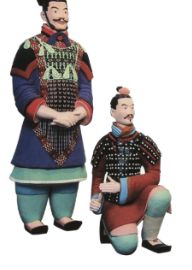
What is the theory of the five elements and what does this indicate about the First Emperor’s understanding of himself? How does this theory relate to the paint utilized on the terracotta warriors below?
The theory of the five elements states that cycles of power follows the existence of the five elements. The First Emperor associated with water, which was tied to the color black. This relates to the armor on the terracotta warriors
Name at least five things that the First Emperor of Qin did to unify the country after he defeated the Warring States.
He unified weights and measures, standardized script, connected the great wall, standardized currency, and created a highway system
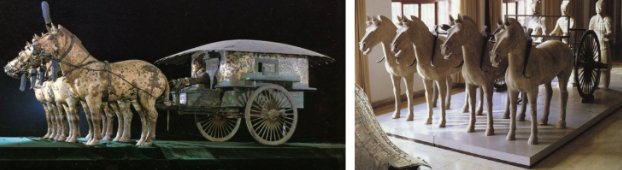
Compare and contrast the following two components from the First Emperor’s tomb in terms of location where they were found, materials, and composition.
Object A was found in the Western part of the tomb and depicts a half-life sized chariot that was inlaid with silver and gold. This chariot was symbolic in function and remained unused. Object B was found in Pit 1. This Object is more life sized, and the chariot and horses are not attached, but rather exist separately from each other. These horses were also made with terracotta rather than Bronze. Object B was created to exist in the afterlife in order to serve the Emperor. Object A was created as a ritual object, and as more of a sacrifice since it was unused.
Were the terracotta warriors modeled on individual soldiers in the Qin army? Why or why not? Explain the process by which they were manufactured.
They were not modeled on individual warriors, but were highly detailed to give the idea that they were. There were different facial molds that were paired with different eyes, ears, and other facial details that made them look unique.
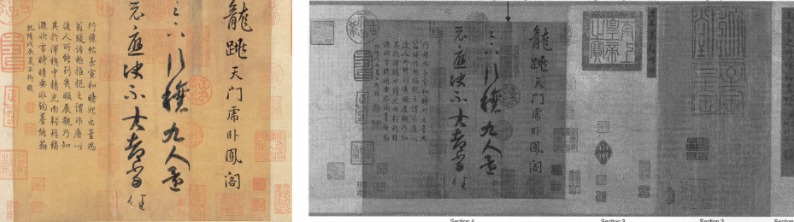
Referring to the images below, explain why Martin Kern argues that Wang Xizhi’s work, Ritual to Pray for Good Harvest, was a large cultural performance carried over generations?
Kern argues this because of the different stamps. The first work was originally by Wang Xihi, but as time went on, more seals and labels with various colophons were added to the work.
Aside from preparing for the afterlife, name a practical reason why the First Emperor might have created his tomb.
To showcase his wealth and rule
What is the significance of ziran (naturalness) and wuwei (effortless action) in the context of Wang Xizhi’s calligraphy? Why are these concepts central to the ideals of Chinese calligraphy?
Ziran should show a persons own character, while wuwei helps with being effortless while preforming in front of other people
Name two reasons that we study calligraphy in Chinese art history.
There is a strong emphasis on writing as a form of art. Calligraphy exists as a performance art.
Compare seal/clerical script and running/cursive script in terms of the use of the scripts and the process by which they are produced.
Seal/clerical: script on Bronze vessels and official government documents
Running/cursive: used in personal communications