Chemistry Units 3 and 4 Theory
 Call Kai
 Learn
 Practice Test
 Spaced Repetition
 Match
 Flashcards
 Knowt Play
1/16

Earn XP
Description and Tags
Topic 1: Equilibrium Systems
17 Terms
Distinguish between an Open and a Closed System:
An open system can transfer both energy and matter with its surroundings.
Closed systems can transfer energy in the form of heat or work but not matter with its surroundings.
Reversible Changes (physical and chemical)
Physical changes are usually reversible, such as condensation and evaporation. However, only some chemical changes are reversible, such as N2O4 ←→ 2NO4
Explain Equilibrium Reactions:
Equilibrium reactions are dynamic meaning both reaction take place together.
When equilibrium is reached, the forward and reverse reactions take place at the same rate, where no observable change takes place.
The macroscopic properties are not changing, that is, concentrations of reactants and products are steady but on an atomic level, molecules are still breaking apart and reforming.
What are macroscopic properties?
concentration of reactant and products
temperature of the system (mixture of reactants and products)
pressure (volume) of system
pH of mixture
colour
Reversible vs Irreversible (table)
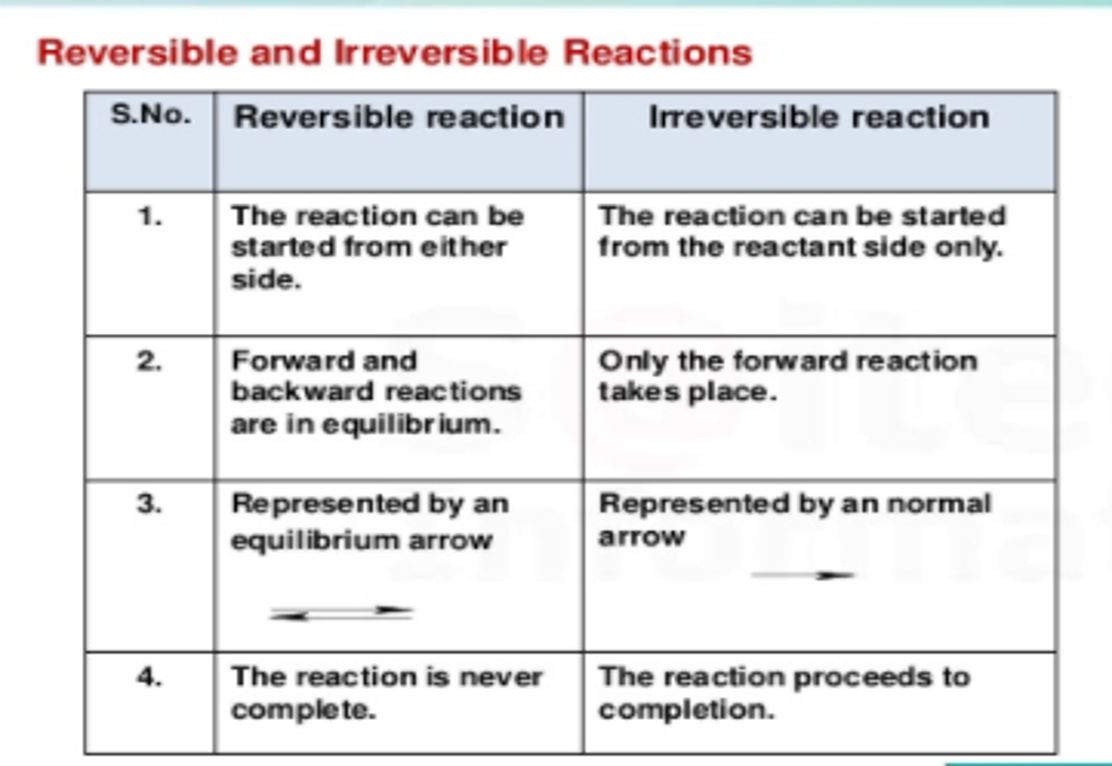
What is reversibility?
Reversibility of a chemical reaction depends on activation energy. If the forwards activation energy is greater than the reverse, equilibrium lies towards the products and therefore more products that reactants. However is the forwards activation is less than the reverse, equilibrium lies towards the reactants and therefore more reactants than products. If the activation energy is too large, reaction is not reversible.
Types of equilibrium systems / reactions:
Physical Equilibrium Reactions include: dissolving - recrystallization; vapour pressure above a liquid; solubility of a gas in water in given pressure & temperature conditions. (involve phase changes)
Chemical Equilibrium Reactions include: acid-base equilibria, gas reactions, ions in solutions (involve the formation of new substances)
What is Le Chatelier’s Principle
States that if a dynamic equilibrium is disturbed by changing one of the conditions, the position of the equilibrium shifts to counteract the change and to reestablish a new equilibrium, such as a change in pressure, temperature or concentration)
What is a disturbance in equilibrium reactions?
When discussing changes to equilibrium, the disturbance is what is changed or added causing an imbalance or offset in the equilibrium. The response is the systems equilibrium shift to counteract it.
How does increasing the concentration of a reactant affect the position of equilibrium?
Adding more reactant suggests more of the other reactant is used up, and therefore both reactants decrease and more product is formed. Therefore the equilibrium shifts to the right (products).
How does increasing temperature effect the position of an equilibrium system?
Considering an exothermic thermochemical equation, if the temperature is increased, Le Chatelier’s principle suggests the system will act to counteract the increase in temperature by decreasing it or ‘using’ up the heat. Therefore, the reverse reaction, which is endothermic, is favoured, as it absorbs heat and shifts the equilibrium to the left. The converse of this is true.
How does increasing the pressure of a gaseous equilibrium (or decreasing volume) affect its position?
Considering a reaction in which the forward reaction produces less than the reverse, increasing the pressure of the system will try to decrease pressure according to Le Chatelier’s principle. Therefore the reverse is favoured as more molecules made and therefore equilibrium shifts to the right.
What is an equilibrium constant?
Each reversible reaction can be represented by a value called the equilibrium constant. The size of this constant depends on how much reactants are in the mixture compared to the products, in which K = [products]/[reactants]
If equilibrium constant Kc >1 then?
The reaction favours the products side, the larger the number the more the products are favoured than the reactants.
If equilibrium constant Kc < 1 then?
Conversely, if the reaction favours the reactants side, then the equilibrium constant will be <1; the smaller the number, the more the reactants are favoured.
Why are pure liquids and solids are not included in equilibrium expressions?
Pure liquids and solids are left out of equilibrium expressions because their concentrations do not change during chemical reactions as they have a fixed density. (they do not have concentration,, and therefore aqueous and gases included.)