Gould
 Call Kai
 Learn
 Practice Test
 Spaced Repetition
 Match
 Flashcards
 Knowt Play
1/20

Earn XP
Description and Tags
Ind Diffs area
21 Terms
what are psychometric tests?
Standardised tests used to measure personality traits, cognitive functions (e.g. intelligence), psychological disorders etc. (quantify psychological attributes)
How was Gould reviewing the history of intelligence testing?
Stanford-Binet had designed a test of intelligence, which was taken individually. It was based on the ‘g’ factor theory of intelligence: analysis of variance had found that people tended to score similarly on spatial, numerical and verbal reasoning tasks.
Yerkes was a hereditarian psychologist who believed that intelligence was genetic and therefore could not be changed. He wanted to design a test to measure this, which could be used to test large cohorts at once (like an exam).
Yerkes believed that if he could show that intelligence tests were reliable and valid, then this quantifiable measure would prove his point. With the outbreak of WW1, the now Colonel Yerkes, developed the idea that it might be possible to use recruits for the American army as a source of sufficient data to show that intelligence testing was scientific.
what was the aim of Gould’s study?
Gould aimed to review the history of intelligence testing and give a critique of its limitations, biases, and ethical and political implications.
outline Yerkes’ sample
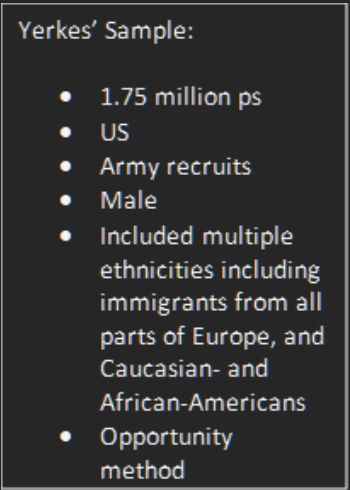
evaluate the sample
Gender bias towards males as all of 1.25 million ps were only male - findinngs cannot be generalised/applied to females, decreasing pop val & external reliability
only used army recruits as ps, making it career specific - as they all have the same occupation, they will typically have the same social group & perhaps certain attributes (army-specific), so cannot be generalised to other careers and people not in the army, reducing pop val, and external reliability
v large sample size
ethnocentric as only US army recruits, however included multiple ethnicities
what are the 3 tests Yerkes’ conducted?
Alpha test
Beta test
Individual spoken examination
outline the alpha test
Designed for literate recruits. Included analogies, number sequences, general knowledge. The test became progressively harder. Quick to score as responses mainly involved checking from multiple-choice options. Less than an hour to complete. Yerkes instructed that anyone who failed the Alpha should be re-tested on the Beta.
look at img for sample q’s

evaluate the design of the Alpha test
design of test is ethnocentric/culturally biased - designed for US army recruits with American-specific knowledge - does not consider immigrants, so results may be biased
outline the Beta test
Designed for recruits with a low level of literacy (less than Grade 5 schooling). Included picture completion, maze puzzles and deciphering codes. Instructions were written in English. Less than an hour to complete. Yerkes instructed that anyone who failed the Beta should be given an individual spoken examination.
for people who are illiterate or failed the Alpha test
7 parts, consisted of picture completion
the pictures were culturally specific
the instructions were written and in English
in 3/7 parts, the answers had to be written

evaluate the Beta test
img for reference of sample
images are not clear & quite grainy
could be difficult to tell what is "missing"
some require specific/prior knowledge (e.g. bulb "filament" and card)
social class & immigrant knowledge
outline the individual spoken examination
If recruits failed on the other two tests, they were supposed to be given an individual spoken examination, this however rarely happened.
How were Yerkes’ tests scored?
Recruits were graded: Every individual who was tested was given a Grade from A to E, with plus and minus signs. C- was the lowest grade suggested as suitable for basic training.
what were the results of Yerkes’ tests?
The average White American had a mental age of 13, which is barely above the level of moronity. In comparison, the average Black recruit had an average mental age of 10.41.
A relationship between skin colour and intelligence was suggested: the fairer people of Northern and Western Europe were graded higher than the Eastern and Southern Europeans.
On average, the Jewish race performed poorly compared to White Americans.
Which debates do Yerkes' findings link to and how?
It is socially sensitive as it focuses on the differences (individualistic too) (White vs Black vs Jewish Americans), suggests that being white = superior in intelligence, which may cause discrimination against non-white people.
Focuses on nature more than nurture - suggests that intelligence is inherited & confirmed by race - which you are born with and cannot change
what are the ethical and political application of Yerkes’ tests, suggested by Gould?
The educationally and culturally biased test affected recruitment and career progression: 2/3rds of promotions given in the U.S. army were given to recruits with high scores in the intelligence tests.
Immigration Restriction Act 1924: the government set new quotas for immigration from areas of Europe based on historic figures when most immigration came from Northern and Western Europe. This meant quotas for immigration from Western and Southern Europe were very low and later preventing Jews, fleeing the Nazi regime, from entering the U.S. (an estimated 6 million were denied entry).
The KKK used the findings as propaganda suggesting that the average mental age of the White American had been lowered by interbreeding with other races with lower intelligence, which helped to justify segregation.
Commercial and educational establishments started requesting the use of the test for screening prospective employees and students.
what are the design limitations of Yerkes’ study, suggested by Gould?
Despite the claim that the test measured innate intelligence (genetic), questions were culturally specific (ethnocentric), such as ‘Washington is to Adams as first is to…?’, which required knowledge of past US presidents that immigrants would lack. The Beta test also included images of technologies and Sports which immigrants may not be familiar with, so may be unable to complete the missing part.
The test for illiterates included written instructions which meant the test was an invalid measure of intelligence as many could not access the questions. A great deal of the questions assessed the extent to which someone had been educated in the U.S. system.
what are the administration issues suggested by Gould?
Use of the Alpha test for illiterate recruits and lack of re-testing on the Beta. Some army camps experienced large queues for the Beta test so re-assigned those who said they could read to the Alpha, regardless of level of schooling. One camp found that only 14.1% who failed the Alpha failed to attain a higher grade on the Beta which showed the extent inappropriate use of the tests contributed to low attainment.
Failure to recall people who failed the Beta for individual spoken examination. One camp could only recall 1/5th of black recruits, even though data showed scores increased when re-tested. This skewed the data, particularly for Black Americans as the large majority did not have access to education.
evaluate the research method and technique
psychometric tests can be given to a large number of people, allowing comparisons between different groups of people (e.g. 1.75 million US army recruits)
tests results are biased as they favour the US culture (ethnocentric)
evaluate the validity
ethnocentric nature of test meant that construct validity is low as the army IQ tests did not assess intelligence accurately, as there was a bias towards culturally-based knowledge
tests lacked face validity as they did not really assess knowledge
validity of the heriditarian assumption that IQ/mental abilities are innate is low - it does not consider environmental influences on knowledge (e.g. more educated households)
evaluate sampling bias
many ps were illiterate but were assessed using tests designed for literate people (Alpha test)
evaluate ethnocentrism
conclusions were drawn from the IQ data about Black people & immigrants, based on the ethnocentric views of white American psychologists (the questions & methods of testing people were rooted in white, middle-class American experience)