nucleotides and nucleic acids
 Call Kai
 Learn
 Practice Test
 Spaced Repetition
 Match
 Flashcards
 Knowt Play
1/28

There's no tags or description
Looks like no tags are added yet.
29 Terms
draw and label a nucleotide

describe the whole process of how a protein is formed
TRANSCRIPTION
The DNA double helix separates/unwinds/unravels in the nucleus to expose the specific gene needed for the protein.
An mRNA (messenger RNA) copy of the gene is synthesized using the DNA strand as a template.
The gene coding for the specific protein is transcribed into mRNA.
During transcription, uracil (U) is used instead of thymine (T) to pair with adenine.
The completed mRNA molecule leaves the nucleus through a nuclear pore and enters the cytoplasm to find a ribosome.
TRANSLATION
The mRNA attaches to a ribosome in the cytoplasm.
Carrier molecules called tRNA (transfer RNA) bring specific amino acids to the codon bases on the mRNA.
Each tRNA features a specific anticodon that is complementary to the mRNA codon.
A particular amino acid is bound to each specific tRNA molecule.
POLYPEPTIDE AND PROTEIN FORMATION
As the ribosome translates the mRNA code, neighboring amino acids brought by the tRNA molecules join together.
The linked amino acids form a long chain known as a polypeptide chain
Finally, the polypeptide chain folds into a unique, functional 3D shape to form a protein
which is the monomer and which is the polymer between nucleotide and nucleic acids?
Nucleotide = monomer
nucleic acid = polymer
describe the structure of DNA
The bases are joined together by hydrogen bonds
Bases: adenine, thymine, guanine and cytosine
• nucleotide made up of nitrogen bases, deoxyribose sugar and phosphate.
polymer made up of repeating units of nucelotides.
Complimentary base pairing (A-T, C-G)
doube helix (2 strand)

DESCRIBE THE STRUCTURE OF RNA NUCLEOTIDE
1 strand
Bases: adenine, uracil, guanine and cytosine
• nucleotide made up of nitrogen bases, ribose sugar and phosphate.
Complimentary base pairing (A-U, C-G)
The bases are joined together by hydrogen bonds
Adenine (A) pairs with Uracil (U) via two hydrogen bonds
Guanine (G) pairs with Cytosine (C) via three hydrogen bonds
what is the difference between rna nucleotide and dna nucleotide
dna nucleotide - has thymine and it forms a double helix
rna nucleotide - has uracil and forms 1 strand
full meaning of dna and rna
DNA = deoxyribonucleic acid
RNA = ribonucleic acid
describe the function, size, location in cell, quantity in cell and chemical stability
of
dna
rna
DNA
Stores genetic information
Larger- more nucleotides
found in Nucleus
Remains a constant quantity in the cell
it is Chemically stable
RNA
Transfers genetic information to ribosomes
Smaller-fewer nucleotides
Nucleus, cytoplasm (including ribosomes)
Quantity in the cell varies
not as chemically stable as DNA
describe purines
contains 2 carbon- nitrogen rings (Adenine and Guanine)

describe Pyrimidine
contains 1 carbon- nitrogen ring (Thymine, Cytosine and Uracil)
ATP
ADENOSINE TRIPHOSPHATE
A nucleotide involved in energy transfer within cells
draw and label structure of ATP
Only a small amount of energy is needed to break the last phosphate group off the ATP but a large amount of energy is released when bonds are formed by the 'free' phosphate group which is involved in other reactions.
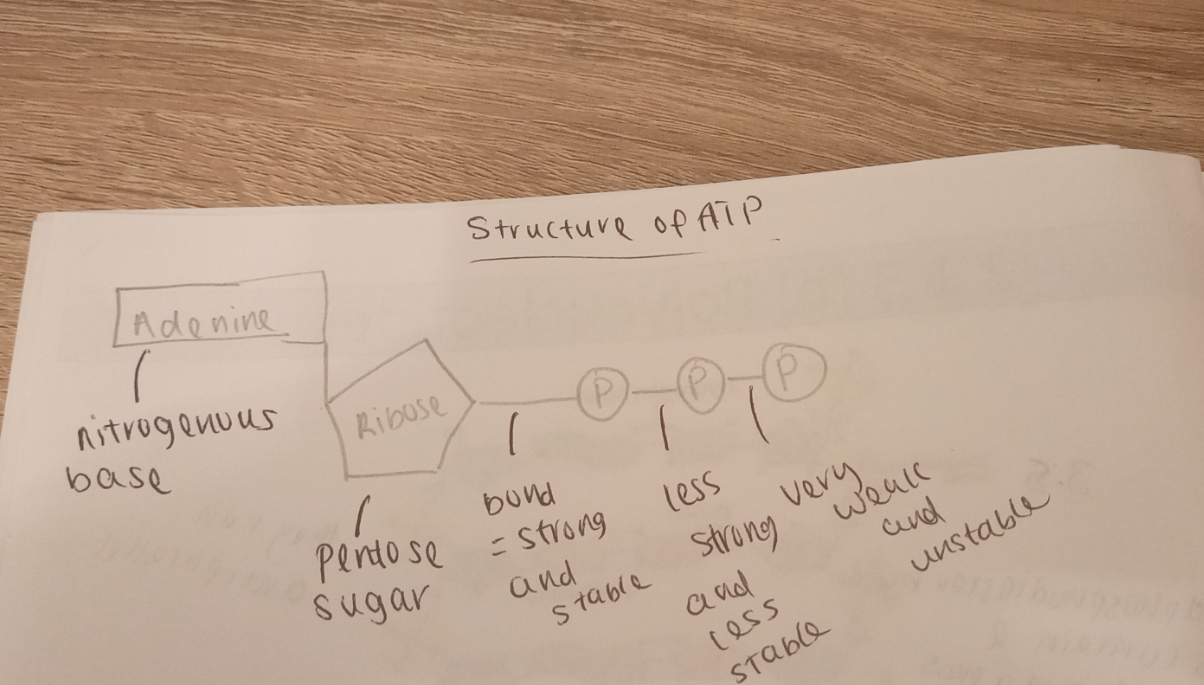
adenosine = ?
adenine + ribose
describe the formation of ATP
Condensation reaction
ADP + Inorganic phosphate group → ATP + H2O
this reaction requires energy
that energy is gotten from the oxidation of glucose as glucose is broken down in respiration.
this reaction involves ATP synthase enzyme
ATP stores most of the energy in the third bond of the molecule

describe the formation of ADP. draw and label the reaction
ATP hydrolase (ATPase) catalyses the hydrolysis of ATP into ADP and inorganic
phosphate (Pi).
the energy released from the hydrolysis reaction is used for metabolic reactions and other reactions
The energy stored between the bond formed between the 2nd and 3rd phosphate group is released

DESCRIBE THE FUNCTIONS OF ATP
1. MOVEMENT
MUSCLE CONTRACTIONS
SPERM CELLS SWIMMING
2. ACTIVE TRANSPORT
MOVES MOLECULES OR IONS AGAINST
CONCENTRATION GRADIENT
(HOW IONS ENTER PLANT ROOTS
FROM SOIL)
3. SYNTHESISING LARGE MOLECULES
HOW PROTEINS ARE SYNTHESISED
4. SECRETION OF SUBSTANCES FROM CELLS
HORMONES SECRETED FROM
CELLS IN GLANDS
5. ACTIVATING OTHER MOLECULES (ENZYMES)
ATP IS HYDROLYSED
RELEASES INORGANIC PHOSPHATE
CAN PHOSPHORYLATE ENZYME
MAKES ENZYIME MORE REACTIVE
good and bad of ATP
Not great for long term energy storage
useful as immediate energy source
Why ATP is not suitable for long-term energy storage
ATP is relatively unstable and is readily hydrolysed.
Therefore, it is not suitable for storing energy over long periods.
Why ATP is useful as an immediate energy source
ATP releases energy rapidly through hydrolysis.
It releases energy in small, manageable amounts.
It can transfer energy directly to energy-requiring metabolic reactions.
It can be rapidly regenerated from ADP and Pi (inorganic phosphate) during respiration.
features of ATP
atp releases energy in small managable amounts

describe how does semi conservative dna replication work
Step 1- DNA unwinds
The enzyme DNA helicase breaks the hydrogen bonds between complementary base pairs/polynucleotide strands.
This causes the DNA double helix to unwind and the two strands to separate.
Step 2- Complementary base pairing
Each original DNA strand acts as a template for a new strand.
Free DNA nucleotides bind to the exposed complementary bases through hydrogen bonding.
Complementary base pairing:
A pairs with T (2 hydrogen bonds).
G pairs with C (3 hydrogen bonds).
Step 3- Formation of the sugar-phosphate backbone
The enzyme DNA polymerase catalyses the formation of phosphodiester bonds between the nucleotides and the bases
This forms the sugar-phosphate backbone of each new DNA strand.
Two identical DNA molecules are produced.
all nucleotides are joined together to form a complete polynucleotide
Each contains one original strand and one newly synthesised strand.
- DNA polymerase can only synthesise new DNA strands in the 5' → 3' direction.
describe dna strands
The two original DNA strands are antiparallel, meaning they run in opposite
directions:
One runs 5'→ 3'.
The other runs 3' → 5'.
This affects how the two new strands are synthesised.
describe how leading and lagging strand are formed
Leading strand
Synthesised continuously by DNA polymerase.
Synthesised in the 5' → 3' direction.
Synthesised in the same direction as the DNA helix unwinds.
Lagging strand
Synthesised discontinuously in short fragments because DNA polymerase can only work in the 5' → 3'
direction.
Synthesised in the opposite direction to the unwinding of the DNA helix.
Produces short sections called Okazaki fragments.
DNA ligase joins the Okazaki fragments together by catalysing the formation of phosphodiester bonds.
describe the Meselson and Stahl (1958)
Grew E. coli bacteria in a medium containing heavy nitrogen-15 (\(^{15}N\)).
Nitrogen-15 was incorporated into the nitrogenous bases of newly synthesised DNA, making the DNA heavier.
Took a DNA sample and used density gradient centrifugation. The heavy DNA formed a band near the bottom of the tube.
Transferred the bacteria into a medium containing light nitrogen-14 (\(^{14}N\)).
Allowed the bacteria to replicate and took another DNA sample:
After one generation: One intermediate-density band, containing hybrid DNA (\(^{15}N/^{14}N\)).
Allowed the bacteria to replicate again in the nitrogen-14 medium:
After two generations: Two bands formed:
Intermediate-density DNA (\(^{15}N/^{14}N\)).
Light DNA (\(^{14}N/^{14}N\)).
Continued replication in nitrogen-14 medium. The proportion of light DNA increased with each generation.
The shape and behaviour of proteins depends on ?
The shape and behaviour of proteins depends on the sequence of amino acids.
how does dna control protein structure.
DNA controls protein structure by determining the amino acid sequencе.
what controls the order amino acids are assembled and what is the code for a particlular amino acid.
The sequence of three bases is the code for a particular amino acid
The order of bases controls the order that the amino acids are assembled to produce a particular protein
facts about a gene
Each gene contains a different sequence of bases
Codes for a particular polypeptide
Each gene is on a fixed position (locus) on a strand of DNA
features of genetic code
Each amino acid in a protein is coded for by a sequence of 3 nucleotide bases (triplet) on mRNA called a codon
The code is degenerate (there is usually more than one codon that codes for each amino acid)
The code is non-overlapping. Each base sequence is only read once.
Universal code the same codon codes for the same amino acid In all organisms
The code is only ever read on one DNA strand (sense strand) - codes for mRNA.