CH15- Firms in Competitive Markets
0.0(0)
Studied by 0 people Call Kai
 Learn
 Practice Test
 Spaced Repetition
 Match
 Flashcards
 Knowt Play
Card Sorting
1/95

There's no tags or description
Looks like no tags are added yet.
96 Terms
1
New cards
Competitive market
A market with many buyers and many sellers trading identical products, so each buyer and seller is a price taker
2
New cards
Price taker
A buyer or seller who must accept the price the market sets and cannot influence it
3
New cards
Characteristics of a competitive market
Many buyers and sellers, undifferentiated (identical) goods, and free entry and exit (no barriers to entry)
4
New cards
Barriers to entry
Obstacles that keep new firms from entering a market; competitive markets have none
5
New cards
Total revenue (TR)
Price times quantity sold (TR = P × Q)
6
New cards
Average revenue (AR)
Total revenue divided by quantity sold (AR = TR / Q); equals price for every type of firm
7
New cards
Marginal revenue (MR)
The change in total revenue from selling one more unit (MR = ΔTR / ΔQ); equals price for a competitive firm
8
New cards
Profit
Total revenue minus total cost (TR − TC)
9
New cards
Marginal cost (MC)
The change in total cost from producing one more unit (MC = ΔTC / ΔQ)
10
New cards
Average total cost (ATC)
Total cost divided by quantity (TC / Q); also called unit cost
11
New cards
Average variable cost (AVC)
Variable cost divided by quantity (VC / Q)
12
New cards
Profit-maximizing rule
Produce the quantity where marginal revenue equals marginal cost (MR = MC); for a competitive firm, P = MC

13
New cards
Competitive firm's supply curve
The marginal-cost curve, because MC shows the quantity the firm will supply at each price
14
New cards
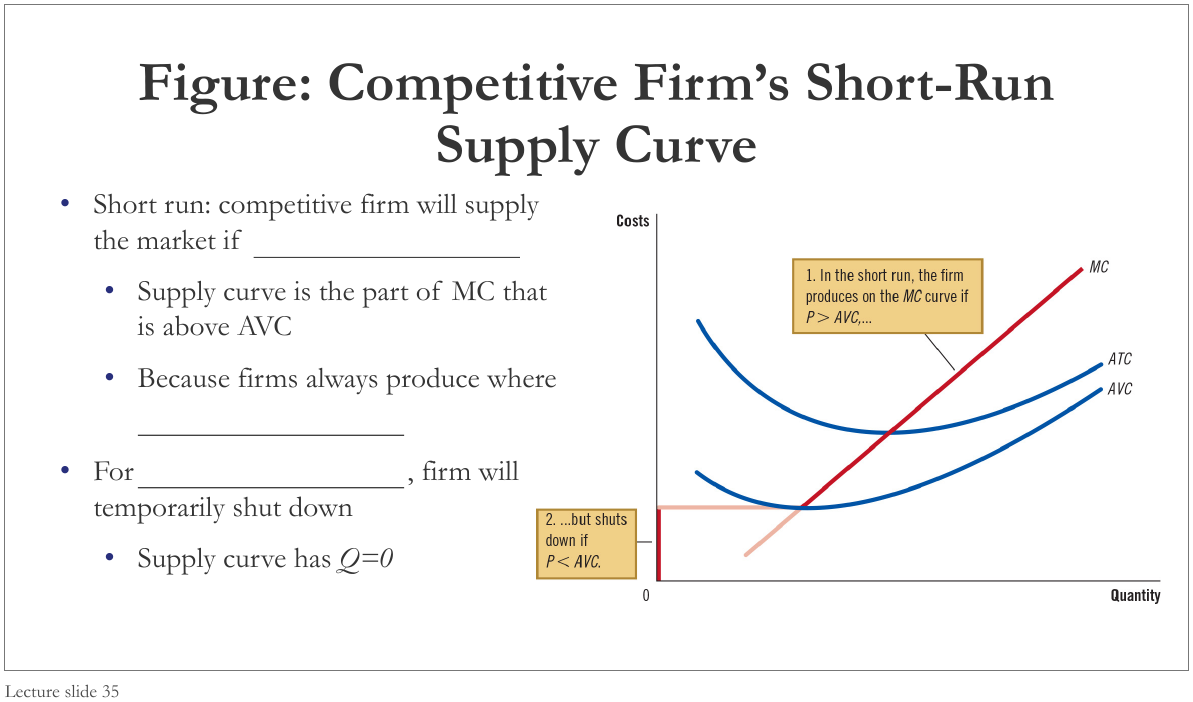
Short-run supply curve (firm)
The portion of the MC curve above average variable cost
15
New cards
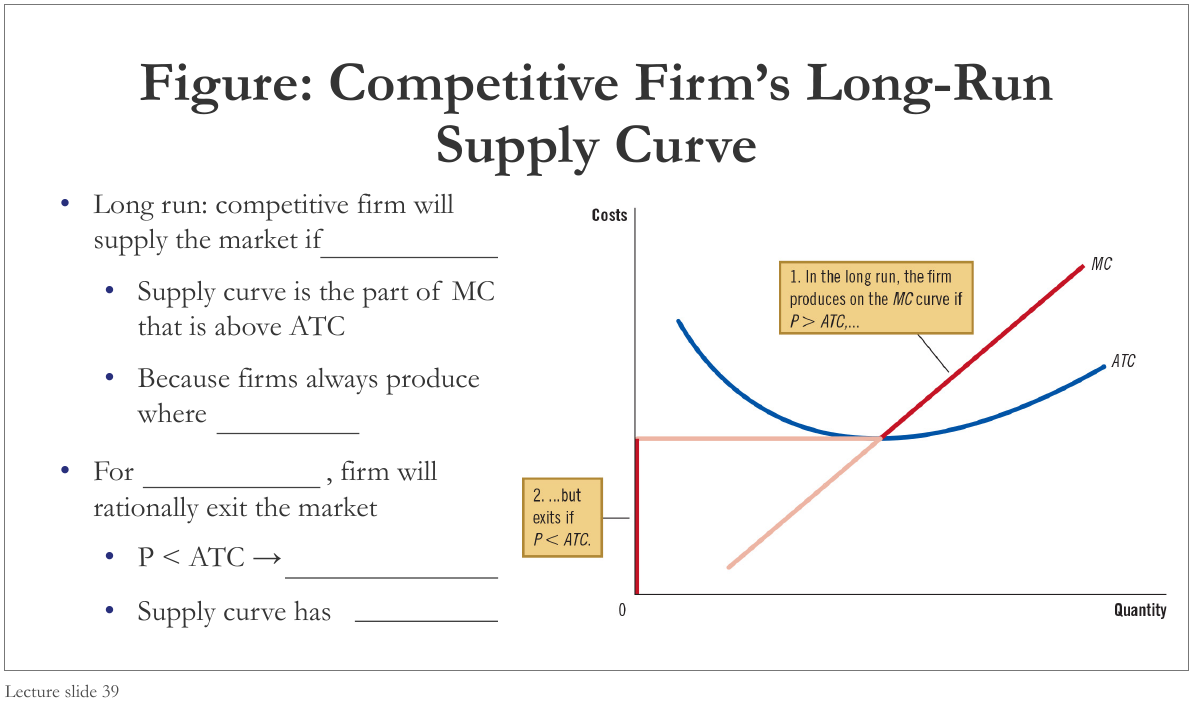
Long-run supply curve (firm)
The portion of the MC curve above average total cost
16
New cards
Shutdown
A short-run decision to produce nothing for a period because of current market conditions; the firm still pays fixed costs
17
New cards
Exit
A long-run decision to leave the market entirely; the firm pays no costs at all
18
New cards
Shutdown rule
Shut down in the short run if TR < VC, which is the same as P < AVC

19
New cards
Exit rule
Exit in the long run if TR < TC, which is the same as P < ATC

20
New cards
Entry rule
A new firm enters in the long run if TR > TC, which is the same as P > ATC
21
New cards
Sunk cost
A cost that has already been committed and cannot be recovered, so it should be ignored in decisions
22
New cards
Fixed costs in the short run
Sunk costs, because they are paid whether or not the firm produces
23
New cards
Short-run market supply
The sum of the identical firms' individual supply curves when the number of firms is fixed
24
New cards
Long-run market supply
Supply with free entry and exit; usually horizontal (perfectly elastic) at minimum ATC
25
New cards
Efficient scale
The quantity that minimizes average total cost; where MC crosses ATC
26
New cards
Zero-profit equilibrium
Long-run competitive equilibrium where P = minimum ATC, so economic profit is zero
27
New cards
Economic profit
Total revenue minus all opportunity costs (explicit and implicit)
28
New cards
Profit area on a graph
Rectangle with height (P − ATC) and width Q

29
New cards
In a competitive market, each buyer and seller is a _____
price taker
30
New cards
Goods sold by different sellers in a competitive market are _____
identical
31
New cards
Competitive markets have free entry and exit, which means there are no _____ to entry
barriers
32
New cards
For any firm, average revenue equals _____
price
33
New cards
For a competitive firm, marginal revenue equals _____
price
34
New cards
A firm aims to maximize _____, not revenue
profit
35
New cards
If MR > MC, the firm should _____ output
increase
36
New cards
If MC > MR, the firm should _____ output
decrease
37
New cards
At the profit-maximizing level of output, MR equals _____
MC
38
New cards
The marginal-cost curve determines the firm's quantity _____ at each price
supplied
39
New cards
The MC curve is typically upward _____
sloping
40
New cards
The ATC curve is typically _____-shaped
U
41
New cards
The MC curve crosses the ATC curve at the _____ of ATC
minimum
42
New cards
A short-run decision to stop producing while still paying fixed costs is called a _____
shutdown
43
New cards
A long-run decision to leave the market is called _____
exit
44
New cards
In the short run, a firm shuts down if price is less than _____
AVC
45
New cards
In the long run, a firm exits if price is less than _____
ATC
46
New cards
A cost that has already been paid and cannot be recovered is a _____ cost
sunk
47
New cards
In the short run, fixed costs are _____ costs
sunk
48
New cards
In the short run, the firm's supply curve is the part of MC above _____
AVC
49
New cards
In the long run, the firm's supply curve is the part of MC above _____
ATC
50
New cards
If P > ATC, new firms will _____ the market
enter
51
New cards
If P < ATC, existing firms will _____ the market
exit
52
New cards
In long-run equilibrium, firms produce at their _____ scale
efficient
53
New cards
In long-run equilibrium, economic profit is _____
zero
54
New cards
Entry and exit make the supply curve more _____ in the long run than in the short run
elastic
55
New cards
Long-run market supply is often perfectly elastic, meaning it is _____
horizontal
56
New cards
Profit is zero when price equals _____
ATC
57
New cards
Which of the following is NOT a characteristic of a competitive market?
Firms sell differentiated products
58
New cards
Why does marginal revenue equal price for a competitive firm?
The firm is a price taker, so each extra unit adds exactly P to total revenue
59
New cards
Which statement about average revenue is true for every type of firm?
AR equals price
60
New cards
What quantity does a profit-maximizing competitive firm produce?
The quantity where P = MC
61
New cards
What does a competitive firm's marginal-cost curve represent?
The firm's supply curve
62
New cards
What is the key difference between shutdown and exit?
A shutdown firm still pays fixed costs; an exiting firm pays no costs
63
New cards
A firm should shut down in the short run when
TR < VC, or P < AVC
64
New cards
A firm should exit the market in the long run when
TR < TC, or P < ATC
65
New cards
Why should fixed costs be ignored in the short-run shutdown decision?
They are sunk costs paid regardless of whether the firm produces
66
New cards
Where does the MC curve cross the ATC curve?
At the minimum point of ATC
67
New cards
What happens in a competitive market when firms are earning positive economic profit?
New firms enter, price falls, and profits shrink toward zero
68
New cards
In long-run competitive equilibrium, price equals
Minimum average total cost
69
New cards
Why do competitive firms stay in business if they earn zero economic profit?
Total cost includes opportunity costs, so zero economic profit still covers the owners' next-best alternative
70
New cards
Why is long-run market supply more elastic than short-run market supply?
Firms can enter and exit the market in the long run
71
New cards
How is the short-run market supply curve found when there is a fixed number of identical firms?
Add up the quantity each firm supplies at each price
72
New cards
After a demand increase in a market in long-run equilibrium, what happens in the long run?
Firms enter, supply shifts right, and price returns to minimum ATC
73
New cards
A cupcake shop in a competitive market sells 150 cupcakes at $4 each. What is total revenue?
$600
74
New cards
The same cupcake shop sells a 151st cupcake. What is the marginal revenue of that cupcake?
$4
75
New cards
A wheat farm earns $9,000 in total revenue from 1,500 bushels. What is average revenue?
$6
76
New cards
A car wash has total revenue of $5,000 and total cost of $3,800. What is its profit?
$1,200
77
New cards
A T-shirt printer's total cost rises from $410 to $428 when output goes from 20 to 21 shirts. What is the marginal cost of the 21st shirt?
$18
78
New cards
A firm's total cost is $2,400 when it produces 300 units. What is ATC?
$8
79
New cards
A competitive firm sells 200 units at P = $12 with ATC = $9. What is its profit?
$600
80
New cards
A competitive firm sells 300 units at P = $5 with ATC = $7. What is its profit?
−$600
81
New cards
A firm sells 1,000 units at P = $4. Variable cost is $5,000 and fixed cost is $2,000. What is its profit if it keeps operating?
−$3,000
82
New cards
Same firm (P = $4, Q = 1,000, VC = $5,000, FC = $2,000). What is its profit if it shuts down in the short run?
−$2,000
83
New cards
A market has 500 identical firms, and each supplies 40 units at P = $15. What is the market quantity supplied at $15?
20,000 units
84
New cards
A competitive firm's price is $10. The 5th unit has MC = $11. How does producing the 5th unit change profit?
Profit falls by $1
85
New cards
Table: Q = 0, 1, 2, 3, 4, 5 and TC = $10, $14, $20, $28, $38, $50. P = $9. What is the profit-maximizing quantity?
3 units
86
New cards
Same table (TC = $10, $14, $20, $28, $38, $50; P = $9). What is profit at the profit-maximizing quantity?
−$1
87
New cards
Same table (TC = $10, $14, $20, $28, $38, $50; P = $9). At Q = 3, AVC = $6. What should the firm do in the short run?
Keep producing 3 units because P > AVC
88
New cards
Graph: P = MR is a horizontal line at $20. MC crosses it at Q = 50. ATC at Q = 50 is $14. What is the firm's profit?
$300
89
New cards

On a profit graph, what are the height and width of the shaded profit rectangle?
Height = P − ATC at Q*, width = Q*
90
New cards
Graph: P = $6, MC crosses P at Q = 30, ATC at Q = 30 is $9, AVC at Q = 30 is $5. What is the firm's result and short-run decision?
Loss of $90; keep operating because P > AVC

91
New cards
Same graph (P = $6, ATC = $9, AVC = $5 at Q = 30). What does the firm do in the long run?
Exit the market because P < ATC
92
New cards
A firm's MC curve shows Q = 10 at P = $4, Q = 14 at P = $6, and Q = 17 at P = $8. Minimum AVC is $5. How much does it supply at P = $4?
0 units, because P is below AVC
93
New cards
Same firm (Q = 14 at P = $6, Q = 17 at P = $8). If price rises from $6 to $8, what happens to quantity supplied?
Rises from 14 to 17, moving up the MC curve
94
New cards
A firm's MC curve crosses its ATC curve at Q = 60, where ATC = $8. What is the long-run equilibrium price in this competitive market?
$8
95
New cards

A market is in long-run equilibrium at P = $10 (minimum ATC). Demand increases and the short-run price rises to $13. What is the price in the long run?
$10
96
New cards

On a two-panel graph (firm and market), price drops below minimum ATC. What happens in the market panel over the long run?
Firms exit, supply shifts left, and price rises back to minimum ATC