Demyelinating Disease: Multiple Sclerosis
 Call Kai
 Learn
Learn Practice Test
 Spaced Repetition
 Match
Match Flashcards
 Knowt Play
1/65

There's no tags or description
Looks like no tags are added yet.
Name | Mastery | Learn | Test | Matching | Spaced | Call with Kai | Chat |
|---|
No analytics yet
Send a link to your students to track their progress
66 Terms
What is MS?
a demyelinating disease that impacts the white matter in the brain and spinal cord
- plaque!
immune response where the ____ and ____ are destroyed typically in a selective pattern
myelin ; axon
______ can occur after a flare up, but not always the case
remyelination
what is the etiology of MS?
no clear etiology
- could be related to genetics along with environmental factors
what gender is more at risk?
women
- 2.5x more likely
what region of the US is at higher risk?
northeastern
- vitamin B deficiency
what ages are more at risk?
between 20-40 years old
if you have what disease prior to a MS diagnosis puts you more at risk?
epstein barr virus (mono)
what nationality is more at risk?
caucasian particularly from northern european descent
what are other comorbidities that put you at higher risk?
smoking, obesity, prior autoimmune disease
6 early sxs of MS =
• Optic Neuritis
- Sensation changes: numbness/tingling, pain
- Weakness: hemi, unilateral, bilateral
- Changes to bowel and bladder
- Stiffness or spasms, pain
- Change in cognition (slowed, impaired)
5 possible other symptoms of MS =
- emotional changes (depression, anxiety)
- fatigue
- MS hug (dysthesia)
- vertigo/dizziness
- ambulation dysfunction
what are 4 less common symptoms of MS?
- Breathing issues
- Hearing loss
- Seizures
- Swallowing/Speech Issues
what are the 4 types of MS?
- relapsing remitting
- primary progressive
- secondary progressive
- clinically isolated syndrome
What is relapsing-remitting MS?
unpredictable attacks which may or may not leave permanent deficits followed by periods of remission
What is secondary progressive MS?
initial relapsing-remitting MS that suddenly begins to have decline without periods of remission
What is primary progressive MS?
A gradual decline with no periods of remission
- older population
What is clinically isolated syndrome MS?
1st episode of inflammatory demyelination in CNS --> can become MS is progressed
what is the gold standard for diagnosing MS?
MRI with and without contrast
what is the T1 weighted without contrast MRI?
dark spots showing permanent nerve damage
what is the T1 weighted with contrast MRI?
white/bright spots showing active inflammation
what is the T2 weighted MRI?
overall disease burden, total amount of lesions - old and new
MS is often diagnosed by ____ ____ due to most prevalent symptoms
rule out
what is the neurofilament light chain biomarker?
diagnostic blood test every couple of months that shows if you had any flare ups in the last 6 months
what is the purpose of blood tests during diagnosing of MS?
to manage immune responses to treatment but do NOT help with actual diagnosis only rule out
a ___ ____ is done to determine high immunoglobin levels and infections
lumbar puncture
3 types of disease modifying treatments =
oral, injectable, infused
what are examples of oral DMTs?
- Cladribine (Mavenclad®)
- Dimethyl fumarate (Tecfidera®)
- Diroximel fumerate (Vumerity®),
- Fingolimod (Gilenya®, Tascenso ODT®)
- Monomethyl fumarate (Bafiertam )
- Ozanimod (Zeposia®)
- Ponesimod (Ponvory )
- Siponimod (Mayzent®)
- Teriflunomide (Aubagio®)
what are examples of injectable DMTs?
- Glatiramer acetate (Copaxone®, glatiramer acetate injection, Glatopa®)
- Interferon beta-1a (Avonex®,Betaseron®, Extavia®, Rebif®)
- Peginterferon beta-1a (Plegridy®)
- Ofatumumab (Kesimpta®)
what are examples of infused DMTs?
- lemtuzumab (Lemtrada®)
- Mitoxantrone (Novantrone®)
- Natalizumab (Tysabri®),
- Natalizumab-sztn (Tyruko®)
- Ocrelizumab (Ocrevus®)
- Ublituximab-xiiy (Briumvi )
what is the only infused DMT for primary progressive MS?
ocrelizumab (ocrevus)
what are 4 other medications that can be used for MS?
- baclogen
- IVIG
- corticosteroids
- PLEX
why is IVIG used with MS?
used for improving immune response by boosting immune system and fighting infections
with MS, there could also be medications for what 4 other symptoms?
sexual dysfunction, sleep disturbances, pain management, etc.
what types of diet should you be on with MS?
- Anti-inflammatory Diet such as the Mediterranean Diet
- Low-fat diet
- Omega-3 and omega-6 fatty acids
- Herbs/supplements such as garlic, ginger, ginseng, etc.
what body mind therapy may be useful in someone with MS?
acupunture, massage, tai chi, yoga
what 5 outcome measures in the acute care setting can be used on people with MS?
- 12-item MS walking Scale
- Berg Balance
- MS impact scale
- Timed 25 foot walk
- TUG with Cognitive and Manual
what 7 outcome measures in the IPR setting can be used on someone with MS?
- 12-item MS walking Scale
- Berg Balance
- MS impact scale
- 6-Minute Walk test
- MS Quality of Life
- TUG with Cognitive and Manual
- Dizziness Handicap Inventory*
why would someone with MS be in the acute care setting?
newly diagnosed or acute flare-ups
how can we assess new current level of function in someone with MS?
- MMT testing
- Sensation testing
- Coordination testing (toe taps, finger to thumb, etc.)
in acute care, we should always be assessing their ____
mobility
- ambulation, stair navigation, bed mobility, transfers
what are the discharge recommendations for someone with MS?
- home - OP vs HH
- SAR/SNF
- IRF (BEST ONE)
- DME
what are 3 options of follow up treatment in acute care for MS?
- Progressing mobility
- Trialing home set up
- Family/care giver education
in IPR/SAR, we must determine _____ ____ since acute care stay
functional change
- increase in strength or sensation?
how can we assess someone with MSs mobility in IPR/SAR?
- IRF: QI scores
- Home set up training, community training, work training, etc.
what is the discharge planning in an IPR/SAR for someone with MS?
- home - OP vs HH (hopefully here)
- IRF or SAR
- DME
what is the treatment focus in an IPR/SAR for someone with MS?
- Return to PLOF or "New normal"
- Caregiver/family training
what are the treatment considerations for outpatient PT for someone with MS?
- Long term care and improvements
- Continued progression of function or return to baseline
- Care giver training
in outpatient PT for someone with MS, we may do manual therapy, including what 2 techniques?
- Stiffness/Spasticity
- PNF techniques
in outpatient, we want to progress towards a plan for someone with MS to become _______ with HEP
independent
outpatient timeline is typically _____ term and more _____ than other PT options for someone with MS
long ; recurrent
what are 4 overarching treatment considerations for someone with MS?
- fatigue
- temperature of patient and environment where exercise is being completed
- treatment schedule
- combination of aerobic and strength training
what do we need to think about when it comes to treatment schedule?
- What type of treatment are they on
- If infusions, when was their last infusion
- Side affects from treatments
how can we combine aerobic and strength training?
- Aquatic therapy
- Balance training
- Dual task training
what is MS fatigue?
Reported as a feeling of tired/exhaustion that does not go away
what are the causes of MS fatigue?
- inflammation
- nervous system impact
- symptoms of MS: sleep problems such as apnea or insomnia, spasm, pain, anxiety/depression
what is the 2 hours rule during exercise for someone with MS?
2 hour rest period after if in an active stage of inflammation
regardless of treatment, MS may lead to what?
a life of disability
if left untreated, 30% of people will have significant disability in __-___ years
20-25
older research will show MS may decrease ____ ____ , but newer research is showing that is no longer true
life expectancy
worsening of symptoms can lead to what 4 things?
- Cognitive changes/memory loss
- Needing an AD for mobility
- Sexual dysfunction
- Change in bowel/bladder function
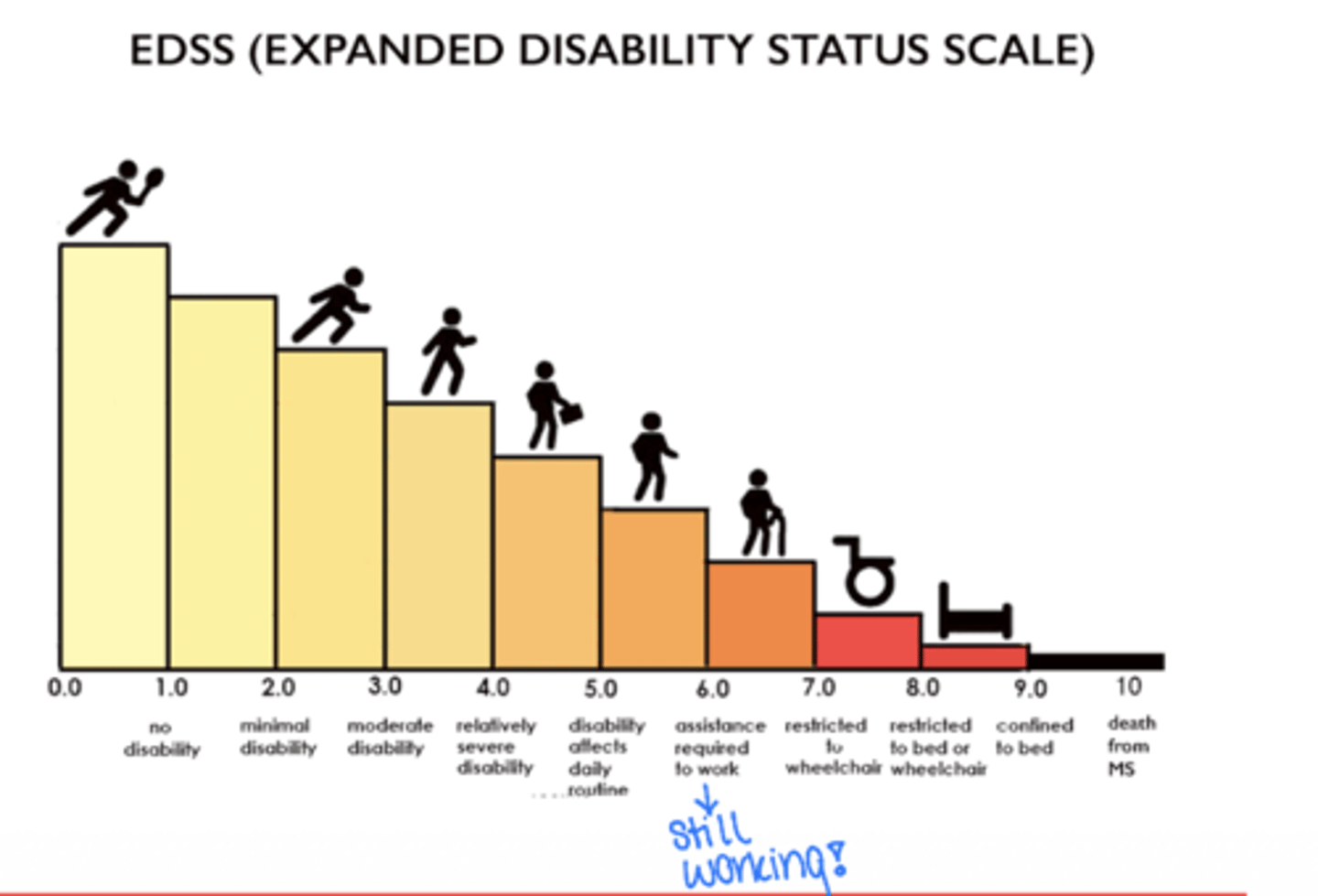
what is the expanded disability status scale?
a 0-10 outcome measure that tracks the progression of MS based on "functional systems" on a scale that physicians and research will use
photo of the EDSS =
_____ MS had increased disability and impaired mobility compared to ____ MS
mod/severe ; mild
mod/severe had decreased _____ ____ , increased need for a WC< and increased perceived ____ ____
social interaction ; physical impact
97% of people in the _____ group were independent without an AD in 10 years
mild