Bio 1406 - Exam 3
 Call Kai
 Learn
 Practice Test
 Spaced Repetition
 Match
 Flashcards
 Knowt Play
1/20

There's no tags or description
Looks like no tags are added yet.
21 Terms

DNA
(Deoxyribonucleic acid)
the molecule that carries genetic information in living organisms; made up of nucleotides
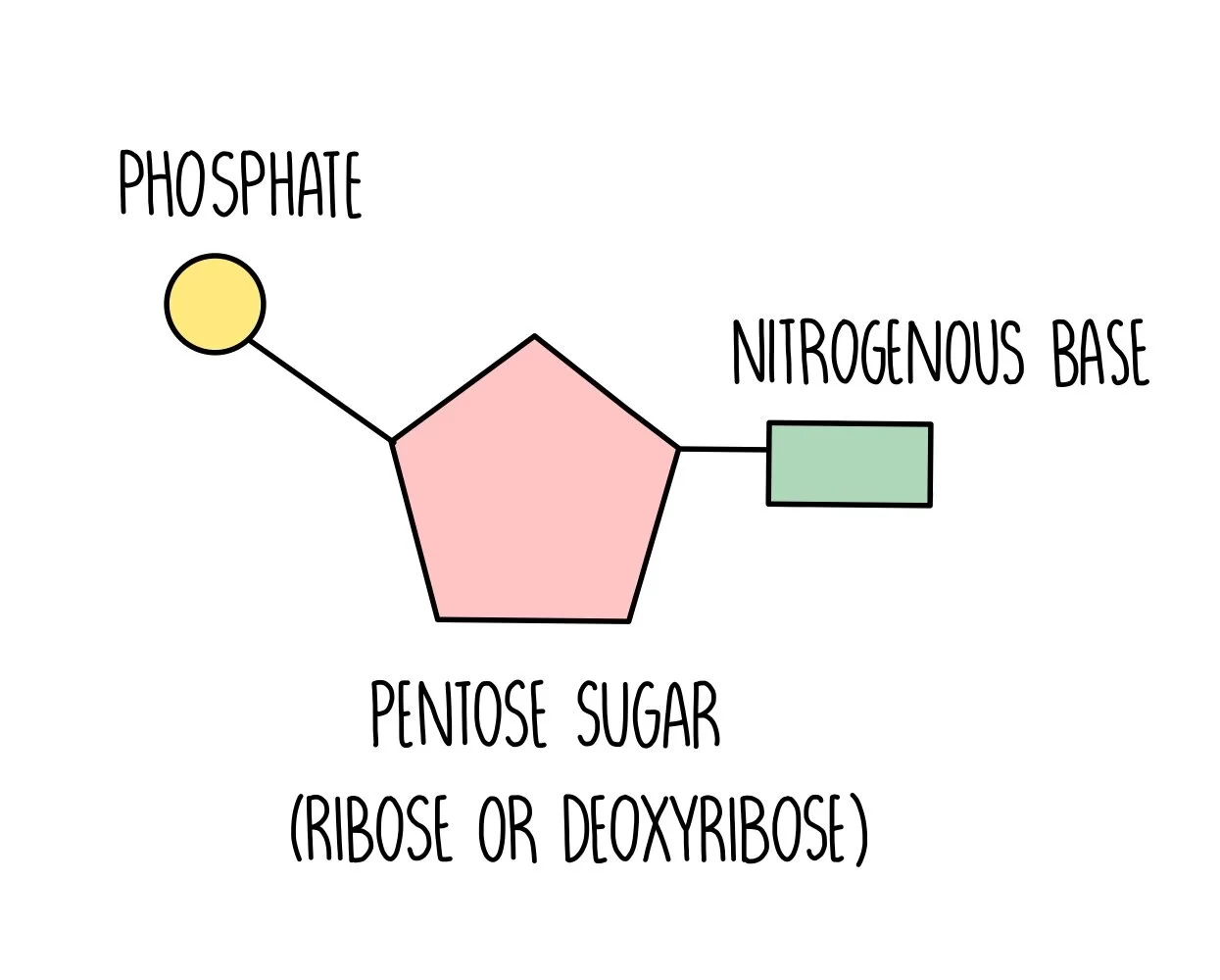
Nucleotides
building blocks of DNA; made of:
5-carbon sugar (deoxyribose)
phosphate group
nitrogenous base

Nitrogenous bases
adenine (A), guanine (G), cytosine (C), and thymine (T)
Adenine (A) and Guanine (G) are purines (2 ring-
structure)Cytosine (C) and Thymine (T) are pyrimidines (1
ring structure)
Base-pairing rules:
A+T
G+C
Because of this the amount of A+T is always the
same and G+C is always the same = Chargaff’s Rule

Structure of DNA
two strands of nucleotides twisted into a double helix, held together in middle of bases by hydrogen bonds; discovered by Watson & Crick & Franklin
-sugar-phosphate groups form the outside backbone.
-nitrogenous bases face inward and pair between the strands.
-the two strands are antiparallel, meaning they run in opposite directions.
-5′ end has an unbound phosphate group, and the 3′ end has an unbound hydroxyl (OH) group
Who developed and discovered the DNA structure?
James Watson, Francis Crick (Made the double helix model), and Rosalind Franklin (X-Ray)

DNA Replication
the process by which DNA copies half of itself (replicate) before cell division
Steps:
Separation: The hydrogen bonds between complementary nitrogenous bases are
broken by enzymes.Unwind: The two DNA strands separate, exposing their bases.
Matching: Free nucleotides pair with exposed bases from the old DNA using base-pairing rules (A–T and G–C).
Building: Enzymes connect the new nucleotides to form complementary strands
Result: The strands form two DNA double helices. Each new DNA molecule contains one (old) original strand and one newly synthesized strand = Semiconservative replication
The process of replicating DNA can be considered
semi conservative since it keeps one old strand and one new strand

Origins of Replication (DNA Replication)
Site where the replication of a DNA molecule begins, consisting of a specific sequence of nucleotides
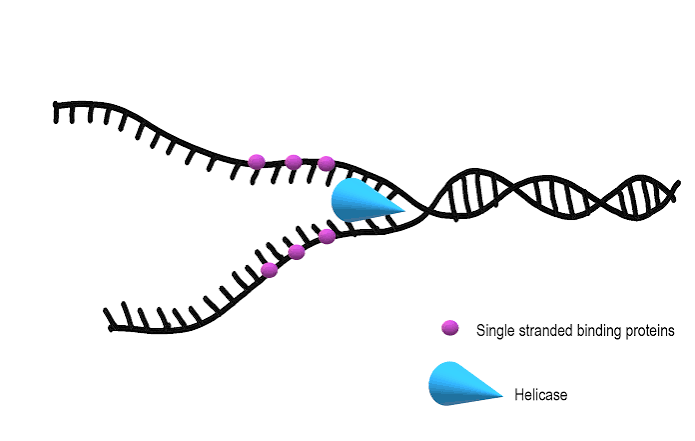
Helicase (DNA Replication)
Enzyme that recognizes and acts at replication sites. It unwinds DNA by separating the two strands
(enzyme that untwists the double helix at the replication forks, separating the two parental strands and making them available as template strands)

Single-strand binding proteins (SSBs; DNA Replication)
Attach to separated open DNA strands and keeps them stable to
prevent them from rejoining

Replication forks
A replication fork is a Y-shaped region where DNA is
being opened and copied
(Open sites create this)

Replication Bubble
forms when DNA opens at an origin, and the speed in both declines
Synthesis of DNA has to be initiated by _______.
Primers

Primer
made by short segments of RNA complementary to exposed nucleotides which are made my enzymes called primases
-the starting point to before adding DNA nucleotides

DNA polymerase
Catalyzes and adds complementary nucleotides to the old DNA template using the base-pairing rules;
-the energy comes from phosphate groups on new nucleotides (give 2 of 3Ps)
-forms covalent bonds in the sugar-phosphate backbone (holds molecules together)

New nucleotides are added to the ______.
3' end (unbound OH)
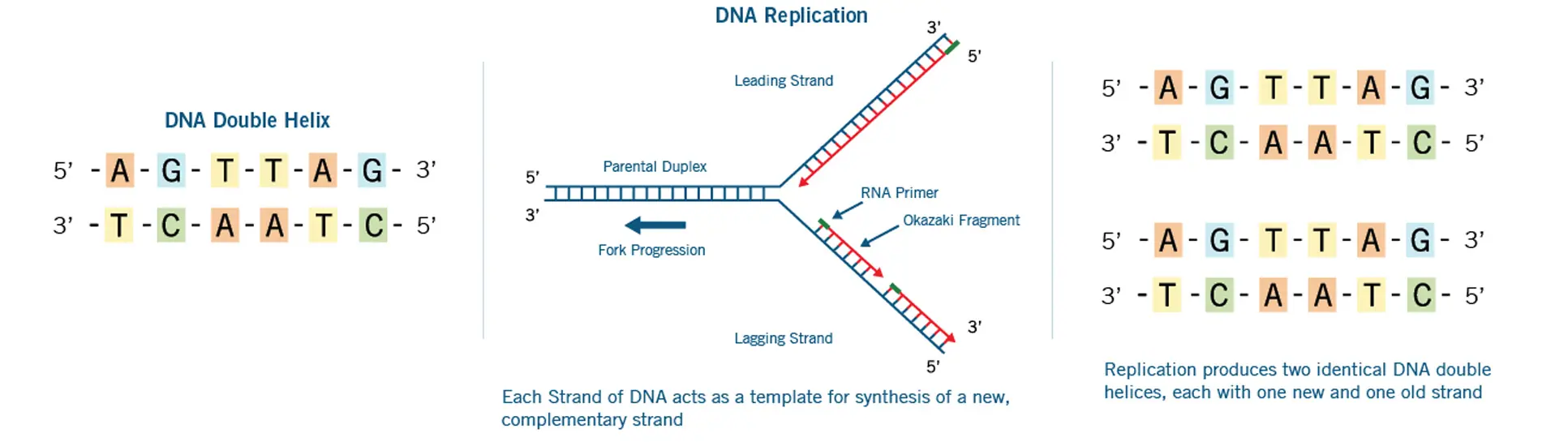
New strands of DNA grow from _____ only.
5' to 3' end only

Leading Strand
strand that is synthesized continuously using only one primer
-5’ to 3’ strand

Lagging Strand
strand that is synthesized discontinuously using multiple primers, Okazaki fragment, and ligase
-Goes against direction, but in short sections
-5’ to 3’ strand

Okazaki Fragments
Short sections of newly synthesized DNA on the
lagging strand; Connected by DNA ligase
-formed when DNA polymerase assembles DNA on the 5' to 3' strand
-caused b/c polymerase must return to replication fork after each segment

DNA ligase
joins the DNA fragments by sealing breaks in the sugar-
phosphate backbone