bio, Unit 3 CELL DIVISON
 Call Kai
 Learn
 Practice Test
 Spaced Repetition
 Match
 Flashcards
 Knowt Play
1/55

There's no tags or description
Looks like no tags are added yet.
56 Terms
What did the Miller-Urey experiment show?
Proved you could make organic molecules with inorganic precursors
The Miller-Urey experiment showed how complex organic molecules could have arisen from water and simple atmospheric components
He tried to recreate the early Earth conditions in a closed system
what are the multiple ways RNA can function?
Some can be self-replicating
RNA can act as an enzyme
RNA can encode proteins and DNA
How do cell membranes form spontaneously?
they form spontaneously from amphipathic molecules
They come together to hide the hydrophobic tails(form compartments)
What uses binary fusion?
Many prokaryotes, like bacteria, use binary fission
Binary fission also performed by unicellular eukaryotes for reproduction
what are single-celled eukaryotes able to perform in terms of cell division? Why can they do this?
Since single-celled eukaryotes also have nuclei, they perform both mitosis AND binary fission!
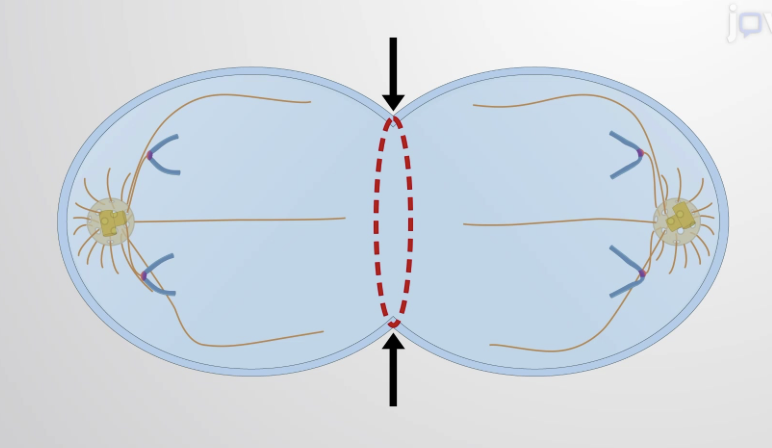
What does the FtsZ do in cell division? And what is the contractile ring?
FtsZ pulls the membrane together and splits the cell into 2
Contractile ring called Z ring, made primarily of FtsZ proteins
Contractile ring: Gets smaller and smaller until it pinches the 2 bacteria apart
In binary fission in a bacterium, where does DNA replication start? circle or line?
DNA replication from the orgion of replication(ori) at the center of the cell
what is binary fisson?
Binary fission is a form of asexual reproduction where a single parent cell replicates its genetic material and divides into two genetically identical daughter cells
In binary fission, what happens as the chromosomal DNA is replicated?
the two origins move apart as the replication proceeds.

describe binary fisson after “The two origins move apart as the replication proceeds”
The chromosomal DNA continues to replicate and the 2 daughter molecules move apart(segregate)
A ring of protein fibers, especially FtsZ, forms that constricts the cell, starting cytokinesis
Cytokinesis is complete; two new cells are formed

how are chromosomes different in prokaryotes vs eukaryotes
Prokaryotes(circles with ori)
Single circular chromosome
Single origin of DNA replication and a single termination site
Eukaryotes(image of 2 sister chromatids)
Multiple linear chromosomes
Eukaryotic chromosomes are much larger and tend to have multiple origins of DNA replication
Chromosomes must be…….during the cell ycle
Chromosomes must be faithfully replicated and segregated during the cell cycle
Must be identical, equal amounts of genetic info in both cells
what are chromosomes?
long DNA molecule that contains genetic information for an organism
what is DNA?
DNA is negatively charged(acidic), so to fold back on itself and become more compact, it must associate with positively charged (basic proteins)
what are histones?
small basic proteins (+ charged)
To make DNA more compact, they are wrapped around histones
You need something positive for the negative charges to attach to
what are nucleosomes?
Nucleosome: 2 turns of DNA wrapped around histone octamer
Histones get together in an octamer(8 of them)
DNA wraps around the cluster of proteins: Nucleosome

what are chromatins?
Material consisting of DNA + protein

is DNA bound and compact always or usally not?
Most of the time, DNA, is not bound and compact
What is interphase, and what are the stages? what about when a cell is not going through this cycle?
Interphase is when the cell is not undergoing cell division
G1-growth
S-DNA is replicated
G2-growth phase
These cells are in G0, not actively dividing

what is the centromere?
Chromosomes have a waist in the middle called the centromere
this is where sister chromatids are held together at
Are human cells diploid or haploid? And what does it mean?
Most human cells are diploid, meaning they contain two complete sets of chromosomes — one inherited from the mother and one from the father.
in mitosis, what do the microtubules grab onto when seperating the sisters/
The microtubules grab onto the kinetochore, which is a specialized protein structure located on the centromere of each chromosome.
what do the kinetochore microtubules vs the polar microtubules do?
Kinetochore microtubules pull chromosomes apart
Polar microtubules push centrosomes apart
How many kinetochores per chromosome?
Two kinetochores per chromosome, one attached to each pole—this is important to avoid missegregation
What is interphase in mitosis?
DNA is unraveled and replicated
centrosomes replicated
nucleur envelope intact
no mitotic spindle

what is prophase in mitosis
chromosome start to condense
spindle starts to form
centromsome migrate to poles
nucleolus no longer visible

what is prometaphase in mitosis?
Nuclear envelope breaks down
Kinetochore microtubules appear
Microtubules attach to kinetochores

what is metaphase in mitosis
chromosomes align at metaphase plate
line up right down the middle of the cell(easy to see)

what is anaphase in mitosis?
Sister chromatids separate(go from one chromosome to 2)
Daughter chromosomes move towards poles

what is telophase in mitosis?
Chromosomes reach the poles
The nuclear envelope reforms around the two piles of chromosomes
Chromosomes decondense
Nucleoli reform

what is the product of mitosis?
The product of mitosis is two cells that are identical to each other AND to the parent cell
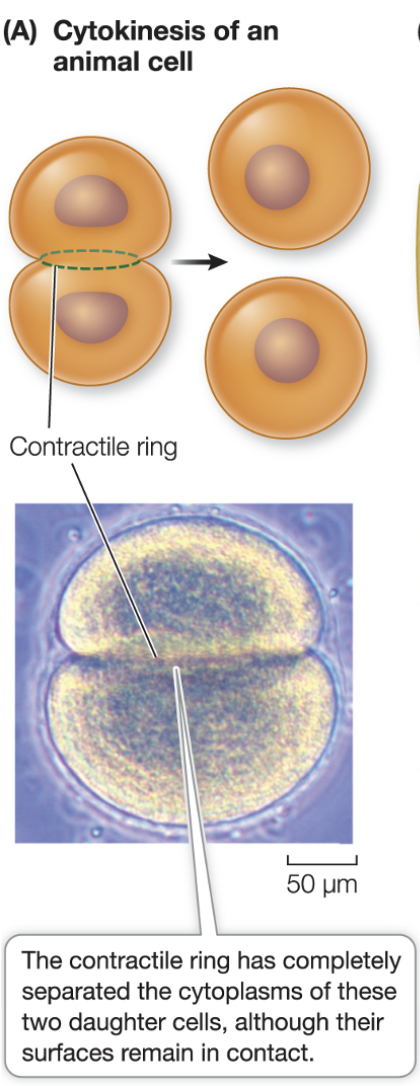
What is cytokinesis, and what does it look like in animal cells?
Cytokinesis divides the cytoplasm
Animal cells:
-Contractile ring made of actin microfilaments and myosin motors
-Furrowing of the cell membrane
-Pinching of cells in two
what does cytokinesis look like in plant cells?
Tougher bc of their cell wall
Vesicles derived from the Golgi appear at the plane of cell division
Vesicles move along microtubules using kinesin motor proteins
Vesicles fuse to create new membrane
Vesicle contents create a cell plate, which will become the new cell wall

if two cells are fused, one is in S phase, and one is in G1 phase, what does the resulting cell look like?
the fused cell has 2 nuclei
both nuclei in fused cell enter the s phase
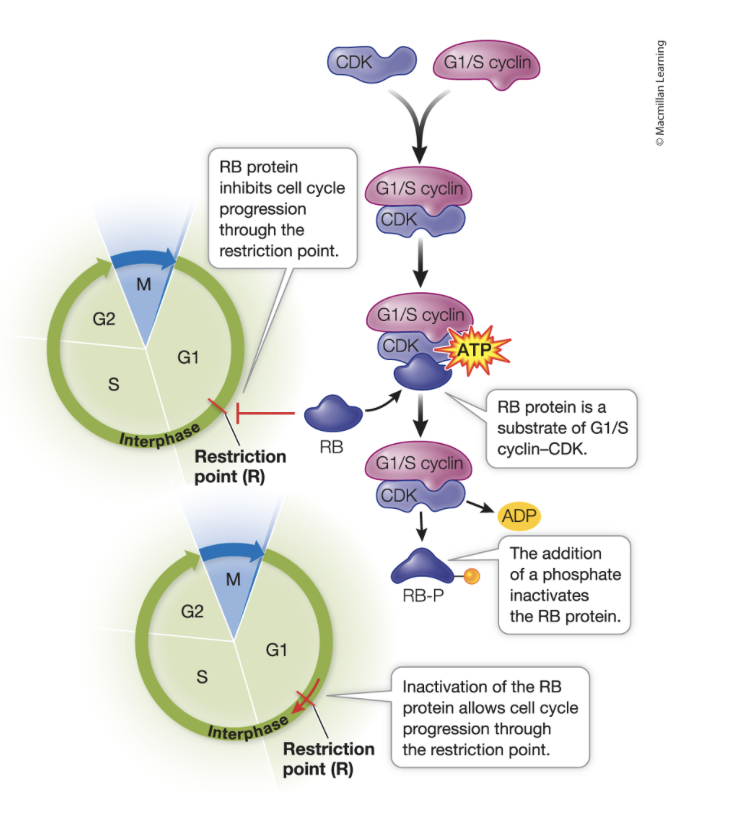
what does cyclin do?
Cyclin determine if the cell will go from one part of the cycle to another
what is CDK protien and what does it do?
CDK protein is always present but not always active
The cyclin will bind to CDK, making the active site available
Adds Phosphate to protein substrate
Begins making individual proteins for one part of the cell cycle to the next

what is RB?
RB's normal role is to prevent the cell from going from G1 to S
pumps the brakes on the cycle
When RB is phosphorylated, it cannot stop the cycle
Do CDKs regulate cyclin? or does cyclin regulate CDKs
CDKs are regulated by cyclins
Cyclins are transiently expressed during the cell cycle
Cyclins are made at a particular time and then break down—they are cyclical
what are the differences between sexual and asexual reproduction?
Asexual reproduction: offspring are genetically identical to the parent, fast, all of your genes are passed on, doesn’t require another organism, low variation (can be wiped out by sudden changes)
Sexual reproduction: offspring are not genetically identical to the parents, slow, only half of your genes are passed on, requires another organism, greater variability combined with natural selection and evolution can lead to organisms more well-adapted to their environment. More likely to create a variant that can withstand changes in the environment, pathogens, predators, etc.
define karyotype?
Ordered display of chromosome pairs
how many pairs of chromosomes do humans have?
23 pairs
meiosis starts as a parent cell that is 2n, and ends as….
4 cells that are all 1n
in meiosis 1 and 2, how many times does DNA replication occur?
only once
at the end of meiosis 1, what do the cells look like? what does each cell consist of?
At the end of meiosis I, cells are already haploid.
Each contains only one chromosome of each homologous pair.
Each chromosome consists of two sister chromatids
what is chiasmata?
Chiasmata is when two pieces of DNA from an X
They intersect and break and rearrange
what happens in meiosis II?
the segregation of sister chromatids
We don't replicate DNA between I and II
We reduce the amount of DNA
At the end have four haploid cells, each containing one copy of each unreplicated chromosome
Four daughters are not identical due to independent assortment and crossing over
What are ribozymes?
catalytic RNA
what is the mitotic spindle made from?
microtubulues
what is a centriole?
Each centriole is a hollow tube formed by nine microtubule triplets
Centrosomes (each with a pair of centrioles) are microtubule organizing centers that template the growth of spindle microtubules
In animal cells, what is the contractile ring made of?
Contractile ring made of actin microfilaments and myosin motors
how many cell cycle checkpoints are there?
3 checkpoints in interphase and 1 during mitosis
what is P21(cell cycle checkpoints)
-DNA damage results in the production of p21, which binds to the G1/S CDK, preventing cyclin binding. Pauses the cell cycle until repairs can be made
-When the DNA damage signal is no longer active, p21 gets degraded, and cyclin-CDK can function again.
-If DNA cannot be repaired, the cell undergoes apoptosis
what type of cell cannot undergo meiosis?
Haploid cell
what types of organisms are fungi, ferns, and storks?
fungus-haploiud
fern-diploid sporophytes
stork-diploid organism
When does crossing over happen in meiosis?
prophase i
what is nondisjunction?
Nondisjunction is the failure of homologous chromosomes or sister chromatids to separate properly during anaphase in cell division (mitosis, meiosis I, or meiosis II), leading to daughter cells with an abnormal number of chromosomes (aneuploidy).