5.2: Excretion as an example of homeostatic control
 Call Kai
 Learn
 Practice Test
 Spaced Repetition
 Match
 Flashcards
 Knowt Play
1/115

There's no tags or description
Looks like no tags are added yet.
116 Terms
Define excretion
the removal of metabolic waste from the body
How is excretion different from egestion?
excretion removes metabolic wastes; egestion removes undigested food from the gut.
What are the key excretory organs?
the lungs, the liver, the kidneys and the skin
How are the lungs involved in excretion?
here, carbon dioxide diffuses into the alveoli to be excreted as you breathe out
How are the kidneys involved in excretion?
urea is passed into the bloodstream to be transported to the kidneys. In the kidneys, urea is removed from the bladder in urine
How is the liver involved in excretion?
involved in converting excess amino acids to urea in deamination
How is the skin involved in excretion?
sweat contains salts, urea, uric acid and ammonia
Why is excretion important?
some metabolic waste such as carbon dioxide and ammonia are toxic, they interfere with cell processes by altering PH. Other metabolic products may act as inhibitors or reduce the activity of important enzymes
What key things need to be excreted from the body?
carbon dioxide from respiration, nitrogenous waste e.g urea and other compounds e.g bile pigments
How is carbon dioxide carried in the blood and what does it react with?
Most CO2 is transported in the blood as hydrogencarbonate ions, though forming this also forms H+ ions. CO2 reacts with water to form carbonic acid. Carbonic acid dissociates to release hydrogen ions and hydrogencarbonate ions.
Why is carbon dioxide staying in the body an issue?
carbonic acid and excess H+ ions reduce the PH of the plasma, altering the structure of many proteins in the blood affecting metabolic reactions
lower PH can also cause headaches, drowsiness but mainly respiratory acidosis
H+ ions interact with haemoglobin bonds changing its 3D shape, reducing the affinity of haemoglobin for oxygen affecting O2 transport. They can combine to form haemoglobinic acid. The CO2 not converted to ions can combine directly with haemoglobin forming carbaminohaemoglobin. They are both unable to combine with O2 as normal further reducing O2 transport
Why does the body need to excrete nitrogenous waste?
the body can’t store amino acids, but getting rid of them would be wasteful seeing how much energy they contain. Instead, they are transported to the liver where deamination takes place, and the toxic amino group is removed and urea is produced
What is deamination?
the process where the liver removes the amine group (NH₂) from excess amino acids, producing ammonia (NH₃)
What is the deamination word equation?
amino acid + oxygen = keto acid + ammonia
What is the word equation for the formation of urea?
ammonia + carbon dioxide = urea + water
Where in the body is the liver found?
in the abdomen, just below the diaphragm. It is the largest internal organ.
How many blood supplies does the liver have and why?
two, the dual supply ensures the liver gets enough oxygen for energy and direct access to absorbed nutrients and toxins to process them quickly
What does the hepatic artery do?
brings oxygenated blood from the aorta which is essential for aerobic respiration
What does the hepatic portal vein do?
it brings deoxygenated blood from the digestive system but carries blood rich in the products of digestion (toxic and good)
What does the hepatic vein do?
carries deoxygenated blood back to the heart
What is the fourth vessel connected to the liver that is not for blood?
the bile duct
What does the bile duct do?
it carries bile from the liver to the gall bladder, where it is stored until required to aid digestion in the small intestine. Bile also contains some excretory products like bilirubin which will leave the body with faeces
What is a liver lobule?
A hexagonal unit of liver tissue with a central vein, rows of hepatocytes, and sinusoids.
What are hepatocytes?
liver cells that carry out metabolic functions like detoxification and glycogen storage.
What are sinusoids?
Wide capillaries in the liver that connect the hepatic portal vein and hepatic artery to the central vein. Here, the blood between them mixes
What does the central vein do?
carries blood that has been processed by the hepatocytes into the hepatic vein, to leave the liver
What are Kupffer cells and their function?
specialised macrophages in the sinusoid that break down old red blood cells into a pigment called bilirubin
What happens to the bilirubin produced by the kupffer cells?
it is secreted into bile
What is bile canaliculus?
tiny channels that carry bile from hepatocytes to the bile duct
What does the bile duct do?
transport bile to the gall bladder
When have all the concentrations of things been modified in the liver?
at the end of the sinusoid
What is the priority of the liver in terms of arrangement?
to ensure the greatest possible contact between the blood and the liver cells
What are the main functions of the liver?
controls blood glucose levels
detoxification
breaks down excess amino acids
How does the liver control blood glucose levels?
stores glycogen when blood glucose concentration is too high, and can convert glycogen to glucose when the blood glucose concentration is too low
What does the liver mainly detoxify?
alcohol (ethanol) and drugs
Why does the liver need to detoxify alcohol?
Ethanol is small, lipid-soluble → diffuses easily into cells.
Toxic in high amounts: damages membranes, denatures proteins.
The liver detoxifies ethanol to prevent harm.
Describe the pathway of alcohol detoxification?
Ethanol → Ethanal. Enzyme: ethanol dehydrogenase. Cofactor: NAD → reduced NAD
Ethanal → Ethanoic acid. Enzyme: ethanal dehydrogenase. Cofactor: NAD → reduced NAD
Ethanoic acid → Acetyl coenzyme A (which is essential and used for respiration)
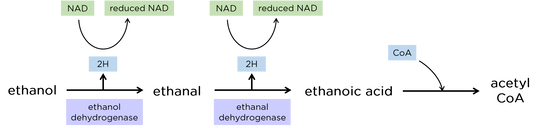
Why is NAD important in detoxification?
as it is needed to oxidise and breakdown fatty acids for use in respiration
What is the consequence of the over-consumption of alcohol?
Liver keeps converting NAD to reduced NAD to detoxify
With not enough NAD available, fatty acids can’t be broken down so they accumulate in the liver causing ‘fatty liver’
liver tissue becomes inflamed, swollen and painful
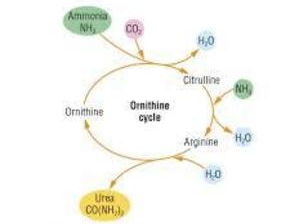
What is the ornithine cycle?
a series of biochemical reactions that convert ammonia to urea (happens after deamination)
Describe the ornithine cycle
Ammonia (NH₃) + CO₂ + ornithine → citrulline + water (H20)
Citrulline + another NH₃ → arginine + water (H20)
Arginine + water → urea + ornithine (ornithine recycled to start the cycle again).
What is the role of the kidney?
excretion - they remove waste products from the blood and produce urine
What are the key parts of the kidney?
capsule
cortex
medulla
pelvis
branch of renal vein
branch of renal artery
ureter
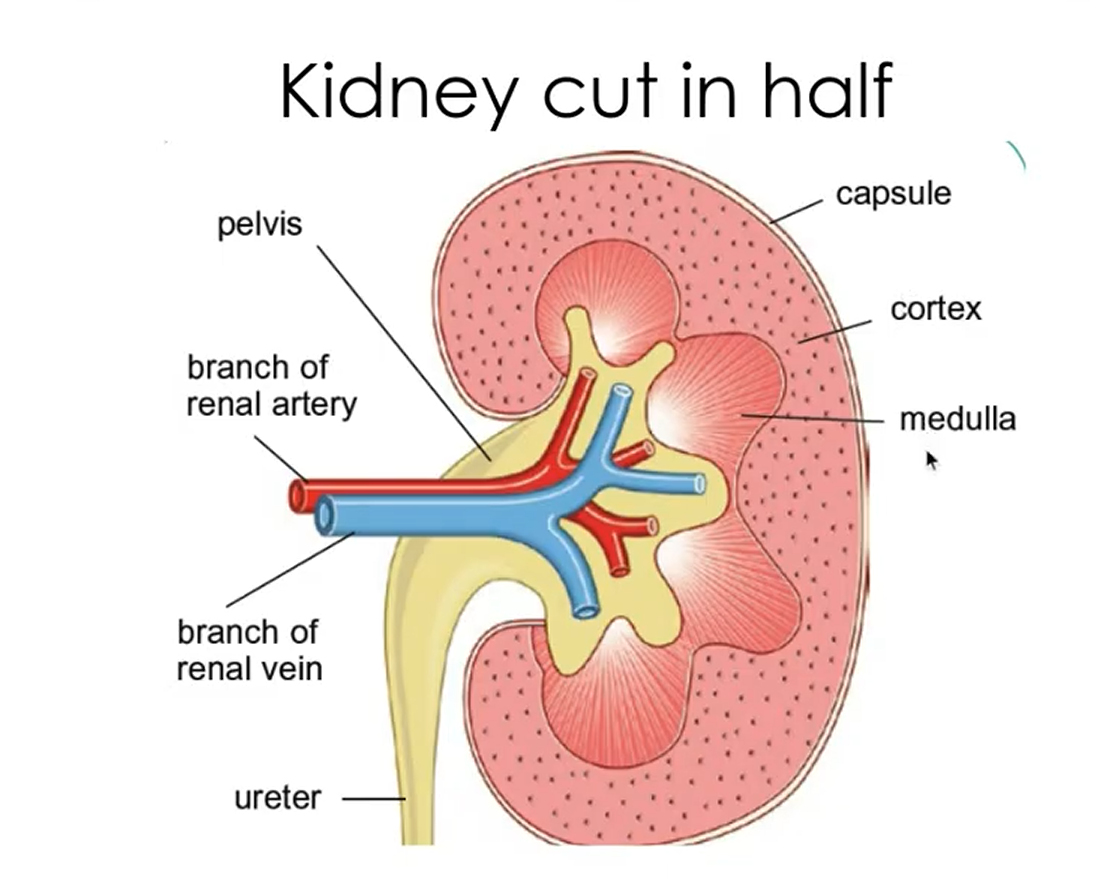
What is the role of the renal artery?
to bring oxygenated blood to the kidney
What is the role of the renal vein?
to take deoxygenated blood away from the kidney
What is the role of the ureter?
it is where the urine that is collected and extracted from the blood is sent t the bladder and the bladder takes it out through the urethra
What are the kidneys made up of?
millions of nephrons
What structures make up the nephron?
Bowman’s capsule + glomerulus, proximal convoluted tubule (PCT), loop of Henle, distilled convoluted tubule (DCT), collecting duct
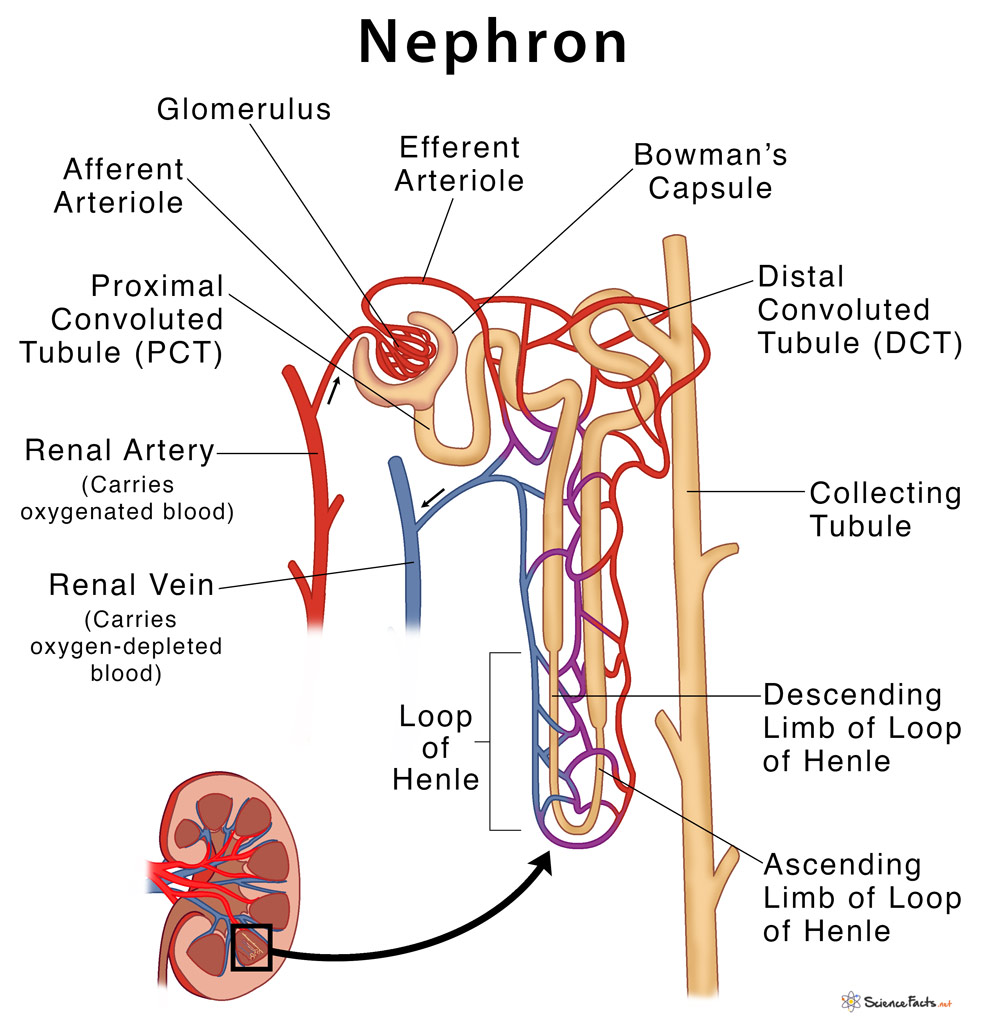
What does the cortex contain?
Renal corpuscles (Bowman’s capsules + glomeruli) and convoluted tubules.
What structures are found in the medulla?
Loops of Henle, collecting ducts, and capillary networks (vasa recta)
Where does urine collect before leaving the kidney?
In the renal pelvis, then through the ureter to the bladder
What is the glomerulus and where is it found?
a network of capillaries found inside the Bowman’s capsule
What blood vessel feeds into and out of the glomerulus?
the afferent arteriole feeds in whilst the efferent arteriole feeds out
Why is the diameter of the afferent arteriole larger than the diameter of the efferent arteriole?
it ensures that blood enters the glomerulus under a high hydrostatic pressure which pushes the fluid and substances into the Bowman’s capsule
How is the bowman’s capsule adapted for ultrafiltration?
the endothelium of the capillaries have narrow gaps that blood plasma and dissolved substances can pass through
the basement membrane - small pores that stop the removal of large substances from the blood (most proteins and all blood cells)
podocytes - specialised shape with finger like projections that ensure the passage of substances
What substances does the blood plasma push into the bowman’s capsule contain?
water
urea
glucose
ions
amino acids
What is left in the capillary after ultrafiltration?
blood cells and most proteins
Where does selective reabsorption occur?
In the proximal convoluted tubule
Which molecules are reabsorbed here?
All glucose and amino acids, most Na⁺ and Cl⁻, and most water
How do the useful substances move in selective reabsorption?
from the lumen of the PCT, through the tubule’s epithelial cells, and into a capillary
How does selective reabsorption occur?
sodium ions are actively pumped out of the epithelial cells lining the tubule
this creates a concentration gradient between the tubule lumen and the epithelial cell
sodium uses facilitated diffusion to diffuse into the cell through a co-transport protein carrying a glucose or an amino acid at the same time
the glucose/ amino acid diffuses into the blood (back in capillary)
What are the adaptations of the PCT for selective reabsorption?
lots of mitochondria to release ATP for active transport
large number and variety of co-transport proteins
microvilli in the epithelial cells to increase the surface area for diffusion
short diffusion distance through one cell
What is the function of the loop of Henle?
Creates a water potential gradient in the medulla so the collecting duct can later reabsorb water
What is the shape of the loop of Henle?
A U-shaped tubule with a descending limb and an ascending limb
What happens in the descending limb?
It’s permeable to water, so water leaves by osmosis into the salty medulla; salts stay in, making the filtrate (inside) concentrated
What happens in the ascending limb?
It’s impermeable to water; Na⁺ and Cl⁻ move out (by diffusion in the thin part (low U), active transport in the thick part (high U)), making the medulla salty and filtrate dilute
Why does the ascending limb use active transport?
To pump salts out against their concentration gradient, keeping the medulla salty.
Summarise what happens in the descending limb
1. Filtrate enters the descending limb from the proximal convoluted tubule.
2. The descending limb is permeable to water but impermeable to ions (Na⁺, Cl⁻).
3. As filtrate travels down, water leaves by osmosis into the salty interstitial (medulla) tissue.
4. The filtrate becomes more concentrated and reaches its lowest water potential at the bottom (tip) of the loop in the medulla.
5. The water that leaves is reabsorbed into nearby capillaries (vasa recta) and carried away.
Summarise what happens in the ascending limb
6. The ascending limb is impermeable to water but permeable to Na⁺ and Cl⁻ ions.
7. In the lower (thin) part of the ascending limb, Na⁺ and Cl⁻ diffuse out into the medulla.
8. In the upper (thick) part of the ascending limb, Na⁺ and Cl⁻ are actively pumped out using ATP because their concentration in filtrate decreases as it rises.
9. This movement of ions makes the medulla very salty (low water potential), while the filtrate becomes more dilute as it moves up.
What is meant by “countercurrent”?
The two limbs have fluid flowing in opposite directions.
Why is the loop described as a “countercurrent multiplier”?
Opposite flow directions multiply the concentration gradient down the medulla.
What is the result of the countercurrent multiplier?
increases the efficiency of the transfer of mineral ions -The medulla becomes very salty (low water potential) and the filtrate in the loop becomes dilute
Suggest why some animals have a longer loop of Henle than ours?
so there is much more of a water potential gradient so it can reabsorb as much water as possible
What is the role of the distilled convoluted tubule (DCT)?
to fine-tune the blood’s salt and acid balance after most water and nutrients have already been reabsorbed
What happens in the DCT?
it uses active transport to selectively reabsorb Na⁺ and secrete K⁺ or H⁺ depending on the body’s needs
What is the main job of the collecting duct?
to control how much water is reabsorbed from the filtrate back into the blood
What is osmoregulation?
the homeostatic control of the water potential of the blood. This balance is essential because significant changes in water potential can harm cells.
What type of feedback is osmoregulation?
negative feedback
What are osmoreceptors?
a sensory receptor in the hypothalamus that detects changes in the water concentration of the blood
What hormone does osmoreceptors produce?
antidiuretic hormone (ADH)
Where is ADH stored?
the posterior pituitary gland
What are the target cells of ADH?
those lining the distal convoluted tubules (DCTs) and collecting ducts in the kidneys.
What happens when the water potential is low (dehydration)?
Osmoreceptors in hypothalamus detect low Ψ (cells shrink)
Nerve impulses sent to posterior pituitary.
ADH released into blood.
ADH binds to receptors on collecting duct and DCT cells.
Causes vesicles with aquaporins to fuse with cell membranes.
Walls become more permeable to water → more water reabsorbed into blood.
Urine becomes concentrated and low in volume.
What is aquaporin?
intrinsic protein pores increasing the permeability of the membrane allowing more water to pass through
How is the permeability of the DCT and collecting duct increased?
the receptors on the walls of the DCT and collecting duct are complementary and specific to ADH and so ADH attaches to them
the ADH causes the active phosphorylase enzyme to be produced causing a series of controlled reactions to occur
the vesicles (containing aquaporins) to fuse with the cell surface membrane due to the cytoskeleton
aquaporins are inserted into the cell wall meaning more water can be reabsorbed back into the blood
What happens in the collecting duct if there are low ADH levels?
the cell surface membrane folds inwards - creating new vesicles
these remove the aquaporins making the membrane less permeable
the urine is more dilute in a larger volume
How can kidney function be assessed?
by estimating the glomerular filtration rate (GFR) and by analysing the urine for substances such as proteins
What does proteins in the urine indicate?
that the filtration mechanism has been damaged
What is the glomerular filtration rate?
the rate at which fluid enters the nephrons, a measure of how much fluid passes into the nephrons each minute
How do doctors estimate the GFR?
by estimating the concentration of creatine in the blood
What does a high concentration of creatine suggest?
the blood isn’t being filtered effectively
What is a normal GFR?
≈ 90–120 cm³ min⁻¹
What does a figure below 60 and 15 indicate?
below 60 cm³ min⁻¹ indicates there may be some form of chronic kidney disease whereas a figure below 15 cm³ min⁻¹ indicates kidney failure and the need for immediate medical attention
What are some of the possible causes of kidney failure?
diabetes (both type 1 and 2)
heart disease
hypertension (high bp)
infection
What are some of the problems that arise from kidney failure and what effect do they have?
build up of urea and toxins causing nausea, vomiting, fatigue and possibly death
loss of water and ion balance leading to swelling, high blood pressure and cardiac problems
bone problems due to calcium and phosphate imbalance
anemia causes tiredness
What are the main treatments for kidney failure?
renal dialysis and kidney transplant
What is haemodialysis?
a type of renal dialysis that removes waste and maintains solute balance artificially
How does haemodialysis work?
The patient's blood passes along one side of a semi-permeable membrane, while dialysis fluid flows on the other - countercurrent flow maintains a steep diffusion gradient
Dialysis fluid contains normal plasma levels of mineral ions, so ions diffuse through the semi-permeable dialysis tubing membrane into blood until normal levels of ions are present in blood.
Dialysis fluid contains normal plasma levels of glucose, so glucose also diffuses from dialysis fluid into blood until their concentrations of glucose are equal.
Dialysis fluid contains no urea, so urea is removed from the blood into the dialysis fluid by diffusion.
Larger molecules, like blood cells and proteins, remain in the blood as they are too large to pass through the semi-permeable membrane.
What drug is needed during haemodialysis?
heprin which stops blood clotting
What needs to be removed from the blood during haemodialysis before it re-enters the body?
air bubbles