CH6 Pt1: Physical & Brain Development Across the Lifespan
 Call Kai
 Learn
 Practice Test
 Spaced Repetition
 Match
 Flashcards
 Knowt Play
1/43

Earn XP
Description and Tags
PSYC 207 exam 2 material
44 Terms
physical development
Several developmental topics fall within the physical domain
Physical Growth, Neural Development, Sleep Patterns
Important to remember that development is characterized by:
Multi-directional nature (ex. cognitive ability)
Cascading, downstream effects (both within & between domains)
birth weight
Average = 7lbs.
First days of life…
Loss of 5% of birth weight
Removal of waste products
Adjustment & adapting to feeding reflexes (sucking & swallowing)

birth length
Average = 19.5in
Measured from top of head to heel of foot
29.5in by first year
34.4in by second year

physical; childhood
_______ Growth in ______:
Occurs in spurts
Although slower than in infancy
Not just height & weight
Increases in muscular strength & lung capacity
Facilitates greater physical activity
Proportions change
Following cephalocaudal principle
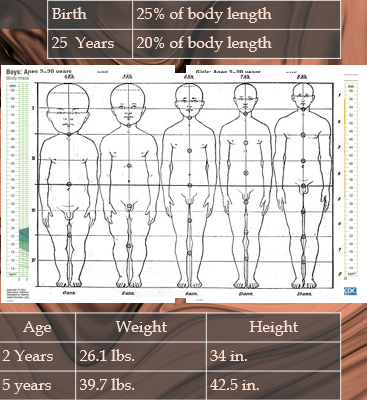
Puberty
Process of rapid growth & sexual maturation
Onset: between 8-14yrs
Typical Duration: 4yrs
Adolescent growth spurt inverts prior growth principles
Distoproximal: extremities preced torso; ears,nose,lips preced head
Caudocephalic: feet preced head
Substantial growth of internal structures & systems
Cardiovascular & Respiratory systems
indicators; puberty
_____ of the Onset of ______:
Acne
Gonadarche
Gonadarche
Development of the gonads (ie. sexual reproduction glands)
Sexual desire
Emergency of primary & secondary sex characteristics
acne
Occurs when development of sebaceous glands outpace growth of pores
Pores become blocked with dead skin
Experienced by 85% of adolescents
Higher prevalence among males
Associated with social distress — easily treatable
Medical & Social support
primary sex characteristics
The physical organs and structures present at birth that are directly involved in reproduction
secondary sex characteristics
Physical traits that appear during puberty/sexual maturity to distinguish the sexes of a species
male sex differences
Sex differences become more pronounced during puberty
9-14yrs.
Primary Sex Characteristics
Spermarche
Nocturnal
Few living sperm
Secondary Sex Characteristics
Broad shoulders
Lower voice
Coarser, darker body hair
female sex differences
Sex differences become more pronounced during puberty
8-13yrs
Primary Sex Characteristics
Menarche
Born with over 400,000 eggs
Released every 28 days
Secondary Sex Characteristics
Breast development
Widening hips
Coarse, darker body hair
early/late bloomers
Timing in the onset of puberty can vary as a function of…
Genetics & Environment
Factors associated with variation in onset include…
Stress: function of excessive cortisol exposure
Higher BMI
Race: exposure to psychosocial stress
Diet: restrictions or nutritional deficits may delay onset
early maturation
Implications of _____ _______
May be problematic due to a mismatch between…
Apparent physical maturity
Psychological maturity
Risk of being perceived as older by peers & adults alike — greater freedom at the cost of higher expectations
Potential Social Implications…
Premature sexualization
Harm to existing social connections
Perceptions as more imposing
Adoption of older peers
Early maturation also incurs greater risk for psychopathology
late maturation
Implication of ____ _______
Adolescents who mature later risk…
Bullying (smaller, more childlike appearance)
Poor self image
Harm to peer relationships
Increased risk of depression
Typically resolve after maturation
Different implications for males & females
Proposed to be protective factor in females
the secular trend
Observed trend of increasingly younger onset of puberty (began in 20th century)
Amongst American & European adolescents
4 year decrease in onset over the past 150 years
May reflect effects of industrialization
Greater exposure to stress
Increased separation from parents
Disruptions in circadian rhythm
Weight gain
Effects of chemicals on endocrine function
hormonal changes
_______ _______ in Adulthood
Somatopause
Adrenopause
Sex-specific Milestones
Andropause
Menopause
somatopause
Reduction in growth hormone production
adrenopause
Reduction in DHEA (steroid) hormones production in adrenal glands
andropause
Reduction in testosterone production beginning in 30s & 40s
Approximately 1% reduction in androgen production per year
Effects include..
Fatigue
Reduced muscle mass
Thinning body hair
Breast enlargement
Low bone mineral density
Sleep disturbances
Increases in body fat
Low sperm quality
hypogonadism
Decreased productivity of sex hormone glands
Prevalence
Men 45yrs+ = 35%
Men w/ underlying condition (T2DM, Obesity) = 30-50%
erectile dysfunction
Persistent inability to achieve or maintain an erection sufficient for satisfactory sexual performance
Risk factors include…
Prostate issues
Type 2 diabetes & Hypertension
Kidney disease
Substance use (Tobacco & Alcohol)
Chronic stress
Depression
Poor technique
Treatment Options
Hormone replacement therapy
Pharmaceuticals
Lifestyle changes
Menopause
Decline in estrogen & progesterone levels, resulting in cessation of menstrual cycles in women
Implications not just for sexual health
Associated with higher risk for age-related illness
perimenopause
Extended transitional period preceding menopause
Characterized by fluctuations of estrogen & progesterone
Often marked by irregular periods
menopause symptoms
Also peri- symptoms
Well Known Symptoms…
Vasomotor (hot flashes, night sweats)
Hair loss
Sexual dysfunction (painful intercourse & decreased libido)
Other Symptoms…
Bone loss
Sleep disturbances
Muscle/joint pain
Fatigue & Vertigo
Cognitive fog & Migraines
Irritability & Mood disorder
Tingling extremities
Tempo mandibular disorder
individual; menopause
________ Differences in _______
Average age of onset is 51 years of age
Typically range extends from 45 to 55 years of age
Timing of onset can vary as function of…
Genetics
BPA exposure
Autoimmune disease
Nulliparity
Premature Onset: prior to 40yrs. (increased risk of osteoporosis)
Late Onset: after 55yrs. (increased risk of hormone dependent cancers)
hormone replacement therapy
According to the NIH’s Women’s Health Initiative (2002):
Increased risk of…
Breast cancer
Endometrial cancer
Colorectal cancer
Stroke
Hip fracture
Corresponding drop in utilization
Prior: 25-30%
After: 3-4%
More recent research recommends nuance; consideration of
Timing & Duration
A decision made between an individual woman and her provider
cultural; menopause
_______ Variation in _______
Evidence of cultural variation in…
Menopause symptomology
Attitudes toward menopause
Relevant cultural factors
Minority culture status
Religious & cultural attitudes toward aging & gender roles
Conceptualization of menopause — medicalization, whether concept even exists

early adulthood
Mid 20s
Peak in physical conditioning
Strength
Sensory ability
Cardiac functioning
Reaction time
Motor skill
Lung capacity
Reproductive function
middle adulthood
Mid 30s to Early 40s
Physical aging more apparent
Around 35 — Hair begins to gray
Development of wrinkles (drier, less elastic)
Reduced immune function (longer recovery)
Decline in reproductive capacity
physical; adulthood
______ Change in Late ________
Proceeding from gray to white, hair follicles…
Reduce production of melanin
Produce fewer strands, which are smaller & thinner
Rates of graying & balding varies depending on genes
In both sexes, generally a gradual process
Sudden dramatic hair loss may be indicative an underlying condition
Iron deficiency
Hormonal deficiency/imbalance
Unmanaged, chronic stress

primary aging
A maturational process, facilitated by…
DNA modification
Oxidative damage
Reduction in cell production & quantity
Decline in cellular functioning
secondary aging
Aging facilitated by environmental factors
Sedentary lifestyle
Diet
Substance use
Disease
Baltimore; aging
_____ Longitudinal Study of _____
Followed 3,200 adults from 22 to 99 years of age
Goal: distinguish effects of primary & secondary aging
Measures effects of physical exertion on…
Heart rate
Ambulatory efficiency & endurance
Balance & coordination
Findings…
Maturation does NOT inherently lead to disease
There is no universal trajectory of aging
theories of aging
Programmed theories
Damage/Error Theories
Evolutionary theories
Gene regulation theory
mtDNA theory
Cellular damage theory
Neuroendocrine theory
programmed theories
Frame aging as a maturational process
Damage error theories
Frame aging as incidental environmental damage
antagonistic pleiotropy
Theory of ______ ________
Based in concept of evolutionary tradeoffs between longevity & reproduction
gene regulation theory
Theory that proposes a “longevity gene”; informed by centenarian studies
mtDNA theory
Theory of aging based in dysfunction of mitochondrial DNA
Cellular theory
Theory of aging that emphasizes changes in telomere length
DNA damage theory
Theory of aging that emphasizes environmental damage to DNA integrity
neuroendocrine theory
Theory of aging based in chronic exposure to elevated cortisol
free radical theory
Theory of aging based in accumulation of byproducts of cellular functioning