speech acoustics - quiz 2 (respiratory and phonation)
 Call Kai
 Learn
Learn Practice Test
 Spaced Repetition
 Match
Match Flashcards
 Knowt Play
1/134

There's no tags or description
Looks like no tags are added yet.
Name | Mastery | Learn | Test | Matching | Spaced | Call with Kai | Chat |
|---|
No analytics yet
Send a link to your students to track their progress
135 Terms
Tuning fork and frequency
There is a tuning fork set to vibrate at a certain frequency, which sets the air molecules around it to that same frequency it is vibrating at. If there is a tuning fork nearby, it will start to vibrate at the same frequency as the first tuning fork and the surrounding air molecules. As frequency moves and that energy goes to nearby objects, the energy will transfer but the frequency might not be the same? Because the second tuning fork is smaller, it doesn't vibrate at the same frequency.
An acoustic resonator is created when
the air inside a partially or completely enclosed container vibrates
Process of breathing
Inhalation
Inspiration
Exhalation
Expiration
Gas exchange (O2 and CO2)
Diffusion
Inhalation
taking in air
Exhalation
breathing out air
Inspiration and expiration are both…
gas exchange
Diffusion
movement of air molecules from high concentration to low concentration
Boyle's law
If the volume of a gas is increased, given a constant temperature, the pressure will decrease. If the volume of a gas is decreased, given a constant temperature, the pressure will increase.

How will a size of a container change the amount of pressure inside that container?
A bigger container will have less pressure (because there’s more space for the air molecules to move around). A smaller container will have more pressure
How does inhalation work? (apply Boyle’s law)
We expand the volume of our lungs. There is negative pressure inside our lungs relative to Patmos (atmospheric pressure) of the air outside our lungs. Air flows from outside the lungs to inside the lungs (inhalation!) There is now positive pressure within the lungs. Due to contracting lung volume, air flows outside (exhalation!)
What is part of the bony thorax and axial skeleton?
Vertebral column, ribs, sternum, pectoral girdle, pelvic girdle
Ribs attach to
superior, inferior and transverse costal facets
What are the attachments to the axial skeleton?
Pectoral Girdle (Scapula & Clavicle)
What is the attachment point for upper extremities?
Pectoral Girdle (Scapula & Clavicle)
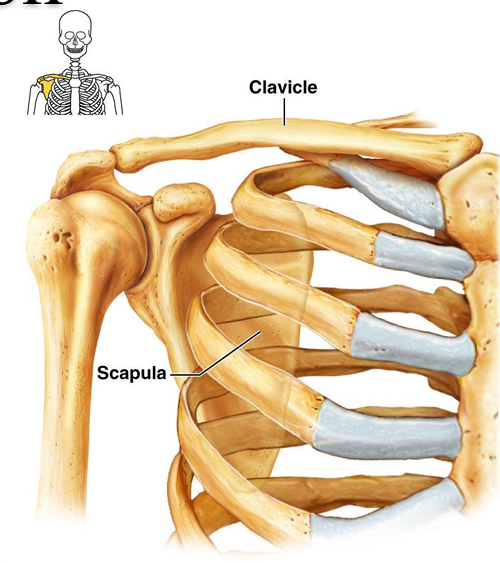
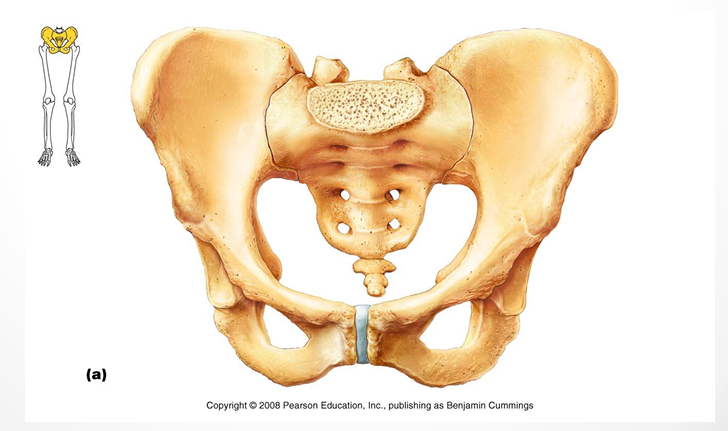
The pelvic girdle is the attachment point of…
lower extremities to vertebral column

What is this?
Sternum

What is this?
Sternum
The respiratory structures in the visceral thorax are divided into…
the respiratory zone and the conducting zone
Conducting zone
Respiratory passageways that carry air to respiratory zone
Respiratory Zone
Site of gas exchange, includes respiratory bronchioles, alveoli
What does the trachealis muscle do and what is the importance?
the trachealis muscle contracts the trachea. importance - when you need to cough, this muscle contracts to help you cough or sneeze
Parietal Pleura
Internal surface of thoracic cavity
Visceral Pleura
External surface of the lungs
Pleural cavity
Space between parietal and visceral pleurae, filled with pleural fluid
1st function of pleural fluid
holds parietal and visceral pleura together, thus lungs cling to thoracic wall, and MOVE WITH the thoracic wall
2nd function of pleural fluid
lubricates, allowing lungs to slide across the thoracic wall
Muscles of respiration use
muscles of inspiration (quiet & forced), and muscles of expiration
Function of diaphragm
primary mover of inspiration; increases vertical dimension of thorax; increases intra-abdominal pressure
What are the muscles for quiet inspiration?
External intercostal muscles
Function of external intercostal muscles
raise ribs (up and out)
What are the muscles for forced expiration?
Internal intercostal muscles
Function of internal intercostal muscles
pulls ribs downward
The rate of breathing is measured in…
breaths per minute (BPM)
Your rate of breathing changes or stays constant?
Changes with age and level of activity
BPM depends upon
Lung size
Lung weight
Angle of rib cage
Pleural pressure changes (becomes more negative)
Thoracic cavity size
Nervous system development
Resting expiratory level (REL)
Air not moving into or out of system for a brief instant
At resting expiratory level (REL), what is the pressure like?
Palv (alveolar pressure) is equal to Patmos (atmospheric pressure)
End-expiratory level (EEL)
End point of a normal quiet exhalation
In EEL, what is the pressure like?
There is no difference between alveolar pressure and atmospheric pressure
Lung volumes
the amount of air that is within our lungs at a given point in time and how much air is used for varying purposes like speech
Lung volume is measured in
Litres (l) or millilitres (ml)
True or false: Lung volumes are single, non-overlapping values
True
tidal volume
amount of air inspired and expired in a normal breathing cycle
In simple terms, tidal volume is
normal breathing in and out
Tidal volume involves which muscles?
muscles of quiet inspiration and quiet expiration
inspiratory reserve volume
maximum amount of additional air inspired after a tidal inhalation is completed
In simple terms, inspiratory reserve volume is
maximum inhalation
Inspiratory reserve volume involves which muscles?
muscles of forced inspiration
expiratory reserve volume
maximum volume of air expired after a tidal expiration
In simple terms, expiratory reserve volume is
maximum exhalation
residual volume
air remaining in the lungs even after a maximum exhalation
Lung capacities
Two or more lung volumes
Lung capacities is measured in
Litres (l) or millilitres (ml)
vital capacity formula
tidal volume + inspiratory reserve volume + expiratory reserve volume
The vital capacity formula is used to calculate…
amount of air available for breathing or speech
functional residual capacity formula
expiratory reserve volume + residual volume
The functional residual capacity formula is used to calculate…
amount of air that is remaining in the lungs after an expiratory volume
inspiratory capacity formula
tidal volume + inspiratory reserve volume
The inspiratory capacity formula is used to calculate…
amount of air inhaled at the end of an inspiratory level
total lung capacity formula
tidal volume + inspiratory reserve volume + expiratory reserve volume + residual volume
The total lung capacity formula is used to calculate. . .
total amount of air that your lungs are capable of holding
Gas exchange for breathing during rest
gas exchanged to match metabolism, otherwise hypo- hyperventilation
Gas exchange for breathing during speech
tend to hyperventilate, less CO2 especially in extended & loud speaking
Clavicular breathing pattern
when the clavicle and neck is moving
Thoracic breathing pattern
(most common) more chest movements than diaphragmatic
Diaphragmatic-thoracic breathing pattern
(not common, usually with singers) lower thoracic and abdominal muscles moving
Breathing for sustained vowels
steady outflow of air
Breathing for connected speech
more variable pitch and loudness changes, rate, duration of utterance, linguistic stress
Extended vocalization
max inspiration to max expiration, lung volume starts high and ends low, rib cage & abdominal start high and decrease
Running speech (also called connected speech)
much more variable, lung volume is usually twice resting tidal but not max, rib cage & abdomen decrease (rib cage faster than abdomen)
children demonstrate breathing behaviours that reflect speech-like utterances (shorter inhalations and longer exhalations) by age…
age 2
In older adult breathing patterns, they have reduced…
elastic recoil pressure (their lungs don’t bounce back as well)
vital capacity, inspiratory and expiratory reserve volume (they can’t inhale or exhale as much extra air)
In older adult breathing patterns, they have increased…
residual volume (more air stays trapped in the lungs after exhaling)
What auditory–perceptual measures of respiration do SLPs evaluate?
Pressure - loudness, Volume - how many syllables per breath (assessed using caterpillar passage, rainbow passage, etc.), Shape of breathing pattern (are their chest or abdomen moving)
Respiratory problems
Obstructive, Restrictive, Central
Obstructive respiratory problem
asthma, bronchitis, COPD
Restrictive respiratory problem
fibrosis of lungs, neuromuscular disease
Central respiratory problem
brain stem damage/stroke
In an obstructive respiratory problem, it usually affects (inhalation or exhalation?)
exhalation
In a restrictive respiratory problem, it usually affects (inhalation or exhalation)?
inhalation
In a central respiratory problem, it usually affects (inhalation or exhalation)?
inadequate ventilation (could be inhalation or exhalation)
Symptoms of a respiratory breathing problem
Dyspnea & stridor
Dyspnea
discomfort when a person is breathing, could be chest tightening
Stridor
there is some sound when a person is breathing, like a wheezing sound
Parkinson’s Disease
Parkinson's Disease (information from Parkinson's Foundation website)
1. Parkinson's disease is a movement disorder of the nervous system that worsens over time. Tremors common in Parkinson's disease. But the disorder also may cause stiffness, slowing of movement and trouble with balance.
2. Shortness of breath in Parkinson’s can result from “wearing off" from medication such as levodopa, respiratory dyskinesia (an occurrence of irregular and rapid breathing, dyskinesia (writhing movements) of other body parts. Advanced PD can increase the risk of swallowing difficulties, choking, and aspiration pneumonia (which is pneumonia that develops after food or liquid “goes down the wrong pipe.”)
3. Treating breathing difficulties in PD depends on the cause identified. For wearing off of levodopa and dyskinesia, adjusting PD medication is helpful. Anxiety can be treated with medication or psychotherapy. Aspiration pneumonia is typically treated with antibiotics.
Tips - exercise/staying active, managing anxiety, quitting smoking, working with an SLP for any swallowing issues
Adduction
the vocal folds come together (close) for speech
What muscles are used for adduction?
Lateral cricoarytenoid, transverse arytenoid, and oblique arytenoid muscle
Abduction
the vocal folds move apart (open) to allow for breathing
What muscles are used for abduction?
Posterior cricoarytenoid
Tissues of the vocal folds
Squamous epithelium (superficial)
Lamina propria (3 layers)
Thyroartenoid muscle
Subglottal pressure (also called tracheal pressure)
air builds up beneath the closed vocal folds during adduction, which creates pressure called subglottal pressure
Two primary adjustments to regulate voice
Longitudinal tension and medial compression
Longitudinal tension has an relationship between…
tension and cross-sectional area (as cross-sectional area decreases, tension increases)
How does longitudinal tension affect pitch/tone?
As crossectional area (width) decreases, tension increases. When we change the tension of our vocal folds, it changes the pitch of our voice. We need higher tension for a higher pitch. We need a lower cross-sectional area and less tension for a lower pitched voice
Medial Compression has a relationship between…
medial compression and subglottal pressure (more medial compression, more subglottal pressure required)
How does medial compression affect intensity/loudness?
If we have more medial compression (when vocal folds close), more subglottal pressure is required. After we have a build up of subglottal pressure in the vocal folds, that air will push through and create sound. When we produce a louder and more intense voice, we have more medial compression and more subglottal pressure.
Myoelastic Aerodynamic Theory of Phonation
voice production is a combination of muscle forces (myo), tissue elasticity (elastic), and air pressures and flows (aerodynamic)
What are the central concepts of the Myoelastic Aerodynamic Theory of Phonation? (Basically, what processes are used during speech?)
Subglottal pressure, elasticity, and Bernoulli effect
Bernoulli effect
Reduced velocity, increased pressure. Increased velocity, reduced pressure
How does the Bernoulli effect apply to the vocal folds?
When air flows through a narrow space like the vocal folds, it speeds up. This sudden increase in speed causes the pressure inside the air to drop, but the pressure in the area around the air (like the vocal folds) stays the same. This difference in pressure creates negative pressure between the vocal folds. This negative pressure acts like a small vacuum which pulls the vocal folds toward each other.