Applications Flashcards 5-7
 Call Kai
 Learn
 Practice Test
 Spaced Repetition
 Match
 Flashcards
 Knowt Play
1/120

There's no tags or description
Looks like no tags are added yet.
121 Terms
Temperament
Distinctive personality from first few weeks of life
Basic response tendencies
Children have unique patterns of responding
Identical twins more similar in temperament than fraternal twins
Thomas and Chess (2956) collected information about 9 dimensions of infant behaviour
Mood
Regularity of biological functions - sleep, feed
Tendency to approach or withdraw from novel stimuli
Intensity of emotional reactions
Temperament Classifications
Easy Child (40%): Regular routines in infancy, cheerful and adapts to new experiences
Difficult child (10%): Irregular routines, slow to accept new experienced and reacts negatively
Aggressive behaviour in school
Slow-to-warm-up child (15%): Inactive, mild reactions, negative mood and adjusts slowly to new experienced
Fearfulness and slow behaviour in school
Attachment
Emotional development begins shortly after birth
Attachments to caregiver
Strong, long lasting emotional ties to a person
Develops across lifespan
Bowlby's Attachment Theory
Attachment between mothers and newborns
Very early interactions curial to development
Feelings of security
Quality of attachment varies between infants
Attachment Classifications
Secure Attachment - 65% of USA
Parent is a secure base
If cry, this is due to them preferring the parent to stranger
Actively seek parent upon return
Crying reduce immediately
Avoidant attachment (20%)
Unresponsive to parent
Not distressed when parent leaves
Unresponsive to stranger
Resistant attachment (10-15%)
Seek closeness and fail to explore
Angry and resistant when parent returns
Disorganised-disorientated attachment (5-10%)
Greatest insecurity
Confused at reunion - look away while being held
What influences attachment security
Quality of caregiving:
Secure attachment: Sensitive caregiving
Insecure attachment: Less contact
Childs temperament can influence this
Opportunity for attachment:
Tizgard and Rees (1975) observed a children's home
High child-staff ratio, but high turn over of staff
First attachment after 4 years old
Adolesent - Autonomy and attachment
Autonomy
Key developmental task of adolescence
Establish identity separate to parents
Secure attachment with parents still important
Naturally occurring 'strange situation'
Attachment and later development model
Internal working model: expectations from early caregiving experience concerning the availability of attachment figures and the self's interaction with those figures
Attachment Styles
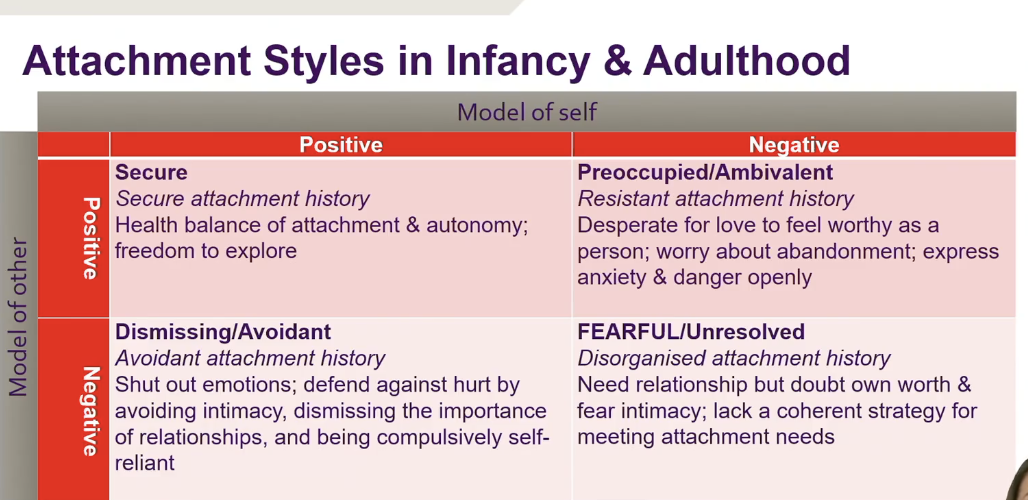
Parenting Styles:

Moral Reasoning + types
As child develop, they develop morality
Right or wrong?
Learn from authority figures and peers
Preconventional morality (birth to 6 years old, stages 1 and 2) Base decision on right or wrong and the likelihood of avoiding punishment
Conventional morality (7-12 years old, staged 3 and 4) Have internalised societies rules
Postconventional morality (12 years onwards, stages 5 and 6) Able to look beyond fixed rules and focus on principles
Eriksons Stage Theory 1-2 - BA
Stage 1: Basic trust vs basic mistrust
Birth to 12-18 months
Feeding
Form a loving relationship or develop a sense of mistrust
Optimistic vs pessimistic personality
Stage 2: Autonomy vs shame and doubt
18 months to 3 years
Toilet training
Success in toilet training and other skills such as dressing self requires control and gaining autonomy or failures may lead to feelings of shame
Erikson 3-4 - II
Stage 3: Initiative vs guilt
3-6 years
Gaining independence or it chastised for being forceful, leading to guilt
Stage 4: Industry vs inferiority
6-12 years
Staring school
Learn new skills or feel a sense of inferiority
Erikson 5-6 - II
Stage 5: Identity vs identity confusion
Adolescence
Identity crisis
Influenced by previous stages
Weak trust: Difficulty selecting ideals to believe
Low autonomy: Little exploration of alternatives
Low industry: Difficulty selecting vocation which matches their interests
Stage 6: Intimacy vs Isolation
Early adulthood
Commitment can be challenging
Surrender some independence and redefine themselves
Achievement of intimacy is marked by cooperation, tolerance and acceptance of different values
Promotes empathy and openness
Isolation is marked by hesitancy to form close relations
Erikson 7-8n- GE
Stage 7: Generativity vs stagnation
Middle adulthood
Helping to guide the next generation
Commitment expands beyond yourself and partner
Concern for future generations
Anything that can outlive the individual
Stagnation: Self-indulgent, placing own comforts above sacrifice
Stage 8: Ego integrity vs despair
Late adulthood
Coming to terms with your life
Integrity: Feel whole and satisfied with achievements
Meaningful life
Despair: Feel they have made the wrong decisions
Hard to accept death
Self concept
Children younger than 15 months rarely touch their nose
Unlike 2 year olds - recognise how they should look
Visual self concept developed between 15-24 months
At age 8 children define themselves based on internal, psychological attributes
They start to think about their abilities, likes, dislikes and their personality
Conceiving the self involves comparisons
Concepts of others
Understanding others is a developmental process
Infants understand social interactions are reciprocal
By 3/4 months infants learn smiling brings playful responses
Infants learn to read emotions
At 12 months the infant looks at their parent for reassurance when playing
Perspective taking and thery of mind
Perspective-taking is the ability to understand other peoples perspectives
Involves moving our of egocentrism and representing the other persons mind in ones own
A prerequisite to perspective taking is theory of mind
An implicit set of ideas about existence of mental states in oneself and others
Appears to arise between 2-4
Before this children struggle to understand people can hold false beliefs
Have trouble recognising thought and reality can differ
Theory of mind relies on normal neurological development
ASD and ADHD associated with impairment of theory of mind
Infants appear to understand peoples actions reflect their goals
Infants also engage in joint visual attention when someone points
Gender Schemas
People have turned their attention to children's knowledge
Cross culturally children show an awareness of the cultures about gender by age 5
By middle childhood they share common stereotypes with society
They encode and organise information about maleness and femaleness in gender schemas
Mental representations that associate psychological characteristics with sex
Technological change is reducing distinctions between sexes
Individualistic societies hold more egalitarian sex roles
Information Processing theories on moral development
Information-processing theories do not postule stages of moral development
They break moral thining down into processes and examine the way they change in childhood
People in the west tend to determine punishment according to criteria
The extend of damage
If the perpetrator has already made appropriate restitution
Perpetrator has suffered as a result of actions
Understanding moral development means understanding changes in the way children answer questions
role of emotion: Psychodynamic
This view of moral development proposed children start our narcissistic
The begins to change with development of conscience between 2-5
Moral development occurs through identification or internalisation
Children take on parents value and adopt them as their own
Guilt is the primary emotion that motivates people to obey their conscience
Guilt arises from discrepancies between what people feel they should do and what they contemplate themselves doing
Cognitive approaches: Moral development
The strength of cognitive social approach is its emphasis on moral/prosocial behaviour
Thinking about morality is irrelevant if it does not affect action
This approach assumes behaviours are prosocial and does not address situations that require choices between imperfect and mora options
Kohlberg's theory highlights that moral development may go beyond internalisation of societies rules
Kohlberg's theory has been critised
People at higher stages of moral reasoning do not behave differently to people who are conventional in moral reasoning
Emotional approaches
Morality requires self sacrifice and self-restrain
Anxiety or guilt seems essential to balance out the net losses in gratification
Empathy adds a source of motivational for moral behaviour
Mothers are more responsible for moral training in most western countries
Identification with the father not seen as central as Freud supposed
Prosocial responses are common by 18/20 months when infants witness other peoples distress but not when they cause the distress
Health Psychology
Is the scientific study of mental processes and behaviours that influence health and illness
Aim to promote health, prevent and treat illness
History of Health Psychology
Biopsychosocial Model
Biological, psychological and social factors influence health and illness
Treat illness or promote health must address all aspects
Deaths due to infectious diseases are less likely than in the past
Penicillin and improved hygiene
Many of the current causes of death and disability in developed nations are due to lifestyle factors and are preventable
Two areas in health psychology
two areas in health psychology
Behavioural medicine
Treatment of illness among those already ill
Behavioural health/ Health Promotion
Promotion and maintence of health among individuals who are already healthy
Behavioural medicine
Coping with disease disability
Anxiety reduction for medical treatments
Pain management
Experience of pain is both physiological and psychological
Adherence to treatment
Patients adopts behaviours/treatment recommended by physician
Health promotion
Road safety
Vaccinations
Sun smart
Healthy diet
Regular exercise
No smoking
Drug and alcohol use
Safe sex
Screening
Wellbeing
Wellbeing = Good health and positive feelings about life
Good mental and physical health
Ability to function in everyday life
Life satisfaction
APS tracks wellbeing since 2011
Track changes and trends
Increase wellbeing
Workplace changes
Gamification - aspects of game design to promote health
Health Belief Model
Person might have beliefs that is against smoking but might wait until cue to action
The health belief model suggests health behaviours are predicted by:
Perceived susceptibility to the health threat
Perceived seriousness of the health threat
The benefits and barriers of undertaking particular health behaviours and cues to action

Protection Motivation Theory of Health

Self- efficacy - belief in ability to change behaviour
Have the ability to change - self-efficacy
People may not alter behaviour even if the threat is large
The health model was therefore changed to include self-efficacy
A persons belief in their ability to undertake a particular action or behaviour
Now model is called the protection motivation theory of health
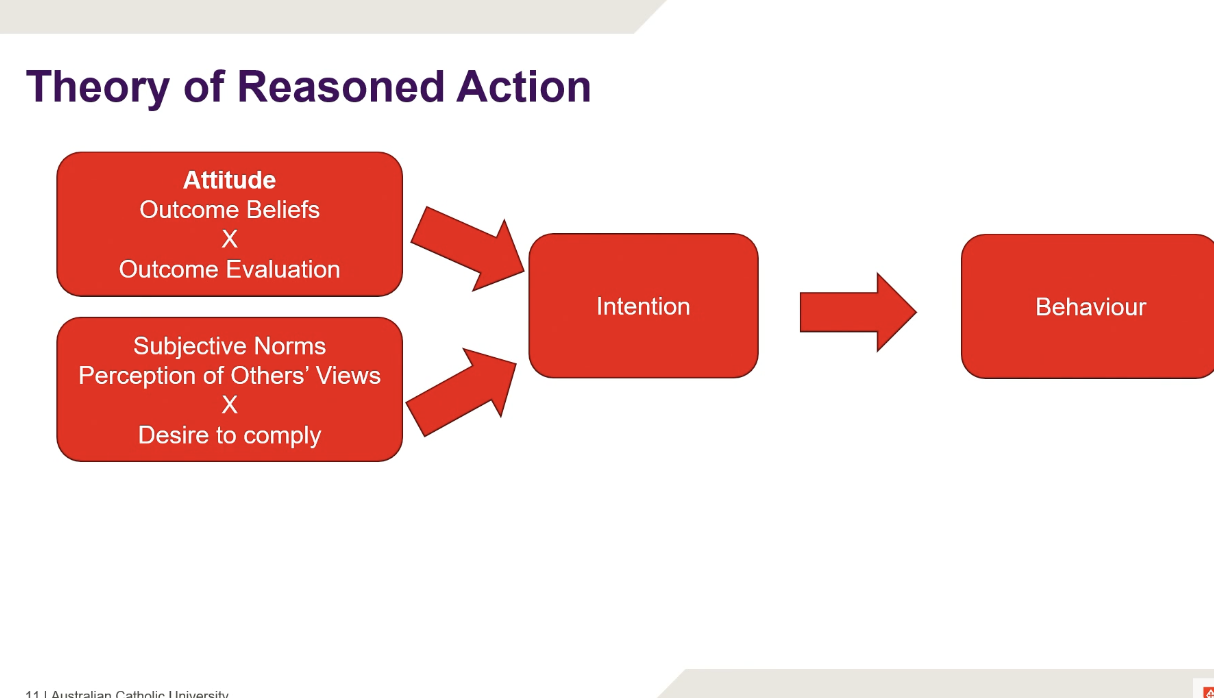
Theory of Reasoned Action
Look at intentions to quit smoking
Need to look at attitudes and subjective norms
Outcome beliefs - reduce cancer and smelling bad
How important is that to you? - outcome evaluation
Subjective norms
Perception of others views - parents want me to quit
Desire to comply with parents
Theory of Planned Behaviour
Added self-efficacy
Belief about ability for change in behaviour

Transtheoretical Model
Precontemplation - not considering changing the behaviour in near future
Contemplation - aware problem exists and are considering taking action soon but are not yet committed to that action
Preparation - people are preparing to make behavioural change in next month or so and are making small changes that will help them achieve their goal
Action - lasts approx. 6 months and is when people are actively working on behavioural change
Maintenance - people have achieved desired behaviour change and are working to maintain this
Obesity
Excessive body fat
BMI= kg/m2
Underweight = under 19
Acceptable = 20-24
Overweight = 25-29
Obesity = above 30
Problems with measurement:
Muscle
Nationality
Age
Waist circumference
Males = 94cm and higher is unhealthy
Females = 80cm and higher is unhealthy
Worldwide epidemic
Percentage of people with BMI above 25 is increasing
Australia
2/3 of adults with BMI above 25
Obesity Consequences
Overweight (including obesity) was the second leading risk factor (after tobacco use) contributing to ill health and death
Overweight (including obesity) was linked to 30 diseases, including cancer, CVD, musculoskeletal conditions and type 2 diabetes
Psychosocial:
Increased change of
Low self-esteem
Body dissatisfaction
Discrimination
Depression
Cognitive:
Lower performance on memory and word fluency tasks
Obesity Causes
Availability of a variety of foods that are high in calories
Ease, convivence, and low cost of fatty foods compared to health foods
Motivated to east more than body requires and foods high in calories
Useful in competitive environments where food is not plentiful
Store excess in fat
Reduction in physical activities
Jobs require less excertion, cars, escalators, town planning, rise of sedentary activities - tv, video games
Food and Body Weight
Set Point Theory
Weight Thermostat
Consistent with Drive theory
Deviations from set point difficult
When weight falls below set point
Increase hunger, decrease metabolic rate. Food obsession
When weight rises above set point
Huner decreases, increase metabolic rate. Food repulsion
Obesity causes Hormone
Hormones (Leptin) may regulate weight thermostat
Leptin resistant = less control of weight
Genetic, social and environmental factors
Genetic Vulnerability
Some people more genetically prone for obesity than others
Obesity treatment
Calorie restricting diets
Yo-yo effects
Increase physical activity
Barriers to exercising in public
Appetite suppressing drugs
Side effects
Decrease in self-efficacy
Surgery (gastroplasty and gastric bypass)
Surgery risk
Therapy
Cigarette smoking
Contributors
Genetics
Environmental and social factors
Treatment
Difficult to quit smoking
Psychological addiction (habit), physical addiction
Nicotine replacement, therapy, support
Prevention
Costs of smoking: Taxes, ban on advertising, risk warning
Benefits of not smoking: school programs, advertising
Smoking nicotine
People with 9-repeat allele gene are less likely to become smokers than people with other form of gene
Environmental and social variables play key roles
Main reasons people smoke include peer pressure and self-presentational concerns
Desire to be accepted or maintain identity leads people to become hooked
At physiological level smoking has rewarding propties
Nicotine increased epinephrine and nopinephrine producing improved mental acuity
Nicotine increases release of dopamine in reward centres of the brain
Treatment nicotine
Taxes on cigarettes have made them very expensive and inaccessible
Educational programs show hazards of smoking in schools
Advertising campaigns to show smoke free lifestyle
Bans on Tabaco advertising
Smoking is now prohibited in all indoor workplaces, public places and public transport
Nicotine replacement therapy used to curb physiological urge to smoke
Alcohol use
Risky drinking - more than 10 standards drinks a week and or more than 4 standards on any day
Consequences
5th highest risk factor for disease
60 diseases = casual link 200 diseases = contributing link
2022 - 1742 deaths
Increase injury
2022 - 1900 death
Social issues - violence
Alcohol use
Contributing factors
Risky drinking
Social factors, cultural and environmental factors
Alcohol dependence
Withdrawal symptoms in absence of alcohol
Genetic factors
Stressors
Alcohol serves as a self-handicapping function
Self-handicapping is the process by which people set themselves up to fail
Consequences of alcohol use
Damage to liver is one of the most obvious physiological effects to excessive alcohol consumption over time
Alcohol is risk factor to cancer of mouth, larynx, stomach, colon and breast
Problems with memory and reasoning can result from long term dependence
Risk of injury of death is higher due to falls are accidents
Car crash, falls, drowning, burns, suicide, occupational injuries, DV
Relationships are affected by the person who abuses alcohol
Treatment - EIMSP

Education
Improving community safety
Managing availability
Supporting people to obtain help
Promote healthier community
Spontaneous remission is when someone reduces alcohol intake on their own
People with social support are likely to engage in spontous remission
First stage of rehab is detoxification - drying out
Barriers to healthy behaviours
Health care system
Cost/pricing
Focus on illness rather than health/prevention
Patient-practitioner relationship
Adherence to advice
Community and culture
Families and communities model behaviour
Education = understanding the benefits and risks
Self -presentation
Trying to manage the impressions others have of you
Drug taking, exercise, condom use, use of medical services, high risk behaviours, sunbathing
Individual barriers
Lack of knowledge is rarely an explanation for people engaging in health-compromising behaviours
Negative behaviours are rewarding - short term
Health promoting behaviours are less enjoyable and take more discipline
The negative effects of health compromising behaviours do not occur immediately and are always preceded by positive consequences
Women are more likely than men to engage in preventive health behaviours and health promoting behaviours
Family barriers
Primary models of health behaviours is parents or caregivers
Genetics do account for part of intergenerational transmission of health habits - do not account for all
Children emulate what their parents and older siblings model
They see parents experience immediate reward from negative health habits they assume they will as well
Health System Barriers
Biomedical model dominates field of medicine
Doctors trained to focus on illness not health
People don’t go to the doctor when well
Encourage women to take preventative measures against breast cancer
Health insurance prevents people from preventative health measures
The ways doctors treat their patients is a major factor in influencing if patients follow instructions
The doctors are overwhelmed with malpractice insurance costs and threat of lawsuit
Patient expectations of doctors might be too high
May become dissatisfied with doctor and quality of care
Self presentation
Self presentation refers to people attempts to control the impressions that others form
Can be maladaptive for health and lead individuals to engage in bad health behaviours
Stress
Organisms response to an event (stressor) that threatens well-being and taxes coping ability
Threaten physical or psychological well-being (perceived or actual)
Long term (chronic stressor) or short term (acute stressor)
Response
Behavioural, emotional, cognitive, physiological
Responses
Emotions
Angry, Annoyance, Rage
Apprehension, Anxiety, Fear
Dejected, Sadness, Grief
Cognitive
Lack of concentration/attention due to worry (future focused) or rumination (past focused)
Behavioural
Coping - efforts to master educe or tolerate the stressful event
Negative: aggression, smoking, avoidance
Positive: Tackling the problem, seeking help
Physiological responce to stress
Activation of the Sympathetic NS
Fight or flight response
Emergency system typically activated in face of threat
Dilated pupils
Increase rate of breathing
Increase HR
Release of glucose
Increase blood flow to muscles
General Adaptation Syndrome (Hans Selye)
Alarm Stage
Activation of fight or flight response
Resistance Stage
Adjust to stress
Body still on high alert
Physical arousal above normal
Exhaustion Stage
Body exhausted
Prone to serious disease or death
Stress and health
Muscle Tension
Tension headaches, back pain
Compromise Immune System
Increases susceptibility to bacterial and viral infections
Increase the risk of chronic diseases
CVD, cancer, asthma attacks, stroke, ulcers
Indirect effects on health
Disrupts eating, sleeping patterns, exceise, socialising
Can be associated with using alcohol, coffee and cigarettes
What causes stress
Change
Holmes and Rahe
The more changes = greater stress
Consistent evidence that some events case stress
However
Bad changes cause more stress than good changes
Evaluation o change is important
Daily Hassles
Lazarus
Everyday irritations = stress
Change = more daily hassles
Holmes and Rahes Social Reasjustment Scale

Transactional Model of stress
Primary appraisal - is the event stressful
Threat (potential for harm or loss)
Challenge (positive)
Secondary appraisal - evaluate options and decides response
Personality
Type A personality
Impatient, ambitious, competitiveness, hostile
Increase risk of CVD's
Optimistic/Pessimistic
Optimistic = expect good outcomes = lower stress
Pessimistic = expect bad outcomes = higher stress/poorer health
Take less care of self
External vs Internal locus of control (LOC)
Internal LOC - belief that they control their own life = lower stress
External LOC - belief that chance, fate or others control own life = high stress
Coping with stress
Problem focused coping - efforts to change or remove the event causing stress
Problem solving, confronting, seeking support and assistance
Emotional focussed coping - change the emotional response to the stressful event
Positive reappraisal, distancing, humour, denial, avoidance
Loosing a loved one
What is the good to come out of this situation
Social support
People with social support cope better with stress
Explicit social support - seeking comfort, support or advice off others
Implicit social support - knowing that others are supportive
Western more likely to seek explicit, Eastern more likely to seek implicit
Either protective against harmful effects of stress or less susceptible to stress
Increases the functioning of immune system
Treating Stress
Drugs - Valium
Psychological treatment:
Relaxation training
PMR
Meditation
Mindfulness based stress reduction
Guided Imagery
Cognitive Therapy
Change coping style
Optimistic rather than pessimistic
Is stress always bad
Stress can act as a motivator
Inverted U hypothesis
Optimal performance on task under medium levels of stress
Acculrative stress
Acculturation means coming into contact with a new dominant culture
Acculturative stress refers to the stress people experience in trying to adapt to new culture
Symptoms may include depression, anxiety, uncertainty and conflict
People entering new cultures encounter language difficulties, prejudge, lower SES, and separation from family
Immigrants face conflicts over preserving of values and beliefs and adapting new values of culture
Stress and health
Stress can also affect memory
Prefrontal cortex plays important role in working memory
And hippocampus involved in long term memory
Stress interferes with functioning of both of these
Chronic stress leads to permeant cell death and smaller hippocampus
Stress early in life can cause changes to children's brain structure
Biological changes in brain can lead to mental and physical disorders, poor behaviour
People under stress can suffer from headaches, depression, influenza
Stress can direct effect by decreasing bodies capacity to fight illness
Stress and immune systen
Psychoneuroimmunology examines the influence of psychosocial factors on the functioning of immune system
The immune system detects and eliminates disease causing agents - bacteria
B cells, T cells and natural killer cells are immune system
B cells produce antibodies, protein molecules that attach themselves to invaders to be destroyed
Some T cells destroy invaders
T helper cells stimulate immune functioning - primary target of HIV
Natural killer cells fight viruses and tumours
Coping Mechanisms
Strategies aim at changing the situation producing stress are called problem-focused coping
Emotion-focused coping are efforts to alter thoughts about the situation, and efforts to alter the unpleasant emotional consequences
If a person cannot change a stressful situation directly they can change their perception
Efforts to cope by changing the situation involve problem solving
Coping mechanisms include active coping, suppressing competing activities, seeking out social support
Social Support
Social support is the presence of others in whom one can confide in
Social support is associated with protection against hypertension, herpes to cancer and heart disease
Enhances the functioning of immune system
Social relationships is a predictor of mortality
Social support is associated with lower levels of PTSD and higher post-traumatic growth
Can lead to positive, transformative changes in a persons philosophy about life
The buffering hypothesis proposes that social support is a buffer or protective factor against harmful effects of stress
Psychological Disorders
Psychological disorder, mental disorder or psychopathology
Defined as patterns of thought, emotion and behaviour that result in
Personal distress, or
A significant impairment in a persons social or occupational functioning
Psychopathology affects:
Individuals and the people whom they interact
Defining Psychological disorders
Whether an individuals thoughts, emotions or behaviour are abnormal can be judged on 3 criterion
The context in which it is occurring
Deviance
The outcome associated with the behaviour
Distress
Dysfunction
Psychodynamic Perspective
Psychodynamic theorists distinguish three classes of psychopathology that form continuum of functioning
Neuroses are problems with living - phobias, self doubt and repetitive interpersonal problems
Personality disorders are characterised by enduring maladaptive patterns of thought, feeling and behaviour that lead to chronic disturbances in interpersonal and occupational functioning
People with personality disorders have difficulty maintain relationships and employment, interpret events in distorted wats
Psychoses are gross disturbances involving a loss of touch with reality
Hearing voices
Secret service trying to kill them
Neurotic symptoms may occur in severely disturbed individuals and psychotic states occur episodically in people who are healthy
These levels of pathology lie on a continuum with respect to aetiology
Psychoses result from biological abnormalities with some environment
Neuroses and personality stem from environment interacting with biology
Cognitive Behavioural Perspective
Cognitive-behavioural integrate an understanding of classical and operant conditioning with cognitive-social perspective
They focus on discrete processes like thoughts that precede anxiety reaction or physiological symptoms
Many of the problems that require treatment involve conditioned response
Clinician assess the conditions under which symptoms such as depression and anxiety arise and tries to discover the stimulus that elicit them
Psychopathology reflects dysfunctional cognitions like low self efficacy expectancies
Biological Approach
Mental health professions need to move from a mental to physiological level
Need to evaluate for potential biological contributions to symptoms
Neural Circuits
Looks at roots of mental disorders in brains circulatory
Normal anxiety occurs through activation of neural circuits involving amygdala and frontal lobes
Abnormal neural firing can have genetic or environmental roots
Biologically oriented clinicians are likely to assess carefully for family history of disorders
Examined regions of brains of people with and without sirdooer
Difference in frontal and temporal lobes for people with schizophrenia
Frontal lobes regulate consciousness and thought and temporal lobes involved in language
Researchers looked for evidence of neurotransmitter dysfunction in particular disorders
People may be overly anxious if they have to much norepinephrine
Suicide
75% males
Leading cause of death for Australians aged 15-44
Prevention
Ask
Listen and Stay
Get help
Follow up
Approaches to diagnosis
Psychodynamic:
Neuroses (anxiety, due to environment) - personality disorders (impact on functioning, enduring state or problematic behaviour, early life experiences) - psychoses (detachment from reality, due to biological causes)
Cognitive-Behavioural:
Learning processes; cognitive and social process
Biological:
Neural circuits; neutransmiter dysfunction
Systems:
Family systems - dysfunctional in context of family
Psychological symptoms are actually dysfunctional efforts to cope with a disturbance in the family
Family systems theorists focus on the way the family is organised - family roles, boundaries, alliances
Family roles are the parts individuals play in repetitive family interaction patterns among family members
Biopsychosocial Model
Considers 3 sets of factors
Biological factors:
Disorders stem primarily from an underlying illness that can be diagnosed, treated and cured
Biological factors cause mental illness
Psychological processes:
Wants, needs, emotions, attachment history
Sociocultural contexts:
Gender, age, cultural values and traditions
Those influence what is normal
Diathesis Stress Model
Biopsychosocial model considers a range of causal factors
The diathesis-stress model attempts to explain how these different factors interact to create disorder
Genetic factors, biological processes and early life experience may combine to create a predisposition (diathesis) for a psychological disorder
Stressful life events can then trigger the psychological disorder
In other words, people have a differential vulnerability to developing a psychological disorder
Psychodiagnosis
International Classification of Disease
Produced by WHO
Commonly used in Europe
Diagnosis and Statistical Manual of Menta Disorders
Produced by American Psychiatric Association
Used in Aus
Current version: DSM-5-TR 2022
DSM-5-TR
Describes abnormal patterns of thinking, emotion and behaviour that define mental disorders
Disorders grouped by symptom characteristics and underlying vulnerability
For each disorder specific criteria outlining the conditions that must be present before a person can be given that diagnostic label
Schizophrenia
Lifetime prevalence = 1%
Similar prevalence in males and females
Early onset
Only 10-20% fully recover
Hospitalisation
Risk of suicide
Positive Symptoms
Delusions and irrational thought
Defining features
Delusional thinking
False beliefs that are maintained even though they are clearly out of touch with reality
Delusions of grandeur
Loosening of associations
Disjoined thought
Hallucinations
Sensory perceptions that occur in the absence of a real, external stimulus or are gross distortions of perceptual input
Auditory hallucinations most common
Insults
Running commentary
Instructions
Negative Symptoms
Disturbed emotion
Blunted or flat affect
Inappropriate responses
Emotionally volatile
Catatonic behaviour
Motor disturbance
Rigid (catatonic stupor)
Random activity (catatonic excitement)
Etiology of Schizophrenia
Genetic Vulnerability
Neurochemical abnormality
Dopamine hypothesis
Excess dopamine
Diathesis-stress model
Genetic vulnerability + environmental stress
Hostile parenting
Child abuse
Trauma
Neurodevelopmental Hypothesis
Disruption in maturation process before or at birth
Increases vulnerability
Viral infections or malnutrition
Influenza epidemic
Famine during WW2
Birth complications
Prolonged labour or deprivation of oxygen
Bipolar Disorder
Depression and manic episodes
Only one manic episode needed
Euphoria, elation, hyperactive, tireless, increased appetite, talkative, self-confidence, increase in self-esteem
Early Onset
1 in 50 Australians diagnosed a year
3 x greater prevalence in women
Suicide risk
Major Depressive Disorder
Subjective judgment required to determine whether mood is more extreme that normal unhappiness
Duration
Persistent feelings of sadness and despair and a loss of interest in previous sources of pleasure
Impact on functioning
Anhedonia: Reduced ability to feel pleasure
Lack motivation
Lack energy
Change in eating, reduction in self-esteem, hopelessness, co-morbidity
Prevalence = 6.2%
Present but less prevalent in children and adolescents
Higher prevalence in Indigenous populations, rural and females
Risk of suicide
Etiology of Depressive Disorders
Heredity may be linked to neurochemical abnormalities
Low levels of neurotransmitters
Norepinephrine
Serotonin
Anti-depressant medication increase levels of these neurotransmitters
Cognitive
Learned helplessness
Give up in the face of negative events
Pessimistic explanatory style: Internal, stable and global attributions
Cognitive distortions
Transform neutral or positive information
Magnification and minimization
Over generalisation
Specific phobia
High anxiety and irrational fear related to a specific object or situation
Must interfere with everyday functioning
Trembling and palpitations are common
Can relate to anything - spiders, feathers, flying
Genrealised Anxiety Disorder
High anxiety not related to a specific threat
Worry about mistakes and problems - family, money, work
Prevents major negative events
Trembling, diarrhoea, dizziness
Prevalence = 2%
Panic Disorder and Agoraphobia
Panic disorder: Unexpected anxiety attacks
Concerned about their next attack
Late adolescence or early adulthood
Female
Agoraphobia: Fear of public places
May not want to leave home
May be related to fear of having another panic disorder
Etiology of Anxiety Disorders
Learning
Classical: Neutral stimulus paired with negative event
Operant conditioning: Avoidance of stimulus
Evolution: Preparedness suggest people are able to acquire fears
Snakes and spiders
Limitations:
Many do not remember the first event
Can be learned vicariously
Cognitive:
Thinking styles
Misinterpretation of situations
Attend to threats
Selective recall
"the doctor examined little Emmas growth"
Stress
Disorders can follow from stressful experiences
OCD
Persistent, uncontrollable intrusions of unwanted thoughts (obsessions) and urges to engage in senseless rituals (compulsions)
Impair functioning
Early onset
Obsessions: Intrusive thoughts
Compulsions: Actions
Rituals
Etiology of OCD
Etiology: interaction between biological and psychological factors
Aspects of OCD may overlap with other disorders - feeding and eating disorders
Biological:
Serotonin deficiency
PTSD
Severe anxiety associated with major trauma
War veterans
Also
Rape
Car accident
Natural disaster
Re-experieing trauma, hallucinations, increased arousal
Intensity of reactions towards the event is a predictor
Lifetime prevalence: 12%
Higher in front line professions
Dissociative Disorders
Lose contact with portions of their consciousness or memory, resulting in disruptions in their sense of identity
Dissociative Amnesia and Fugue
Memory deficits
Dissociative amnesia: Loss of personal information
Individual traumatic event or time around this event
Dissociative fugue: loss of entire personal memory and personal identity
Retain other memories - driving a car, playing golf
Dissociative Identity Disorder
Co-occurrence of two or more distinct personalities
Multiple identities
Own name
Memories
Characteristics
Unaware of the other existence
History of anxiety disorders
Female
Increase in diagnosis between 70s-90s
Etiology of Dissoaciative Disorders
History of extreme trauma - sexual abuse
Little genetic influence
Majority of cases female
Feeding and eating disorders
Severe disturbance in eating behaviour
Anorexia nervosa
Bulimia nervosa
Pica - eat things that are not edible
Avoidant-restrictive food intake disorder - extreme fussy eating
Binge eating disorder - overeating
Lifetime prevalence 8.4% females, 2.2% males
Anorexia nervosa
3% of those with an eating disorder
10x more prevalent in females
Self-starvation, self-induced vomiting, excessive exercise and laxative use
Body weight below 85% of normal
Serious permanent health consequences - including morality
Etiology of Anorexia Nervosa
Complex aetiology
Genetic factors
Biological factors - hormone
Social influences
Personality factors
Cultural pressures to be thin
Bulimia Nervosa
12% of people with eating disorders
70% female
Person may be thin, normal or overweight
Binge-purge episodes
Non-life threatening health consequences
Complex aetiology including personality factors, low self-esteem, stress, depression and cultural pressures to be thin
Personality Disorders
Defied as long standing, inflexible ways of behaving that create a variety of problems
DSM-5-TR defines 10 personality disorders
10-12% prevalence
