Chapter 20 spectrophotometry
0.0(0)
Studied by 0 people Call Kai
 Learn
 Practice Test
 Spaced Repetition
 Match
 Flashcards
 Knowt Play
Card Sorting
1/46

Earn XP
47 Terms
1
New cards
Single beam spectrophotometer
•Light from a source is separated into a narrow band of wavelength by a monochromator, passed through the sample in a sample holder, and measured by the detector.
• Using the reference cell containing the solvent or reagent blank, we measure the irradiance P0 striking the detector.
• We replace the blank with the sample and if it absorbs some radiation, we measure the irradiance P striking the detector.
• Using the reference cell containing the solvent or reagent blank, we measure the irradiance P0 striking the detector.
• We replace the blank with the sample and if it absorbs some radiation, we measure the irradiance P striking the detector.

2
New cards
disadvantages of single beam instruments
• The sample and the reference must be placed alternately in the beam.
• For measurements at multiple wavelengths, the reference must be run at each wavelength.
• Poor for measuring absorbance versus time for kinetics studies because both the source and the detector response slowly drift.
• For measurements at multiple wavelengths, the reference must be run at each wavelength.
• Poor for measuring absorbance versus time for kinetics studies because both the source and the detector response slowly drift.
3
New cards
double beam spectrophotometer
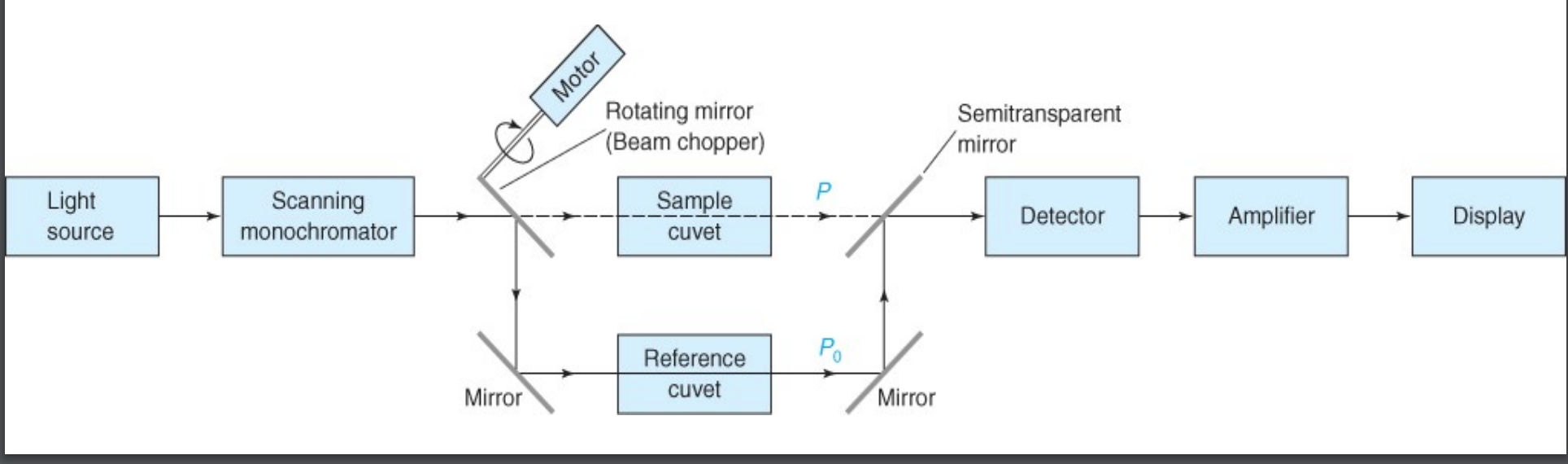
• The beam is alternately sent through the reference and sample cells.
• It is chopped several times a second. • When light passes through the sample, P is measured; through the reference, P0 is measured.
• P is compared to P0, T is obtained and converted to A.
• It can measure absorbance vs time for kinetics well.
• It is chopped several times a second. • When light passes through the sample, P is measured; through the reference, P0 is measured.
• P is compared to P0, T is obtained and converted to A.
• It can measure absorbance vs time for kinetics well.
4
New cards
Tungsten lamp
is an excellent source of continuous visible and near-IR radiation, giving useful radiation in the range 320 to 2500 nm.
5
New cards
Deuterium Arc Lamp
lamp which emits UV radiation from 110 to 400 nm.
6
New cards
360
In a UV-Vis instrument, a change is made between deuterium and tungsten lamps when passing through ___ nm so that the lamp of highest intensity is always used.
7
New cards
silicon carbide glowbar
Infrared radiation (4 000 to 200 cm- 1) is obtained using a ________, which emits approximately the same spectrum as a blackbody at 1000 K.
8
New cards
lasers
give isolated lines of a single wavelength.
9
New cards
laser light
_____ is
1. Monochromatic
2. Extremely bright
3. Collimated
4. Polarized
5. Coherent
1. Monochromatic
2. Extremely bright
3. Collimated
4. Polarized
5. Coherent
10
New cards
population inversion
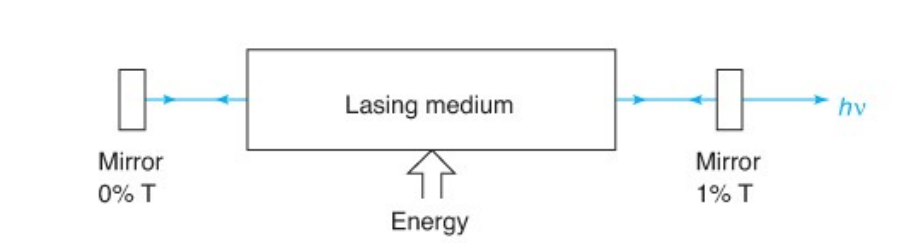
in which a higher energy state has a greater population, n, than a lower energy state in the lasing medium. a necessary condition for lasers
11
New cards
pump energy
is directed through the side of the lasing medium to create the population inversion.
12
New cards
useful output of the laser
The small amount of light passing through the mirror on the right
13
New cards
Monochromator
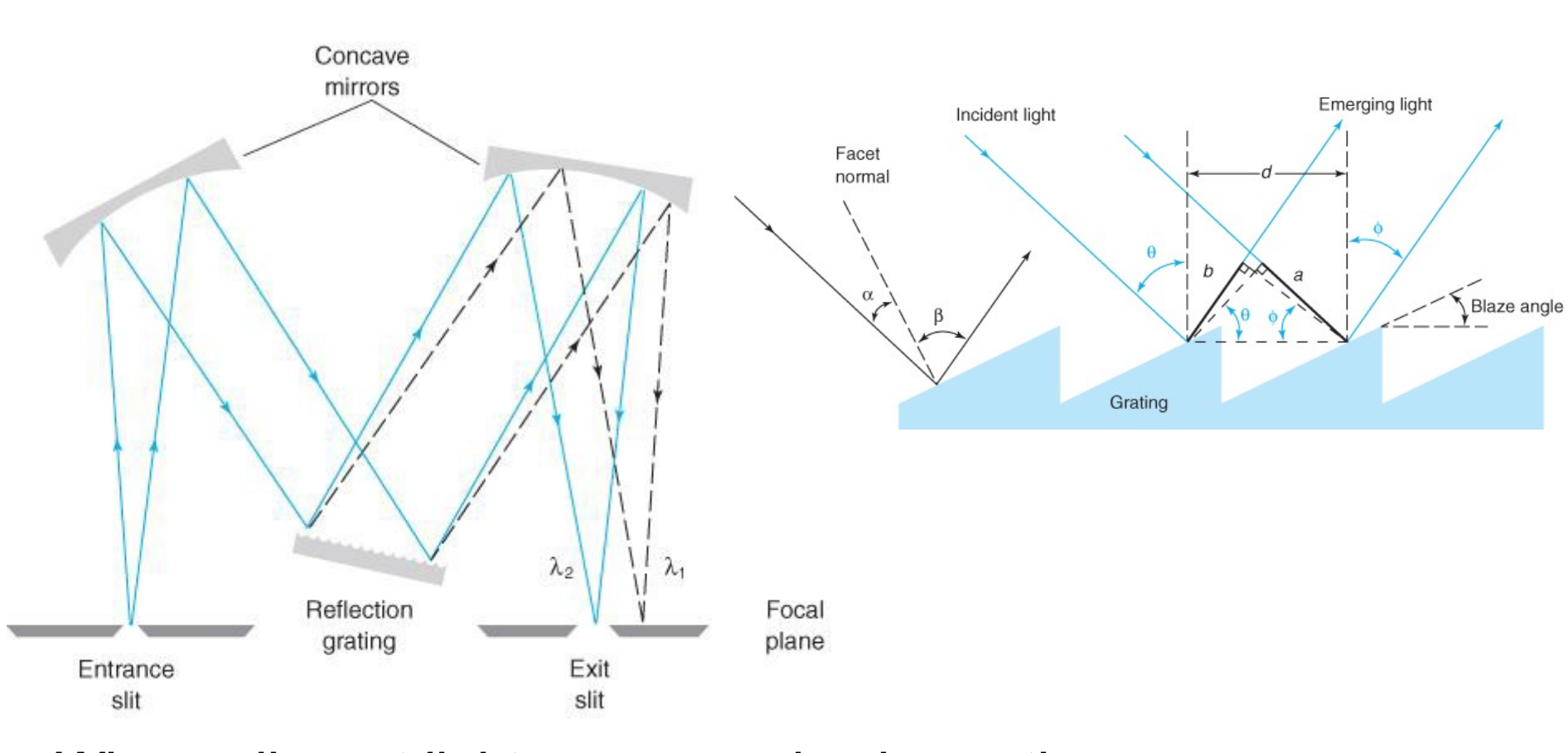
disperses light into its component λ ’s and selects a narrow band to pass on to the sample or detector
14
New cards
reinforce
When adjacent light waves are in phase, they ______ each other.
15
New cards
cancel
When adjacent light waves are not in phase, they partially or completely ____ each other.
16
New cards
Resolution
• ______ measures the ability to separate two closely spaced peaks.
• The greater the ______, the smaller the difference (Δλ ) between two wavelengths that can be distinguished from each other.
• The greater the ______, the smaller the difference (Δλ ) between two wavelengths that can be distinguished from each other.
17
New cards
Resolution of a Grating
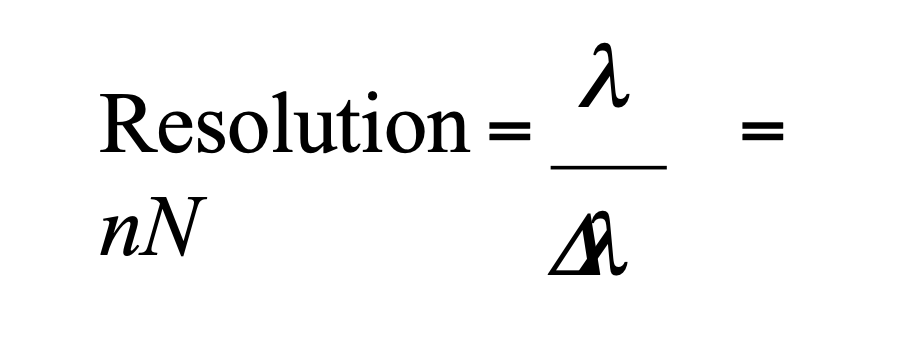
18
New cards
Bandwidth
• To select a narrower band of λ ’s from the monochromator, we decrease the exit slit width.
• A narrower ______ gives better performance.
• Decreasing the exit slit width decreases the selected ______ (wavelengths) and decreases the energy to the detector.
• There is a trade-off between resolution and signal.
• The narrower the exit slit, the greater the ability to resolve closely spaced peaks and the noisier the spectrum.
19
New cards
Relative efficiency
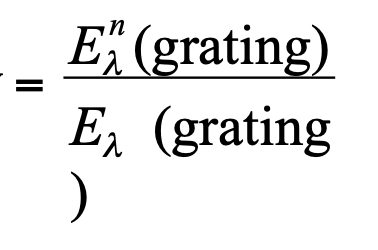
20
New cards
Stray light
– λ ’s outside the bandwidth expected from the monochromator reaches the detector from:
1. Unwanted diffraction orders
2. Outside of the instrument when the sample compartment is not perfectly sealed.
1. Unwanted diffraction orders
2. Outside of the instrument when the sample compartment is not perfectly sealed.
21
New cards
high
Error from stray light is most serious when sample absorbance is ____
22
New cards
Filters
are used to permit only certain bands of λ ’s from passing through.
23
New cards
detector
produces an electric signal when it is struck by photons.
____ response is a function of of incident light.
____ response is a function of of incident light.
24
New cards
photomultiplier tube
contains a photoemissive surface (photocathode) as well as several additional surfaces (dynodes) that emit a cascade of electrons when struck by an electron from a photosensitive area. Very sensitive detector but cannot distinguish different wavelengths.
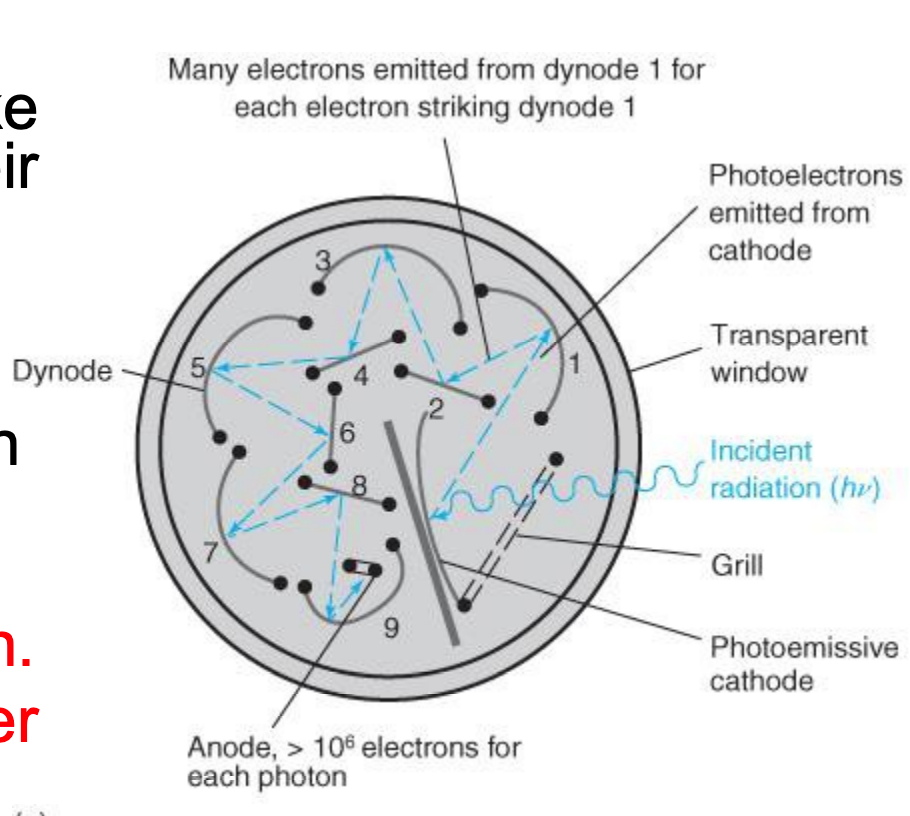
25
New cards
How a detector works
Photon strikes the photosensitive surface and electrons are ejected.
• They are accelerated and strike the dynode with more than their original kinetic energy.
• Each dynode is more positive than the previous. • Each electron causes emission of several additional electrons.
• 106-107 electrons reach the anode for each incident photon.
• Instruments with photomultiplier tube detectors scan through a spectrum one at a time.
26
New cards
photodiode array
is essential for rapid spectroscopy.
• Rows of p-type silicon on a substrate of n-type silicon create a series of pn junction diodes.
• Photons absorbed in the semiconductor create mobile electron-hole pairs.
Don’t need a monochromator
• Rows of p-type silicon on a substrate of n-type silicon create a series of pn junction diodes.
• Photons absorbed in the semiconductor create mobile electron-hole pairs.
Don’t need a monochromator
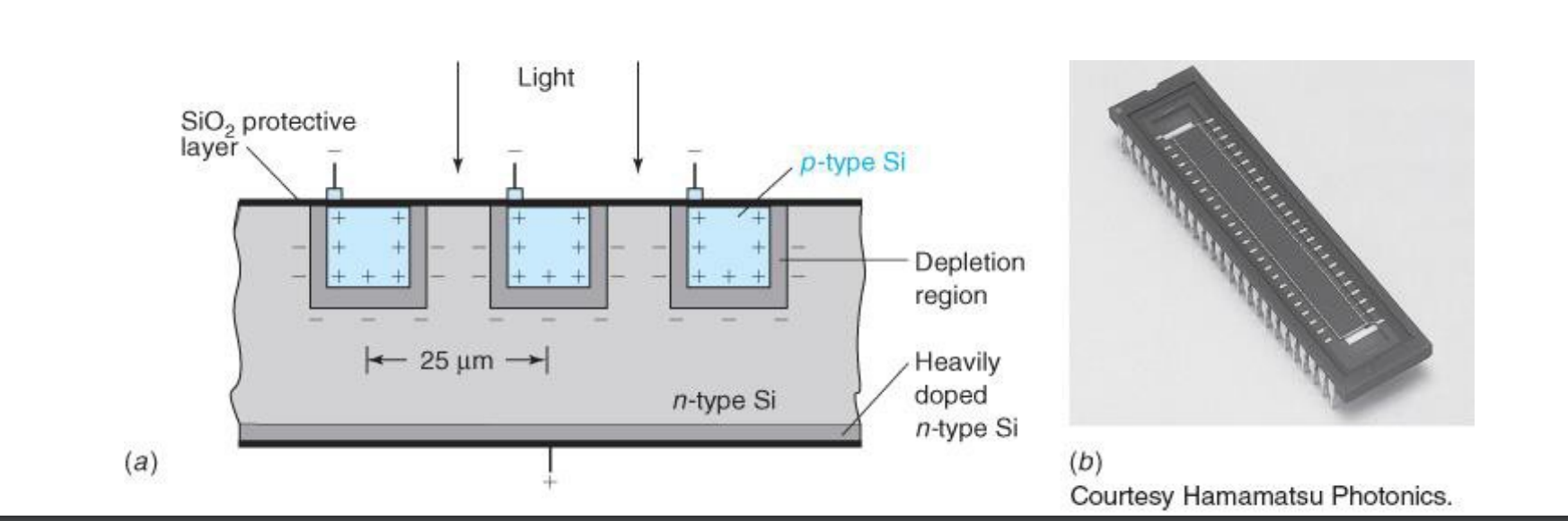
27
New cards
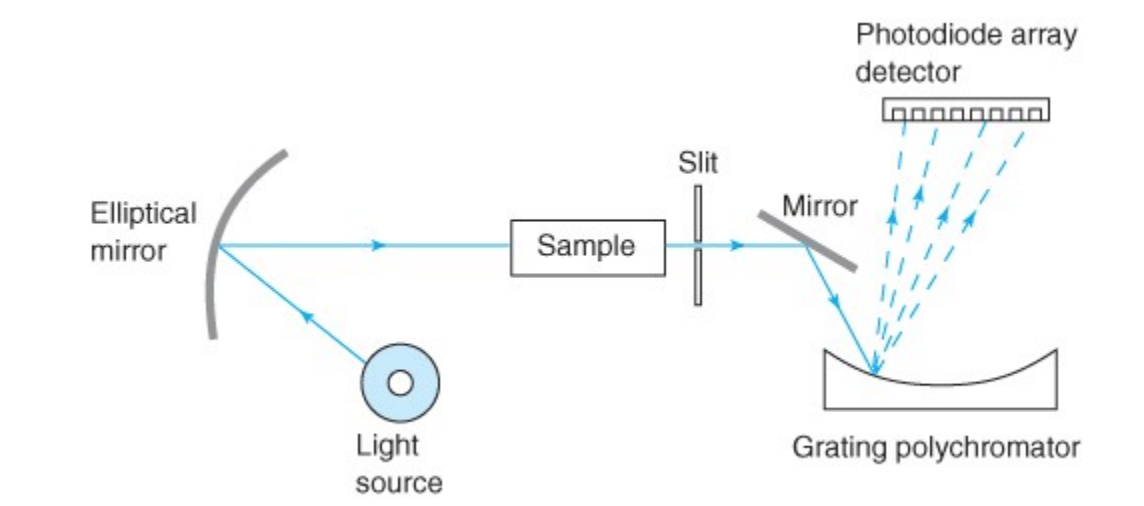
photodiode array spectrophotometer
records the entire spectrum at once in a fraction of a second. Each diode receives a different wavelength.
28
New cards
polychromator
White light is passed through the sample, then a ____ disperses light into its component wavelengths and directs the light at the photodiode array
29
New cards
advantages of photodiode array
• Allow faster spectral acquisition (<1 s) than dispersive instruments, which require several minutes.
• Have almost no moving parts.
• Have almost no moving parts.
30
New cards
disadvantages of photodiode array
• The resolution of \~0.1nm attainable with a dispersive instrument and the wavelength accuracy are better than those of a photodiode array (\~0.5-1.5 nm).
• Stray light is less in a dispersive instrument than a diode array instrument. (less sensitive
• Stray light is less in a dispersive instrument than a diode array instrument. (less sensitive
31
New cards
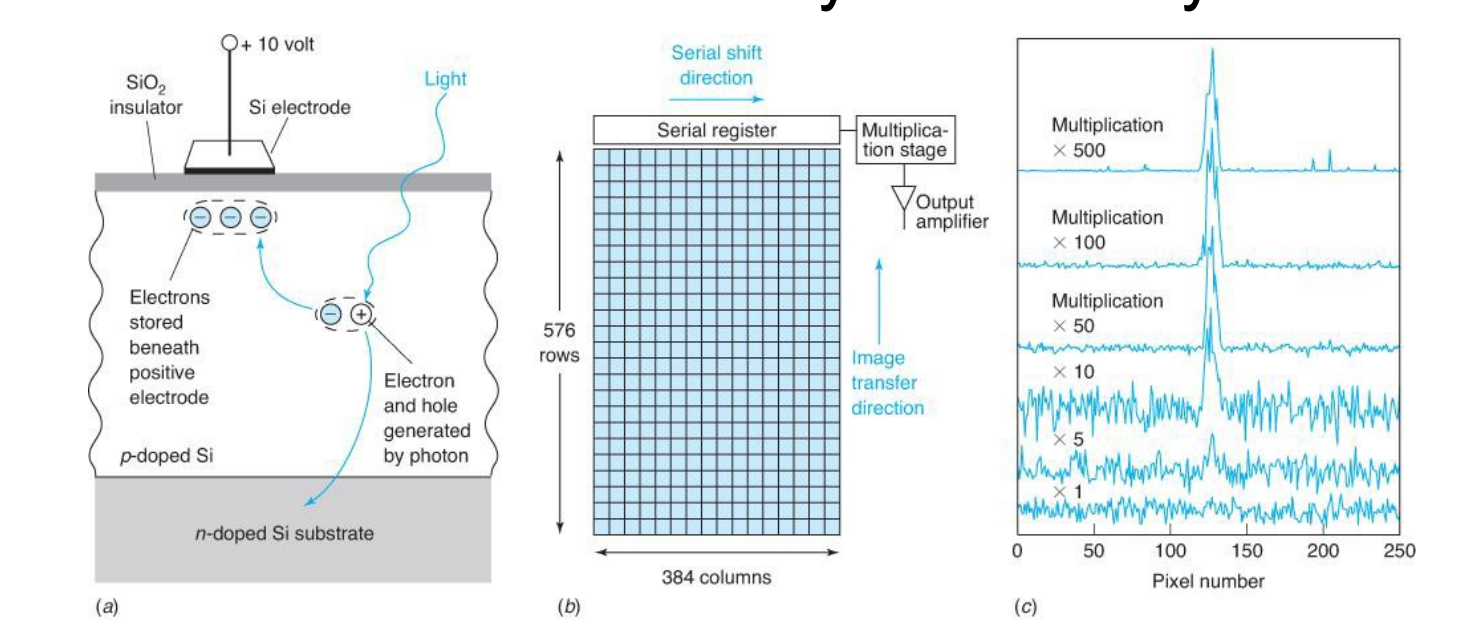
charge coupled device
is an extremely sensitive detector that stores photo-generated charge in a two-dimensional array.
32
New cards
deuterated triglycine sulfate
(DTGS)- infrared detector commonly used in FTIR spectrometers
33
New cards
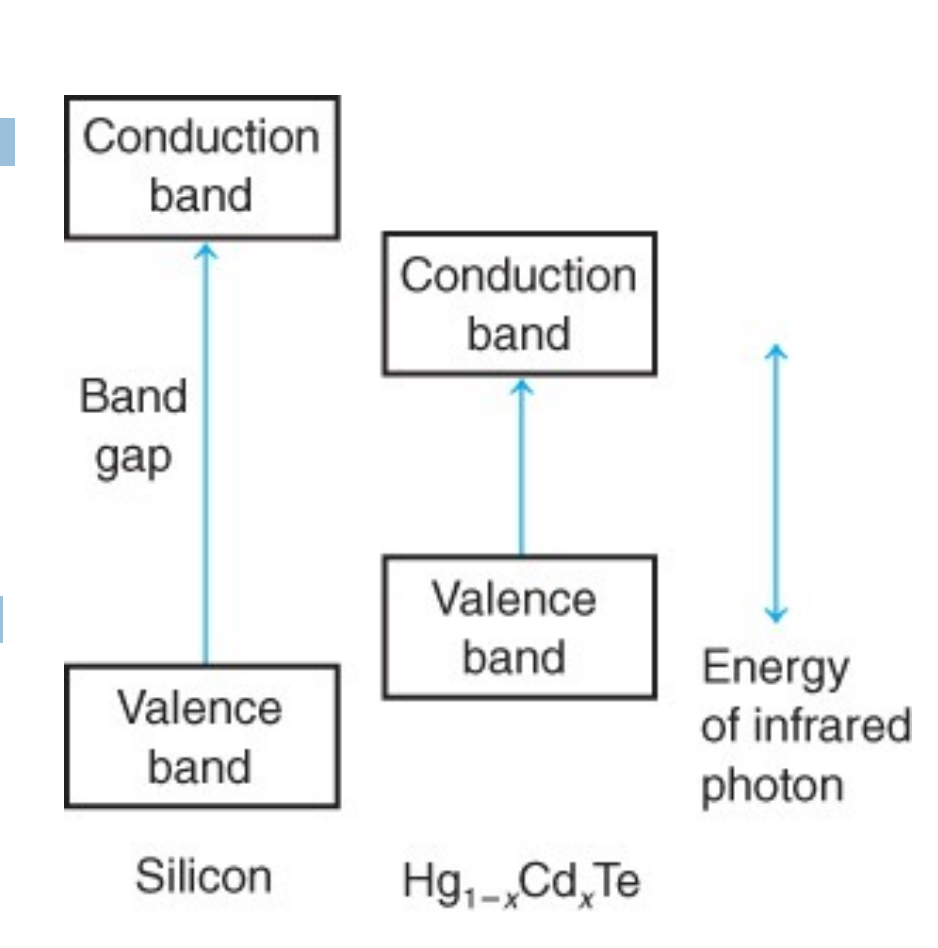
photoconductive detectors
are semiconductors have a small band gap that corresponds to IR energies.
• When they absorb a photon, an electron is excited into the conduction band and collected at an electrode.
• IR – mercury/cadmium telluride (MCT) and NIR – lead sulfide (PbS) and indium antimonide (InSb).
• When they absorb a photon, an electron is excited into the conduction band and collected at an electrode.
• IR – mercury/cadmium telluride (MCT) and NIR – lead sulfide (PbS) and indium antimonide (InSb).
34
New cards
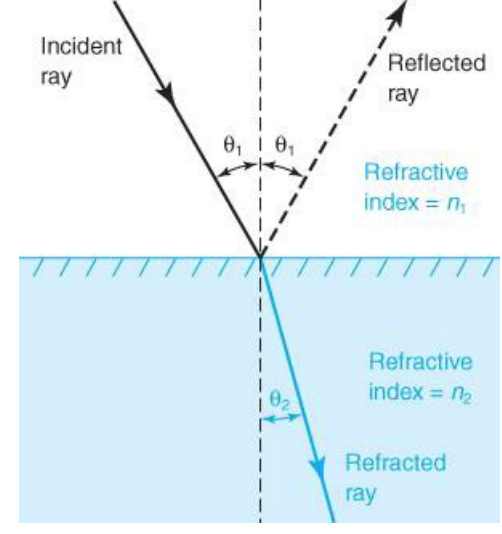
Snell’s law

35
New cards
total internal reflection
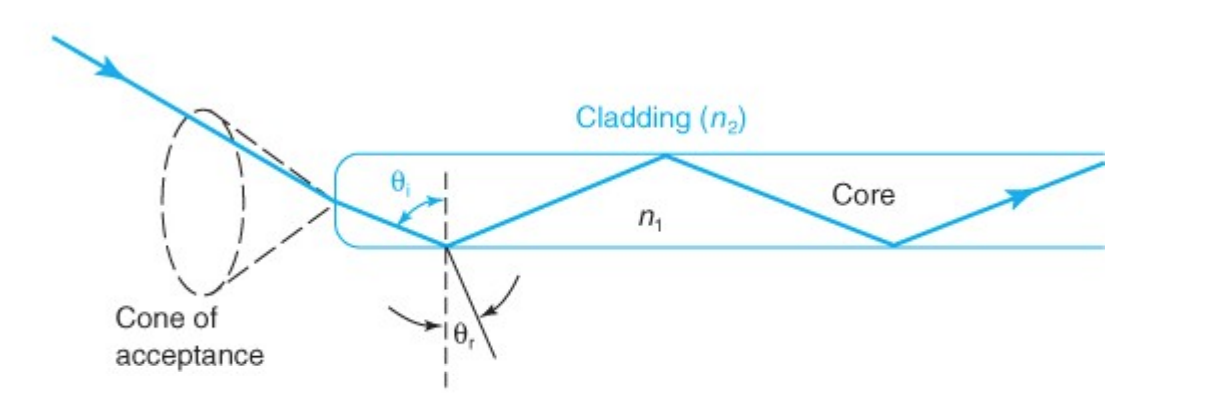
how optical fibers carry light
The fiber has a high-refractive-index transparent core (n1) enclosed in a lower-refractive index transparent cladding (n2):
The fiber has a high-refractive-index transparent core (n1) enclosed in a lower-refractive index transparent cladding (n2):
36
New cards
refracted
When light passes from one medium into another, its path is ____ (bent) and is described by Snell’s law
37
New cards
when n1 > n2
When *___* (core) *>* __ (cladding)

38
New cards
1
If n1/n2 > ___, there is a range of θi in which essentially all of the light is reflected at the walls of the core and none enters the cladding.
39
New cards
Optodes
Optical sensors for specific analytes are made by placing a chemically sensitive layer at the end of a fiber; called _____.
40
New cards
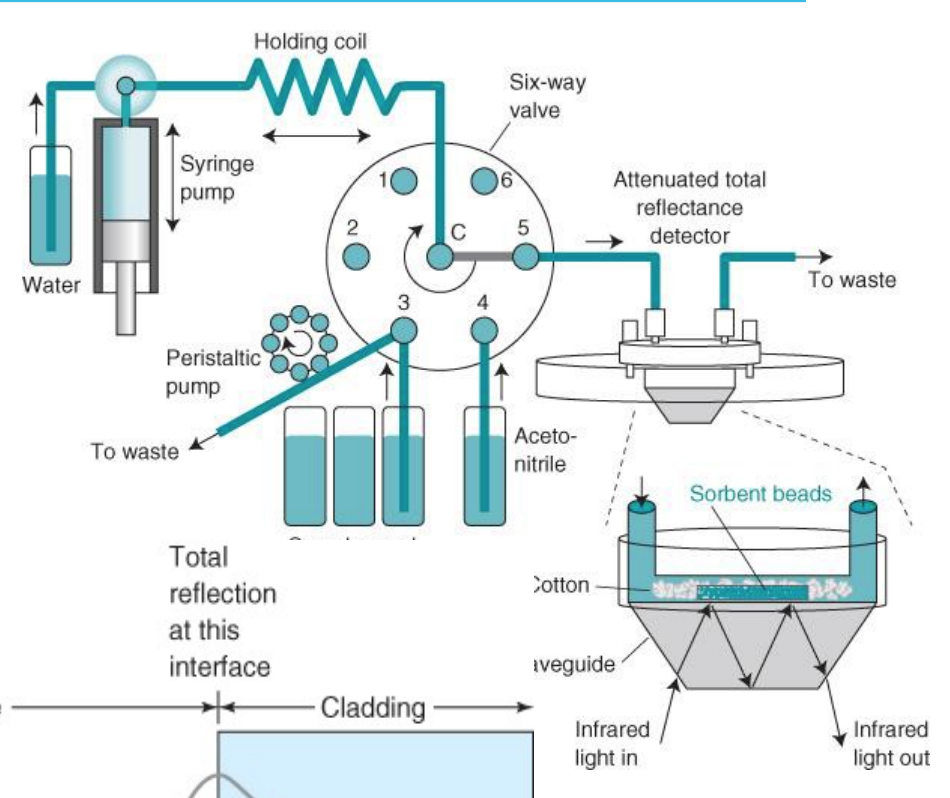
waveguide
A flat material in which light is totally reflected because n1 (material) > n2 (surroundings) is called a ____. Sensors can be made by putting a chemically sensitive layer onto this.
41
New cards
reflected
• The light is totally ____ if θi exceeds θcritical = n2/n1.
42
New cards
evanescent wave
the part of the light that penetrates the wall. Extends into the sorbent beads
43
New cards
Surface plasma wave
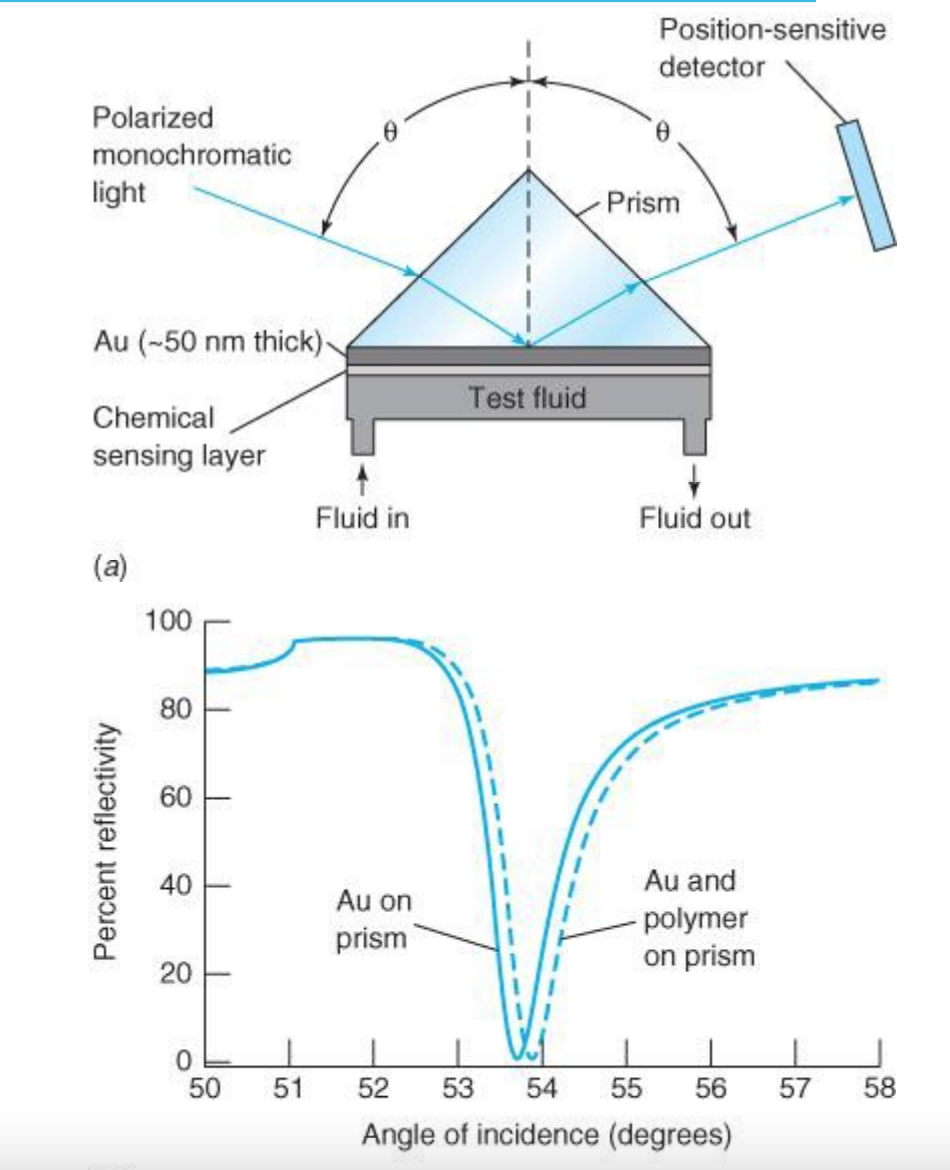
(surface plasmon) propagates along the boundary between a metal and an insulator (dielectric).
44
New cards
root mean square noise
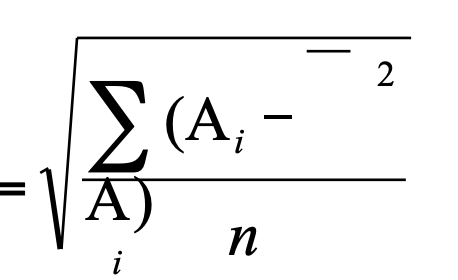
A more common measurement of noise, which requires a digitized signal and a computer, is the _____. It is \~5 times less than the peak-to-peak noise.
45
New cards
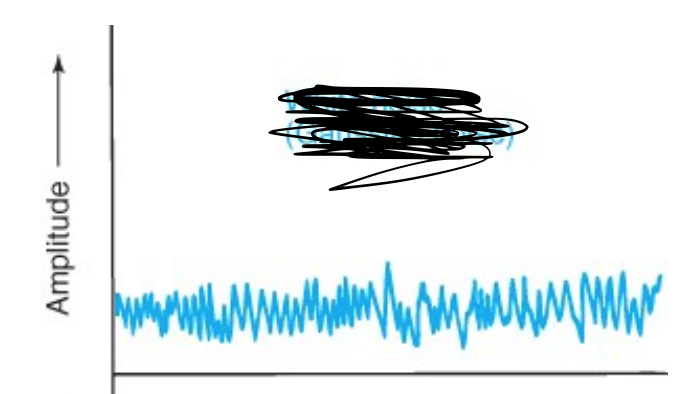
white noise
normal, random, Gaussian noise arises from causes such as random motions of electrons within a circuit
46
New cards
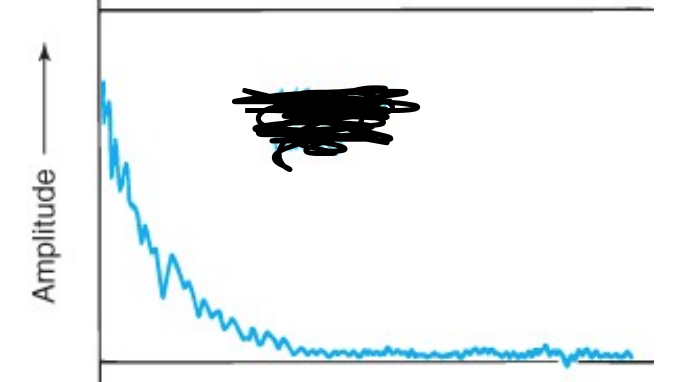
1/f noise
also called drift, greatest at zero frequency and decreases in proportion to 1/ frequency.
47
New cards
line noise
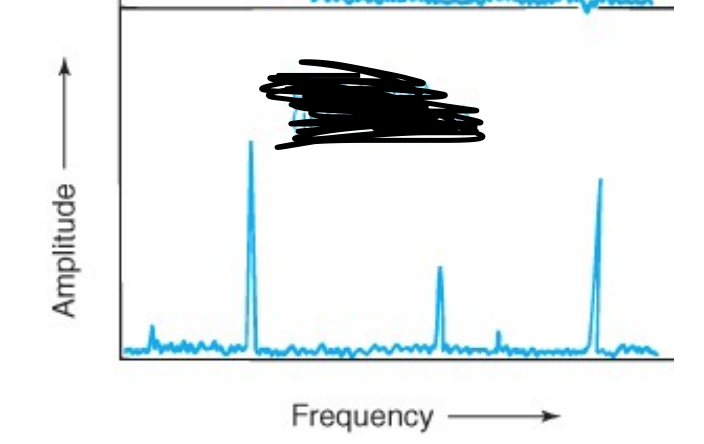
also called interference or whistle noise, at discrete frequencies such as the 60-Hz transmission-line frequency.