Getting Gas to the Patient: Breathing Systems
 Call Kai
 Learn
Learn Practice Test
 Spaced Repetition
 Match
Match Flashcards
 Knowt Play
1/27

Earn XP
Description and Tags
Go to Part 2 PP for diagrams
Name | Mastery | Learn | Test | Matching | Spaced | Call with Kai | Chat |
|---|
No analytics yet
Send a link to your students to track their progress
28 Terms
Define Tidal Volume:
Volume of gas exhaled in 1 breath
10-20 mL/kg
Define Respiratory Minute Volume (minute ventilation):
Volume of gas exhaled in 1 minute
Tidal volume x respiratory rate
≈ 200 ml/kg
What is a rebreathing system?? What are the two different types of rebreathing?
Rebreathing:
Inhalation of previously exhaled gas
Two types:
Rebreathing of exhaled gas from which CO2 has been removed (by an absorbent) is not detrimental
Rebreathing of unchanged exhaled gas leads to build up of CO2 (hypercapnia)
Moderate to severe hypercapnia is detrimental causing catecholamine release, cardiac arrhythmias and acidaemia
Define equipment dead-space:
Volume of breathing system that MAY CONTAIN EXHALED GAS and COULD BE REBREATHED during the subsequent breath

What are the two different arrangements of tubing you could see?
PARALLEL
Side-by-side
COAXIAL
1 tube inside of the other

What is the adjustable pressure limiting (APL) valve in your breathing system?
Your “pop-off” or “expiratory valve”
Provides a means of escape for excess gas, preventing pressure buildup
Connects to scavenging system for disposal of waste gases
“OPEN”: Slight increase in pressure during expiration lifts disc and opens valve
Turn left to open
“CLOSED”: Tension in spring opposes lifting of disc and valve remains closed
Turn right to close
** Valve should always be FULLY open during spontaneous ventilation
Only adjust during intermittent positive pressure (IPPV)

NON-rebreathing systems…
What is their function? What is required for them to perform this function?
Non-rebreathing systems expel CO2 exhaled from the patient, ensuring they don’t inhale it again
Removal of exhaled CO2 depends on an adequate fresh gas flow (FGF)
Each system has a recommended FGF
Using oxygen as carrier gas, then FGF = O2 flow
Oxygen + nitrous oxide (1 part O2 to 2 parts N2O)
Oxygen + medical air (30% O2 & 70% air)
What are the 3 main kinds of non-rebreathing systems?
1) Lack (incl. minilack for patients smaller than 10kg)
2) T-piece
3) Bain
What is the biggest advantage for a non-rebreathing system?
Patient inspires fresh gas
Patient breathes gas of known composition
Anaesthetic depth can be changed rapidly
What are some disadvantages to non-rebreathing systems?
High fresh gas flow (FGF)
Increased cost
Increased potential for environmental pollution
Fresh gas is cold & dry (breathing in REBREATHED air is already warm)
Hypothermia
Respiratory dessication
Not good for a patient with respiratory disease to be constantly breathing in cold air
How would you calculate FGF?
Using mL/kg/min
For example: Calculate FGF required for a 10 kg dog using a Lack
Lack 150-200ml/kg/min
T-piece 400-600ml/kg/min
Bain 200-600ml/kg/min
So then:
FGF = 200 mL/kg/min x 10kg = 2L/min
Doesn’t take into account respiratory rate
May need to adjust flow based on how rapid patient is breathing (go towards the higher end of the range)
How is calculating the FGF not always super accurate?
Normal ventilatory pattern:
Inspiration, expiration & then expiratory pause
Expiratory pause is crucial:
Fresh gas flushes expired gas out of system
If too short there is insufficient time for expired gas to be removed & rebreathing occurs
So increase FGF in patients with rapid respiratory rates
What is one disadvantage to using a Lack system?
NOT suitable for sustained IPPV
Reservoir bag on INSPIRATORY limb
Rebreathing and hypercapnia can develop during prolonged IPPV
Can be reduced (not eliminated) by increasing FGF
Inefficient use of gas
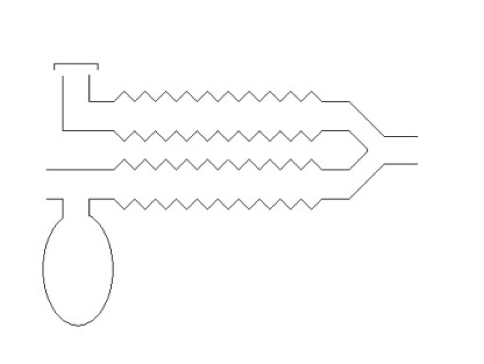
Describe the Ayre’s T-piece system… what are two problems this system has?
Low resistance (no APL valve)
Problems:
No reservoir bag so difficult to observe ventilation
IPPV possible but exposes lungs to high pressure

How has the T-piece system been modified?
Adaptation to facilitate scavenging
Includes closed reservoir bag & APL valve
Called Mapleson D T-piece
For patients UP TO 10kg
FGF of 400-600 mL/kg/min
Now suitable for IPPV

Describe a Bain system…
Either parallel or coaxial (most common)
Damage/disconnection of central tube leads to marked rebreathing
BUT: we can test integrity of inner tube in coaxial Bain
Use for patients 10kg and above
FGF 200-600 mL/kg/min
Suitable for IPPV
Essentially:
Modification of T-piece (FGF 400-600 ml/kg/min) but used in larger patients
Slower respiratory rate
Longer expiratory pause

REBREATHING systems…
How are these different from your non-rebreathing systems?
Exhaled gases are rebreathed after removal of CO2 by an absorbent
Relatively low FGF can be used
Patient inspires a mixture of fresh gas & exhaled gas
Less predictable in terms of how much anesthetic / fresh O2 patient is receiving
What are the advantages of using a rebreathing system?
Lower gas flow
More economical - less O2, N2O and anaesthetic agent used
Less environmental contamination
Gases are warmed and humidified
What are the DISadvantages of using a rebreathing system?
Greater resistance to breathing
Soda lime canister (CO2 absorber)
Unidirectional valves
Unsuitable for small patients due to resistance
Patient inspires a mixture of fresh gas & exhaled gas
Composition of inspired mixture unknown
Anaesthetic vapour
Oxygen (build-up of nitrous oxide)
Slower to alter anaesthetic depth
What is the absorbent that takes care of exhaled CO2 in a rebreathing system?
SODA LIME
80% calcium hydroxide
4% sodium hydroxide
14-20% added water
Indicator dye
pH of soda lime changes, reveals exhaustion
More water produced than consumed
** Newer CO2 absorbents that lack strong bases (e.g. NaOH) are available that don’t interact with sevoflurane to produce compound A (damaging)
What is the relationship between rebreathing systems and fresh gas flow?
High FGF not needed to expel exhaled CO2
Relatively low FGF can be used
FGF used will determine extent of rebreathing
Full (complete) rebreathing
Partial rebreathing
No (minimal) rebreathing
> 200 ml/kg/min (minute volume)
Describe full (complete) rebreathing in regards to FGF…
Oxygen supplied is just sufficient to meet the patient’s metabolic oxygen requirement
Oxygen requirement ≈ 5-10 ml/kg/min
FGF 10 ml/kg/min generally recommended as a safe minimum
No gas exits via the APL valve
Alternative name is “closed” system but do NOT actually close APL valve
Maximal rebreathing occurs
What could be some problems with using a full rebreathing technique?
1) Flowmeters may be inaccurate
2) Vaporisers may be inaccurate
Both may not be calibrated for such a low flow for a 10kg dog
3) Marked dilutional effect
Inspired concentrations of inhalant & oxygen may differ significantly from those set
Slow to adjust anaesthetic depth
Cannot use N2O unless inspired concentration of O2 is monitored
EX: for full rebreathing a 20kg dog requires 200 ml/min of oxygen (= FGF 200 ml/min)
Describe partial rebreathing in regards to FGF…
MOST PEOPLE USE THIS
Oxygen supplied is greater than that required for metabolic O2 consumption but less than the minute ventilation
> 10 ml/kg/min but < 200 ml/kg/min
For convenience a FGF of 1 or 2 L/min is often used
Excess gas spills via APL valve
Alternative name is “semi-closed” system
Partial rebreathing occurs
How does the partial rebreathing technique compare to the full rebreathing technique?
Flowmeters should be accurate
Vaporisers should be accurate
Less dilution effect (though it still occurs)
Easier to adjust anaesthetic depth
N2O can be used (relatively) safely
What are the two different types of rebreathing SYSTEMS?
1) To and fro system
2) Circle system (see image)
Usually for larger patients ( > or equal to 10kg)
These systems can be used in full or partial rebreathing modes depending on the FGF

Compare non-rebreathing systems to rebreathing systems…

What system should you choose for a patient < 10kg? What about 10-15 kg? >15 kg?
<10kg → T-piece or MiniLack
For IPPV → T-piece
10-15kg → Bain, Lack, (Circle)
For IPPV → Bain or Circle
>15kg → Bain, Lack or Circle
For IPPV → Bain or Circle
NB: the larger the dog the less economic non-RB systems become