Trunk and head
 Call Kai
 Learn
Learn Practice Test
 Spaced Repetition
 Match
Match Flashcards
 Knowt Play
1/122

There's no tags or description
Looks like no tags are added yet.
Name | Mastery | Learn | Test | Matching | Spaced | Call with Kai | Chat |
|---|
No analytics yet
Send a link to your students to track their progress
123 Terms
How many total vertebrae are in the spinal column?
24
How many cervical vertebrae are there?
7
How many thoracic vertebrae are there?
12
How many lumbar vertebrae are there?
5
What kind of vertebrae are the sacrum and coccyx?
fused

Vertebral arch
forms posterior margin of each vertebral foramen

Vertebral foarmen
Holes within the vertebrae for the spinal cord and or blood vessels
Vertebral canal
The cavity that contains the spinal cord

Pedicle
Where the body of the vertebrae connect to the posterior arch (walls)/ connects transverse process to the body

laminae
roof of the vertebral arch

Transverse process of vertebra
Projects laterally or dorsolaterally from pedicles and are site of muscle attachment
Spinous process
projects posteriorly from where laminae fuse together (bumps along midline of back)
Articular process
At junction between pedicles and laminae (superior and inferior) and contact one another at articular facets
articular facets
allow adjacent vertebrae to articulate with each other
Superior facets of C1 articulates with ...
occipital condyles
What is C1 called?
Atlas
What is C2 called?
Axis
True or false:
Cervical vertebrae are the most mobile and accessible
True
What do the cervical vertebrae have that the other vertebrae don't and why?
Transverse foramina that protect the blood vessels coming from the brain
What do the 12 thoracic vertebrae articulate with?
12 ribs at costal facets
What amount of movement do the thoracic vertebrae have and why?
Minimal movement to help stabilize the thoracic are and protect internal organs
True or False:
Lumbar vertebrae are the larger and stockier than the other vertebrae
True
Where are the thoracic vertebrae located and what is their function?
Located between the 12th rib and the posterior iliac crest
They support the weight of the upper body
The thorax is made up of what two structures?
Sternum and ribcage
The rib cage consists of what?
Costal cartilage and 12 pairs of ribs
Costal cartilage
Identical to ribs and serves as bridge between them and sternum
Which of the ribs are true ribs (attach to the sternum)?
1-7
Which of the ribs are false ribs (attach indirectly to the sternum via costal cartilage)?
8-12
What kind of ribs are 11-12? Why?
False and floating because they don't attach to sternum or have costal cartilage
What are the parts of the sternum?
Jugular notch, manubrium, sternal angle, body, articulation with ribs, and xiphoid process

What bony landmark is this?
Sternal end of rib

What bony landmark is this?
Head of rib

What bony landmark is this?
Neck of rib
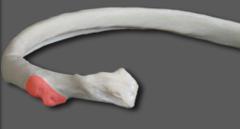
What bony landmark is this?
Tubercle of rib

What bony landmark is this?
angle of rib

What bony landmark is this (closest to sternal end)?
Groove for subclavian artery and vein
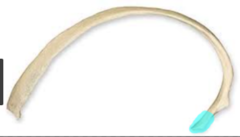
What bony landmark is this?
vertebral end of rib
How many natural curvatures are in the spine
4
Lordotic curve
Cervical and lumbar regions- anterior bends/secondary curves (develop after birth)
Kyphotic curves
Thoracic and sacral- bow posteriorly/ primary curves (present at birth)
When does cervical lordosis develop?
With head control
When does lumbar lordosis develop?
as baby starts to stand and walk
Abnormal lateral curvature of the spine is...?
Scoliosis
True or false:
Muscles of the spine and thorax are situated along the posterior and abdominal regions and create movement of the vertebral column and rib cage
True
The spine and thorax muscles are difficult to isolate why?
They are arranged and composed of numerous bands of dense interwoven fibers so isolating particular portions is difficult
What are the 4 groups of muscles
erector spinae, transversospinalis, splenii, and subocciptals
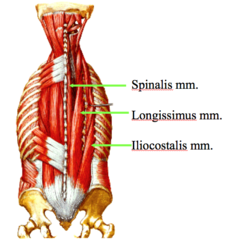
Erector spinae group (I Love Spine- lateral to medial... 1st)
Spinalis, longissimus, iliocostal
What is the origin of the erector spinae group?
Common tendon (thoracolumbar fascia) that attaches to the posterior surface of sacrum, iliac crest, spinous processes of the lumbar, and last two thoracic vertebrae
Insertion of erector spinae group
Various attachments at the posterior ribs, spinous and transverse processes of thoracic and cervical vertebrae and mastoid process of temporal bone
Action of the erector spinae group
Unilaterally: Laterally flex vertebral column to the same side
Bilaterally: Extend the vertebral column
innervation of the erector spinae group
Spinal Nerve

Transversospinalis group
three major branches but deep to erectors (fibers)
Three muscles of transversospinalis group
multifidi, rotatores, semispinalis capitis (link vertebrae together)
Multifidi origin
Sacrum and transverse processes of lumbar through cervical vertebrae
Multifidi Insertion/ span
spinous process of lumbar vertebrae through second cervical vertebrae/ span 2-4 vertebrae
Multifidi Innervation
spinal nerve
Rotatores origin
Transverse processes of lumbar through cervical vertebrae
Rotatores Insertion/ span
spinous processes of lumbar vertebrae through second cervical vertebrae (rotators span 1-2)
Rotatores action
Unilaterally: Rotate the vertebral column to the opposite side
Bilaterally: Extend the vertebral column
rotatores innervation
Spinal nerve
semispinalis capitis origin
Transverse processes of C4-T5
semispinalis capitis insertion
Between the superior and inferior nuchal lines of the occiput
semispinalis capitis action
extend vertebral column and head
semispinalis capitis innervation
Cervical nerve
Splenius Capitis and cervicis origin
Capitis: Inferior one-half of ligamentum nuchae and spinous processes of C-7 to T-4
Cervicis: Spinous processes of T-3 to T-6
Splenius Capitis and cervicis Insertion
Capitis: Mastoid process and lateral portion of superior nuchal line
Cervicis: Transverse processes of C-1 to C-3
Splenius Capitis and cervicis action
Unilaterally:
Rotate the head and neck to the same side
Laterally flex the head and neck to the same side
Bilaterally:
Extend the head and neck
Splenius Capitis and cervicis Innervation
cervical nerve
Qudratus Lumborum Origin
posterior iliac crest
Qudratus Lumborum Insertion
Last rib and transverse processes of first through 4th lumbar vertebrae
Qudratus Lumborum Action
Unilaterally:
laterally tilt (elevate) the pelvis/ laterally flex the vertebral column to the same side (lumbar region)/ assist to extend the vertebral column
Bilaterally:
Fix the last rib during forced inhalation and exhalation
Qudratus Lumborum Innervation
Lumbar plexus Nerve
What are the Abdominals?
rectus abdominis (I), external oblique (\/), internal oblique (/\), transverse abdominis (=)
As a whole what do the abdominals assist in?
Expiration and exhalation
Rectus Abdominis origin
Pubic crest, public symphysis
Rectus Abdominis Insertion
cartilage of 5th-7th ribs and xiphoid process
Rectus Abdominis Action
flexes vertebral column, tilt pelvis posteriorly
Rectus Abdominis Innervation
Spinal Nerves T7-T12
External Oblique Origin
external surface of ribs 5-12
External Oblique Insertion
anterior iliac crest and rectus sheath to linea alba
External Oblique Action
Unilaterally:
laterally flex vertebral column to the same side, rotate vertebral column to opposite side
Bilaterally:
Flex the vertebral column and compress abdominal contents
External Oblique Innervation
Spinal Nerve T8-T12
Internal oblique origin
Lateral inguinal ligament, iliac crest, thoracolumbar fascia
Internal oblique Insertion
Internal surface of lower three ribs, rectus sheath to linea alba
Internal oblique action
Unilaterally:
laterally flex the vertebral column to the same side; Rotate the vertebral column to the same side
Bilaterally:
Flex the vertebral column; Compress the abdominal contents
Internal oblique Innervation
Spinal nerve T8-T12
transverse abdominis origin
lateral inguinal ligament, iliac crest, throacolumbar fascia, and internal surface of lower 6 ribs
transverse abdominis insertion
rectus sheath to linea alba
transverse abdominis action
compresses abdomen contents
upper portion helps dec angle of the ribs as in expiration/ stabilizes linea alba permitting better action
transverse abdominis Innervation
Spinal nerves T8-T12
diaphragm origin
Costal attachment: Inner surface of lower six ribs
Lumbar attachment: Upper two or three lumbar vertebrae
Sternal attachment: Inner part of xiphoid process
diaphragm insertion
central tendon
diaphragm action
Draw down the central tendon of the diaphragm
Increase the volume of the thoracic cavity during inhalation
principal muscle of inspiration (muscle descends)- relaxes during expiration and ascends
diaphragm innervation
Phrenic Nerve
intercostals origin
inferior border of rib above
intercostals insertion
superior border of rib below
intercostals action
External:
Draw the ribs superiorly to assist with inhalation
Internal:
Draw the ribs inferiorly to assist with exhalation
intercostals Innervation
intercostal nerves
Intertransversarii origin
Cervical: Spanning the transverse processes of vertebrae C-2 to C-7
Lumbar: Spanning the transverse processes of vertebrae L-1 to L-5
Intertransversarii Insertion
transverse processes of vertebrae above