Brain y10
 Call Kai
 Learn
 Practice Test
 Spaced Repetition
 Match
 Flashcards
 Knowt Play
1/32

There's no tags or description
Looks like no tags are added yet.
33 Terms
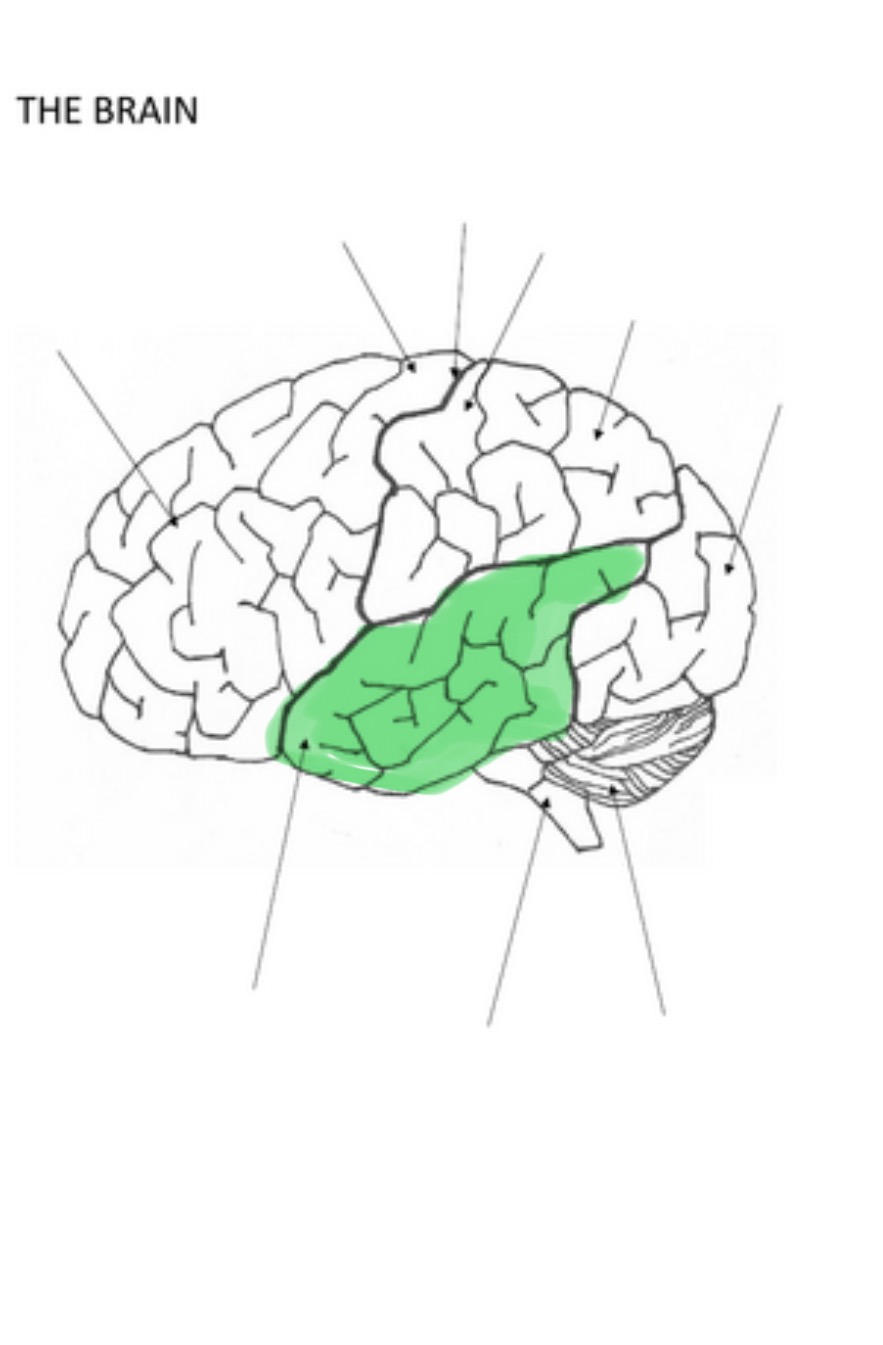
Frontal Lobe
responsible for complex cognitive functions, emotions, and perception (planning day)
Parietal lobe
receives sensory input for touch and body position for spatial awareness (knowing hand position and heat without looking)
temporal lobe
Handles hearing, langauge comprehension, and memory (understanding speech
Occipital lobe
Responsible for visual processing (seeing colours, recognising shape)
Hindbrain
Controls vital survival functions like breathing, heart rate, balance, and coordination
Midbrain
Region between the hindbrain and the forebrain; it is important for hearing and sight. Processes sensory info (turning head toward a loud noise)
Forebrain
Responsible for complex cognitive functions, emotions, and perception; includes the cerebral cortex. (solving maths problem)
Cerebral cortex
Outer layer of the forebrain, involves complex mental abilities like perception, memory, language, thinking, and problem solving, processes sensory information and plans voluntary body movements; handles thinking, reasoning, planning, memory, language, and perception. (writing an essay)
Medulla
hindbrain structure that controls automated processes like breathing, blood pressure, and heart rate
Pons
hindbrain structure that connects the brain and spinal cord; involved in regulating brain activity during sleep
Cerebellum
A large structure of the hindbrain that controls fine motor skills.
Thalamus
A forebrain structure that processes sensory information for all senses, except smell, and relays it to the cerebral cortex.
Hypothalamus
forebrain structure that hunger, thirst, body regulation
Limbic system
A group of structures in the forebrain that regulates emotion, motivation, and memory.
Broca’s area
Generally in the left hemisphere, responsible for production of articulate speech, involved with coordinating movements of the muscles required for speech
If damage —> Broca’s aphasia
Wernicke’s area
Generally in the left hemisphere, comprehension of speech/ language, interpretation of written word, locates words from memory to express meaning, creates meaningful and/or grammatically correct speech
Damage —> Wernicke’s aphasia
Cerebrum
Outer cerebral cortex,
Corpus Callosum
Band of approx 200 mill nerve fibres
Connects both hemispheres of brain
Main function is to enable transfer of info from one hemisphere to another
Gap between hemisphere - longitudinal fissure
Left hemisphere
Verbal functions:
Recognition & use of words
Reading, writing, speaking, understanding speech
Analytical functions:
Breaking down task into parts and logical sequential way (mathematical formula, recipe)
Right hemisphere
Non verbal functions:
creativity, fantasy, spatial and visual thinking, recognising faces, patterns, and tunes
Appreciating music and art (not necessarily making)
Recognising emotions from facial cues

Where is the frontal lobe?


Where is the parietal lobe?


Where is the temporal lobe?

Where is the occipital lobe?


Where is the cerebellum?


Where is the forebrain?


Where is the cerebral cortex?


Where is the hindbrain?


Where is pons?


Where is the medulla?


Where is the midbrain?


Where is Wernickes area?


Where is Broca’s area
