PSY389 LECTURE 2: Social Learning Theory
 Call Kai
 Learn
 Practice Test
 Spaced Repetition
 Match
 Flashcards
 Knowt Play
1/18

There's no tags or description
Looks like no tags are added yet.
19 Terms
Social learning theory: Arises from Behaviourism (John B. Watson)
Psychology should study observable behaviours using objective scientific methods.
Human and animal behaviour can be explained through stimulus–response (S–R) associations.
Behaviour is shaped by environmental influences and conditioning.
Internal mental processes (e.g., thoughts, consciousness) are not necessary to explain behaviour.
Famous (and controversial) example: Little Albert experiment demonstrating conditioned fear.
Social learning theory: From Behaviourism to Learning Theory: The Role of Consequences
Focusing on how behaviours are acquired and modified through experience.
Edward Thorndike demonstrated that cats learned to escape puzzle boxes through trial-and-error learning.
Behaviours followed by satisfying consequences became more likely to occur again (Law of Effect).
B.F. Skinner expanded this idea into operant conditioning, showing that behaviours are strengthened or weakened by their consequences (reinforcement and punishment).
Key concept:
Behaviours followed by rewards are strengthened and become more likely to occur in the future.
Social learning theory: From Learning Theory to Social Learning Theory
In the 1960s, Albert Bandura expanded learning theory by proposing Social Learning Theory (SLT).
Bandura argued that people can learn by observing others, not only through direct reinforcement or punishment.
SLT later developed into Social Cognitive Theory (SCT), incorporating the role of cognitive processes in learning.
SLT/SCT proposes that learning occurs through reciprocal interactions between:
Personal factors (e.g., thoughts, beliefs, expectations)
Behaviour
Environment
Key concept:
People are active participants in their own learning, influencing and being influenced by their social environment.
The A → B → C Model: Behaviour is Shaped by Consequences
A — Antecedent
A stimulus, cue, or trigger that occurs before a behaviour.
Sets the occasion for a behaviour to occur.
B — Behaviour
The observable action or response.
C — Consequence
The outcome that follows a behaviour.
Determines whether the behaviour is likely to occur again.
Key concept
Behaviours followed by reinforcement (rewarding consequences) are more likely to be repeated.

Positive Reinforcement
A behaviour increases because it produces a rewarding or pleasurable outcome
Examples:
Alcohol use → feelings of pleasure, relaxation, or euphoria \
Drug use → intense reward (“rush”/high) • Using substances → increased confidence or sociability
Cannabis use → pleasurable sensations or altered mood
Stimulant use (e.g., cocaine/amphetamine) → increased energy, alertness, or excitement
Key idea:
“I use because it makes me feel good.”
Negative Reinforcement
A behaviour increases because it removes or reduces an unpleasant experience
Examples:
Alcohol use → reduces anxiety, stress, or social discomfort
Drug use → temporarily reduces negative emotions (e.g., sadness, distress)
Opioid use → relieves physical pain
Alcohol or drugs → reduces withdrawal symptoms (e.g., nausea, agitation, cravings)
Substance use → provides relief from trauma-related distress or intrusive thoughts
Sedative use → reduces insomnia or difficulty sleeping
Key idea:
“I use because it makes me feel less bad.”
Cognitive Processes in Social Learning Theory
Unlike traditional conditioning models, Social Learning Theory (SLT) proposes that behaviour is not determined only by stimulus–response associations.
Behaviour is influenced by:
What we have learned about a situation
Our expectations about outcomes
The perceived value of those outcomes
These cognitive processes influence how we interpret situations and make behavioural choices.
Key Difference from Conditioning
Conditioning: Behaviour is shaped primarily by external stimuli and consequences.
SLT: Behaviour is shaped by learning, expectations, reinforcement value, and cognitive processes.
Outcome Expectancies and Substance Use
People’s expectations about the effects of substances can influence their likelihood of using them:
Negative outcome expectancies (e.g., “Alcohol will make me feel worse” / “Drug use has harmful consequences”)
→ Lower likelihood of substance use
Positive outcome expectancies (e.g., “Alcohol helps me relax” / “Drugs make me feel confident”)
→ Higher likelihood of substance use
Multiple factors lead to the initiation and subsequent levels of alcohol use, cessation, and resumption
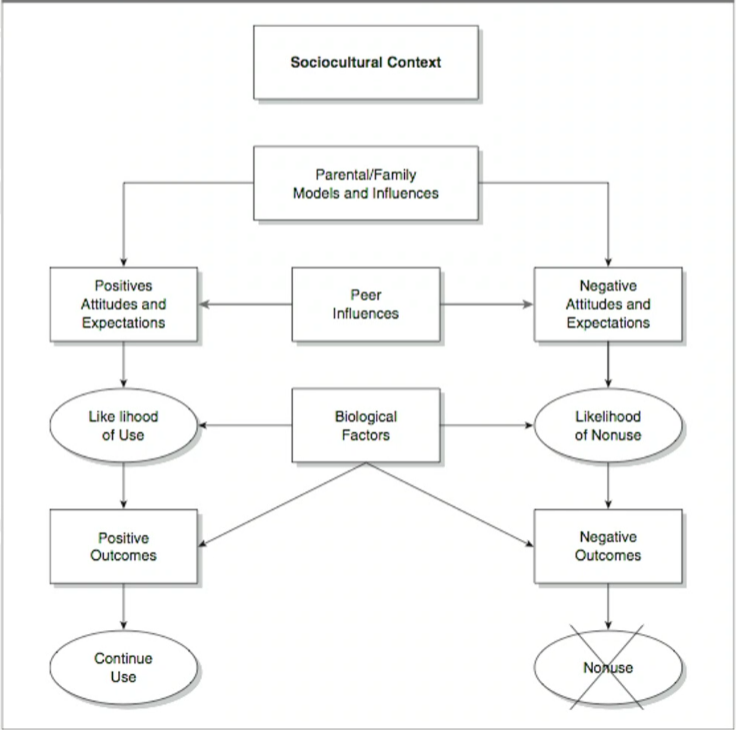
Expectancy Questionnaire (AEQ)

Social Learning Theory & Dependence (Hodgson and Stockwell, 1986) Key Assumptions of Social Learning Theory
Drug use is:
Normal
→ Many people use substances
Functional
→ Serves a purpose (e.g., pleasure, coping, relief from distress)
Learned (socially influenced)
→ Shaped by peers, culture, and expectations about substance effects
Key idea:
Substance use is not random; it is a learned behaviour maintained by its perceived benefits.
Drug use is normal - Substance use across cultures
Psychoactive substances have been used throughout history for social, cultural, religious, medicinal, and recreational purposes.
Opium – Asia and worldwide
Tobacco – worldwide
Coca leaves – Indigenous Andean cultures (South America)
Betel quid (betel leaf and areca nut) – South and Southeast Asia
Khat and hashish – parts of Africa and the Middle East
Kava – Pacific Island cultures
Cannabis – worldwide
LSD and ecstasy (MDMA) – Western cultures and beyond
Key message:
Substance use is a common human behaviour, but the substances used and their meanings vary across cultures.
Drug use is functional - Drug use serves a function
Provides desired outcomes (e.g., pleasure, relaxation, increased confidence)
Helps manage unwanted experiences (e.g., stress, negative emotions, withdrawal symptoms)
The function of drug use varies depending on individual characteristics, environmental factors, and expectations
Key message:
People use substances because they perceive them as serving a purpose or meeting a need in their lives.
Drug use is learned
Learned through social and environmental influences (e.g., peers, family, media, cultural norms)
Learned through personal experiences (e.g., using alcohol to reduce stress or anxiety)
Associations develop between substances and specific situations (e.g., drinking with friends at a local pub)
Repeated use strengthens learned behaviours, leading to:
Tolerance (needing more substance to achieve the same effect)
Withdrawal symptoms when use stops
Increased use to relieve withdrawal symptoms (negative reinforcement)
Over time, learned patterns can develop into compulsive substance use
Key message:
Substance use is not simply a choice—it is a behaviour shaped and strengthened through learning experiences
Learned Habits Can Become a Compulsion - When learned habits become compulsive
Negative consequences may outweigh benefits, leading some people to reduce or stop use
e.g., hangovers, health problems, relationship conflict, financial or social consequences
For others, immediate benefits outweigh long-term costs, so substance use continues
e.g., relief from stress, anxiety, frustration, or pain
Approach–avoidance conflict develops:
Wanting to use because of perceived benefits
Wanting to stop because of negative consequences
This internal conflict can contribute to compulsive substance use
Key message:
Substance use can shift from a learned behaviour to a compulsive pattern when immediate rewards continue to outweigh delayed consequences.
Support for Social Learning Theory
Social influences shape substance use
Peer and parental substance use can influence an individual’s drug use behaviours
Children may model drinking behaviours observed in their environment
Expectancies influence substance use
Positive expectations about substances → higher levels of use
Negative expectations → lower levels of use
Substance use is not fixed
People can regulate, reduce, or stop substance use (natural remission can occur)
Learned drug-use behaviours can be unlearned
Self-efficacy influences change
Confidence in one’s ability to control use is important in both developing dependence and recovery
Treatments target expectancies, self-efficacy, and behavioural control skills
Key message:
If substance use is learned through social and cognitive processes, it can also be changed through new learning experiences.
Gossop (2013) - The Social Context - Robins’ (1993) study
1. American soldiers became addicted to heroin during their time in Vietnam because of the:
➢Availability of heroin in VN
➢Psychological needs
➢Social influence/pressure
2. Many soldiers used heroin but they were not addicted to it (not everyone becomes addicted)
3. Some soldiers, who were addicted in VN, recovered without any treatment when they returned home (recovery can occur naturally)
4. These findings challenged some of the myths relating to heroin as a drug and heroin addiction.
Gossop (2013) The Social Context - Cultural/religious reasons
Ecstasy (means ‘flight of the soul from the body’ in Greek): religious visionaries and supernatural experience
Mescaline in peyotes cactus used by the Aztecs as the ‘divine messenger’, and by various Native American tribes as a sacrament in their religious service
Kava (plant root) – used for social and religious ceremonies by South Pacific islanders (e.g. Tonga, Fiji, Samoa)
Cannabis – used by Hindu and Ethiopia Zion Copic Church as religious sacrament
LSD - The Hippies in the 1960’s used LSD to obtain hallucinogenic and psychedelic effects and as a sacrament in their culture.
Gossop (2013) The Social Context - Lack of cultural experience and guideline for alcohol use has led to pronounced alcohol abuse in some indigenous groups:
The Native Americans:
Use of peyotes for religious reasons was in control for centuries
Alcohol was made available to them by white settlers without guidance
The Inuits (Eskimos)
Had no cultural experience with alcohol
No guideline for alcohol use when alcohol was introduced to them
The Australian indigenous
Had no experience with alcohol prior to the arrival of white settlers
Learned the cultural norm of excessive drinking and associated antisocial behaviours from the white settlers (primarily cattlemen)