anatomy female urogenital
 Call Kai
 Learn
Learn Practice Test
 Spaced Repetition
 Match
Match Flashcards
 Knowt Play
1/69

There's no tags or description
Looks like no tags are added yet.
Name | Mastery | Learn | Test | Matching | Spaced | Call with Kai | Chat |
|---|
No analytics yet
Send a link to your students to track their progress
70 Terms
vulva
external female genitalia
Mons pubis
fatty area overlying pubic symphysis

prepuce of clitoris
hooded skin fold of the clitoris formed by the junction of the labia minora folds

Labia minora
folds of skin on each side of vaginal vestibule, cover the top of clitoris as the prepuce, have no hair follicles, but sebaceous follicles (oil/sweat glands)

labia majora
thick fold of skin forming lateral boundary of vaginal vestibule, sebaceous glands medially, have hair follicles laterally

vaginal orifice
the exterior opening of the vagina, enclosed by labia minora

vaginal vestibule
contains external openings of vagina and urethra enclosed by labia minora

external urethral orifice (female)
between vaginal orifice and clitoris

greater vestibular glands (Bartholin glands)
inferior to the vestibular bulb; secrete mucus to lubricate the labial opening of the vagina

Lesser vestibular Glands/ paraurethral glands
(Skene's) - network of glands around the inferior portion of the urethra that secrete a fluid similar to that secreted by the prostate

Ischiocavernosus m.

Bulbospongiousus m.

Vestibular (clitoral) bulb
positioned on each side of the vaginal canal, upon erection they constrict the urethra and prevent micturation
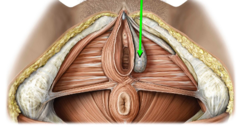
Deep transverse perineal muscle
Supports pelvic organs; steadies central tendon

superficial transverse perineal m.
stabilizes perineal body

clitoris
pyramid-shaped mass of erectile tissue. Gemale homologue of the penis.

glans clitoris
non-erectile densely innervated structure at the tip of the body

crus of clitoris
legs of the clitoris, extended along each pubic ramus

ovaries
endocrine glands that produce the egg cells and hormones

suspensory ligament
anchors ovary laterally to pelvic wall, contains ovarian artery and vein.

proper ovarian ligament
anchors ovary medially to uterus

ovarian follicles
Areas within the ovary in which individual eggs develop
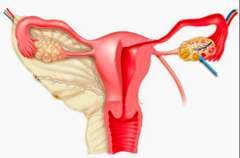
uterine (fallopian) tubes
pair of tubes attached to the uterus that provides a passageway for the ovum to move from the ovary to the uterus

fimbriae
create currents to carry the oocyte into the uterine tube

isthmus of uterine tube
the narrowest part of the uterine tube immediately adjacent to the uterus

infundibulum
cilated fimbriae which move the egg into the tube.

Ampulla
normal site of egg fertilization

fundus of uterus
Most superior & widest portion of uterus, attachment point of isthmus of uterine tubes

uterine cavity
Interior of the body of the uterus

body of the uterus
superior and is 2/3 of uterus

cervical canal
a spindle-shaped canal extending from the uterus to the vulva

cervix of the uterus
"neck" of uterus, projects into vagina. Cervical glands secrete mucus that covers the external os and block sperm entry except during midcycle, and secretes alkaline fluid supportive of sperm.
1/3 of uterus.

internal os of cervix
superior opening into cervical canal, open up during child birth.

external os of cervix
inferior opening of cervix

uterine position
Anteverted and anteflexed, can be retroflexed and/or retroverted

flexion of the uterus
The angle between the cervix and the body

version of the uterus
angle between cervix and vagina

uterine wall layers outermost to innermost
1. Perimetrium
2. Myometrium
3. Endometrium

Perimetrium
outermost serous layer; the visceral peritoneum
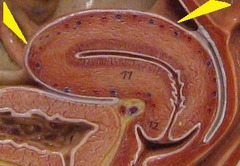
myometrium
middle layer; interlacing layers of smooth muscle

endometrium
innermost mucosal lining of the uterine cavity
-stratum functionalis
-stratum basalis

stratum functionalis of the endometrium
has cyclic changes in response to ovarian hormones, sheds during menstruation—when blood vessels close off the tissue undergoes necrosis
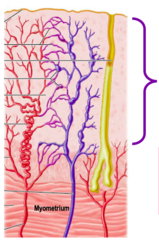
stratum basalis of endometrium
deep thin layer, permanent, stem cells give rise to stratum functionalis

menstrual cycle phases
menstrual phase, proliferative (follicular) phase, secretory (luteal) phase
menstrual phase
days 1-5, uterus sheds all but the deepest part of the endometrium

proliferative (follicular) phase
days 6-14, endometrium rebuilds ovulation/fertilization can occur.
Secretory (luteal) phase
days 18-28, endometrium prepares for implantation of the embryo on the way down the tube. if no embryo the uterus sloughs off.
uterosacral ligament of uterus
connects uterus to sacrum

broad ligament of uterus
sheet-like peritoneal fold; supports the uterine (fallopian) tubes, uterus and vagina and encloses the ovarian ligament

round ligament of uterus
dense connective tissue analogous with the vas deferens running from uterine tube, through inguinal canal, into labia majora

rectouterine pouch
reflection of peritoneum between uterus and rectum

vesicouterine pouch
reflection of peritoneum between uterus and bladder
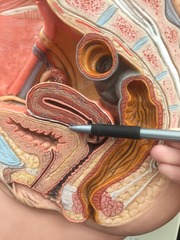
vagina
internal female genitalia, distensible musculomembranous tube, usually collapsed.
•The canal for menstrual fluid
•The inferior part of the birth canal
•Receives the penis and ejaculate during intercourse
•Relatively low pH to protect against microorganisms

vaginal canal
fibromuscular tube opening externally into the vaginal vestibule and extending to the cervix

anterior fornix
extension of vagina in front of the cervix toward the vesicouterine pouch

posterior formix
extension of vagina behind the cervix toward the rectouterine pouch

homologous structures in male/female

menopause
the time of natural cessation of menstruation; also refers to the biological changes a woman experiences as her ability to reproduce declines, at around age 35 degeneration quickens, from ages 46-54 this process usually occurs.
•Reproductive organs and breasts atrophy
•Vagina can become dry causing painful sex and increased risk of vaginal infections
•Skin thins and bone mass declines
•May see elevations in blood cholesterol in
postmenopausal women
urinary tract infection (UTI)
•Most common in sexually active anatomic females due to bacteria from the vagina, anus, and external genitalia entering the urethral opening
•In elderly the cause is typically due to bladder weakness, incontinence, or urine retention
•S/S: burning/painful urination, increased urgency and frequency, fever, back pain (if progressed to the kidneys), and mental changes in elderly.
tubal sterilization
the permanent, surgical method of birth control, can be performed laparoscopically or during a cesarean section

uterine fibroids
Benign tumors (myomas) of the uterine muscular wall
They cause pelvic pain, heavy menstrual bleeding, and put pressure on the bladder
Risk factors: family hx, obesity, early onset puberty
Treatment: medications (birth control, homones), IUD, surgery

ovarian cysts
-Very common (8-18%)
-Fluid-filled remnants of follicles
-Usually benign
-Can cause pain and bleeding, menstrual irregularities, painful intercourse, irregular bowel movements
-Most frequent during childbearing years
-Treatment: medications, surgery

pelvic organ prolapse
descent of the uterus or bladder into the vagina, depending where it is determines its name, can be scaled on severity.

uterine prolapse
downward displacement of the uterus into the vagina

incontinence
inability to control bladder and/or bowels
female reproductive system cancers
ovarian, endometrial (uterine), cervical (HPV)
ectopic pregnancy
Most common site for ectopic pregnancy is in the uterine tube at the ampulla, but any implantation outside the body of the uterus is considered ectopic. lead to severe hemorrhaging and infection potential.

hypersectomy
Removal of uterus, either through the anterior abdominal wall or through the vagina.
Used to treat uterine, cervical, ovarian cancers, remove fibroids, treat endometriosis, in cases of severe postpartum bleeding, etc.

feminizing lower surgeries
orchiectomy - removal of testes
vulvoplasty- creation of vulva
vaginoplasty - creation of neovagina using donor tissue from penis and scrotum.
masculinizing lower surgeries
hysterectomy w/ salpingo-oophorectomy - removal of uterus, ovaries, and fallopian tubes
metoidioplasty - creation of a neopenis by releasing the clitoris and creating a penile shaft with donor vulvar tissue.
phalloplasty - creation of neopenis and scrotum using tissue grafts from the forearm, thigh, or back and vulvar tissues.