BIO261 Lab Practical 1
 Call Kai
 Learn
 Practice Test
 Spaced Repetition
 Match
 Flashcards
 Knowt Play
1/166

Earn XP
Description and Tags
Covers Ch. 1 - 6 (Cell structure and function, Homeostasis and pH, Reflexes and sensory Reception, Osmosis and diffusion, Intro to Powerlab, Skeletal muscle la
167 Terms

Familiarize yourself with the parts of a microscope (type “Done” when you’re finished)
Done

Which part of the microscope allows you to look through the lens and magnifies 10x?
Ocular

Which parts of the microscope adjusts the light intensity?
Iris Diaphragm Lever
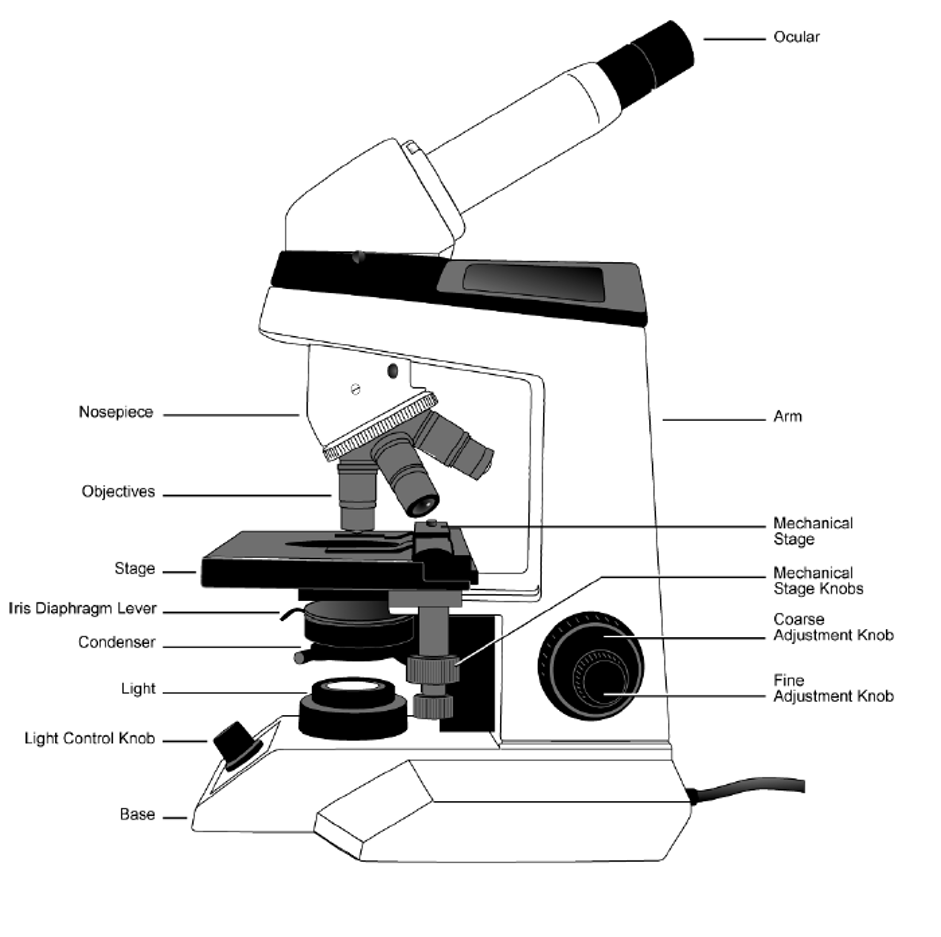
Which knob on a microscope should you use first to focus?
Course Adjustment Knob
Which knob on a microscope should you use to sharpen the image?
Fine Adjustment Knob
True or False: Red blood cells contain hemoglobin
True
True or False: Red blood cells are surrounded by a cell membrane
True
True or False: The shape of a red blood cell is described as a biconcave disk
True
True or False: The function of red blood cells is to protect a person from infectious diseases
False
True or False: Mature red blood cells contain a nucleus
False
True or False: You should first bring a microscope sample into focus under low power
True
For the “Cell Structure and Functions” lab, what is the first step we have to do?
Use a toothpick to gently scrape the inside of your cheek
For the “Cell Structure and Functions” lab, what substance do we use to stain our cheek cells?
1 drop of methylene blue
Do cheek cells (stratified squamous epithelium) have a nucleus and other cellular structures? What can be picked up?
Yes (nucleus, cytoplasm, cell membrane)
Which cell is filled with hemoglobin?
A) Red blood cell
B) Cheek cell
C) This is true of both cells
A) Red blood cell
Which cell is surrounded by a selectively permeable membrane?
A) Red blood cell
B) Cheek cell
C) This is true of both cells
C) This is true of both cells
Which cell has no nucleus when mature?
A) Red blood cell
B) Cheek cell
C) This is true of both cells
A) Red blood cell
The function of which cell type is protection?
A) Red blood cell
B) Cheek cell
C) This is true of both cells
B) Cheek cell
Which cell’s shape is flattened and part of a tissue made up of many layers?
A) Red blood cell
B) Cheek cell
C) This is true of both cells
B) Cheek cell
You should always begin with the ___ objective (lens)
A) Low power (4x)
B) Medium Power (10X)
C) High power (40x)
A) Low power (4x)
Which cell structure controls what enters and leaves the cell?
A) Cell membrane
B) Nucleus
C) Cytoskeleton
D) Mitochondria
A) Cell membrane
Which cell structure contains DNA?
A) Cell membrane
B) Nucleus
C) Cytoskeleton
D) Mitochondria
B) Nucleus
Which cell structure maintains the shape of the cell?
A) Cell membrane
B) Nucleus
C) Cytoskeleton
D) Mitochondria
C) Cytoskeleton
Which cell structure produces energy for the cell?
A) Cell membrane
B) Nucleus
C) Cytoskeleton
D) Mitochondria
D) Mitochondria
Blood must be kept within a very narrow pH range of _______.
7.45 - 7.45
What occurs when arterial blood pH is below 7.35?
Acidosis
What occurs when arterial blood pH rises above 7.45?
Alkalosis
What are the upper and lower limits of blood pH before death occurs?
Below 6.8 or above 8.0
What is an acid?
A substance which, when dissolved in water, will release a hydrogen ion (H+)
What is a base?
A substance which, when dissolved in water, will release a hydroxide ion (OH-)
Which of the following pH values is the strongest acid?
A) pH 3.0
B) pH 8.0
C) pH 3.2
D) pH 10.0
E) pH 7.0
A) pH 3.0
Which of the following pH values is neutral?
A) pH 7.0
B) pH 7.4
C) pH 6.8
D) More than one of these answers is correct
A) pH 7.0
The pH of saliva is between 5.5 and 6.9. It is:
A) a strong base
B) a strong acid
C) moderately basic
D) moderately acidic
E) a weak base
F) a weak acid
G) neutral
F) A weak acid
The pH of bile is between 7.8 and 8.6. It is:
A) a strong base
B) a strong acid
C) moderately basic
D) moderately acidic
E) a weak base
F) a weak acid
G) neutral
E) A weak base
The pH of urine is between 5.5 and 6.9. It is:
A) a strong base
B) a strong acid
C) moderately basic
D) moderately acidic
E) a weak base
F) a weak acid
G) neutral
F) A weak acid
The pH of gastric juice is between 1.6 and 1.8. It is:
A) a strong base
B) a strong acid
C) moderately basic
D) moderately acidic
E) a weak base
F) a weak acid
G) neutral
B) A strong acid
The pH of arterial blood is between 7.35 and 7.45. It is:
A) a strong base
B) a strong acid
C) moderately basic
D) moderately acidic
E) a weak base
F) a weak acid
G) neutral
C) Moderately basic
Which enzyme is present in saliva and begins to digest starch?
Salivary amylase
What is an ezyme?
A protein that catalyzes chemical reactions and can be used repeatedly
Can enzymes work with any substrate? Explain.
No; they have a very precisely shaped active site where only a certain substrate will fit
When an enzyme comes out at the end of a reaction, it will look:
A) The same as it started and can be used over again for the same reaction
B) Different since the process of reaction changed the enzyme and it will not work again
A) The same as it started and can be used over again for the same reaction
Which two conditions affect how enzymes work?
Temperature and pH
What do the different temperature ranges do to enzymes (cooler, warmer, extremely high)?
Cooler temperatures will make an enzyme reaction slow down
Warmer temperatures will make an enzyme reaction speed up
Extremely high temperatures will denature an enzyme
How do the different pH ranges affect enzymes (more acidic/basic than optimum, extremely acidic or basic)?
More acidic/basic: enzyme reaction will slow down
Extremely acidic/basic: denature the enzyme
Given the following setup, answer the question below:
10 ml of starch was added to each of the tubes.
Tube 1
20 drops saliva
10 drops pH buffer
Tube 2
20 drops saliva
20 drops of 0.5% HCl
Tube 3
No saliva
10 drops of pH buffer 7
If we want to find out how much of the starch has been digested, which indicator should we use?
Iodine
Given the following setup, answer the question below:
10 ml of starch was added to each of the tubes.
Tube 1
20 drops saliva
10 drops pH buffer
Tube 2
20 drops saliva
20 drops of 0.5% HCl
Tube 3
No saliva
10 drops of pH buffer 7
4 drops of a specific indicator was added to observe if starch was still present in the solution. What does each color of the indicator tell us about the solution?
Dark blue — starch has not been digested
Yellow-brown — starch has been digested (only glucose is present)
Given the following setup, answer the question below:
10 ml of starch was added to each of the tubes.
Tube 1
20 drops saliva
10 drops pH buffer
Tube 2
20 drops saliva
20 drops of 0.5% HCl
Tube 3
No saliva
10 drops of pH buffer 7
4 drops of an indicator was added to observe if starch was still present in the solution. Which tube(s) have broken down its glucose? Why?
Tube 1; The neutral pH provided an ideal environment for the salivary amylase to digest the starch
Given the following setup, answer the question below:
10 ml of starch was added to each of the tubes.
Tube 1
20 drops saliva
10 drops pH buffer
Tube 2
20 drops saliva
20 drops of 0.5% HCl
Tube 3
No saliva
10 drops of pH buffer 7
4 drops of an indicator was added to observe if starch was still present in the solution. Which tube(s) have not broken down its glucose? Why?
Tube 2; The acidity of the solution caused the enzymes to denature
Tube 3; No enzyme present in solution
Which acid forms when CO2 reacts with water?
Carbonic acid
What are the two strategies that the body uses to keep pH constant as CO2 is being produced?
Exhalation and chemical buffers
Given the following setup, answer the question below:
Beaker 1
50 ml of tap water poured into 100 ml beaker
10 drops of an indicator was added to the solution
Poured ½ solution into Beaker 2
A straw was placed in the beaker
Beaker 2
½ of solution from Beaker 1
A straw was placed in the beaker
Which indicator was used in this experiment according to the lab manual?
Phenol Red pH Indicator
Given the following setup, answer the question below:
Beaker 1
50 ml of tap water poured into 100 ml beaker
10 drops of an indicator was added to the solution
Poured ½ solution into Beaker 2
A straw was placed in the beaker
Beaker 2
½ of solution from Beaker 1
A straw was placed in the beaker
What color should this specific indicator turn in acidic solutions?
Yellow
Given the following setup, answer the question below:
Beaker 1
50 ml of tap water poured into 100 ml beaker
10 drops of an indicator was added to the solution
Poured ½ solution into Beaker 2
A straw was placed in the beaker
Beaker 2
½ of solution from Beaker 1
A straw was placed in the beaker
A person who was sitting quietly breathed out through the straw in Beaker 1’s solution and timed how long it took for the solution to turn yellow. After exercising vigorously for 2 minutes, that same person breathed out through the straw in Beaker 2’s solution. Which of the two beakers had turned yellow faster? Why? Be sure to list the specific indicator used in your explanation.
The second beaker turned yellow faster than the first; during exercise, the rate of CO2 production increases. In response, the body exhales the excess CO through quicker and deeper breathing. Because more CO2 was entering the solution in Beaker 2, the phenol red pH indicator acidified and turned yellow quicker than Beaker 1.
Pick the strongest base from the following pH values:
A) 0
B) 5.3
C) 12.3
D) 9.7
E) 7.2
C) 12.3
Pick the strongest acid from the following pH values
A) 14
B) 5.1
C) 7.2
D) 4.9
E) 6.8
D) 4.9
When an acid is dissolved in water, it gives off ___
H+
The gastric juice secreted by the lining of the stomach is:
A) a strong base
B) a strong acid
C) a weak base
D) a weak acid
E) neutral
B) A strong acid
True or False: Increased activity (exercise) increases the amount of CO2 produced by the body
True
When acid is added to water, the pH of the solution:
A) Becomes more basic
B) Becomes more acidic
C) Remains fairly constant
B) Becomes more acidic
When acid is added to a solution of water and buffer, the pH of the solution:
A) Becomes more basic
B) Becomes more acidic
C) Remains fairly constant
C) Remains fairly constant
The normal pH of blood is:
A) Weakly acidic
B) Weakly basic
C) Neutral
B) Weakly basic
What substance contained the enzyme salivary amylase?
Saliva
In our “Homeostasis and pH” lab, which solution made the pH of a solution too extreme for the enzyme to work?
HCl
In our “Homeostasis and pH” lab, what was the product highlighted in the enzyme activity?
Glucose
In our “Homeostasis and pH” lab, which substance kept the pH of the solution neutral?
pH 7 Buffer
In our “Homeostasis and pH” lab, what was the substrate in the enzyme activity?
Starch

Familiarize yourself with this image. When you’re done, type “Done”
Done
Aside from the five basic senses, what other senses do humans have?
Temperature, pain, vibration, joint position, and proprioception
Which sensory receptor will be stimulated if you place your hand in hot or cold water?
A) Chemoreceptor
B) Thermoreceptor
C) Photoreceptor
D) Mechanoreceptor
B) Thermoreceptor
Which sensory receptor will be stimulated if you place a piece of candy on your tongue?
A) Chemoreceptor
B) Thermoreceptor
C) Photoreceptor
D) Mechanoreceptor
A) Chemoreceptor
Which sensory receptor will be stimulated when you identify different colors?
A) Chemoreceptor
B) Thermoreceptor
C) Photoreceptor
D) Mechanoreceptor
C) Photoreceptor
Which sensory receptor will be stimulated if you touch the skin on your hand?
A) Chemoreceptor
B) Thermoreceptor
C) Photoreceptor
D) Mechanoreceptor
D) Mechanoreceptor
Which sensory receptor will be stimulated if a light is shining in your eye?
A) Chemoreceptor
B) Thermoreceptor
C) Photoreceptor
D) Mechanoreceptor
C) Photoreceptor
What are reflexes?
Involuntary movements which occur almost immediately after a stimulus
Why are peripheral reflexes so fast?
They occur in the spinal cord via reflex arcs (they don’t travel to the brain for a response)
How many neurons make up a monosynaptic reflex pathway? What are they?
2; a sensory and motor neuron
True or False: Only the most simple reflexes are monosynaptic
True
How many neurons make up a polysynaptic reflex pathway? What are they?
At least 3; one sensory, one or more interneurons, one motor
Are most reflexes classified as monosynaptic or polysynaptic?
Polysynaptic
What is the role of interneurons in polysynaptic reflex pathways?
Allows for processing of the reflex by the brain
What type of reflex is a stretch reflex?
Monosynaptic
What are muscle spindles?
Sensory receptors stimulated by changes in muscle length
The stretch reflex is a protective measure for the muscles. What does it prevent?
Tearing
What type of reflex is a flexion reflex?
Polysynaptic
What happens during a patellar reflex test? Does it integrate with the brain or spinal cord?
The patellar ligament is lightly tapped, which causes special sensory receptors called stretch receptors to stretch; spinal cord
Why are reflex tests conducted clinically?
It gives an indication of the health of your whole nervous system
What happens during a blink reflex? Does it integrate with the brain or spinal cord?
Occurs when the cornea is stimulated, causing both eyelids to shut involuntarily; brain
What does ‘ipsilateral’ mean?
Same side of body as stimulus
What does ‘contralateral’ mean?
Side of body opposite of stimulus
What does ‘consensual’ mean?
A reaction occurring in both sides of the body in response to a stimulus on one side of the body
When shining a light in someone’s eye (pupillary light reflex), should the response be ipsilateral or contralateral?
Ipsilateral
What happens to the eye during the accommodation-convergence reflex?
When we view near objects the eyes converge, the pupils constrict, and curvature of the lens increases (and vice versa for distant objects)
How did the pupils constrict during the accommodation-convergence reflex?
Ipsilaterally and consensually
Which area of the skin has greatest acuity?
Fingertip
Why are stimuli no longer felt after a certain amount of time?
The sensory receptors adapted to the continuous unchanging stimulus. They stopped responding to this unimportant stimulus
After a stimulus is no longer felt, why could it be felt again after more pressure is applied?
The additional weight changed the strength of the stimulus. The sensory receptors responded to this change.
Note the procedure below, and answer the following question:
1) Fill 3 containers with water—one hot, one cold, and one lukewarm
2) Place one hand in hot water and the other hand in cold water. Keep them there for 3 minutes.
3) Now place both hands in the lukewarm water and note the sensations.
When the hand in the cold water is placed in the warm water, the warm water feels:
Warmer
Note the procedure below, and answer the following question:
1) Fill 3 containers with water—one hot, one cold, and one lukewarm
2) Place one hand in hot water and the other hand in cold water. Keep them there for 3 minutes.
3) Now place both hands in the lukewarm water and note the sensations.
When the hand in the hot water is placed in the warm water, the warm water feels:
Cooler
Note the procedure below, and answer the following question:
1) Fill 3 containers with water—one hot, one cold, and one lukewarm
2) Place one hand in hot water and the other hand in cold water. Keep them there for 3 minutes.
3) Now place both hands in the lukewarm water and note the sensations.
Describe sensory adaptation.
The thermoreceptors for both cold and hot temperatures have adapted to their respective temperatures, so introducing them to a temperature that’s warmer/colder than what they’re used to will feel even more intense or exaggerated in the opposite direction.
Chemoreceptors are stimulated by specific chemicals and include
smell, taste, O2/CO2 levels, pH, etc.