Social Psych - Midterm 1
 Call Kai
 Learn
Learn Practice Test
 Spaced Repetition
 Match
Match Flashcards
 Knowt Play
1/141

There's no tags or description
Looks like no tags are added yet.
Name | Mastery | Learn | Test | Matching | Spaced | Call with Kai | Chat |
|---|
No analytics yet
Send a link to your students to track their progress
142 Terms
Social Psychology
The study of how ppl feel, think, behave, and interact within a social context
3 tasks of social psychology
How the ABC’s affect
Affect: feelings/emotions
Ex: you feel nervous when meeting new ppl
Behavior: actions
What does the person in result of the feelings (A)
Ex: when you feel nervous, you avoid talking to strangers
Cognition: thoughts/beliefs
What does the person think
Ex: You think, “They prob won’t like me”
2 Questions social psychologists ask abt the same ABCs
When does it happen: They look for the situation that trigger the ABCs
Ex: You feel nervous and stay quiet when you’re around strangers
Why does it happen? They look for the reason behind it
Ex: You stay quiet bc you’re worried abt the strangers might judge or dislike you
Why is social psych needed
Not everyone’s common sense is the same
even if common sense is the same, it can be wrong
It is impossible to predict in advance when it will be wrong
So scientific evidence is needed to understand social beheavior
Case study: “They Saw a Game” - Hastorf & Cantril (1954)
Study: Princeton and Dartmouth students watched the same rough football game and judged which team committed more rule violations
Results: Princeton students blamed Dartmouth more strongly, while Dartmouth students were more likely said both teams were responsible
Concept: Selective perception/ biased social perception
Demonstrate concept: Their affliction with their own school influenced how they interpreted what happened
Prediction: If 2 groups strongly identify with opposing sides, they may interpret the same ambiguous event in the ways that favor their own group
Selective Perception/Biased Social Perception
People can interpret the same event differently depending on their group identity, expectations, or loyalties
Hindsight Bias
After learning an outcome, we tend to believe that “we knew it all along” and the result was more predictable than it really was
Experimentally: Give different groups opposite “research findings.” If both groups say their assigned result seems obvious, that shows hindsight bias
Case Study - Lazarfled American Solider
Hypothesis
A testable proposition that describes a relationship that may exist bwtn events
allow us to test a theory
gives direction to reserach
can make a good theory practical
Theory
an integrated set of principles that explain and predict observed events
good theories effectively summarize many observations and make clear predictions that can be used
Observational/Descriptive Research
for non-experimental situations
observe and systemically record what occurs w/o manipulating variables
Pros:
general understanding if how ppl behave in a social context
useful for generating hypotheses
Provide information abt natural setting
Cons:
depends on accuracy of observer —> observer bias
some behaviors rarely happen
difficult to be unobtrusive (measures that don’t require reserachers to intrude
is the sample actually representative of the population and random?
can’t establish causation
measurement methods can be unreliable or invalid
What are the descriptive designs?
Archival Data
Naturalistic Observation
Descriptive Surveys
Archival Research
Studying existing records or data to investigate social behavior
Allows researchers to study behaviors, populations, or historical patterns that would be difficult to create experimentally
Naturalistic Observation
Observing behavior as it naturally occurs rather than creating a experimental situation
good for generating hypotheses
can not establish causations
Descriptive Surveys
ask ppl abt attitudes, beliefs, or behaviors
2 functions of observational methods
Qualitative: Describe behavior in its natural environment
Quantitative: document the rate or level of some behavior
Properties of measurement
reliability
validity
measurement
construct
Reliability vs. Validity
Reliability: consistency of measurement
Validity: whether the measure actually captures what it is supposed to measure
Ex: A scale that gives the same wrong weight every time is highly reliable but not valid
Construct validity
whether an operational measure actually captures the theoretical concept it claims to measure
What can bias responses in surveys?
Question wording, question order, framing, and social desirability (to be liked be society), so the responses may reflect how a question is presented rather than the person’s actual belief or behavior
Correlation Reserach
the study of the naturally occurring relationships among variables
correlation shows an association, but it doesn’t establish casuation
correlation range from -1 to 1 (negative to positive correlation)
Positive Correlation: variables move in the same direction (ex: as x increases, y increases)
Negative Correlation: variables move in opposite direction (ex: as x increases, y decreases)
No Correlation: no relationship bwtn IV and DV
Why can’t correlation establish causation?
due to reverse causality and third-variable problem
Reverse Causality vs. Third-variable problem
Reverse causality: the assumed effect actually cause the assumed caused
Ex: more social media use → more depression ; but it also can be true that more depression → more social media use
Third Variable: another factor may independently influence both variables
Ex: Sleeping w/ your shoes on and waking up with a headache
Its wrong to say: sleep w/ shoes on → headache
Third variable: alcohol use → falling asleep w/ shoes on, alcohol use → headache
Problem with self selection
ppl naturally enter diff groups or experiences instead of being randomly assigned. self-entered groups can create alternative explanations for the correlation
Ex: ppl who exercise regularly are found to have better mental health; These ppl aren’t randomly assigned to exercise. They self-select into being regular exercisers. These ppl may also differ in sleep, income, motivation, diet etc.
Experimental Research
Studies that seek clues to cause-effect relationship by manipulating one ore more factors (independent variables) while controlling others (constant
Indenpendent Variable (IV) vs. Dependent Variable (DV)
IV: can be manipulated and expected to causally influence the DV
DV: the outcome variable
Sampling
Sample: the ppl who will participate in a study
Random Sampling: one in which every person in the population being studied has an equal chance of inclusion
External Validity: how closely the sample represent the population
Sample Size: the number of participants in a study
Types of External Validity & The External Validity Problem
Population Validity: generalized from sample to other ppl
Ecological Validity: generalizes from the study setting to real-world setting
External Validity Problem: WEIRD
W: Western
E: Educated
I: Industrialized
R: Rich
D:democratic
**This narrow population may not generalize to all humans
Pre-experimental vs. Quasi-experimental Design
Pre-experimental Design: everyone is treated equally, there is no comparison group
Quasi-experimental Design: comparing 2 groups that exist naturally (boy and girl), no random sampling, possible confounding variables
Confounding Variables
Another factor that differs bwtn conditions and could explain the outcome (if a confound exists, we can’t know whether the IV caused the effect)
Ex: In the headache and sleeping problem, alcohol is a confounding variable
3 key features of experiments
Manipulation of the IV
Random assignment of participants:
Control over extraneous variables
Internal vs. external validity
Internal Validity: Confidence that the IV caused the DV
External Validity: confidence that findings generalize to other ppl, settings, or situations
Random Sampling vs. Random Assignment
Random Sampling: one in which every person in the population being studied has an equal chance of inclusion → increases external validity
Random Assignment: assigning participants to conditions by change to reduce preexisting group differences and strengthen casual conclusions → increases internal validity
Between-subjects vs. within-subjects
Between-subjects: each person experiences one condition
Within-subjects: each person experiences all conditions, allowing comparison within the same participants (introduce possible order/carryover effects)
Factorial Design
an experiment with more than one IV
2 × 2 factorial design
2 IV with 2 levels each
an interaction occurs when the effect of one IV depends on the level of other IV
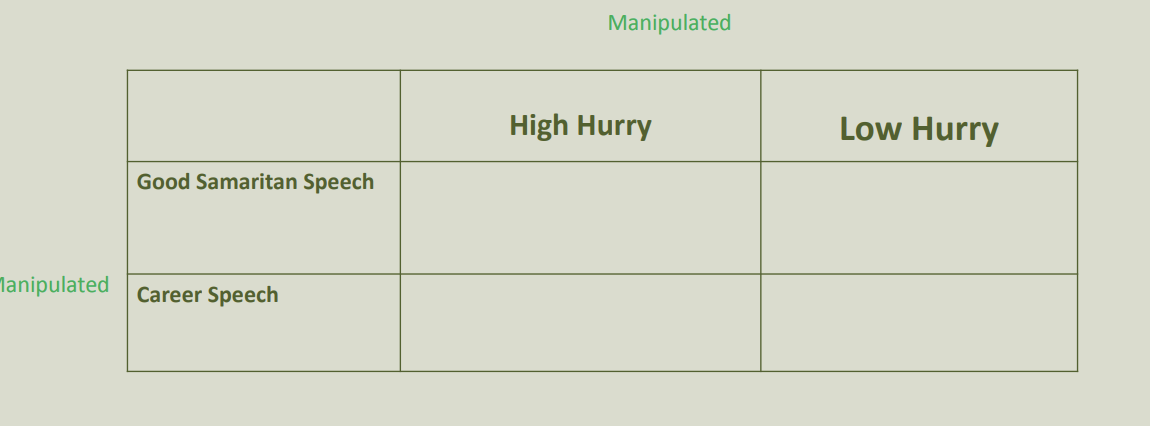
Ex: Good Samaritan Study
Good Samaritan Study
Q: What makes ppl more likely to help someone in need? Does being in a hurry affect helping, and does the speech affect helping?
IV1: Hurry: High hurry vs. low hurry
IV2: speech topic: Good samaritan speech vs. career speech
DV: whether the person stop to help person in distress
Result: hurry strongly affected helping (ppl who were not in a hurry usually helped and vice versa, the speech they gave had no affect on whether they want to help)
Demand Characteristics
Subtle environmental cues, instructions, or researchers behaviors that lead participants to infer what the study is testing
Lets them know how they are “expected” to behave
Threatens the internal validity
How to avoid demand characteristics
use deception: participants are misinformed or misled abt the study’s methods and purposes
post-experimental questions
employ unobtrusive measures
make the experiment double-blind
minimize contact bwtn experimenter/subject
use between subject design
What are the main ethical protections in social psychological research?
IRB (Institutional Review Board) review, informed consent, minimizing harm, protecting privacy, and debriefing, especially when deception is used.
Mundane vs. experimental realism
Mundane: how much the study resembles everyday life
Experimental: how psychologically involving and meaningful the situation feels to participants
why is it important: It does not need to look exactly like everyday life if participants genuinely experience the psychological process the researcher wants to study
Replication & Replication Crisis
Replication: Repeating studies shows whether an effect can be reliably reproduced. Repeated evidence gives more confidence than a single study
Crisis:Many published psychological findings did not reproduce consistently. The lesson is that one published study should not automatically be treated as established truth
File-drawer Problem
Studies finding no effect may remain unpublished while positive findings are published, making an effect appear stronger or more reliable than it really is
Social influence
How an individual’s thoughts, feelings, and behaviors respond to their social world, including tendencies to conform to others, follow social rules, and obey authority figures
3 major kinds of social influence
Conformity: change in response to social norms or pressure
Compliance: change in response to direct request
Obedience: change in response to a command/demand
Compliance vs. Obedience: compliance is responding to a request that doesn’t come from authority
Conformity
A type of implicit social influence where individuals voluntarily change their behavior to imitate the behavior of others
Why: conform bc
1) uncertainty abt what the correct behavior is
2) anxiety abt fitting in
Implicit Expectations Vs. Explicit Expectations
Implicit: the social norms we learn and understand at an unconscious level that affect our thoughts, feelings, and behaviors
Explicit: the social norms we learn and understand at conscious level that affects our thoughts, feelings, and behaviors
Normative vs. Informational Social Influence
Normative: conforming bc you want to fit in, be accepted, or avoid disapproval
you may not actually believe the group is right
behavior
Informational: conforming bc you think other ppl may know what is correct
belief
The Street Corner Experiment
Chameleon Effect
Unconscious mimicry of the postures, mannerisms, facial expressions and other behaviors of one’s interaction partners
Why do we mimic?
Ideomotor Action: the phenomenon whereby thinking about a behavior makes its actual performance more likely.
Social Lubrication: enhances social relationships, increases affiliation and rapport and enhances pro-social behavior
Mimicry also offers a signal to whether others are on the same page emotionally
What evidence suggests mimicry acts as a social lubricant?
People tend to like those who mimic them more, and mimicking others can increase positive social responses, such as larger tips
Auto-Kinetic Effect
An optical illusion that occurs when an individual perceives a stationary object as moving
Sherif’s auto-kinetic illusion
Study Design: Participants estimated the apparent movement of a light first alone and/or with others. Researchers examined whether people's estimates changed toward a shared group judgment
Result: People's initially different estimates gradually converged toward a group norm when judging together
What does it demonstrate: Because the task was ambiguous, participants treated other people's judgments as useful information about what was correct
After being separated, the participants kept the same responses, suggesting internalization
Generalization Influence
A cultural belief or norm that transcends the replacement of people; when individuals continue to conform even when the originator of the behavior is no longer present
Asch Study
Study Design: Participants judged line lengths after hearing a unanimous group of confederates sometimes give an obviously incorrect answer
Result: Many participants sometimes gave an obviously incorrect answer when a unanimous group gave that answer first, despite performing extremely accurately without group pressure
Displays normative Influence
Factors affecting conformity
Group Size: Conformity rises as the majority grows, but only up to a relatively small group; Extra opinions add less new information once many people already agree, and social pressure also reaches a point of diminishing returns
Dissenter: Conformity drops sharply when one person breaks the majority's unanimity because the participant is no longer psychologically alone (even though if that ally doesn’t share the same answer as the participant)
Informationally, the dissenter suggests “maybe the majority isn't necessarily right.” Normatively, the participant no longer has to stand alone against everyone
What did the Deutsch & Gerard (1955) show?
Participants conformed more when responses were public than private. The extra public conformity showed normative influence, while remaining private conformity showed informational influence.
What is the positive effect of conformity
Social Cascade: large social change in response to the beliefs or actions of a few early visionaries
Obedience
A type of explicit social influence where individuals behave in a particular way because someone of higher status ordered them to do so
Milgram Shock (Demonstration)
Study Design: Participants believed they were “teachers” in a learning study and had to administer increasingly severe shocks to a “learner” for wrong answers. The learner was actually a confederate and was not shocked
Result: Far more participants obeyed all the way to the maximum shock level than experts predicted, showing how powerful situational pressure from authority can be
Takeaway: Harmful obedience cannot be explained simply by saying that obedient people are cruel. Ordinary people can act against their values when authority and the surrounding situation strongly pressure them
Is the Milgram shock an experiment?
Not exactly
Only a single condition
No manipulation of independent variable
It's more of a "demonstration"
What situational factors increased or decreased obedience in Milgram’s study?
Obedience increased when the authority was close/credible, the victim was distant, peers obeyed, and responsibility was divided. It decreased when the victim was closer, the experimenter was distant or contradicted, or other participants refused to obey
Variations of the Milgram Study
Victim/learner distance
Remote feedback: learner was far away; only wall pounding was heard.
Voice feedback: learner could be clearly heard.
Proximity: learner was physically close.
Touch proximity: teacher had to force the learner’s hand onto the shock plate.
Result: the closer and more immediate the victim, the lower the obedience
Experimenter/authority distance
Baseline: experimenter present.
Absent experimenter: orders given by telephone.
Ordinary person: another participant gave the orders.
Two experimenters disagreeing: one told the participant to stop.
Result: weakening or contradicting the authority greatly reduced obedience
Peer behavior
Two other “teachers” refused to continue.
Obedience dropped a lot.
This shows a conformity effect: seeing others resist makes disobedience easier
Institutional prestige
Study moved from Yale to a lower-prestige office.
Obedience decreased somewhat, suggesting authority credibility matters
Learner’s prior condition
Learner said beforehand that they would participate only if they could stop on demand.
This reduced obedience somewhat, but not dramatically
Learner vulnerability / participant sex
Learner complained of heart trouble.
Female “teachers” were also tested.
These did not strongly reduce obedience in the slides’ summary
Divided responsibility
Participant read the questions, while another person actually administered the shocks.
Obedience increased, likely because the participant felt less personally responsible
Why did participants obey in Milgram’s study?
The situation made obedience easier through
gradual step-by-step escalation (shock level go up one by one)
obligation to finish(since they already agreed to participant in this study)
trust in the experimenter (believe that the experimenter won’t harm the learner
reduced personal responsibility (experimenter said they would take full responsibility)
discomfort with disobeying (if you disobey, signals that you think they are incompetent, immoral, or both)
an unfamiliar/confusing situation.
Stanford Zimbardo Prison Experiment
Study Design: Psychologically screened young men were randomly assigned to act as prisoners or guards in a simulated prison. The study examined how people would respond to powerful social roles
Result: Guards became increasingly authoritarian and abusive, while prisoners became passive and distressed; the study was stopped after 6 days
Takeaway: Zimbardo argued that powerful social roles and situational pressures can strongly shape behavior, but later concerns about researcher influence and ethics mean the study’s conclusions should be treated cautiously.
Deindividuatiion
A loss of individual self-awareness when a person becomes absorbed into a group identity or social role, often aided by anonymity
the guard embraced their social role
the prisoners identified themselves by their prison numbers rather than their names
How can anonymity lead to disinhibition and aggression
Disinhibition: Reduced self-awareness and accountability can weaken normal social restraints, making behaviors such as aggression, trolling, or cruelty easier
Cyber-disinhibition: where the anonymity of the internet encourages trolling, harassment, and cruelty w/o consequences
Aggression: Studies show that people wearing masks were more likely to engage in aggressive behavior
Women are just as willing as men to harm others, especially when they can hide under the safety and anonymity of deindividuatio
3 interpretations of harmful behavior
(1) they are inherently bad
(2) situations and roles can lead ordinary people toward good or bad behavior
(3) people may believe they are serving a legitimate or higher cause
What is the “higher cause” explanation of Milgram?
ome participants may have continued not because they wanted to harm someone, but because they believed they were contributing to an important scientific goal.
Compliance
A type of explicit social influence where an individual behaves in response to a direct or indirect request
Ex: You are walking to work and notice that your coworkers are on strike. You are not sure why they are on strike, but you feel obligated to join their cause
What is the main idea behind compliance research?
People often think they comply because of good reasons, but subtle psychological factors can influence compliance without awareness.
Compliance Principles
Commitment and Consistency: Once people make a choice or commitment, they tend to want their later behavior to stay consistent with it
Reciprocation: When someone gives us something, helps us, or makes a concession, we feel obligated to return the favor
Capturing and disrupting attention: Compliance can increase when a request either follows a familiar social script automatically or unexpectedly breaks that script and forces us to pay attention
Consensus/Social Proof: We look at what other people are doing to decide what is appropriate or correct. If many people are choosing or endorsing something, we are more likely to follow
Scarcity: hings seem more valuable or urgent when they are limited or only available for a short time. Examples include “limited quantity” or a fast-approaching deadline
Authority: People are more likely to comply with requests from someone they see as knowledgeable, legitimate, high-status, or credibl
Commitment and Consistency Techniques
Foot in the door
Low ball
Both above tactics capitalize on a strong human desire to remain consistent in one’s thoughts and actions.
bait and switch
Foot in the door (Freedman and Fraser; 1966)
Agree to a small request first, then receive a larger request. The first action changes self-perception (“I’m the kind of person who does this”) and creates pressure to behave consistently later
Takeaway: Small commitments can make people more likely to accept larger related requests because of consistency/self-image.
The small and large request in the foot-in-the-door technique doesn’t have to be related, but the effect is stronger when they are related, but it can still occur with unrelated requests, supporting the idea that the initial act can change self perception
Bait and Switch
You attract someone with a desirable offer (bait), then after they are interested or committed, that option becomes unavailable and they are pushed toward a different, usually less attractive option (switch)
Ex: A store advertises a very cheap laptop. You go in to buy it, but they say it’s sold out and try to sell you a more expensive model instead.
Low ball Technique
Get someone to agree to an attractive offer first, then reveal a less attractive cost or condition after they have committed. Commitment makes them more likely to continue
Cialdini et al low-ball study
Study Design:
IV: Group 1: told initially of 7 am start time
IV: Group 2: told of 7 am start time only after agreeing to participate
DV
agreement to participate
actual participation
Result: Those who committed first were more likely to show up, so those in group 2 was more likely to actually participate
Reciprocation Techniques
door in the face
that’s not all
Norm of reciprocity
When someone gives us a benefit or makes a concession, we feel pressure to return the favor because we want exchanges to feel fair
Ex: Companies use “free samples” to make you feel guilty if you don’t then buy something.
Door-in-the-face technique
a persuasion technique where people who refuse a large request are then more likely to agree to a later, smaller request
Cialdini et al. door-in-the-face study
Study Design: One group was first asked to make a very large commitment: volunteer as an unpaid juvenile-delinquency counselor for 2 hours a week for 2 years. After they refused, they were asked the real target request: take a group of juvenile delinquents on a 2-hour trip to the zoo. A control group got only the zoo request
Result: People were more likely to agree to the zoo trip when they had first refused the much larger request
Takeaway: the smaller request feels like a concession, so the person feels pressure to reciporate by makring a concession too and sayin yes
Tha’s not all tactic (Burger, 1986)
Study Design: Buyers saw either cupcake + cookies together for one price or were first offered the cupcake and then “given” cookies as an added bonus
Result: The bonus framing (those offered the cupcakes and then “given” cookies as an added bonus) increased purchases
Takeaway: The same objective deal can produce more compliance when framed as a concession/gift.
That’s not all tactic
Improve an offer before the person responds, making the added benefit seem like a gift/concession. This can trigger norm of reciprocity and also make the deal seem better
That’s not all tactic are more likely to be effective when they are percieved as 1) surprising 2) personalized
Script-based Compliance
Social Script: an internal model of the sequence of typical events in a well-understood social situation
Ex: When people request a small favor, and offer some reason*, people often say “Yes” in a relatively automatic, unreflective way
Triggering a social script can sometimes induce compliance.
Disrupting a social script can also sometimes induce compliance
Script-based compliance (Langer, Blank, Chanowitz, 1978)
Study Design: A person asked to cut in a copy-machine line with no reason, a real reason, or a meaningless “because I need to make copies.
Result: For small requests, even the meaningless “because” increased compliance
Takeaway: People can follow familiar request scripts automatically without deeply evaluating the reason.
Compliance via Script Violation
An unusual request, designed to disrupt an automatic (i.e., script-based) denial can produce greater compliance
Ex: Panhandlers asked for normal amounts or unusual amounts like 17¢/37¢ , they were more likely to get that change than compared to ppl who asked for 10¢, 20¢
Why can positive mood increase compliance?
Mood Maintenance: motivational - Desire to maintain one’s good mood (“mood maintenance”); helping others tends to produce positive moods
Cognitive: altered construal - Positive mood alters the interpretation of the request (e.g., it is seen as more reasonable and less of an imposition or problem
Forgas positive-mood study
Study Design: Participants were placed in positive, negative, or neutral moods and later asked for paper with varying politeness
Result: Positive mood increased compliance, especially for rude/direct requests
Takeaway: Mood can change both motivation and how a request is interpreted.
How can negative mood sometimes increase compliance?
People may help or comply to reduce guilt or sadness and make themselves feel better—called negative-state relief. Anger does not necessarily have the same effect.
Cunningham et al. 1980 guilt study
Study Design: some participants were made to feel responsible for “breaking” a camera; later another person asked for a donation
Result: Those who were told they broke the camera is more likely to donate (to restore their self-perception/image)
Takeaway: People may help to relieve negative feelings and restore a positive self-view.
Descriptive vs. prescriptive norms
Descriptive: what people actually do
Ex: You see that most students in your class use laptops to take notes, so you start using a laptop too
Prescriptive/injunctive: what people are supposed to do.
Ex: Students are expected to stay quiet during an exam, even if some people might not actually follow that rule.
Norm-based appeals work best when what ppl actually do matches what ppl are supposed to do
Pluralistic ignorance
People privately disagree with a norm but follow it because they mistakenly think others accept it; everyone's behavior then reinforces the false norm
Ex: Most students are confused during lecture, but nobody raises their hand because each person thinks, “Everyone else probably understands.” Because no one asks a question, everyone mistakenly concludes that the class understands.
Are groups always better decision makers than individuals?
No. Groups can outperform the average individual on problems with clear factual answers because they combine knowledge, but social concerns like fitting in, avoiding conflict, or avoiding responsibility can interfere with good decisions
Advantages vs. Disadvantages of Group Decision Making
Advantages: Preference task
if there is no right answer just the group’s preference
Disadvantages:
The social nature of group processes can lead to major problems for groups tasked with making decisions
Groupthink
Faulty decision making in a highly cohesive group when the desire for agreement and harmony overrides critical evaluation of alternatives
What conditions make groupthink more likely?
Strong/directive leader
high group cohesion
isolation
stress
pressure for consensus → members censor disagreement and alternatives receive less scrutiny.
Groupthink symptoms
Illusion of invulnerability: The group becomes overconfident and believes it is unlikely to fail, so members may underestimate risks
moral certainty: he group assumes its goals or decisions are morally right, so members do not seriously question the ethical consequences.
stereotyped outgroups: The group views outsiders or opponents in an oversimplified, negative way, making their perspectives easier to dismiss.
collective rationalization: Group members explain away warning signs or evidence that challenges their preferred decision instead of reconsidering it.
self-censorship: Members hold back doubts, criticism, or disagreement because they do not want to disrupt group harmony.
pressure to conform: Members who disagree are directly or indirectly pressured to support the group's preferred position
illusion of unanimity: Because people stay quiet, the group mistakenly assumes everyone agrees. Silence is interpreted as agreement
mindguards: certain members shield the group from information or criticism that might challenge the group's decision
Bays of Pig
Example of groupthink
Situation: Kennedy's advisers considered the Cuba invasion
Result: doubts and alternative views were suppressed while the group became overly confident
Takeaway: pressure for consensus can prevent groups from properly evaluating risks and alternatives.
The road to groupthink
Antecedents:
Group is (already) cohesive
Isolated
Directive leader
Stress
Poor decision-making rules
Symptoms/Causes
Illusion of invulnerability – Moral certainty – Stereotyped view of outgroup – Self-censorship – Collective rationalization – Direct pressure to conform – Illusion of unanimity – Mindguards
Defective Decision Making
Incomplete survey of alternatives
failure to examine risks of favored alternative
poor information search
few contingency (emergency) plans