Bones and Skeletal Tissue: Anatomy and Physiology Chapter 6
 Call Kai
 Learn
Learn Practice Test
 Spaced Repetition
 Match
Match Flashcards
 Knowt Play
1/106

Earn XP
Description and Tags
BIOL251 Binghamton University
107 Terms
Chondr-
“cartilage”
Osteo-
“bone”
What are the functions of bones?
Support, protection, attachment point, storage, blood cell formation, and hormone production
How do bones support the body?
They hold up the body and cradles organs
How do bones protect the body?
They protect the central nervous system and visceral organs
How do bones attach to one another?
Skeletal muscle attaches to them via tendons
What is the purpose of tendons?
They are a cord-like band that attaches bones together with skeletal muscle tissue and allows them to move.
They are necessary for movement.
What is stored in bones?
Minerals, fat, and yellow marrow (in adults)
Hematopoiesis
Formation of blood cells in red bone marrow
(Blood cell formation in bones)
Osteocalcin
Regulates insulin release, glucose homeostasis, and energy expenditure/use
(Hormone production in bones)
What is the embryonic skeleton made of before the osseous skeleton forms?
Cartilage and connective tissue fibers
Characteristics of all cartilage types
Strong and resilient
Surrounded externally by perichondrium
Perichondrium
Fibrous connective tissue containing blood vessels for cartilage tissue that resists excessive outward expansion of cartilage
What are the three types of cartilage?
Hyaline cartilage
Elastic cartilage
Fibrocartilage

Hyaline cartilage
Most abundant cartilage type
Contains collagen fibers
Elastic cartilage
Cartilage type containing more elastic fibers
Fibrocartilage
Cartilage type containing rows of chondrocytes alternating with thick collagen bands (most of any type), making it very compressible and hard to do any damage to
What are the types of cartilage growth?
Appositional growth
Interstitial growth
Appositional growth
Laying down new cartilage on top of old cartilage, occurring at the surface of cartilage tissue causing it to increase in width/thickness
Interstitial growth
Cells divide and secrete matrix within pre-existing cartilage, occurring deeper in the cartilage tissue causing it to increase in length
Axial skeleton
Long axis of body

Which bones are located in the axial skeleton?
Skull, vertebral column, and ribs
Appendicular skeleton
Limbs (aka appendages) and the girdles

What bones are located in the appendicular skeleton?
Pectoral and pelvic girdles, arm and leg bones
What are the different shapes of bones?
Long bones, short bones, flat bones, irregular bones, and sesamoid bones
Long bones
Longer than they are wide
Short bones
cube-shaped
Sesamoid bones
bones that form in a tendon
ex: patella
Flat bones
thin, flat, curved
ex: ribs
Irregular bones
anything that does not fit in any of the other bone shape types
ex: vertebrae, os coxa
Compact bone
Outer layer of a bone that looks smooth and solid
Spongy bone
Inner layer of a bone that has open spaces with needle-like pieces of bone called trabeculae
Open space is filled with red or yellow marrow
Where is trabeculae mostly found?
Along lines of stress in spongy bone to help transmit pressure to resist mechanical stress and pushing to prevent bones from breaking easily
Structure of flat, irregular, and short bone
Thin plate of spongy bone covered by compact bone
No large cavities for bone marrow (all bone marrow found around trabeculae)

What features make up the structure of long bones?
Diaphysis
Epiphysis
Membranes
Vascularization and innervation

Diaphysis
bone shaft making up most of the length of the bones composed of compact bone “collar” with internal medullary cavity containing bone marrow
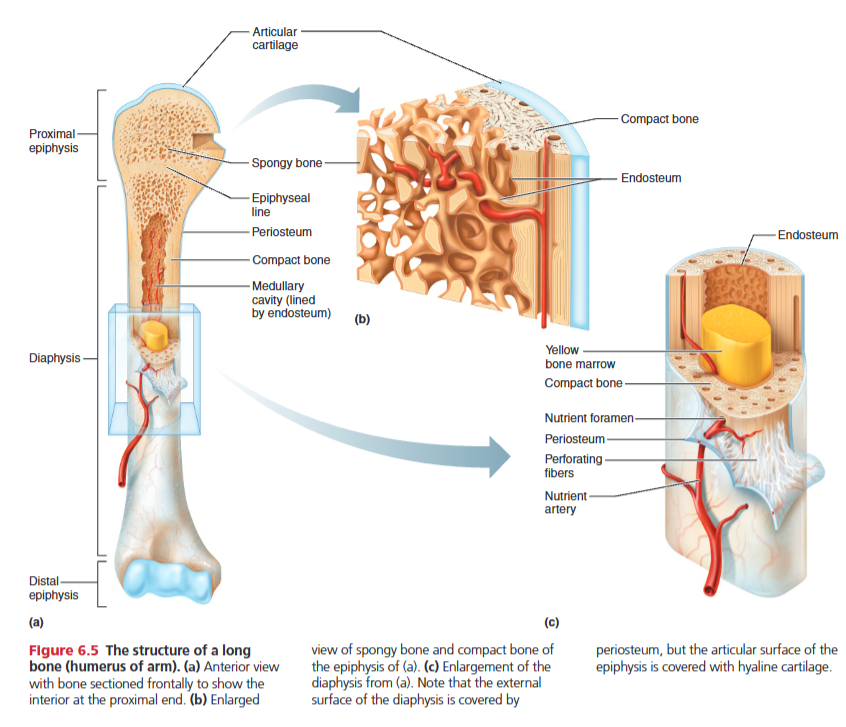
Epiphysis
Bone ends that form joints and are filled with spongy bone and covered with hyaline/articular cartilage. They are composed of compact bone externally and spongy bone internally.

What is the function of the epiphysis?
Location where one bone articulates with another bone at a joint and/or allows for attachment of ligaments and tendons
What membranes make up the structure of long bone?
Periosteum and endosteum
Periosteum in long bone
Double layered membrane covering external bone surface except at epiphysis
Well vascularized
Endosteum in long bone
Covers internal bone surfaces
How is the diaphysis vascularized?
The nutrient artery and nutrient vein
How is the epiphysis vascularized?
The epiphyseal artery and epiphyseal vein
How is long bone innervated?
Nerves travel with blood vessels
Red bone marrow
Produces blood cells
Hematopoietic tissue
Where is red bone marrow found in the skeleton of an infant?
Everywhere to support rapid growth and high blood cell production
Where is red bone marrow found in the skeleton of adults?
skull, ribs, hips, sternum, clavicle, scapula, vertebrae, heads of femur, and humerus
Yellow marrow
Is located in the medullary cavity of long bones in adults and contains more fat and less blood supply than red marrow
When is yellow marrow converted back to red marrow?
When a person is short on red blood cells (low on blood supply and/or oxygen)
Organic chemical composition of bone
Cells and osteoid
Inorganic chemical composition of bone
Mineral salts → mostly calcium phosphate salts packed around collagen fibers
How do mineral salts affect bone tissue?
Gives hardness and resistance to breakdown
What are the 4 primary cell types responsible for bone growth?
Osteoprogenitor (osteogenic) cells
Osteoblasts
Osteocytes
Osteoclasts
Osteoprogenitor (osteogenic) cells
Mitotically active cells that can remain as osteogenic cells or differentiate to form osteoblasts
What makes osteoprogenitor cells important throughout life?
These stems cells are foundational for making sure bone is continuously replenished
Osteoblasts
Bone-forming cells that secrete unmineralized extracellular matrix (osteoid) that forms bone tissue and secrete matrix until surrounded
Unmineralized
Organic bone tissue that has not yet had mineral crystals deposited into it
What happens to an osteoblast once it is surrounded by matrix?
It is converted to an osteocyte
Osteocytes
Mature bone cell that monitors and maintains the bone matrix
What do osteocytes respond to?
Mechanical stress on bone and chemical signals
Osteoclasts
Secrete collagenase to break down collagen in the bone matrix. They are bone-degrading cells that maintain, repair, and remodel bones and play an important role in blood calcium homeostasis.
What structures make up the microscopic anatomy of compact bone?
osteons than contain a central canal and circumferential lamellae that attach osteons together
Osteon
structural unit of compact bone to help bone withstand pressure and stress
Lamella
concentric rings inside a single osteon packed closely together with calcium salts found on and in between fibers
Collagen fibers in a single lamella
Run in one direction
Collagen fibers in adjacent lamella
Run in opposite directions
Lamella can twist against each other
Central canals
Open space that runs through the center of each osteon containing nerve and blood vessels
Perforating canals…
Extending from central canal and connect neighboring osteons and medullary cavity
Circumferential lamellae
Wrap around osteons to form outermost layer of bone by holding the osteons together
Endochondral ossification
Bone formation within cartilage
Uses hyaline cartilage as a “blueprint” to form ossified bone by breaking down cartilage and replacing it with ossified bone
What is the early embryonic skeleton made up of?
Cartilage
Where does endochondral ossification happen?
In most bones below the skull
Step 1 of Endochondral Ossification
Formation of a POC and bone collar
Osteoblasts lay down bone against cartilage diaphysis to form a collar
Formation of primary ossification center in the diaphysis center
POC is rigid and tough on the outside
Step 2 of Endochondral Ossification
Cavity forms in diaphysis center
Cartilage cells inside primary ossification center die off because cartilage tissue inside POC breaks down
Cartilage outside cavity continues to grow → elongates bone
Step 3 of Endochondral Ossification
Formation of initial spongy bone in diaphysis
Periosteal bud invades cavity
Osteoblasts secrete bone matrix inside cavity
(initial formation of spongy bone is bone-covered cartilage trabeculae)
Periosteal bud
Contains nutrient artery/vein, nerve fibers, red marrow elements, osteoprogenitor cells than differentiate to form osteoblasts and lay down bone, osteoclasts
Step 4 of Endochondral Ossification
Formation of medullary cavity and elongation of diaphysis
Spongy bone from step 3 broken down by osteoclasts to form the medullary cabity
Cartilage in remaining diaphysis is calcified, broken down, and replaced with bone
Secondary ossification center forms in epiphyses
Step 5 of Endochondral Ossification
Secondary ossification continues in epiphyses
Similar to primary ossification except spongy bone is retained in bone ends → no medullary cavity formed
There are still some areas with cartilage, but most of the skeleton is ossified by birth
Bone growth in length
accomplished by interstitial growth
Interstitial growth
Occurs at epiphyseal plate found between the epiphysis and diaphysis of a bone
Overall process of growth in length
New cartilage laid down in epiphyseal plate
Cartilage is calcified at center of plate
Calcified cartilage is broken down by osteoclasts and osteoblasts lay down new bone tissue
Growth in width
accomplished by appositional growth
Appositional growth
Osteoblasts secrete new matrix at the periosteum and osteoclasts break down bone tissue at the endosteum
What difference in activity rate between the cells must there be for growth in width to occur?
Need to lay down more bone tissue than is being broken down
Bone growth continues from _________ through ___________.
infancy, adolescence
At the end of adolescence cartilage production in epiphyseal plate _____ and _____.
slows, stops
A person officially stops growing when…
the remaining cartilage in plate is calcified and replaced by bone and the bone of diaphysis fuses with bone of epiphysis
Growth hormone
controls activity at the epiphyseal plate to stimulate growth
What effect does growth hormone have on the epiphyseal plate?
Makes it lay down new cartilage
Sex hormones
Estrogen and testosterone
Estrogen
Causes growth spurt at puberty and “feminization” of certain parts of skeleton
In high levels, like it adults, it induces epiphyseal plate closure
What is the typical age at which a female stops growing?
17-18
Testosterone
Causes “masculinization” of certain parts of skeleton
What is the typical age at which a male stops growing?
21
Bone remodeling
Bone deposition and resorption to maintain Ca2+ homeostasis and bone health
Ca2+ is essential for excitability of body cells
How does bone remodeling function to improve bone health?
Mechanical and gravitational forces acting on bone tissue drive remodeling → strengthens bone exactly where it is needed
Deposition
Lay down new bone tissue
Resorption
Getting rid of old bone tissue
What are the factors involved in the control of deposition and resorption?
Release of parathyroid hormone and mechanical stress
When is the parathyroid hormone (PTH) released?
In response to decreasing blood Ca2+ levels
The hormone increases the number of osteoclasts at the bone and osteoclasts become more active in bone tissue
Once blood Ca2+ returns to normal, hormone release decreases along with the osteoclast number and rate of activity