SZ BH EX 1
 Call Kai
 Learn
 Practice Test
 Spaced Repetition
 Match
 Flashcards
 Knowt Play
1/93

There's no tags or description
Looks like no tags are added yet.
94 Terms
What's the criteria for involuntary commitment?
▪Diagnosed with mental illness
▪Danger to self or others
▪Gravely disabled - can't provide necessities- (food, clothes, shelter)
▪Needs treatment but can't seek help due to illness

What is Tarasoff law?
• Therapists have a duty to warn patient's potential victim of harm

What is Right to Treatment?
▪Right to be free from excessive/unnecessary meds/treatments
▪ Right to an attorney, judge, clergy, providers

What is Right to Refuse Treatment?
-Right to withhold or withdraw consent anytime, even if they're involuntary committed

What is Right to Informed Consent?
➔ Pt informed of risks/benefits and alternatives
➔ Pt voluntarily accepts treatment

what is Rights Regarding Confidentiality?
➔ Duty to Warn is an exception
➔ HIPPA

What is Rights Regarding Psychiatric Advance Directives?
➔ Prepared when patient is well
➔ Expresses treatment preferences, wishes/choices

When can a patient be medicated without a court hearing?
In emergency situations-patient wants to harm to self or others
When can a patient be medicated AFTER a court hearing?
-Has a serious mental illness/can't make decisions
-Functioning is worsening with suffering or is threatening
-Benefits of treatment outweigh the risks
-Less-restrictive options aren't working

What are restraints?
-Restricting movement physically or chemically
->Check for food, water, toileting, safety, comfort (Q15 minutes

What is seclusion vs timeout?
Seclusion: blocked exit-for someone violent, helps deescalate
Timeout: patient may leave at any time

What are interventions before using restrain and seclusion?
- Always do least restrictive for shortest time
◆ Verbally intervening (asking pt for cooperation)
◆ Reducing stimulation
◆ Actively listening
◆ Provide diversion
◆ Ordering PRN meds

What happens if a voluntarily patient wants to leave?
•Patient won't be automatically discharged its against medical advice
• Nurse must contact the psychiatrist

What can a psychiatrist do if a voluntary patient wants to leave?
• Discharge immediately
• Hold for no more than 24hrs until psychiatrist sees them in person
• Convert to involuntary if danger to self or others

What causes schizophrenia?
-Genetics=Chronic, long-term illness

How do medications treat schizophrenia?
Decrease the amount dopamine and serotonin
->1st generation drugs- decreases just dopamine (hallucination/delusion)- used for positive sx only
->2nd generation drugs- decreases dopamine and serotonin (mood/cognition)- used for positive and neg sx
What are positive symptoms of schizophrenia?
-Present of symptoms that should NOT be present-> seek treatment
• Hallucinations
• Delusions- false beliefs
• Disorganized/bizarre thoughts, speech, behavior
• Paranoia

What are negative symptoms of schizophrenia?
-Absence of symptoms that should be present
• Anhedonia - can't enjoy activities or experience pleasure
• Avolition - reduced motivation or goals
• Affective blunting - reduced or constricted affect
• Apathy - reduced interest; doesn't care
• Alogia - reduced speech
• Asociality- reduced social

What are negative affect symptoms of schizophrenia?
o flat: blank facial expression
o inappropriate: laughing during tragedy
o blunted: low emotional response
o bizarre: odd, inappropriate, grimacing
o constricted: reduced range/intensity

What are cognitive symptoms of schizophrenia?
-Impaired attention
-Impaired memory/judgement
-Impaired executive function-can't reason, set priorities
-Impaired problem-solving/decision-making

How do you communicate with a schizophrenia patient?
-Acknowledge feelings, don't validate hallucination/ delusions
-Avoid "why" questions
-Use calm, reality-based communication
What's prodromal phase in schizophrenia?
• Early assessment improves prognosis
• Enhancing social, coping skills
• Reducing risk factors (stress, substance abuse)

What's the initial assessment for schizophrenia?
-Interview the patient and observe behavior for symptoms
-Interview family or people who know the patient (patient may minimize symptoms)
-Perform a mental status exam (MSE)
What do you assess for in schizophrenia?
Assess suicide risk
Assess (ADLs)/medications
Assess for delusions- if firmly held, believe they're in danger

What's the family education for schizophrenia?
-how to recognize and respond to symptoms
-how to negotiate & help achieve needed changes

what is health education for schizophrenia?
Minimize tobacco, caffeine, stress
Maintain sleep/hygiene
Maintain weight/being active

What is persecutory delusion?
Believing you're singled out for harm or prevented from making progress
Example: believing food is poisoned and only eating pre-packaged foods
What is grandiose delusion?
Believing your powerful/important
Example: believing you are an FBI agent on a mission

What is erotomaniac delusion?
believing that another person wants you romantically

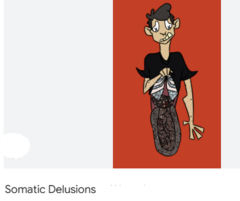
What is somatic delusion?
Believing your body is changing in unusual or abnormal ways
Example: believing an organ is dead or rotting
What is referential delusion?
Believing that unrelated events are connected to you.
Example: Chris believes that birds chirp to make him feel better"

What is nihilistic delusion?
Believing a major catastrophe will occur
◆ Ex: giving away belongings because of world ending

How do you communicate with someone having delusions?
●Don't argue or try to prove them wrong
-> Avoid saying "That's not true."
● Acknowledge feelings, don't validate delusion
-> "That sounds frightening. I can see you're worried."
What is word salad?
jumble of words, meaningless to listener
ex: "salad hug cat"

What is clang association?
Choosing words based on sound or rhyme instead of meaning.
Ex: "clang, dang, rang" when answering a question.

What are neologisms?
Made-up words that have meaning only to patient.
Ex: Lemonia= it's lemony

What is Echolalia?
Repeating back words
Example: Nurse says, "Take your meds," patient repeats, "Take your meds."

What is associative looseness?
illogical thinking, poor concentration
◆ e.g., "My friends talks about French fries, but how can you trust the French?"

What is flight of ideas?
-moving from one thought to another, jumping topics
Example: "I need to go to the store — stores are always busy — busy people make money

What is pressured speech?
Urgent/intense speech unable to allow comments from others.
Ex "I'm fine I don't need sleep I already cleaned I feel amazing."

What is magical thinking?
Believing reality can be changed by thoughts or actions, common in children.

What is circumstantiality?
unnecessary details in conversations

What is tangentiality?
Wandering off topic and never reaching the point.

What is paranoia?
irrational fear-believing that another person wants to cause harm.

What are hallucinations?
Sensory perceptions without an external stimulus
Auditory is most common->Hearing voices or sounds
Laughing suddenly
Lips moving slowly
Talking to someone not there

What are command hallucinations?
instructs the person to take a specific action
This is an EMERGENCY

What are visual hallucinations?
Seeing things that are not present
What's the difference between Olfactory and Gustatory Hallucinations?
• Olfactory: Smelling odors•
Gustatory: Experiencing tastes
How do you communicate with a hallucination patient?
When they began, What makes them worse or better
->Ask about Content (describe/experience)
"Can you describe what you're experiencing now?"

How do you not communicate with a hallucination patient?
Avoid referring to hallucinations as if they're real or not real- don't argue
"what are the voices saying"
"What does the shadow want?

What do you assess for during hallucination?
-Asses for suicide-> requires safety measures
-Focus is on realty based here and now
What is depersonalization?
feeling of being unreal or detached from self or identity
e.g., pt may see her fingers as being smaller than they actually are or not as hers

What is derealization?
Feeling that the environment has changed or is strange

What is catatonia?
increase or decrease in the rate and amount of movement
->leads to exhaustion, pneumonia, clots, malnutrition, or dehydration

What is motor retardation?
slowing of movement

What is motor agitation?
restlessness, such as running or pacing

What are stereotyped behaviors?
Repetitive behaviors that do not serve a logical purpose.

What is echopraxia?
mimicking the movements of another

What is negativism?
oppose requests or wishes of others

What is concrete thinking?
impaired ability to think abstractly, thinking in a literal manner.
EX: nurse asks the patient, "What brings you in?" and the patient responds with "a cab" rather than "a suicide attempt.

What occurs during Phase I: Acute?
-Hospitalization for days to weeks
-Acute symptoms stabilized
-Monitor for decline that could lead to suicide
-Medication and psychoeducation

What occurs during Phase II: Stabilization and Phase III: Maintenance?
Maintenance by
-Meds/Therapy
-Case management/emergency services
-Housing and employment support

What is Milieu Management?
-Feeling of the room; Physical and social environment

What's important to know about antipsychotics?
-Not addictive
-Take 2-6 weeks to become effective

What are risks of antipsychotics?
-discontinue slowly to prevent discontinuation syndrome → dizzy, tremor, paresthesia, electric shock pains
-Can cause impaired swallowing → choking risk
-Can cause sedation, orthostatic hypotension → fall risk

What are First-Generation Antipsychotics?
-Haloperidol (Haldol)
-Chlorpromazine (Thorazine)
-Also called typical antipsychotics or neuroleptics

What do First Generation Antipsychotics do?
-Reduce dopamine
-Treats positive symptoms (hallucinations/delusions)

What are side effects of First Generation Antipsychotics?
extrapyramidal symptoms (EPS)
◆ Acute Dystonia
◆ Akathisia
◆ Pseudoparkinsonism
◆ Tardive Dyskinesia (TD)

What is Acute dystonia?
Sudden, severe stiff muscle spasms (neck, eyes, jaw, back).

What is Akathisia?
Motor restlessness can't sit still, constant pacing/tapping

What is Pseudoparkinsonism?
Parkinson-like symptoms:
S - Shuffling/impaired gait
M -Masked face (no expression)
A - Akinesia / Bradykinesia (no or slow movement)
R - Rigidity- resistance passive ROM (cogwheel stiffness)
T - Tremor at rest ("pill-rolling")

What is tardive dyskinesia?
-Tongue protrusion, lip smacking, grimacing, choreiform movements
-Often irreversible involuntary, repetitive movements
-Occurs after long-term antipsychotics use (months to years)

What is the treatment for tardive dyskinesia?
anticholinergics= Benadryl, Cogentin

What are signs of anticholinergic toxicity? ** Wri
Cognitive impairment
Constipation/Urinary retention
Autonomic instability
Dilated pupils
Delirium/confused
Dry mucous membranes

What are Second-Generation Antipsychotics?
-Risperidone (Risperdal)
-Olanzapine
-Clozapine (Clozaril)
-Also called atypical antipsychotics
-First-line antipsychotic

What do Second Generation Antipsychotics do?
Block dopamine and serotonin
Treat positive symptoms and negative symptoms
Less side effects-(EPS/tardive dyskinesia)

What are side effects of second-generation antipsychotics?
Metabolic syndrome
Sedation
Seizures
Sexual dysfunction
What is metabolic syndrome?
Abdominal weight gain
Dyslipidemia
Increased blood glucose
When is clozapine/Clozaril used in treatment?
-Used if 2 monotherapy or 2 antipsychotics have failed
-If clozapine isn't tolerated add second antipsychotic

What is the main side effects of clozapine/Clozaril?
Severe neutropenia

What do long-acting antipsychotics end in?
Most end in "-decanoate" or "-cononate"
Examples: haloperidol decanoate, fluphenazine decanoate
Administered every 2-4 weeks or months

What are symptoms of Neuroleptic Malignant Syndrome (NMS)?
• Fever, unstable vitals
• Autonomic dysfunction
• Reduced consciousness/response
• Increased muscle tone/rigidity(stiffness)
• Stop antipsychotic, give fluids, temp reduction

What is Bipolar Disorder 1 ?
- Most severe form
- At least 1 manic episode (lasts a week)
- Has psychosis (hallucinations/delusions)
- High Suicide Risk

What is mania?
• Period of mood disturbance
• Anosognosia - don't see themselves as sick
• Last at least 1 week
• Lack of sleep
• Extreme unsafe goal-directed activity or energy

How do you communicate with a mania patient?
• Redirect energy — use distractibility
• Use short statements
• Set limits, expectations, consequences— prevent manipulation

DSM-5 Criteria for Bipolar 1 Disorder **WR
At least one manic episode and lasts ≥ 1 week
Elevated energy/mood
Distractibility
Indiscretion (risky behavior)
Grandiosity (high self-esteem)
Flight of ideas
Activity goal increase
Sleep decreased
Talkative (pressured speech)

What is Bipolar II Disorder?
○ At least one hypomanic episode and one major depressive episode
○ Psychosis(hallucinations/delusions) is not present
○ Euphoric and increases functioning/productive

What is lithium used for?
•Used for acute mania and maintenance treatment
• Takes 7-14 days to become effective
• Check renal and thyroid

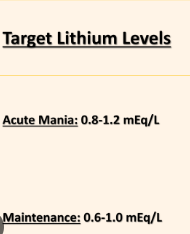
What are lithium levels?
• Therapeutic level: 0.8-1.2 mEq/L (maintenance 0.6-0.8)
• Monitor levels every 2-3 days initially, then every 3-6 months
What are symptoms of Lithium level >1.5?
• N/V/D
• Thirst
• Polyuria
• Fine hand tremor

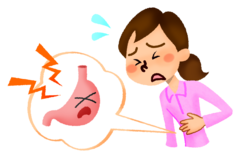
What are symptoms of lithium level 1.5-2.0?
▪ GI upset
▪ Coarse hand tremor
▪ Confusion
What is valium (diazepam)?
• Benzodiazepine- used for agitation or anxiety
• Short term for acute mania only->risk of dependency
What is Ativan (lorazepam)?
Benzodiazepine- used PRN
Used for panic attacks, anxiety, seizures
What is Cymbalta (duloxetine)?
Serotonin and Norepinephrine Reuptake Inhibitors (SNRIs
Antidepressant
Typically used as a daily medication- builds over time