theory of architecture ( Francis D.K. Ching )
 Call Kai
 Learn
Learn Practice Test
 Spaced Repetition
 Match
Match Flashcards
 Knowt Play
1/98

There's no tags or description
Looks like no tags are added yet.
Name | Mastery | Learn | Test | Matching | Spaced | Call with Kai | Chat |
|---|
No analytics yet
Send a link to your students to track their progress
99 Terms
a concept that implies that “each element is first considered as a conceptual element, then as a visual element in the vocabulary of architectural design”
primary elements
indicates a position in a space
(no length, width, or depth)
point
an ordering device used throughout history to organize building forms and spaces
two points
a point extended
(properties: length, direction, and position)
line
examples of linear elements
columns
obelisk
towers
a line extended
(properties: length, width, shape, surface, orientation, position)
plane
it spans and shelters the interior spaces of a building from the climatic elements that forms the upper enclosing of a room
overhead plane
it is an active in our normal field of vision and vital to the shaping and enclosure of architectural space
wall plane
isolate a portion of space to create a controlled interior environment
exterior wall planes
govern the size and shape of the internal spaces or rooms within a building
interior wall planes
it serves as the physical foundation and visual base for building forms;
it forms the lower enclosing surface of a room
base plane
a plane extended
(properties: length, width, depth, form, space, surface, orientation, position)
volume
the point of contact between mass and space
an external appearance that can be recognized
form
the characteristic outline of a plane figure or surface configuration of a volumetric form
principal aspect by which we identify and categorize forms
shape
a plane curve in which every point is equidistant from fixed point within the curve
circle
a plane figure bounded by three sides and having three angles
triangle
a plane figure having four equal sides and four right angles
square
the physical dimension of length, width, and depth of form
size
a phenomenon of light and visual perception that maybe described in terms of an individual’s perception of hue, saturation, and tonal value.
color
the visual and especially tactile quality given to a surface by the size, shape, arrangement, and proportion of parts
texture
the location of a form relative to its environment or the visual field within which it is seen
position
the direction of a form relative to the ground plane, the compass points, or to the person viewing the form
orientation
the degree of concentration and stability of a form
this depends on the forms geometry as well as its orientation relative to the ground plane, the pull of gravity, and our line of sight
visual inertia
a solid generated by the revolution of a semicircle about its diameter whose surface is at all points equidistant from the center
a ________ is a centralized highly concentrated form
sphere
a solid generated by the revolution of a rectangle about one of its sides
a ___________ is centralized about the axis passing through the centers of its two circular faces
cylinder
a solid generated by the revolution of a right triangle about one of its side
the ______ is a highly stable form when resting on its circular base and unstable when its axis is tipped or overturned
cone
a polyhedron having a polygonal base and triangular faces meeting at a common point or vertex
the _______ can rest in a stable manner on any of its faces
pyramid
a prismatic solid bounded by six equal square side, the angle between any two adjacent faces being a right angle
it is a stable form except when it stand on one of its edges
cube

refer to those whose parts are related to one another in a consistent and orderly manner
generally symmetrical and stable in nature in one or more axis
regular forms

are those whose parts are dissimilar in nature and related to one another in an inconsistent manner
they are generally asymmetrical and more dynamic than r_____ forms
irregular forms
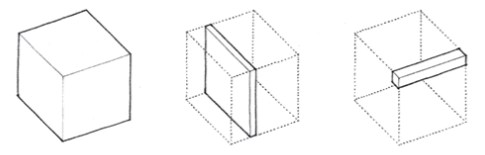
a form can be transformed by altering one or more of its dimensions and still retain its identity as a member of a family forms
dimensional transformation

a form can be transformed by altering the shapes and geometric relationships of its enclosing planes
geometric transformation
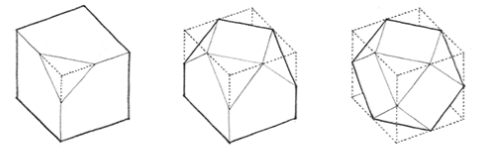
a form can be transformed by subtracting a portion of its volume
depending on the extent of the subtracting process, the form can retain its original identity or transformed into a form of another family
subtractive transformation

a form can be transformed by the addition of elements to its volume
additive transformation

this type of relationship relies on the close proximity of the forms or their sharing of a common visual trait such as shape, color, or material
spatial tension

in this type of relationship, the forms share a common edge and can pivot about that edge
edge-to-edge contact

this type of relationship requires that the two forms have corresponding planer surfaces which are parallel to each other
face-to-face contact
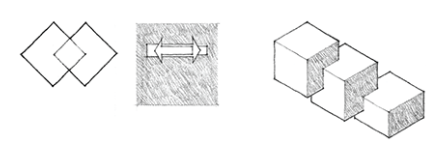
in this type of relationship, the forms interpenetrate each other’s shapes; the forms need not share any visual traits
interlocking contact
refers to the manner in which the surfaces of a form come together to define its shape and volume
articulation

defines the meeting of two planes
corners
this constantly encompasses our being
space

a horizontal plane laying as a figure on a contrasting background which defines a simple field of space
base plane

a horizontal plane elevated above the ground plane that establishes vertical surfaces along its edges that reinforce the visual separation between its field and the surrounding ground
elevated plane

a horizontal plane depressed into the ground which utilizes the vertical surfaces of the lowered area to define a volume of space
depressed base plane
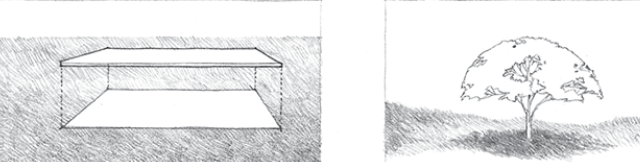
a horizontal plane located overhead which defines a volume of space between itself and the ground plane
overhead plane

it defines the perpendicular edges of a volume of space
vertical linear elements
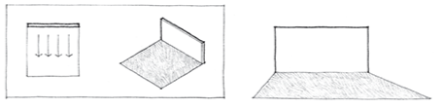
it articulates the space on which it fronts
single vertical plane

it generates a field of space from its corner outward along a diagonal axis
L-shaped plane

it defines a volume of space between them that is oriented axially toward both open ends of the configuration
parallel planes

it defines a volume of space that is oriented primarily toward the open end of the configuration
U-shaped plane

it establish the boundaries of an introverted space and influence the field of space around the enclosure
four planes: closure
what are the qualities of architectural space?


the form of space; determined by the configuration of its defining elements and the pattern of its openings, has a significant impact on our perception of its form and orientation
degree of enclosure
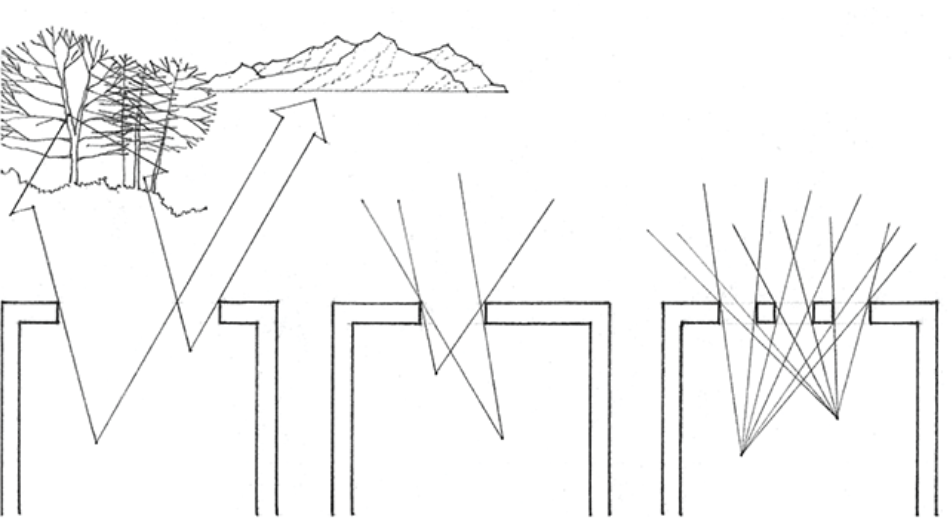
the focus of the space
view or outlook

the illumination of its surfaces and forms
light

consist of using natural forces to impel airflow through a space
ventilation
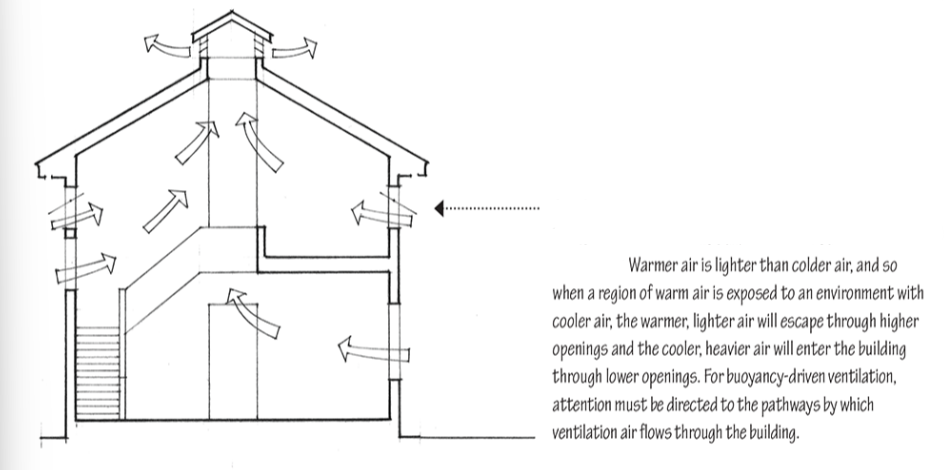
relies on the temperature difference between the air inside the building and the outdoors to drive the airflow
stack ventilation
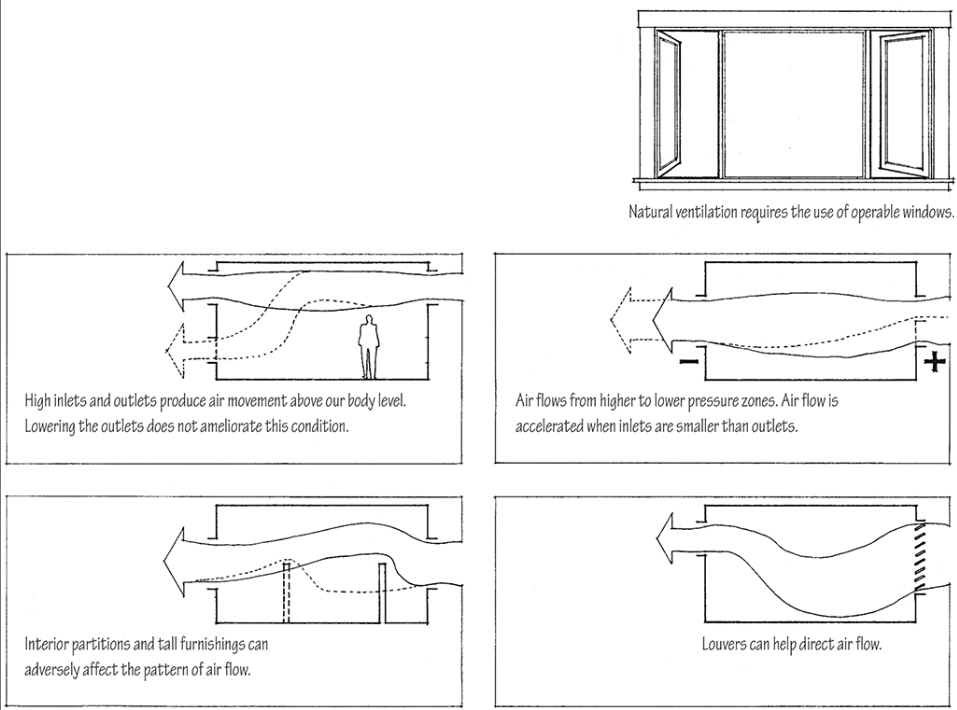
an important strategy for natural ventilation which occurs when wind hits the windward side of a building creating a positive pressure on that facade and a region of lower pressure on the opposite leeward side
cross ventilation

a space may be contained within the volume of a larger space
space within a space

the field of a space may overlap the volume of another space
interlocking space

two spaces may abut each other or share a common border
adjacent space
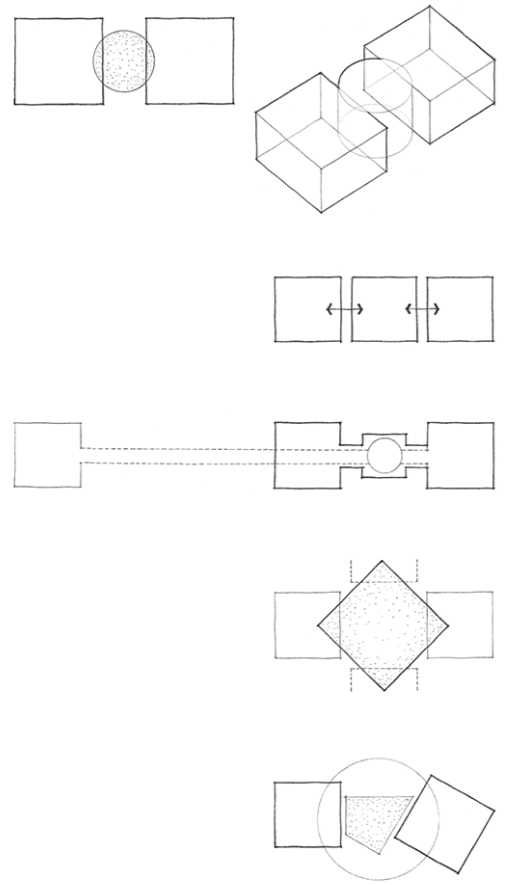
two spaces may rely on an intermediary space for their relationship
space linked by a common space

a central, dominant space about which a number of secondary spaces are grouped
centralized organization
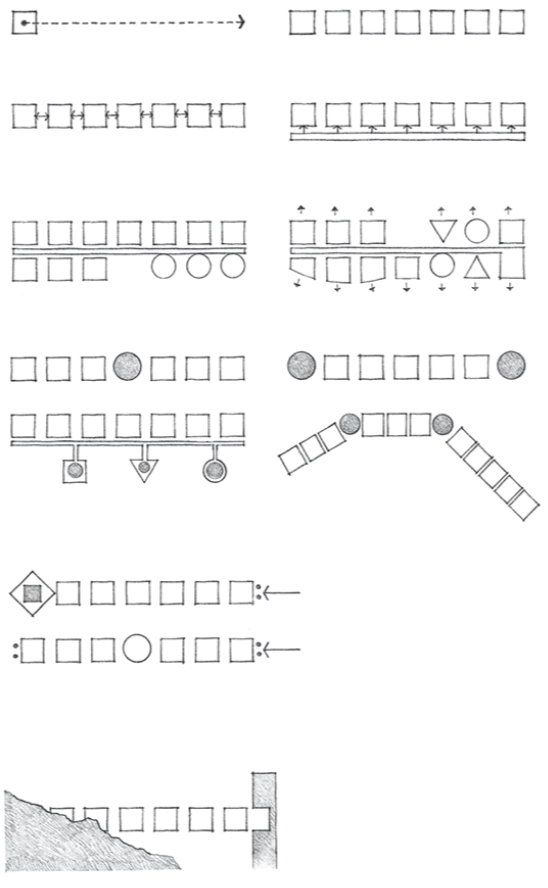
a linear sequence of repetitive spaces
linear organization

a centralized space from which linear organization of space extend in a radial manner
radial organization
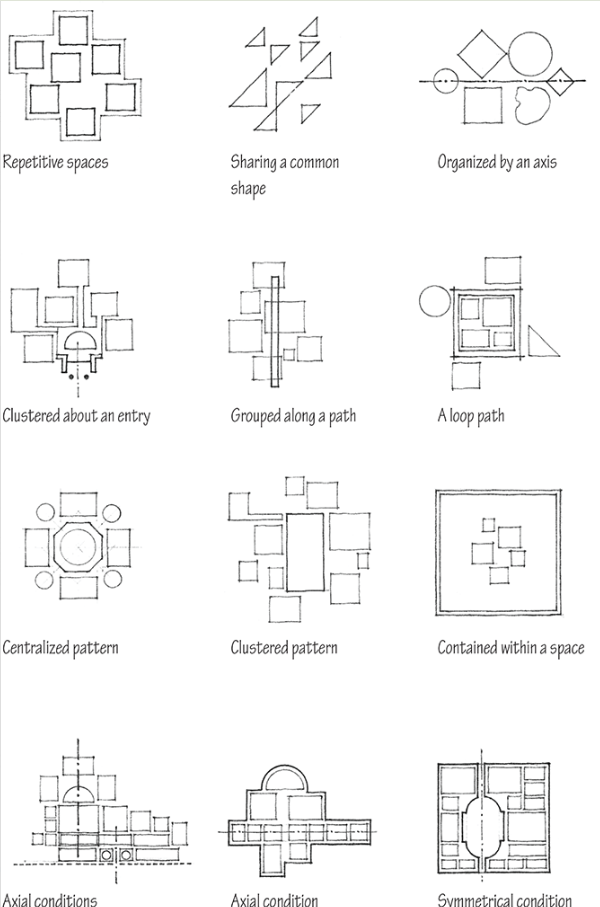
spaces grouped by proximity or the sharing of a common visual trait of relationship
clustered organization

spaces organized within the field of a structural grid or other three-dimensional framework
grid organization
the path of our movement can be conceived as the perceptual thread that link the spaces of a building or any series or exterior spaces together
circulation

the distant view
approach

leads directly to the entrance of a building along a straight axial path; the approach is clear
frontal approach

enhances the effect of perspective on the front facade and form of a building; the path can be redirected one or more times to delay and prolong the sequence of the approach
oblique approach

prolongs the sequence of the approach and emphasize the three-dimensional form of a building as we move around its perimeter
spiral approach

from outside to inside
entrance

the sequence of spaces
configuration of the path

edged, nodes, and terminations of the path
path-space relationships

corridors, halls, galleries, stairways, and rooms
form of the circulation space

a straight path that can be curvilinear or segmented, intersect other path, have branched, or form a loop
linear configuration

has linear paths extending from or terminating at a central common point
radial configuration

a single continuous path that originates from a central point, revolves around it, and become increasingly distant from it
spiral configuration

consist of two sets of parallel paths that intersect at regular intervals and create square of rectangular fields of space
grid configuration

consist of paths that connect established points in space
network
combination of the preceding patterns
composite configuration

the integrity of each space is maintained
the configuration of the path is flexible
mediating spaces can be used to link the path with the spaces
pass by spaces
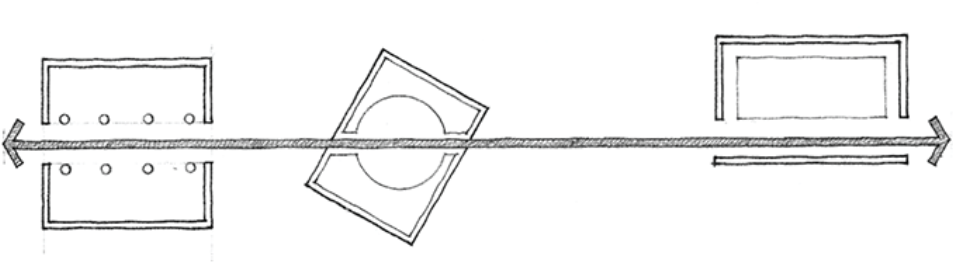
the path may pass though a space axially, obliquely, or along its edge
the path creates patterns of rest and movement within it
pass through spaces

the location of the space establishes the path
used to approach and enter functionally or symbolically important spaces
terminate in a space
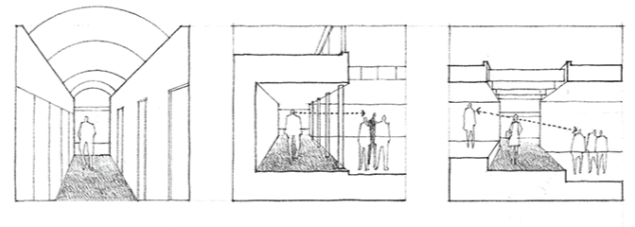
give (3) forms of the circulation space
enclosed
open on one side
open on both sides

provide vertical movement between the levels of a building or outdoor space
stairs and stairways
a fixed proportion used in determining measurements and dimensions
relationship between the size of an object or space and its size in relation to something else.
scale
refers to proper or harmonious relation of one part to another or to the whole
proportion
give the (3) types of proportion
the difference between each measurement is the same. (e.g., 1, 2, 3)
each measurement is multiplied by the same number. (e.g., 1, 2, 4)
multiple dimensions relate to one another to create unity and balance. (e.g., 2, 3, 6)

give the (7) theories of proportion
golden section
classical orders
renaissance theories
modulor
ken
anthropometry
scale
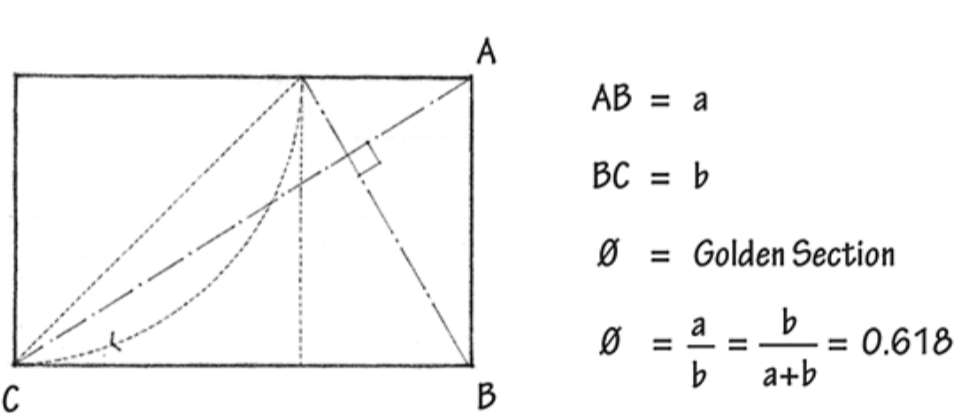
the ratio between two sections of a line or the two dimensions of a plane figure in which the lesser of the two is to the greater as the greater is to the sum of both
also known as the golden ratio, divine proportion, or phi (Ф)
is a mathematical proportion of approximately 1.618
golden section
enumerate the (5) classical orders
tuscan
doric
ionic
corinthian
composite

tuscan measurements
1 ¾ diameter
3/2 diameter
6 diameter
½ diameter

doric measurements
2 diameter
½ diameter
7 diameter
½ diameter

ionic measurements
2 ¼ diameter
½ diameter
8 1/3 diameter
½ diameter

corinthian measurements
2 ½ diameter
7/6 diameter
8 1/3 diameter
½ diameter

give the (5) classification of temples according to their intercolumniation

give Vitruvius’ rules for the diameter, height, and spacing of columns
