Chapter 6: Axial Skeleton
 Call Kai
 Learn
Learn Practice Test
 Spaced Repetition
 Match
Match Flashcards
 Knowt Play
1/48

There's no tags or description
Looks like no tags are added yet.
Name | Mastery | Learn | Test | Matching | Spaced | Call with Kai | Chat |
|---|
No analytics yet
Send a link to your students to track their progress
49 Terms
Features of the maxillae include ________.
All of the above
Which of the following features belongs to the mandibular bone?
Mental foramen
The spinous processes of the five fused sacral vertebrae form a series of elevations along the ________.
median sacral crest
The major function of the vertebral body is to ________.
transfer weight along the axis of the vertebral column
The ________ is/are the bone(s) that makes up the inferior portion of the nasal septum.
vomer
The depression of the sphenoid that cradles and protects the pituitary gland is called the ________.
sella turcica
The facial bones ________.
protect and support the entrances to the digestive and respiratory tracts
Which of the following spinal curvatures is/are convex anteriorly?
cervical and lumbar
The bone that contains the cribriform plate and olfactory foramina is the ________.
ethmoid
Which of the following features belongs to the occipital bone?
hypoglossal canal

Identify the structure indicated by Label A.
Sternum
The most inferior portion of the sternum to which the diaphragm and rectus abdominis muscles attach is called the ________.
xiphoid process
Fontanelles on an infant's head ________.
All of the above
Ribs 1-10 articulate with the bodies of the thoracic vertebrae and facets on (the) ________.
transverse processes of the thoracic vertebrae
Which feature of the palatine bone articulates with the maxilla to form the posterior portion of the bony palate?
Horizontal plate
The zygomatic process is part of the temporal bone.
True
The axial skeleton functions in ________.
All of the above
Bones of the axial skeleton form the ________ axis of the body.
longitudinal
Which of the following is true of the foramen magnum?
It is located in the inferior surface of the occipital bone.
The ethmoid contains ________.
All of the above
The ________, which is the interface between the cervical curve and the thoracic curve, has a long, slender spinous process that ends in a broad tubercle that can be felt beneath the skin at the base of the neck.
vertebrae prominens
The anterior, curved surface of the frontal bone that forms the forehead is called the ________, and it serves as an attachment site for muscles of the scalp.
squamous part

Identify the structure indicated by Label E.
Sacrum
The jugular foramen is formed by which bones?
Occipital and temporal
The mandible is the upper jawbone.
False
Which type of vertebra has a transverse costal facet?
Thoracic
Which fontanelle is found at the junction between the squamous suture and the coronal suture?
Sphenoidal
Bones located within a space in the temporal bone that provide the sense of hearing are called ________.
auditory ossicles
In the normal adult, there are ________ distinct curvatures to the vertebral column.
four
Which bone makes up most of the floor of the orbit?
maxilla
The parietal, temporal, frontal, and occipital bones are part of (the) ________.
cranium
Which of the following sutures marks the boundary between the temporal bone and the parietal bone of each side of the skull?
squamous
The anterior two-thirds of the bony palate is formed by the ________ of the maxillae
palatine process
Which bone contains the infra-orbital foramen?
maxilla
The ________ extends to the smooth articular surface of the head of the mandible.
condylar process
The lambdoid suture is the boundary between which bones?
parietal and occipital
Which of the following contains the external acoustic meatus?
temporal
The temporal bone contains the foramen magnum and forms part of the wall of the jugular foramen.
False
The inferior nasal conchae are paired scroll-like bones, each of which attach to the lateral walls of the nasal cavity on each side of the nasal septum.
True
Which structure can most easily be felt on the dorsum?
Spinous process
The superior aspect of each nasal bone articulates with the ________ bone.
frontal
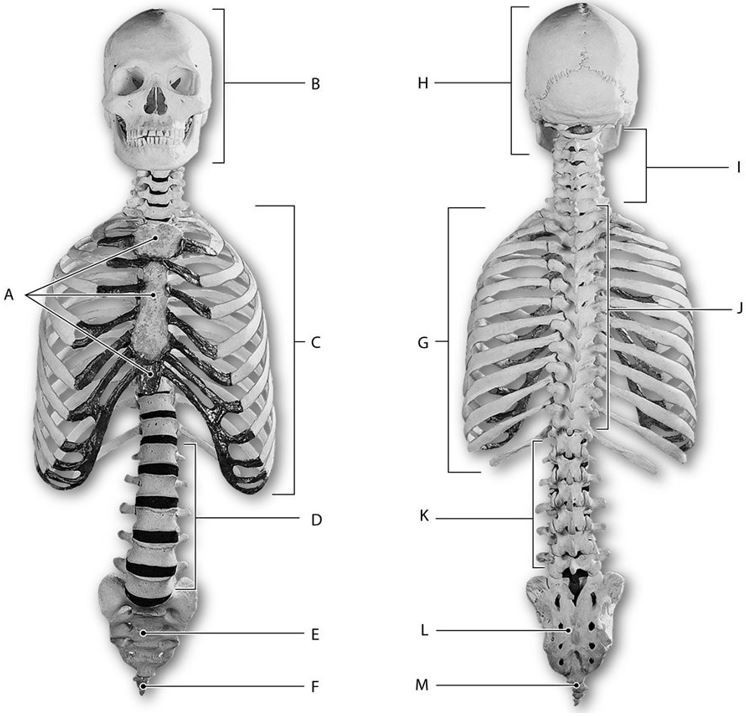
Identify the structure indicated by Label K.
Lumbar vertebrae
The opening that allows passage of the internal carotid artery into the skull is the ________.
carotid canal
In the condition called spina bifida, the most common neural tube defect (NTD), a portion of the spinal cord develops abnormally such that the adjacent ________ do not form.
vertebral arches
Which of the following bones forms most of the lateral wall of the orbit?
zygomatic bone
The temporal processes are part of which bone?
zygomatic
What anatomical feature results from the fusion of the body of C1 and C2 during development and serves as a pivot for head rotation?
odontoid process
Which vertebra contains the dens?
axis
Which of the following organs is protected by the rib cage?
All of the above