DNA (genetics)
 Call Kai
 Learn
Learn Practice Test
 Spaced Repetition
 Match
Match Flashcards
 Knowt Play
1/35

There's no tags or description
Looks like no tags are added yet.
Name | Mastery | Learn | Test | Matching | Spaced | Call with Kai | Chat |
|---|
No analytics yet
Send a link to your students to track their progress
36 Terms
DNA
“Deoxyribonucleic Acid”
CHARAC: Polymer/Polynucleotide (composed of multiple repeating monomers)
FUNC: Carries the genetic blueprint/instructions for building, running, and repairing an organism + expresses hereditary information
who determined the the structure of DNA? (2)
James Watson + Francis Crick
how did the discovery of DNA’s structure support three of its key properties?
Double Helix Model shows:
Information storage (letters for nitrogenous bases spell out instructions)
Replication (complementary base pairs mean each strand can act as a template to create another replica of DNA)
Mutation (changes/errors can cause genetic variation/evolution)
Why did protiens seem better suited for storing genetic info?
It was seen as more versatile/physically complex (with 20 different amino acids = endless combinations/shapes to fold into)
DNA was thought to be too simple (only 4 diff amino acids)
DNA in cells (Loc, structure x2)
Eukaryotic Cells: (animals, plants)
LOC: Nucleus, organells
STRUC: divided into chromosomes + wrap around Histones
Prokaryotic Cells: (bacteria)
LOC: free-floating in nucleoid
nitrogenous bases + Chargaff’s Rule/complementary base pairing + ring type + # and type of bonds
Adenine, Thymine, Guanine, Cytosine
rings contain Nitrogen (N)
A+T: 2 Hydrogen Bonds
G+C: 3 Hydrogen bonds
nucleobases
Purines (adenine, guamine) and Pyrimidines (cytosine, thymine)
“Pure As Gold”
“Pie is CuT”
DNA Nucleotide
The monomer (basic building block) of DNA
Includes: Pentose sugar (deoxyribose), Phosphate group, Nitrogenous base

DNA Nucleoside
A portion of the nucleotide without the phosphate group
Includes: Pentose sugar (deoxyribose), Nitrogenous base
DNA structure (flat)
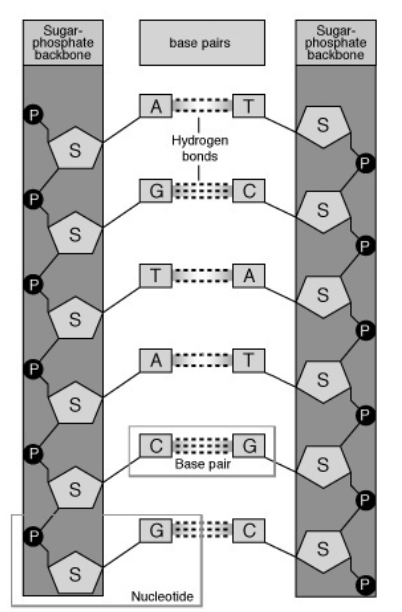
DNA structure 3D
Has 6 billion bases, 3 million pairs
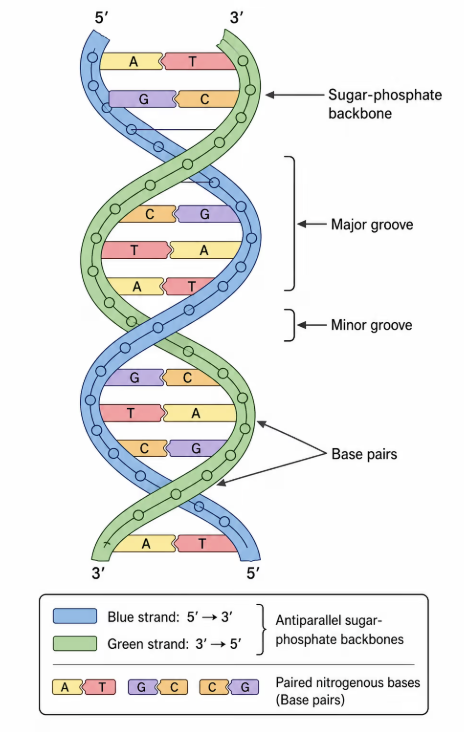
DNA shape
DOUBLE HELIX: Two strands of polynucleotides spiraling around an imaginary axis (translated into a helical shape)
Antiparallel
The backbones (in the DNA double helix) running in opposite directions (5’ —> 3’) from each other
based on where the phosphodiester bonds form on the carbons of deoxyribose sugar (‘5 phosphate OR ‘3 hydroxyl)
necessary for the double helix shape/twist
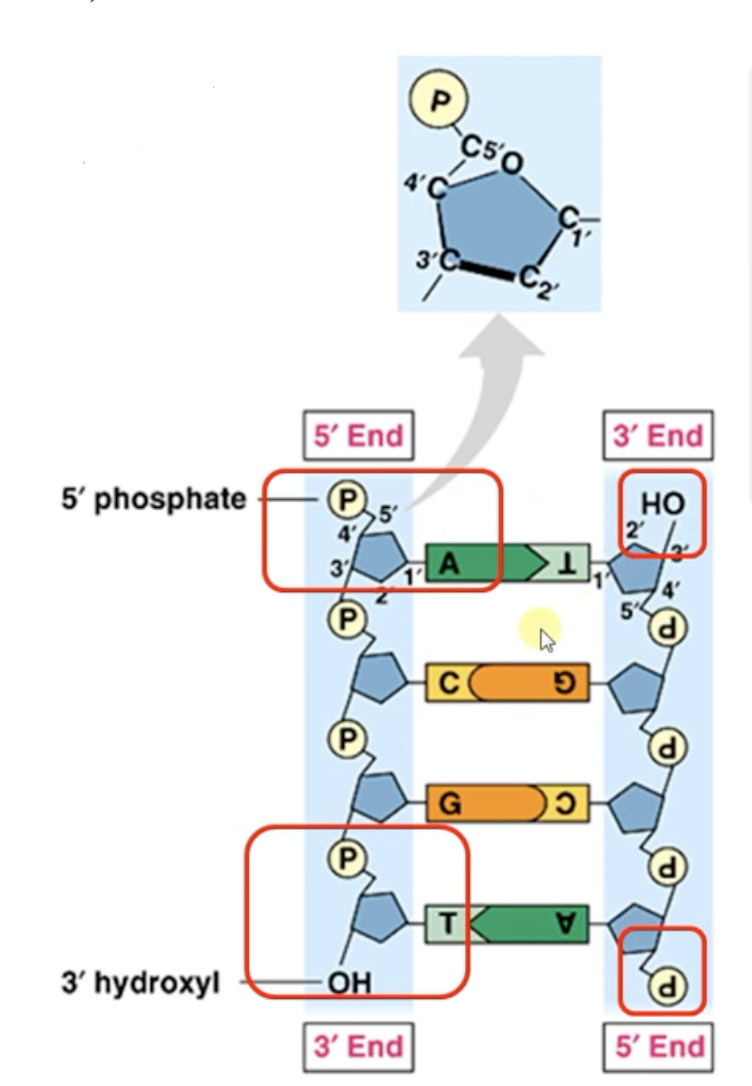
Labeling #’ on a deoxyribose sugar + determining 5’ vs 3’ ends
1’ ALWAYS starts clockwise from the 5’ (which is ALWAYS attached to the phosphate group) —> then go clockwise from there
3’ end = 3’ is sticking up, nucleotide looks upside down
5’ end = 5’ is sticking up, nucleotide looks right side up

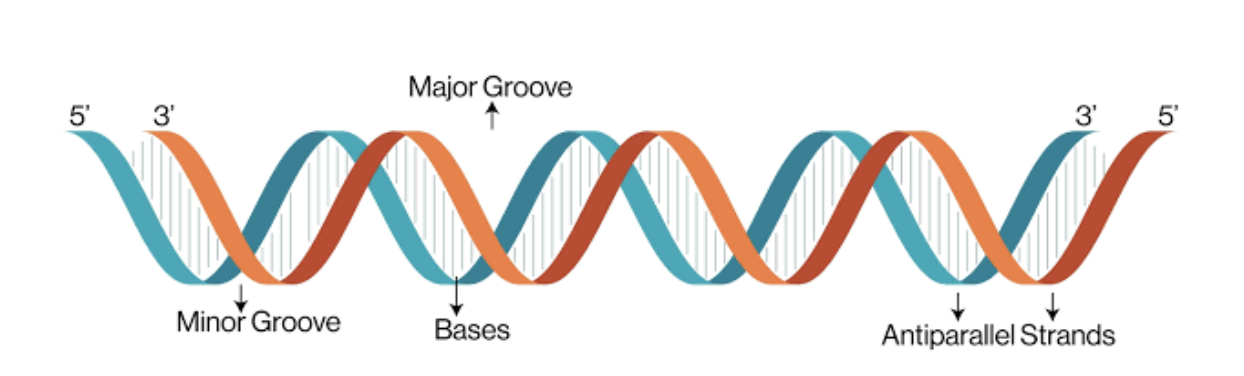
DNA Grooves
Major Groove: wider gap between the backbones (backbones farther apart)
Minor Groove: smaller gap between the backbones (backbones closer together)
less than 30 nucleotide
oligonucleotide
more than 30 nucleotide
polynucleotide
# of rings for Deoxyribose, Adenine, Guanine, Cytosine, and Thymine
Deoxyribose: 1
Adenine (Purine): 2
Guamine (Purine): 2
Cytosine (Pyrimidines): 1
Thymine (Pyrimidines): 1
Hydrogen Bonds
connect nitrogenous bases
maintains the double helix shape + allows unwinding of both strands
Purpose of unwinding DNA
whenever the cell needs to read/copy the genetic code (stored by DNA)
DURING: DNA replication, Transcription (Protien synthesis)
Phosphodiester Bond
A strong chemical bond between two nucleotides, forming the backbone of DNA

atom(s) common to all three parts of a nucleotide
carbon (C), hydrogen (H)
atom found in a base but not found in a phosphate or sugar
nitrogen atom
atom found in a phosphate but not found in a base or sugar
phosphorus atom
which parts of two nucleotides interact when forming a DNA strand
phosphate group and pentose sugar (deoxyribose)
Which part of a nucleotide is not involved in forming the sugar-phosphate backbone of DNA
nitrogenous bases
what part of the nucleotide forms the inside of the double helix (“rungs of the ladder”)
nitrogenous base
why is DNA called a double helix?
because two polynucleotide strands are formed and then twisted around each other by the hydrogen bonds (from the nitrogenous bases of each strand) + they are twisting around an imaginary axis
Prime (‘)
used to indentify the carbon atoms in the deoxyribose sugar
EX: 2’ carbon, 5’ carbon
what groups stick out of the 5’ and 3’ ends of DNA?
5’= phosphate group
3’= hydroxyl group
which two nitrogenous bases appear to have more atoms (bec of rings)
Guanine and Adenine
Mitosis
to split genetic material EVENLY/ACCURATLEY into two new cells
DNA tightly coils up to the point when you can see the chromosome (X shape) — prevents tangling/tearing

Diploid # of chromosomes (human somatic cell VS. gamete)
*shown through karyotypes*
Human somatic cell:
46 (23 pairs)
two complete sets (one for each parent)
Gamete:
23 (no pairs)
single sets
Karyotype
An organized visual profile of one’s complete set of chromosomes
Arranged by size (big —> small), banding pattern, and shape

Why were strawberries used for DNA extraction?
They are Octoploids (have 8 sets of chromosomes), which allows one to see the DNA more easily
Cheaper, safer (allergens), smushable
Function of each step in strawberry DNA extraction
Mashing fruit = physically breaks open cell walls/membrane and releases DNA
Dish soap = dissolves/breaks open lipid bilayers of the cell membrane
Salt = neutralizes negative charges on DNA’s sugar phosphate backbone, allowing strands to clump up
Ice-cold isoporpyl alcohol = makes DNA strands clump up and percipitate out of the solution, isolating it (DNA cannot dissolve in alcohol)