Chemistry-chapter 11: Acids and bases
 Call Kai
 Learn
 Practice Test
 Spaced Repetition
 Match
 Flashcards
 Knowt Play
1/15

There's no tags or description
Looks like no tags are added yet.
16 Terms
Arrhenius acids
produce (H+1) when they dissolve in water, they have a sour taste, turn blue litmus paper red, has H in formula (has a H in the first position)

Arrhenius bases
produce (OH-1), taste bitter or chalky, feel soapy and slippery, has OH in formula, turns red litmus paper blue
Bronsted- Lowry theory
an acid is a substance that donates H+1
a base is a substance that accepts H+1

Bronsted- Lowry theory acids
H+1 donnor/proton donor
H3O+ in water

Bronsted- Lowry base
H+ acceptor
steals H+
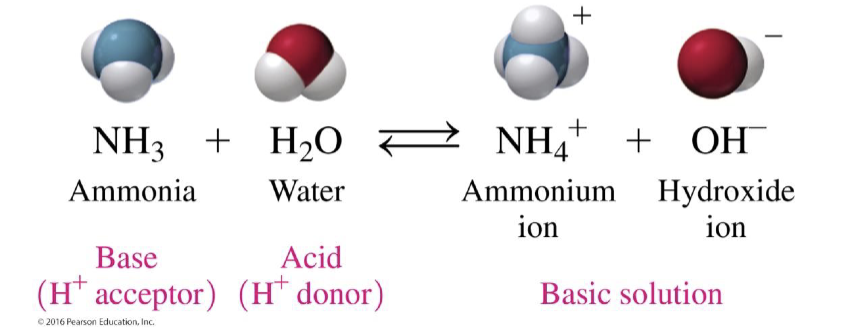
Conjugate Acid-Base pairs
each related by the loss and gain of H+
one occurs in the forward direction
one occurs in the reverse direction
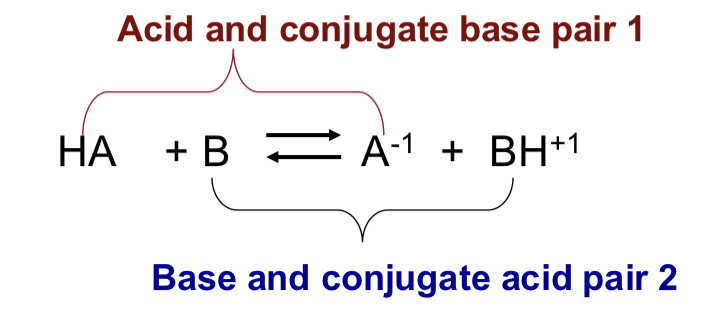
how to write a conjugate base
Minus H+
minus 1 charge
How to write a conjugate acid
plus H
plus 1 charge
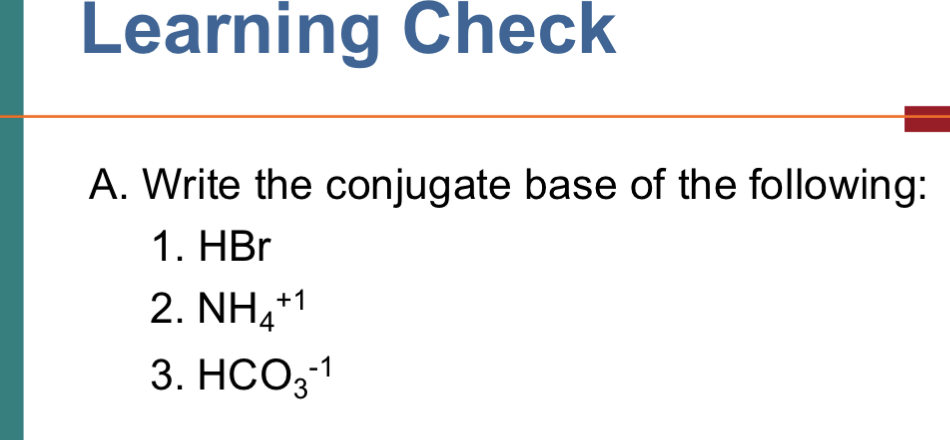
Br-
NH3
CO3-2

HNO2
NH4+1
H2O

Strong acids
Completely ionizes in aqueous solutions
have weak conjugate bases
ex: HCl, HBr, HI, HNO3, H2SO4, HClO4 (memorize these)

Weak acid
dissociates only slightly in water to form a few iron in aqueous solution

Strong bases
formed from metals of Group 1 and 2 with OH-1

A. strong acid
B. weak acid
C. strong base
D. strong acid
E. weak base
Acid dissociation constant Ka
Weak acids have small Ka values, while strong acids have very large Ka Values

Base dissociation constant Kb
The stronger the base the larger the Kb value, the weaker the bas the smaller the Kb