Sustaining ecosystems - polar environments
 Call Kai
 Learn
Learn Practice Test
 Spaced Repetition
 Match
Match Flashcards
 Knowt Play
1/15

There's no tags or description
Looks like no tags are added yet.
Name | Mastery | Learn | Test | Matching | Spaced | Call with Kai | Chat |
|---|
No analytics yet
Send a link to your students to track their progress
16 Terms
arctic + antarctic
The Arctic is an ocean surrounded by land and Antarctica is a continent surrounded by ocean
Most of the Arctic's ice is sea ice, and this varies throughout the year
Melting Arctic sea ice does not raise sea levels, but Antarctica's melting land ice does cause variation in global sea volume
Arctic antarctica : location
Region within the Arctic Circle, from 66.5° to 90° north of the Equator | Landmass encompassing the South Pole and mostly south of the Antarctic Circle from 66.5° to 90° south of the Equator |
Arctic antarctica : climate
Fluctuating between 10° C in summer to -40° C in winter Annual precipitation is less than 500mm per year | Colder than the Arctic with average summer temperatures of -28°C - coastal regions are warmer than the interior but winter temperatures have reached as low as -90°C (Vostok research station) Annual precipitation inland is 50mm and 200mm at the coast |
arctic features
The ocean is surrounded by continents and large islands, with drifting sea pack ice that extends in winter and icebergs. Ice reaches heights of 3m in places
Mountainous regions on land, with areas covered in permanent ice and snow
Includes the treeless, permafrost, tundra region where only the surface layer of the soil thaws each summer
antarctic features
Antarctica is a continent covered by a permanent ice cap ice and surrounded by the Antarctic Ocean
Mountains up to 3794km high with the Transantarctic Mountains running across the whole continent
Ice reaches thicknesses of 4.5km in places
In winter, Antarctica almost doubles in size due to freezing seawater
Arctic antarctica : flora
Arctic region - lichen and mosses Tundra - sedges, grasses, low-growing shrubs and small flowering plants such as the Arctic poppy | Mostly lichen and some mosses Phytoplankton in the ocean |
Arctic antarctica : fauna
| No indigenous terrestrial mammals Penguins, seals and whales rely on the sea for their food and land provides a habitat for breeding |
Arctic soil
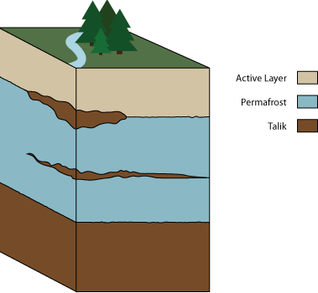
Underlying rock weathers slowly due to low temperatures Permafrost sits below the active layer and remains frozen all year round The active layer melts in the summer months and ranges from 20-100cm To prevent damage to the permafrost, buildings are built on stilts |
Antarctic soil + arctic tundra biodiversity, adaptations
Antarctic soils can be loose, soft, and sandy or frozen, hard, and rocky
Very little organic matter to support more than mosses or lichens
The tundra biome has about 400 varieties of flowers but only 48 different animals
Plants in the tundra need to adapt to wet summers and dry winters:
Summer: The top layer of soil thaws producing boggy and waterlogged land
Winter: Frozen soil and long, dark winters
Animals need to adapt to cold, dry, snowy conditions, as well as wet summers
fauna adaptations for polar environments
Animal Insulation (Climate): Animals have adapted to extreme sub-zero temperatures with thick physical insulation, such as blubber in seals and double-layered fur in polar bears and musk oxen.
Animal Camouflage (Landscape): To survive in barren, snow-covered landscapes, predators (polar bears) and prey (Arctic hares) have evolved white winter coats for camouflage.
many animals hibernate to conserve energy
birds migrate to other places during winter
flora adaptations for polar environments
Plant Roots (Soil/Permafrost): (permafrost prevents further plant growth), plants cannot grow deep roots. They have adapted by growing shallow roots that spread horizontally.
Plant Size & Shape (Climate): To survive the high winds and low moisture (less than 250mm precipitation), plants are small, round-shaped, and have tiny leaves to minimize moisture loss and avoid wind damage. They also have a rapid growing season of just 50–60 days to capitalise on the brief summer.
e.g. caribou moss, lichens and grasses
lots of plants become dormant to conserve energy
interdependence within polar environments : fragile marine food web
Because terrestrial plants are scarce, phytoplankton form the base of the entire food web (Phytoplankton → Krill → Fish → Penguins/Seals/Bears). Upwelling nutrient-rich ocean currents drive phytoplankton growth; if climate change alters ocean currents or melts sea ice, key hunting and breeding platforms for seals and polar bears disappear.
interdependence within polar environments : slow nutrient cycle
Sub-zero temperatures cause extremely slow decomposition, resulting in nutrient-poor soils. Plants rely heavily on herbivores (like reindeer) to fertilize soil with dung and disperse seeds on their fur.
interdependence within polar environments : permafrost feedback loop
Low-growing plants act as an insulating blanket in summer, preventing the permafrost underneath from thawing.
If human activity or warming damages surface vegetation, permafrost thaws, releasing trapped methane from litter decomp and causing surface flooding that destroys plant roots.
human effect of exploiting the polar environments
Mineral & Oil Exploitation: oil spills pollute pristine tundra; heavy machinery melts permafrost
Climate & Permafrost Melt: GH thaws permafrost, decomposing organic matter and releasing trapped methane, further accelerating GHG
Species Range Shifts: Warmer temps force species to migrate further north towards the poles.
Apex predators like polar bears lose sea-ice platforms for hunting and face habitat loss with nowhere further north to go.
Fragile Food Web Disruptions: Because biodiversity is extremely low, drops in key prey populations (e.g., Arctic hares) directly cause predator populations (e.g., Arctic foxes) to crash.
human sites destroy habitats