Software Engineering Exam #2
 Call Kai
 Learn
 Practice Test
 Spaced Repetition
 Match
 Flashcards
 Knowt Play
1/24

There's no tags or description
Looks like no tags are added yet.
Name | Mastery | Learn | Test | Matching | Spaced | Call with Kai | Chat |
|---|
No analytics yet
Send a link to your students to track their progress
25 Terms
The steps of dynamic data flow analysis
Restate the problem as data flow graph
Identify the afferent and efferent data elements
First-level factoring
Factoring of afferent, efferent, and transform branches.
How to produce a factored system for a DDFA problem
-provide detailed data dictionaries for each interface including identifying inputs and outputs.
-Modules should have high cohesion and low coupling
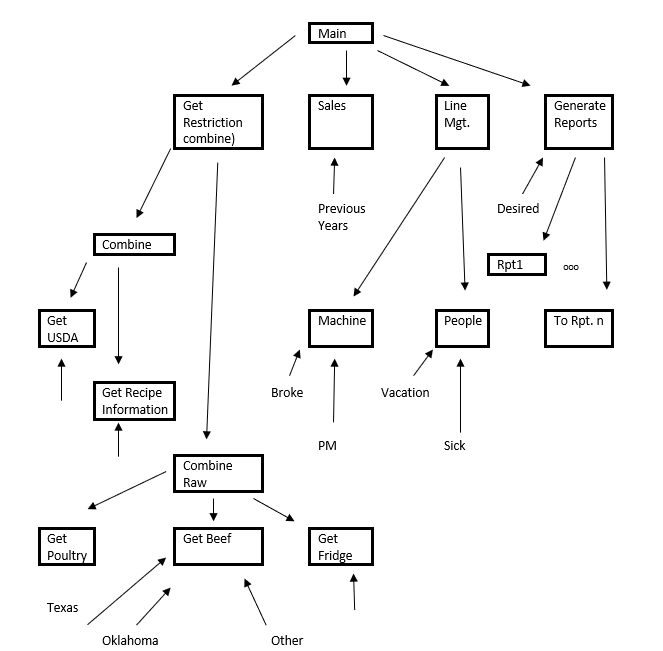

Data Flow Graph Example:

How data flow graphs work
-Design concentrate on identifying what is required, the necessary inputs and desired outputs.
-Label the data elements carefully with descriptive names and leave a transform bubble.
-use ‘and’ and ‘or’ operators where appropriate in diagrams
-make sure the data flow is correct for the level of detail being modeled.

Which metrics to use to evaluate a design
specified all input/output parameters and their types for each module.
Meet Miller’s Law?
Meet Graicunuas Law (Relations or Interactions?)
Minimized Data and Control Coupling
Are the modules Functionally Cohesive with Sequential Cohesion between them?
Highly Factored - upper modules mostly command/control with details implemented in lower level?
Identifiable Afferent, Central Transform and Efferent Branches?
Meet Scope-Of-Effect subset of Scope-Of-Control goals?
The steps of using the Jackson technique
Design:
1.Evaluate the problem environment and record our understanding of it by defining structures for the data to be processed
2.Develop a program structure based on data structure
Implementation:
3.Define the tasks to be performed in terms of elementary operations, any order.
4.Allocate each of the elementary operations to suitable components of the program structure
How to solve problems with the Jackson technique
Define the data structure (Design)
Develop the program structure (Design)
List the tasks (Implementation)
Allocate each operation (Implementation)
The philosophy of the Jackson
Programs process datum, not control!
The structure of a program should reflect the structure of the data it processes.
The types of structures allowed in Jackson approach to design
Sequential
Iteration
Selection
Sequential (type of structure in Jackson)
The notation indicates that the DATA consists of a structure of Type -1 followed by a structure of Type-2.

Iteration (type of structure in Jackson)
The structure indicates that the DATA consists of an iteration of structures of Type-1 (by the *)

Selection (type of structure in Jackson)
The structure (DATA) consists of a structure of TYPE-1 or TYPE-2

The difference between macro and micro flow charts
Macro - Gods Eye View (Overview of what is to be accomplished)
Micro - Detailed implementation of Gods eye view.
How to draw a flow chart
Define purpose and scope
List Steps in Order
Choose Standard Shapes
Draw and Connect the Shapes
Review and Refine

What is Inversion of control?
Where are you likely to encounter it ?
-code being called by another program, got modules separated they work separated
What is a CASE tool?
What it does for you?
Computer Aided Software Engineering
automates and supports design and development activities
What is an audit trail?
What is it used for?
-A record of every transaction made against the system
-Used for system recovery
What are the effects from excessive or unpaid overtime?
results in poor work attitudes, your best employees will eventually leave
The replacement costs for employees
approximately 1.5 to 2 months salary to advertise, interview and hire
The results of the DeMarco and Lister performance studies
A few good employees are better than an army of average employees.
What is flow and why is it important
a deep, nearly meditative involvement with work attained during single-minded work with no interruptions.
IT IS MOST CREATIVE PERIOD
The cost related to having a poor work environment
Ways of measuring quality
When in a project you must build quality