Human Phys midterm 1
 Call Kai
 Learn
 Practice Test
 Spaced Repetition
 Match
 Flashcards
 Knowt Play
1/169

There's no tags or description
Looks like no tags are added yet.
170 Terms
Homeostasis
tendency of a system to maintain internal stability
homeostatic system
an open system that maintains itself by controlling many steady state mechanisms
what are some examples of variables under homeostatic control
osmolarity, temp, pH, movement of material inside and around the cell
another word for steady state
dynamic equilibrium
energy in = energy out
water flowing into tub and draining out at the same rate
Equlibrium
system remains constant at the lowest energy state
no energy in and no energy out
tub full of water
Extracellular Fluid
third of all fluid
plasma in blood vessels and interstitial fluid (between cells)
Intracellular fluid
two thirds of fluid
fluid inside cells
T or F: ECF and ICF are in disequilibrium
F: they are in steady state
Why are the ECF and ICF not in Equilibrium
even though they are in osmotic balance (equal particle concentration) they are not in chemical or electrical balance
Ex. there is a higher conc. of K+ in the ICF and the ICF is more negative than the ECF
T or F: the body is electrically positive
F: the body is electrically neutral
Channels/pores
do not hydrolyze ATP
gated (usually closed at rest)
Ex. aquaporins
Voltage gated
opens due to membrane potential and lets ions through
Ligand Gated
can be agonistic (opened by ligand) or antagonistic (closed by ligand)
Mechanosesnitive
channel is deformed
ex. touch, hearing, proprioception
leak gate
usually open and ion flows down gradient
Transporters/carriers
may or may not hydrolyze ATP
moves ions and small molecules across membrane
3 classes of transporters
uniporters (one molecule)
symporters (2 molecules in the same direction, using one’s gradient)
antiporters (2 molecules in different directions, using one’s gradient)
facilitated diffusion
one molecule flowing down gradient using transporter/carrier
no ATP
secondary vs primary active transporter
secondary is coupled to primary to maintain gradient
utilizes a gradient
primary uses ATP and moves against gradient
ex. Sodium potassium pump
3 sodium out and 2 potassium in
Osmosis
movement of water to more solute concentrated place across a semipermeable membrane
water follows the solute until net flux is reached (steady state)
Osmolarity
OsM
mol. of particles/L of solvent
isoosmotic, hyperosmotic, hyposmotic
T or F: when calculating osmolarity, CaCl2 counts as 3 particles
T! salts dissociate in solution
Tonicity
solute content of ECF compared to ICF
only depends on concentration of Non-penetrating solutes
Why are penetrating solutes included when calculating for tonicity
they will distribute evenly across the ICF and ECF
hypotonic solution
ECF has lower concentration of NP solutes compared to ICF
cell swells
ex. distilled water
hypertonic solution
ECF has higher concentration of NP solutes compared to ICF
cell shrinks
isotonic solution
ICF and ECF have equal concentrations of NP solutes
T or F: a hypoosmotic solution is always hypotonic
T! Because a hyposmotic solution already starts with fewer total solute particles than the cell interior, it will always have a lower concentration of non-penetrating solutes
Fick’s law
membrane permeability is directly proportional to rate of diffusion
Inversely proportional to surface area
hyponatremia
decreased sodium level in the plasma
membrane potential
electrical gradient between the ECF and ICF
T or F: at resting membrane potential, the cell is at Equilibrium
F: it is in a steady state
forces acting on ions
chemical: ions move from area of high concentration to low
electricostatic: ECF is positive and ICF is negative
Equilibrium potential Eion
membrane voltage at which chemical and electrical forces on a single ion are equal and opposite
no net flux
nernst equation
Nernst Equation
helps determine conc. of ion outside/inside
if top is smaller than bottom (out is less than in) then Eion is negative
concentration difference determines Eion
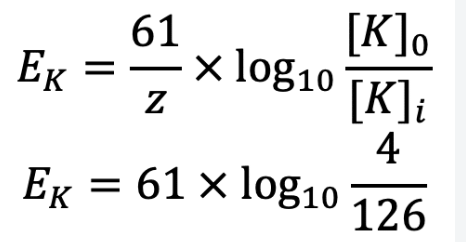
T or F: Eion can change
F: it is fixed, determined by concentrations of ECF and ICF
Concentrations of ions K, Cl, Na
K is mostly ICF
Na and Cl are mostly ECF
Membrane potential (Vm/Em)
collective voltage across the membrane at any given time of all permeant ions
shifts
sits between all permeant ions Eion
uses GHK equation
GHK equation
all ion permeabilities into account
gives more weight to more permeant ions
if membane is impermeable, Vm=0

Driving force
Vm-Eion
if negative: inward push for cations and outward push for anions
if positive: outward push for cations and inward for anions
0 means no net movement
T or F: permeability of K is twice as much as Na in neurons
T: so Vm is closer to Ek
How is concentration gradient maintained
Sodium potassium pump
Ion concentrations for K, Na, Cl
K: 5 (ECF), 150 (ICF) Eion is -90
Na: 145 (ECF), 15 (ICF), Eion is +60
Cl: 108 (ECF), 10 (ICF), Eion is -63
pathway from stimulus to response in neuron
stimulus, sensory receptor, afferent signal, integration in CNS, efferent motor signal, target, response
T or F: sensory neurons are multipolar
F: sensory neurons are pseudounipolar (signal doesn’t pass through cell body) and motor neurons are multipolar
How does the signal change from neuron to neuron
travels as electrical signal, changes to chemical in the cleft, and back to electrical in the cell body
Graded potential
local change in membrane potential (Vm)
occurs when membrane permeability changes
signal loses speed and amplitude as it propagates
T or F: in a graded potential, the amplitude can vary
T: varies depending on the intensity of the stimulus
where do graded potentials occur
in cell body and dendrites
Why do graded potentials lose amplitude
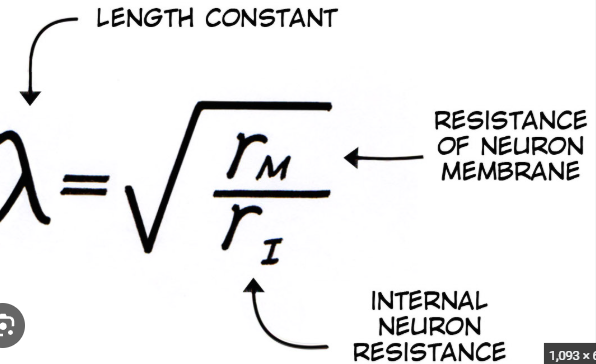
Rm (membrane resistance): depends on how holey the membrane is
increases if gates are closed (signal goes farther)
decreases if gates are open
Rc (cytoplasmic resistance): depends on diameter of the axon
increases if the diameter is smaller (less room for signal)
decreases if the diameter is bigger (signal goes farther)
T or F: Rc is constant and Rm is variable
True!
length constant
if bigger, current flows a longer distance
want a big Rm and a small Rc
Action Potentials
usually occur because of summation of graded potentials at the trigger zone
amplitude does not vary
signal travels the entire axon and doesn’t decrease in voltage
occurs in axon
when membrane potential is -70mV…
neuron is resting
between -70 and -55: graded potentials
when membrane potential is -55mV…
action potential threshold
many voltage gated sodium channels open
sodium floods into the cell
rapid depolarization (rising phase)
when membrane potential is greater than 0 mV…
overshute phase
when membrane potential is 30mV…
peak
driving force of sodium is lowest here (we are the closest to ENa that we will get)
voltage gated sodium channels start to close as we move away from peak and enter repolarization phase
T or F: voltage gated potassium channels start to open during the repolarization phase
F: start to open at threshold, but open much slower than sodium channels (so, potassium is slowly leaving the cell)
when membrane potential is less than -70mV…
hypolarization/ undershute phase
more potassium out than sodium in
How does the cell return to resting potential
sodium leaks back into the cell and the cell retains it because of electrical attraction
Sodium potassium pump DOES NOT restore resting potential, and neither do voltage-gated channels
T or F: during an action potential, the concentration gradients of sodium and potassium flip
False!! there is never a change in concentration gradient
voltage gated sodium channels cycle
resting: activation gate is closed and the inactivation gate is open
when there is depolarization, gate opens: both gates are open and ions can flow through for a defined amount of time
when time ends (miliseconds): activation gate remains open and inactivation gate closes due to conformational change (unrelated to voltage)
as membrane repolarizes: both gates close until conformational change resets sodium channel to resting
why do sodium channels have double gates
limits amplitude of APs and keeps them constant
Absolute refractory period
after AP threshold, AP is irreversible and has fixed amplitude
another AP in this region is not possible
sodium channels are still resetting
Relative Refractory period
enough voltage gated sodium channels have reset (activation gate closed, inactivation gate open)
AP can be generated
membrane is farther away from AP threshold, so a stronger stimulus is needed
VG channels vs. leak channels
VG: effect AP
leaf: effect resting
Action Potential Propagation
graded potential above threshold reaches trigger zone
VG sodium channels open and sodium enters the axon (more positive inside the cell)
positive charge flows into adjacent sections of the axon by local current flow
local current flow causes new sections to depolarize
refractory region prevents backflow of AP
Refractory regions
potassium channels are slower to open, so they open behind the AP
repolarizes the membrane
latency
time between nerve stimulation and response
if too long, may signal nerve damage
Variables that effect conduction speed
Rc
Rm
delayed opening of VG channels
myelin functions
insulates the axon
increases Rm
increases conductance rate
saves energy
what cells create myelin in the CNS and PNS
schwann cells in PNS
oligodendrites in CNS
AP vs passive current slow
AP is powerful but slow
passive current is fast but weak due to signal loss
Saltatory conduction
VG sodium channels in nodes of ranvier (regenerative flow)
signal regenerates here
passive flow in myelinated regions
signal speeds through here
signal never leaves the axon
How is myelin an energy saver
saves energy by using sodium potassium pump less because the gradiance is less diminished
how does anesthesia work
blocks VG sodium channels
pain is recieved, but the signal doesn’t propagate
Electrical synapses
direct current flow via gap junctions
signal never enters ECF
bidirectional
sign conserving
fast
uncommon in mammals
Chemical synapse
indirect signaling
unidirectional
can be sign inverting
in mammals
Calcium regulation of NT release
AP depolarizes axon terminal
depolarization leads to VG calcium channels open and Calcium flowing into terminal
calcium triggers exocytosis of vesicles
NT diffuses across synaptic cleft and binds receptors on postsynaptic cell
NT binding initiates response in postsynaptic cell
ionotropic channels
ion channel
binding causes channel to open and ion flows down its gradient
fast, but every receptor must be bound
What type of channels do glutamate, GABA, and nicotinic ACh bind
all bind ionotropic channels
glutamate is excitatory in CNS
GABA is inhibiting in CNS
ACh is excitatory in PNS
G protein coupled receptors
binding causes dissociation of g protein
g protein activates ion channel
amplification: one receptor can activate many proteins
ex. muscarinic ACh receptors
3 ways to stop NT activity
NT is returned to axon terminals for reuse or transported to glial cells
enzymes inactivate NT
NT can diffuse out of cleft
Signal summation
either excitatory or inhibitory
depends on postsynaptic receptors
excitatory depolarizes and inhibitory hyperpolarizes
summed input from presynaptic neuron determines charge of AP on the postsynaptic neuron
Trigger zone
site of stimulus integration
high density of VG sodium channels
excitatory/inhibitory postsynaptic potential
graded potential
excitatory: net positive charge flows in (depolarization)
makes AP more likely
inhibitory: net negative charge flows in (hyperpolarization)
makes AP less likely
Temporal summation
presynaptic
if graded potentials are close enough in time from a single presynaptic neuron causes an AP
Spatial Summation
postsynaptic
if multiple graded potentials on one postsynaptic neuron fire close enough in time and space, AP is generated
post synaptic inhibition: inhibitory signal can stop AP if close enough
Receptor Potential
conversion of stimulus into electrical signal by opening or closing ion channels
graded potential
Touch receptors
ruffini: stretch
pacinian: vibration
nociceptors (free nerve endings): pain, itch
meissner’s: light touch
merkel’s: course touch
white and grey matter in the spinal cord
white surrounds grey
white matter: myelinated axons and few cell bodies
grey matter: unmyelinated cell bodies, dendrites, and axons
Dorsal Root
carries sensory (afferent) info to CNS from outside
ganglion receives sensory info
made of primary sensory neuron cell bodies
terminates in spine or brain
aka nucleus in CNS
Ventral root
carries motor (efferent) into the muscles and glands from CNS
tract
bundle of axons running through white matter that connects CNS
aka nerve in PNS
T or F: thalamus integrates all sensory information for the brain
F: not smell (olfaction)
T or F: info can switch tracts
F: information will flow down or up one tract to or from the brain
overall pathway to somatosensory cortex
PNS to CNS (primary and secondary synapse at spine or medulla)
CNS to brain (secondary and tertiary synapse in thalamus)
thalamus to cortex (tertiary terminates in specific location in the cortex)
T or F: secondary and tertiary neurons are interneurons
True! they are completely in the CNS
Dorsal column medial lemniscus (DCML) pathway
carries info for more nuanced senses
fine touch, vibration, propioception
neurons cross midline at medulla and synapse in medulla then again in thalamus
spinothalamic tract
recieves survival info
pain, temp, coarse touch
neurons cross midline at spinal cord, then thalamus to cortex
reflexes