acceleration
 Call Kai
 Learn
 Practice Test
 Spaced Repetition
 Match
 Flashcards
 Knowt Play
1/36

There's no tags or description
Looks like no tags are added yet.
37 Terms
acceleration
rate of change in velocity
directions of acceleration (list 6)
+ve g (Gz) → towards feet
-ve g (-Gz) → towards head
Eyeballs in (Gx) → towards back
Eyeballs out (-Gx) → towards front
Lateral g (Gy) → towards left
Lateral g (-Gy) → towards right

G-force
measurement of acceleration used in aerospace
expressed as a multiple of earth’s normal gravity
linear acceleration
change in straight line velocity
radial acceleration
change in velocity from tight turns

name the components
G = acceleration
v = velocity
g = gravitational acceleration
r = radius of turn
the impact of acceleration on blood flow
acceleration can create pressure differences from one part of your body to the next and move blood
if the pressure inside our blood vessels is negative enough (due to acceleration), they will:
collapse

fluid column (explain)
Height of a fluid column is used to measure pressure
Pressure is higher at the bottom of the column
The pressure depends on height of the column and density of fluid
AND acceleration from gravity
when you're standing, the pressure in the veins and arteries of your feet is (?) than of you’re head, due to the amount of blood from above pushing down
higher
transmural pressure
change in pressure across the wall
driving pressure
pressure difference between the ends

describe how these two systems differ in terms of flow and pressure
in B there is no flow acting upon the system
in C there is flow acting upon the system
therefore the pressure at the bottom is higher in C than in B
however, the pressure difference between inlet and outlet is 100mmHg in C (despite pressure peaking at 130mmHg)
this is because the driving pressure remains the same (transmural pressure has increased)

describe what is happening in this system in terms of pressure
above the heart the pressure drops
very low transmural pressure can make veins and arteries collapse
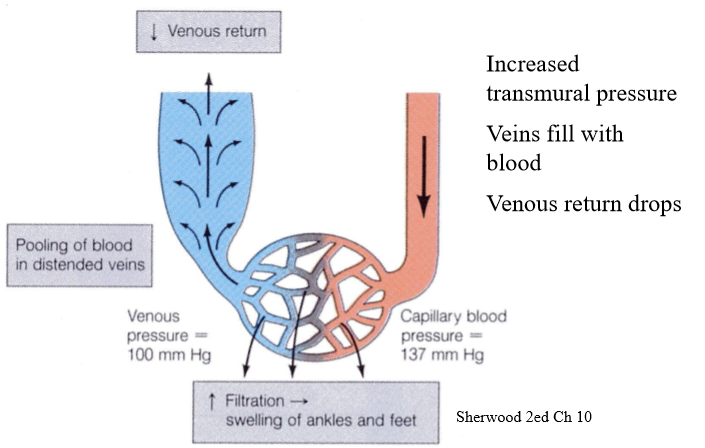
explain the following diagram
blood flowing down into the capillaries of the legs and feet cause pooling
increased transmural pressure → outward pressure on capillary walls increase → increases filtration
causes leakage of plasma into the interstitial tissue → swelling of ankles and feet
veins fill with blood and expand
expansion of the veins decreases venous pressure and venous return (also due to reduced blood volume from leakage)
what happens when the pressure in the capillaries increase (colloidal osmotic pressure)
If pressure in the capillaries increase
The pressure at the arterial and venous end of the capillaries increases --> higher than the colloidal osmotic pressure
Colloidal osmotic pressure pulls fluid back into the capillaries
Blood will leave the capillaries and will not be pulled back in as it normally would
Usually, at the arterial end the blood pressure is higher than at the venous end; colloidal osmotic pressure is lower at the arterial end and higher at the venous end
Plasma that was pushed out into the extracellular fluid is drawn back in at the venous end (due to higher conc of plasma proteins in the blood vessel)
When you stand up there's increased transmural pressure (from sudden increase in blood volume) and that result both in the veins expanding and filling with blood
Increases filtration --> fluid leaves the capillaries and enters interstitial fluid
Reduces blood volume in the veins
Reduces venous return
Causes blood pressure to fall
Lowers cardiac output

baroreceptor response to standing up (explain)
standing up causes an increase in transmural pressure in the capillaries of the legs and feet
decreases venous return which decreases blood pressure
this change is detected by baroreceptors which will relay this message to control centres in the brain
sympathetic activity increases → increases heart rate, vaso-tone and veno-tone
this will increase blood pressure
orthostatic response to standing
Blood volume in legs and feet increase
Central blood volume decreases (as well as central venous pressure)
Stroke volume decrease
Cardiac output decrease
In response venous tone increases (increasing venoconstriction of veins)
Heart rate increases
Increase total peripheral resistance
Redirects blood toward the brain
what is meant by an increase in venous tone?
Increases constriction of veins
Helps to counteract the fall in cardiac output and stroke volume
Helps reduce pooling of blood in the legs
what is total peripheral resistance?
blood pressure in peripheral blood circulation
orthostatic hypotension
Fainting after standing up
Mean arterial pressure abnormally falls on standing
More common in patients with resting hypotension
More common in hot weather due to skin vasodilation
Reflex will override the baroceptor reflex
resting hypotension
fainting when sitting or lying down
doing tight turns at high velocity will greatly (?) the G-force
increase
negative G
Centrifuging blood towards head
Broken capillaries in eyes --> 'redout'
positive G
Centrifuging blood towards feet
Loss of blood flow to eyes --> 'blackout'
acceleration due to gravity is how many G’s?
1 G
during a 4 G turn, the pilot experiences a force (?) times gravity
4
negative G’s move blood to your:
head
you lose blood flow to the eyes before you lose blood flow to the brain which is why:
blackout occurs before loss of consciousness
what happens during acceleration down towards your feet?
drop in blood pressure in vessels above the heart → collapse
venous pooling occurs → also contributes to drop in pressure in vessels above the heart
external pressure pushes arteries to close
jerk
rate of change in acceleration
a jerk of (?) G/s causes bone fractures
500
is positive G or negative G more dangerous?
negative G (towards head)
blackout occurs at about (?) G
4.8
loss of consciousness occurs by (?) G
5.4
G-suits
Allow for high positive G maneuvers
Inflate to compress lower body to stop blood flow to lower body → prevents venous pooling
Increases total peripheral resistance and arterial pressure --> reduces blood flow to the lower body in the first place
summary
Driving pressure (pressure difference between inlet and outlet)
Transmural pressure (pressure across blood wall)
Gravity produces hydrostatic pressures which will move blood
When you stand up, blood moves towards your legs
Venous pooling
Veins expand
Plasma leakage --> interstitial fluid
Reduced venous return
Reduced blood pressure
Baroreceptor reflex
Normal response
Failure of the reflex leads to orthostatic syncope
Aircrafts produce high G turns
For prolonged periods of time
Shorter periods of time --> rollercoaster
Positive G (blood flow towards feet) collapses cerebral arteries
Causes blackout (loss of blood flow to eyes)
Loss of consciousness
Safest way to take high Gs is towards your back
Prevents blackout
