Urinalysis exam 3: CSF and semen
 Call Kai
 Learn
Learn Practice Test
 Spaced Repetition
 Match
Match Flashcards
 Knowt Play
1/137

There's no tags or description
Looks like no tags are added yet.
Name | Mastery | Learn | Test | Matching | Spaced | Call with Kai | Chat |
|---|
No analytics yet
Send a link to your students to track their progress
138 Terms
Which condition does not produce elevated CSF protein?
Fluid leakage
Meningitis
Multiple sclerosis
Hemorrhage
Fluid leakage
When choroid plexus cells are present in the CSF, they:
Are clinically significant
Represent demyelination of neural tissue
May resemble clusters of malignant cells
Indicate a breakdown of the blood-brain barrier
May resemble clusters of malignant cells
The presence of xanthochromia and an increased D-dimer test in the CSF is indicative of:
A traumatic tap
Multiple sclerosis
A cerebral hemorrhage
Viral meningitis
A cerebral hemorrhage
To determine the WBC count on a cloudy CSF specimen that contains both RBCs and WBCs, it is necessary to:
Dilute the specimen using glacial acetic acid
Dilute the specimen using saline
Determine the percentage of polynuclear and mononuclear cells in the counting chamber
Centrifuge the specimen before diluting with saline and gentian violet
Dilute the specimen using glacial acetic acid
A report of many gram-positive cocci on a clear CSF specimen with a normal cell count may be the result of:
An incorrect cell count
Effective antibiotic treatment
Use of contaminated albumin in the cytocentrifuge
Use of recycled cytocentrifuge chambers
Use of contaminated albumin in the cytocentrifuge
A slightly hazy CSF specimen is diluted 1:10 with acetic acid. A total of 50 cells are counted in five large squares on both sides of the Neubauer counting chamber. The count is reported as:
50 cells/µL
55 WBCs/µL
250 cells/µL
500 WBCs/µL
500 WBCs/µL
An IgG index greater than 0.77 indicates:
Synthesis of IgG within the CNS
Alterations of the blood-brain barrier
Active demyelination of neural tissue
Increased reabsorption of IgG from the peripheral blood
Synthesis of IgG within the CNS
Normal CSF protein differs from serum protein by the:
Presence of IgG
Presence of haptoglobin
Presence of ceruloplasmin
Absence of fibrinogen
Absence of fibrinogen
The CSF glucose in a patient with a blood glucose of 90 mg/dL is 60 mg/dL. These results are representative of:
An improperly preserved specimen
Bacterial meningitis
Normal CSF
Damage to the blood-brain barrier
Normal CSF
A CSF specimen, in which there is uneven distribution of blood among the three tubes and clots are detected, is an indication of:
Meningitis
Cerebral hemorrhage
Multiple sclerosis
Traumatic tap
Traumatic tap
Dilution of CSF before performing a total cell count should be made using:
Normal saline
Deionized water
Acetic acid
Acetic acid containing methylene blue
Normal saline
PCR can be used to detect meningitis.
True
False
True
Oligoclonal bands are significant in the diagnosis of multiple sclerosis when:
They are seen in both the serum and CSF
At least five bands are seen in the CSF
They are seen in the CSF and not in the serum
They appear in both the albumin and globulin fractions of serum and CSF
They are seen in the CSF and not in the serum
The CSF/serum albumin index is performed to determine:
The amount of albumin in the CSF
Synthesis of IgG within the CNS
The integrity of the blood-brain barrier
If an unknown fluid is in the CSF
The integrity of the blood-brain barrier
The normal CSF glucose is:
25 to 50 mg/dL
80 to 120 mg/dL
60% to 70% of the blood glucose
10% to 20% higher than the blood glucose
60% to 70% of the blood glucose
Calculate the WBC count using a 1:10 dilution, 64 cells are counted in five large squares on both sides of the hemocytometer.
64 cells/µL
128 cells/µL
640 cells/µL
1280 cells/µL
640 cells/µL
Myelin basic protein is measured in the CSF to assess the condition of patients with:
Cerebral hemorrhage
Multiple sclerosis
Bacterial meningitis
Neurosyphilis
Multiple sclerosis
Three tubes of CSF are submitted to the laboratory. They are numbered 1, 2, and 3 and show blood in all tubes but decreasing in amount as one inspects tubes 1 through 3. This observation should be interpreted as:
The tubes were numbered in the wrong sequence, as one would expect increasing amounts of blood
A traumatic or bloody tap is suspected and, in all likelihood, no pathogenic significance should be attached to the presence of the blood
The pathological presence of RBCs and reported to the supervisor immediately
A pathological presence of RBCs, but because the RBC morphology is normal there is minimal importance
A traumatic or bloody tap is suspected and, in all likelihood, no pathogenic significance should be attached to the presence of the blood
Neutrophils may be present in normal CSF.
True
False
True
Increased CSF eosinophils are associated with:
Multiple sclerosis
Introduction of foreign material
Human immunodeficiency virus
Viral meningitis
Introduction of foreign material
Melanoma cells in the CSF must be differentiated from:
Macrophages containing hemosiderin
Noncleaved lymphoma cells
Medulloblastoma cells
Ependymal cells
Macrophages containing hemosiderin
An unknown bodily fluid can be identified as CSF by determining the:
Lactate content
Albumin content
Presence of "tau" transferrin
Presence of oligoclonal banding
Presence of "tau" transferrin
The lowest levels of CSF lactate can be found in patients with:
Bacterial meningitis
Viral meningitis
Tubercular meningitis
Fungal meningitis
Bacterial meningitis
CSF is formed in the _______________ and reabsorbed by the _______________.
Ventricles, spinal cord
Choroid plexus, arachnoid granulations
Arachnoid space, blood-brain barrier
Blood-brain barrier, arachnoid granulations
Choroid plexus, arachnoid granulations
An IgG index of 1.10 would most likely be seen in a patient diagnosed with:
Meningitis
Cerebral hemorrhage
Leukemia
Multiple sclerosis
Multiple sclerosis
Examination of a CSF shows 1000 WBCs, of which 75% are lymphocytes and 25% are monocytes. This finding is consistent with:
Normal spinal fluid
Bacterial meningitis
Viral meningitis
Multiple sclerosis
Viral meningitis
CSF is produced primarily by:
Secretion by cells of the arachnoid villi
Diffusion from the plasma into the central nervous system (CNS)
Selective filtration of plasma in the choroid plexus
Excretions from the ependymal cells lining the CNS
Selective filtration of plasma in the choroid plexus
A xanthochromic CSF specimen will appear:
Crystal clear
White and turbid
Yellow and clear
Red and turbid
Yellow and clear
If protein electrophoresis was performed on both serum and CSF, which of the following components would have a higher ratio to total protein in the CSF than in the serum?
Transferrin
Ceruloplasmin
Albumin
Prealbumin
Prealbumin
The primary cause of a decreased CSF glucose in bacterial meningitis is:
Utilization of glucose by the microorganisms present in the fluid
Rapid glycolysis
Utilization of glucose by leukocytes present in the fluid
Alteration of blood-brain glucose transport
Alteration of blood-brain glucose transport
Calculate the sperm concentration and sperm count using a 1:20 dilution of a specimen with a volume of 3 mL, an average of 86 sperm are counted in the five RBC counting squares of the Neubauer hemocytometer.
43 million/mL and 129 million/specimen
86 million/mL and 258 million/specimen
17 million/mL and 52 million/specimen
69 million/mL and 206 million/specimen
86 million/mL and 258 million/specimen
Sperm motility after 1 hour should be at least:
50%
60%
70%
80%
50%
Semen analysis on postvasectomy patients should be performed:
Within 1 week postvasectomy
Within 1 month postvasectomy
Until two consecutive monthly specimens show no sperm
Until two consecutive monthly specimens show no viable sperm
Until two consecutive monthly specimens show no sperm
Yellow color in a semen specimen may be caused by all of the following except:
Urine
Preservation at room temperature
Medications
Prolonged abstinence
Preservation at room temperature
Spermatogenesis takes place in the:
Epididymis
Seminiferous tubules
Bulbourethral glands
Seminal vessels
Seminiferous tubules
Which is not included in the motility component of a sperm analysis evaluation?
Progressive and Brownian movement
Percentage of motile sperm
Quality of movement
Motility of normal and abnormal sperm
Motility of normal and abnormal sperm
Semen specimens can contain HIV and hepatitis viruses.
True
False
True
A semen specimen in which clumping of sperm is observed should be further tested using the:
Fructose test
Eosin-nigrosin stain
Immunobead test
Computer-assisted semen analysis
Immunobead test
When performing sperm morphology analysis, the minimum number of sperm that should be evaluated is:
50
100
200
500
200
Which is not proper for collection of a semen specimen?
In a sterile container
After a 3-day period of sexual abstinence
At the laboratory followed by 1 hour of refrigeration
At home and delivery to the laboratory within 1 hour
At the laboratory followed by 1 hour of refrigeration
Antisperm antibodies are produced by both males and females.
True
False
True
The normal sperm concentration is:
140 to 200 million/mL
10 to 90 million/mL
20 to 160 million/mL
50 to 100 million/mL
20 to 160 million/mL
Which is the part of the male reproductive system that neutralizes vaginal acidity?
Prostate
Bulbourethral glands
Seminal vessels
Epididymis
Bulbourethral glands
Which of the following cannot be used to evaluate continued infertility with a normal sperm count?
Semen fructose level
Eosin-nigrosin stain
Plasma and semen agglutination
Immunobead test
Semen fructose level
The World Health Organization has standardized the performance and reporting of semen analysis.
True
False
True
Normal semen should liquefy:
Immediately after ejaculation
Within 1 hour
Within 3 hours
After exposure to diluting fluid
Within 1 hour
Using a 1:20 dilution of semen, a student counts 70 sperm in the five RBC squares on one side of the Neubauer hemocytometer and 82 sperm on the other side. The student should:
Use a new chamber
Report the count as 70 million/mL
Repeat the count
Load only one side of the counting chamber
Repeat the count
Absence of a normal sperm acrosome can:
Decrease sperm motility
Affect ovum penetration
Affect semen liquefaction
Decrease sperm concentration
Affect ovum penetration
Which cannot be used to immobilized sperm before performing a sperm concentration?
Heat
Normal saline
Sodium bicarbonate
Tap water
Normal saline
In which part of the male reproductive system does the maturation of sperm take place?
Prostate
Bulbourethral glands
Seminal vessels
Epididymis
Epididymis
If the first portion of the ejaculation is not collected, which parameter of the semen analysis is most critically affected?
Sperm concentration
pH
Sperm motility
Morphology
Sperm concentration
Which is included in computer-assisted semen analysis?
Sperm count
Trajectory of sperm motion
Velocity of sperm motility
All of above
All of the above
The immunobead test detects:
Male antisperm antibodies
Female antisperm antibodies
Abnormal sperm acrosomes
Both male and female antisperm antibodies
Male antisperm antibodies
When an abnormally low sperm count is encountered in a fertility examination, the follow-up test of choice is:
Male agglutination studies
Semen fructose level
Female agglutination studies
Eosin-nigrosin stain
Female agglutination studies
While performing a sperm morphology examination, a medical laboratory scientist counts 10 neutrophils per 100 mature sperm. To determine whether this observation is significant, the medical laboratory scientist must also know the:
Specimen volume
Sperm concentration
Patient's white blood cell (WBC) count
Sperm count
Sperm concentration
The finding of 3 million neutrophils per milliliter in a semen specimen is:
A normal result
Normal when using Kruger's strict criteria
Indicative of increased prostatic fluid
Indicative of infection
Indicative of infection
The semen analysis is classified as a moderately complexity test by the Clinical Laboratory Improvement Amendments (CLIA).
True
False
False
A yellow semen specimen with a normal sperm concentration and decreased motility may contain:
Bilirubin
Carotene
Bacteria
Urine
Urine
When there is a lack of prostatic fluid, which of the following chemicals is not decreased in the semen?
Alpha-glucosidase
Zinc
Citrate
Acid phosphatase
Alpha-glucosidase
Which of the following will not cause the development of male antisperm antibodies?
Vasovasostomy
Infection
Prolonged abstinence
Trauma
Prolonged abstinence

In this CSF specimen, identify the cell pointed to by the arrow.
Lymphocyte
Neutrophil
Macrophage
Malignant cell
Neutrophil

In this CSF specimen, identify the cell pointed to by the arrow.
Lymphocyte
Malignant cell
Macrophage
Neutrophil
Malignant cell

The red color of this cerebrospinal fluid is due to what process?
Traumatic tap
Rigorous shaking of the tubes
Hemorrhage
Stroke
Traumatic tap
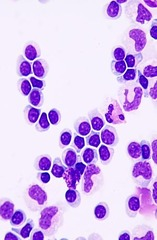
What process might give rise to the population of cells seen in this image of CSF?
Bacterial meningitis
Normal
Hemorrhage
Viral meningitis
Viral meningitis
In bacterial meningitis, the level of glucose in CSF relative to normal is typically:
Unchanged
Decreased
Increased
Markedly increased
Decreased
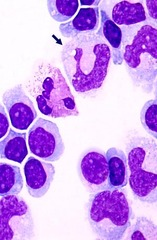
The arrow is pointing to which type of cell in this CSF specimen?
Macrophage
Neutrophil
Lymphocyte
Malignant cell
Macrophage

This CSF would most likely be seen in what condition?
Hemorrhage
Traumatic tap
Infarction
Normal
Normal

The cellular infiltrate seen in this CSF specimen is most likely due to what process?
Viral meningitis
Hemorrhage
Bacterial meningitis
Normal
Bacterial meningitis


This CSF infiltrate is likely a result of what process?
Interventricular shunt
Bacterial meningitis
Viral meningitis
Cryptococcal meningitis
Interventricular shunt

Identify this cell from a CSF specimen.
Macrophage
Neutrophil
Reactive lymphocyte
Blast
Blast
An increase in neutrophils with pyknotic nuclei can be seen in which situation?
Patient with bacterial meningitis
Patient with fungal meningitis
Traumatic tap specimen
Patients on medication
Traumatic tap specimen
A CSF glutamine level is an indirect measure of CSF:
Lactate
Hypoxia
Ammonia
Creatine kinase
Ammonia
The presence of macrophages containing hematoidin crystals indicates a recent hemorrhage.
True
False
False
Measurement of CSF lactate is useful for monitoring cases of:
Multiple sclerosis
Bacterial meningitis
Reye syndrome
Tertiary syphilis
Bacterial meningitis
Oligoclonal bands are located in the gamma region of the CSF protein electrophoresis.
True
False
True
Bacterial antigen tests have replaced the Gram stain as the method of choice for detecting meningitis.
True
False
False
White blood cell (WBC) counts on clear CSF specimens are performed:
Using centrifuged specimens
Only if multiple sclerosis is suspected
On undiluted specimens if there is no cell overlapping
On specimens diluted 1:200 with gentian violet
On undiluted specimens if there is no cell overlapping
Gram stains performed on CSF specimens are helpful in the:
Diagnosis of tubercular meningitis
Diagnosis of bacterial meningitis
Detection of viral meningitis
Detection of bacterial and fungal meningitis
Detection of bacterial and fungal meningitis
A CSF protein report of 32 g/dL:
Is normal
Indicates possible multiple sclerosis
Is an erroneous report
Should be followed by electrophoresis
Is an erroneous report
A positive serum FTA-ABS and a negative VDRL on CSF indicate:
Neurosyphilis
An improperly collected specimen
Successfully treated syphilis
Outdated VDRL reagents
Successfully treated syphilis
The CSF circulates through the brain and spinal cord in the:
Arachnoid mater
Choroid plexuses
Dura mater
Subarachnoid space
Subarachnoid space
India ink preparations are useful in the diagnosis of:
Fungal meningitis
Bacterial meningitis
Tubercular meningitis
Multiple sclerosis
Fungal meningitis
Which of the following tests has the best sensitivity and specificity for detecting meningitis?
Gram stain
Blood culture
PCR
ELISA
PCR
The presence of hemosiderin containing macrophages in CSF indicates:
Fungal meningitis
Cerebral hemorrhage
Reye syndrome
Multiple sclerosis
Cerebral hemorrhage
When using the cytocentrifuge, a daily control slide of saline and albumin is prepared to check:
The correct centrifuge speed
For the presence of WBCs
For bacterial contamination
The pH of staining buffer
For bacterial contamination
PCR testing for meningitis is based on:
Amplification of RNA
Amplification of DNA
Nuclear acids
Antibodies
Amplification of RNA
Crystals with a bright yellow color seen in macrophages are called:
Unconjugated bilirubin
Hemosiderin
Hematoidin
Conjugated bilirubin
Hematoidin
CSF electrophoresis can be used to confirm the diagnosis of multiple sclerosis and would be expected to show which of the following?
Increased IgG with oligoclonal bands not seen on serum electrophoresis
Increased IgG with oligoclonal bands similar to those seen on serum electrophoresis
Decreased IgG with antibody-specific oligoclonal bands
Decreased IgG with oligoclonal bands resembling those seen on serum electrophoresis
Increased IgG with oligoclonal bands not seen on serum electrophoresis
When a CSF specimen is received in the microbiology laboratory, the first thing the technologist should do is:
Perform a Gram stain
Perform an India ink preparation
Centrifuge the specimen
Streak the fluid on chocolate agar
Centrifuge the specimen
Damage to the blood-brain barrier by Mycobacterium tuberculosis may cause the CSF to:
Appear blood-streaked
Appear xanthochromic
Contain a pellicle or clot
Contain decreased protein
Contain a pellicle or clot
Which is not a function of the cerebrospinal fluid (CSF)?
Nutritional enrichment of nervous tissue
Transmission of neurological impulses
Removal of metabolic waste products
Protection of neurological tissue from trauma
Transmission of neurological impulses
Greater than 1 million spermatids per milliliter indicates reproductive tract infection.
True
False
False
An increased amount of prostatic fluid in a semen specimen will:
Lower the pH
Raise the pH
Increase the motility
Decrease the motility
Lower the pH
Calculate using a 1:20 dilution and the five RBC counting squares of the Neubauer counting chamber, an average of 54 sperm is counted. The sperm concentration is:
54,000/cc
54,000,000/mL
108,000/cc
108,000,000/mL
54,000,000/mL
When performing sperm morphology analysis on a semen specimen with a sperm concentration of 20 million, 10 spermatids are seen. This result is:
A normal finding
Associated with infection
Normal in a postvasectomy specimen
Indicative of abnormal sperm maturation
Indicative of abnormal sperm maturation
A sperm motility report graded 2.0 is interpreted as:
Average motility and Brownian movement
Slow forward motility with noticeable lateral movement
Slow forward motion in a straight line
Abnormal motility with normal direction
Slow forward motility with noticeable lateral movement
When using Kruger's strict morphology criteria, the normal value is greater than:
14% normal forms
25% normal forms
30% normal forms
55% normal forms
14% normal forms
Semen specimens should be processed for analysis:
Immediately on receipt in the laboratory
Before complete liquefaction
After complete liquefaction
1 hour after arriving in the laboratory
After complete liquefaction
Which of the following is a normal finding in an eosin-nigrosin stain?
75% of the cells appear bluish white
75% of the cells appear red
30% of the cells appear red
30% of the cells appear bluish white
75% of the cells appear bluish white
Which of the following parameters directly relates to and provides a check on the sperm motility evaluation?
Agglutination testing
Morphology
Sperm count
Viability stain
Viability stain