geology midterm 1
 Call Kai
 Learn
 Practice Test
 Spaced Repetition
 Match
 Flashcards
 Knowt Play
1/84

There's no tags or description
Looks like no tags are added yet.
Name | Mastery | Learn | Test | Matching | Spaced | Call with Kai | Chat |
|---|
No analytics yet
Send a link to your students to track their progress
85 Terms
What a disaster is vs. a natural hazard
Natural hazards are processes that have the potential to cause harm, but disasters only happen when vulnerable populations interact with those processes
That the size and frequency of hazardous events are inversely proportional
The size and frequency of hazardous events are inversely proportional: the larger the event, the less frequently it occurs.
Small events (e.g. minor earthquakes) happen frequently.
Large events (e.g. major earthquakes) happen rarely.
Big events are rare, while small events are common.
How can hazardous geological processes benefit the Earth system?
Even hazardous processes often serve a role in the earth system that is beneficial (natural service functions)
Volcanic eruptions: Create new land and produce fertile soils.
Earthquakes: Help shape Earth's surface and release built-up tectonic stress.
Floods: Deposit nutrient-rich sediments and replenish floodplains.
How does racism and poverty intimately link to risk of hazard
Exposure: Racism and poverty can force disadvantaged communities to live in hazard-prone areas.
Vulnerability: Poor housing, limited healthcare, and lack of resources make people more susceptible to harm.
Coping capacity: Poverty and discrimination can limit access to emergency services, insurance, evacuation, and recovery support.
Hazard: Racism and poverty generally do not cause the hazard, but they can increase its impacts.
What is the equation for risk
Risk = Hazard + exposure + vulnerability + coping capacity
The potential for a natural event will occur, and its ability to cause harm or damage
Hazard
whether people are affected
Exposure
how susceptible people or things are to hazard
Vulnerability
Ability to get back on your feet or for the government to respond
Coping Capacity
What factors of the risk equation cause Hati to be at a far greater risk than the DR despite sharing an island
Exposure: Both countries experience similar regional hazards, including earthquakes, hurricanes, and floods. However, the number of people and buildings in dangerous locations can differ.
Vulnerability: Haiti has widespread poverty, weaker housing and infrastructure, and limited access to essential services, making people more likely to suffer damage and loss of life.
Coping capacity: Haiti generally has fewer resources for emergency response, healthcare, disaster preparation, and rebuilding.
Hazard: Both countries share similar tectonic and climatic threats, although local conditions and the precise location of an event affect its severity.
Haiti's greater disaster risk is largely due to higher vulnerability and lower coping capacity, rather than simply experiencing more natural hazards.
Have deaths from natural disasters increased or decreased over the past few decades? Why or why not
Deaths from natural disasters have generally decreased because humans are better at predicting, preparing and responding to disasters.
Have natural disasters increased or decreased over the past decades? Why or why not
Natural disasters have seemed to increase mainly due to better reporting.
The World Meteorological Organization reported a fivefold increase in weather, climate and water-related disasters between 1970 and 2019, driven by a combination of climate change, more extreme weather, and improved reporting.
Why it is difficult to say for certain how the frequency of natural disaster has changed over the past century
It is difficult because historical records are often incomplete, and modern technology allows more disasters to be detected and recorded than in the past. Different countries also use different methods to define and record disasters, while natural hazards fluctuate over time.
Why some people find the term ‘natural disaster’ problematic
The term "natural disaster" is problematic because the natural event itself does not automatically cause a disaster. The level of damage and loss of life causing it to be a “disaster” is based on the human factors that create risk.
Calling it a “natural disaster” can overlook social inequalities and suggest that the consequences are entirely natural, when many impacts could be reduced through better planning and protection.
From outer to inner, what is the order in which the earth is formed
Crust
Mantle
Outer core
Inner core
What is the crust composed of and its state of matter
Composed of solid silicate materials
What is the mantle composed of and its state of matter
Composed of iron and magnesium rich rocks and is solid but flows
What is the outer core composed of and its state of matter
Composed of iron and is liquid
What is the inner core composed of and its state of matter
Composed of hot iron and is solid (also has the pressure of 48 000 elephants)
Who is Oldham
Geologist who studied seismic waves from earthquakes. He discovered evidence that earths core was distinct from the mantle because seismic waves changed speed and behaviour as they travelled through earth.
What is the relative thickness of the oceanic crust
5-10km thick
What is the relative thickness of the continental crust
30-50km thick
How far have we drilled inot the crust
~12km
How do s-waves interact with the outer core and why is this usefu;
S-waves are earthquake waves that travel through solids but not liquids therefore cannot travel through the outter core.
This creates an S-wave shadow zone on the far side of Earth, where direct S-waves are not detected
This was useful to prove that the outter core is liquid but also the shadow helps
Where in Nova Scotia can you go to see the mantle
What is the lithosphere
What is the asthenosphere
How do the lithosphere and asthenosphere differ
What is isostacy
How does isostacy relate to the asthenosphere
Who Alfred Wegner was and the main lines of evidence he offered for continental drift
What is Marie Tharp’s contributions to plate tectonic theory
What are the key elements of plate techtonic theory
Why are there a mountain range in the middle of the Atlantic Ocean (and in other parts of the ocean)
Why there is a barcode-like pattern of magnetized rocks on either side of a spreading ridge (the Vine, Mathews, and Morley story!)
Explain the slab pull and ridge push power plate tectonics****
What is a fault and what are the three main types
How does the elastic rebound theory explain earthquakes**
What is magnitude and what three factors influence it
How much ground motion & energy released increases with each step in magnitude scale
What intensity is (MMI) and how it differs from magnitude
Where do the very largest earthquakes occur (boundary type) and why
What types of fault puts Vancouver and California at danger, respectively
What are the types of seismic wave
P waves, S waves, Rayleigh waves, and Love waves
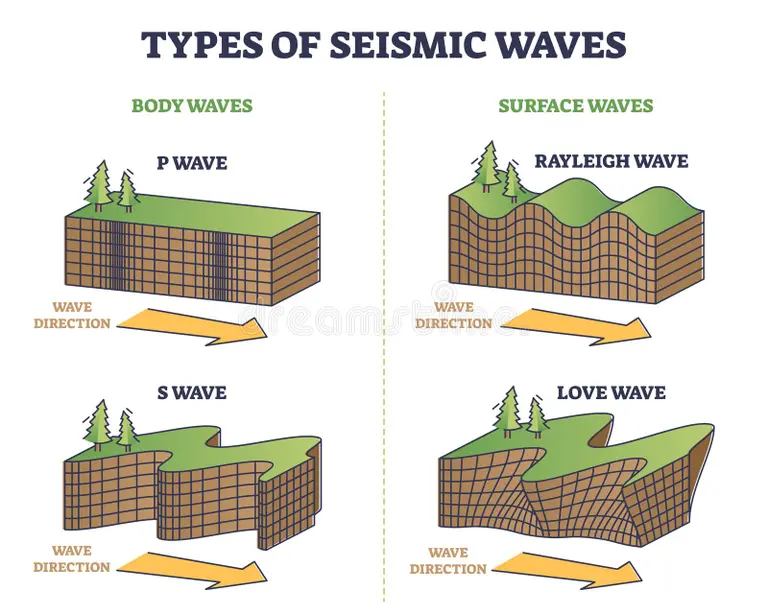
What is the danger of Love waves
What is the danger of P-waves
What is the danger of S-waves
What is the danger of Rayleigh waves
How are p and s-waves are used to triangulate earthquake epicentres/foci
Why is Mexico city is particularly vulnerable to earthquakes
Why buildings of specific heights are impacted by seismic waves of specific frequency
What is liquefaction
What are the conditions required for liquefaction to occur
What are the direct impacts of earthquakes, i.e., ways they can directly kill or damage things
What are the Indirect earthquake impacts:
Why are fires such a problem after earthquakes
How is post-glacial rebound related to intraplate earthquakes in Canada
How do scientists determine the recurrence interval of earthquakes
What are the linkages between earthquakes and other hazards
How can people cause earthquakes
What types of building materials are more at risk from earthquake shaking
Where in Canada has the highest earthquake risk
Why are fires so danergous during an earquake
How is the timing of arival of the earthquake waves can be used to create an early warning system
Most meteors are made of what
Mostly rock, with a moderate amount of iron
What is the difference between continental crust and oceanic crust
Continental crust is thicker, older and contains materials that are richer in silica, causing them to be less dense (felsic) and rise above oceanic crust. Oceanic crust is thinner, younger and contains minerals with less silica but denser minerals (iron and magnesium) (mafic)
What is the distinction between continental and oceanic crust interactions between plate techeonics
When plates collide, a plate boundary with oceanic crust
will sink beneath a plate boundary continental crust
.
What is it called when oceanic crust sinks beneth continental crust and what happens to that oceanic crust
Subduction. Subducted oceanic crust will sink to the bottom of the mantle in which it is destroyed.
Who is Mohorovicic
Geophysicist who discovered a boundary between Earth's crust and mantle, now called the Mohorovičić discontinuity (Moho). He identified it because seismic waves suddenly increased in speed in this boundary.
Who is Inge Lehmann
Seismologist who studied earthquakes and discovered evidence that Earth has a solid inner core surrounded by a liquid outer core.
Why did the contributions of Oldham, Mohorovičić, and Lehmann matter