chapter 15: Sensory Pathways and the Somatic Nervous System
 Call Kai
 Learn
 Practice Test
 Spaced Repetition
 Match
 Flashcards
 Knowt Play
1/106

There's no tags or description
Looks like no tags are added yet.
107 Terms
What three structures can make up a neural pathway?
nerves, nuclei, and tracts.
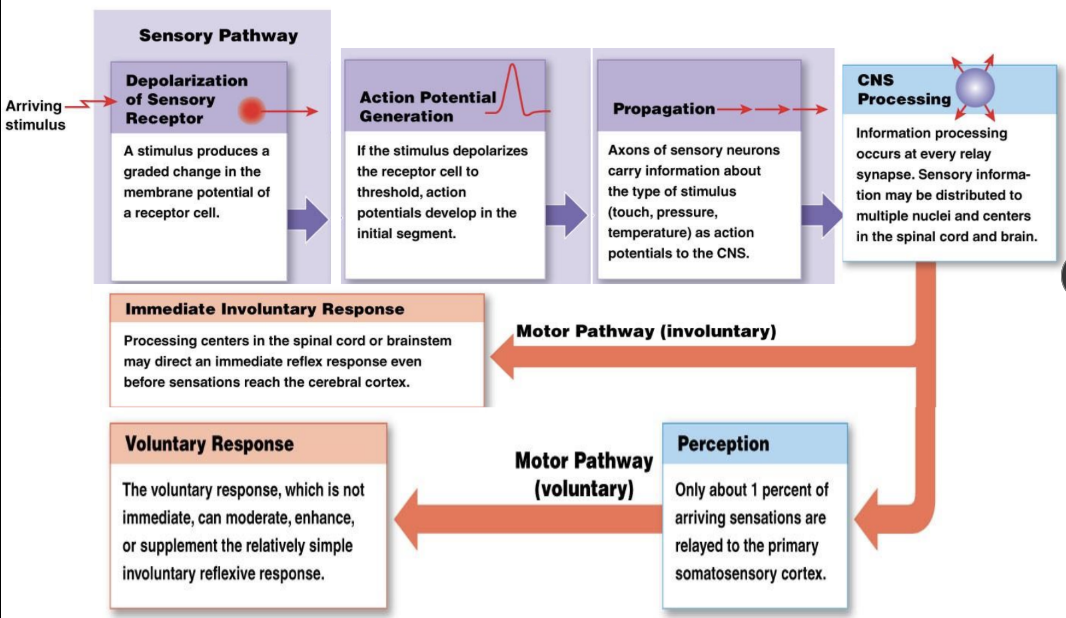
Order the main events from a stimulus to conscious perception
1. Stimulus detection
2. Action potential generation
3. Propagation to the CNS
4. CNS processing
5. perception
6. voluntary response
what is the brain pathway for vision?
Thalamus to occipital lobe
what is the brain pathway for hearing?
Thalamus to temporal lobe
what is the brain pathway for taste?
Thalamus to gustatory cortex (in the frontal lobe)
what is the brain pathway for smell?
Amygdala, hippocampus, and frontal lobe
what is the brain pathway for general senses?
Thalamus to somatosensory cortex
what are the general senses?
Temperature, Pain, Touch, Pressure, Vibration, Proprioception (body position)
what includes special senses?
vision, hearing, smell, and taste
Sensory receptors can be ________ ______ ____ or ____________ of sensory nerve endings
specialized sensory cells; processors
what are the 2 types of graded potential a receptor can make?
generator and receptor potential
generator potential
a graded potential for general senses and smell where the receptor will be with the sensory neurons and generate a action potential in the sensory neuron

receptor potential
a graded potential for special senses where the stimulus is detected by a special receptor cell and it will can the amount of neurotransmitter released by the cell onto the sensory neuron.

specialized sensory cells
non-neuronal cells (e.g., photoreceptors) that detect stimuli and synapse with neurons. This will carry out receptor potential on sensory neurons for special senses
sensory processors
Specialized nerve endings ( Receptors) that directly transduce signals (e.g., pain receptors).
General sensory Receptors are divided into four types by nature of stimulus. What are they?
1. Nociceptors (pain)
2. Thermoreceptors (temperature)
3. Mechanoreceptors (physical distortion)
4. Chemoreceptors (chemical concentration)
Nociceptors
sensory receptors that enable the perception of pain in response to potentially harmful stimuli.
▪ In superficial portions of skin
▪ In joint capsules
▪ Around walls of blood vessels
what are the fiber types of nociceptors?
Myelinated Type A fibers and Unmyelinated Type C fibers
Myelinated Type A fibers carry sensations of _____ pain (prickling pain)
fast
Myelinated Type A fibers
▪ Carry sensations of fast pain (prickling pain)
▪ Sensations reach C N S quickly and often trigger somatic reflexes
▪ Relayed to primary somatosensory cortex and thus receive conscious attention
Unmyelinated Type C fibers
- Carry sensations of slow pain (burning and aching pain)
- Sensations cause generalized activation of reticular formation and thalamus
- You become aware of the pain but only have a general idea of the area affected
They are key players in inflammatory pain, responding to tissue damage, histamine, and temperature changes.
Unmyelinated Type C fibers carry sensations of _____ pain (burning and aching pain)
slow
Thermoreceptors
detect changes in temperature
Free nerve endings located in
▪ Dermis
▪ Skeletal muscles
▪ Liver
▪ Hypothalamus
- Sensations are conducted along same
pathways that carry pain sensations
▪ Sent to reticular formation, thalamus, and the primary somatosensory cortex
Chemoreceptors
chemical sensors in the brain and blood vessels that identify changing levels of oxygen and carbon dioxide. They send information to the brainstem (not primary sensory cortex)
Mechanoreceptors include which receptors
proprioceptor, baroreceptors, and tactile receptors
mechanoreceptors
- Sensitive to physical stimuli that distort their plasma membranes
- Membranes contain mechanically gated ion channels that open or close in response to
▪ Stretching
▪ Compression
▪ Twisting
▪ Other distortions of the membrane
Proprioceptors
monitor the position and movement of skeletal muscles and joints
Proprioception is a ________ sensation
somatic
proprioceptors are not going to be found in -
visceral organs of thoracic and abdominopelvic cavities
where are proprioceptors found?
Muscle spindles, Golgi tendon organs, Receptors in joint capsules
muscle spindles function
monitor skeletal muscle length and trigger stretch reflexes
Golgi tendon organs function
▪ At junction between skeletal muscle and its tendon and monitor tension during muscle contraction
receptors in joint capsule
Free nerve endings detect pressure, tension, movement at the joint
Baroreceptors function
Monitor changes in pressure in an organ
tactile receptors
provide sensations of touch, pressure, and vibration
transduction is
the Conversion of an arriving stimulus (depolarization) into an action potential
pressure sensitive receptors
typically have a encapsulated nerve ending
ruffini's endings, pacinian corpuscles, krause's end bulbs
fine touch receptors
Meissner's corpuscle, Merkel disks, root hair plexus
receptors with free nerve endings will detect what?
crude touch, temperature, and pain
Describe generation of receptor potential in a special
receptor cell
1. Stimulus changes the membrane potential of the receptor cell.
2. Stimulus opens ion channels in the receptor, causing a graded membrane potential
▪ Can be a graded depolarization or graded hyperpolarization
▪ Occur in separate receptor cells
3. Receptor cell releases chemical messenger
4. Chemical messenger opens ion channels in afferent neuron AP generating region
5. If threshold reached, AP is generated

what are tonic receptors?
slowly adapting receptors that respond for the entire duration of a stimulus. They are best at signaling the presence, intensity, of a stimulus.
ex: a bee sting
What are phasic receptors?
Fast-adapting receptors that send signals at the beginning or end of a stimulus. These receptors "rapidly" stop responding to a constant
stimulus; crucial for detecting movement or changes ex: putting on clothes
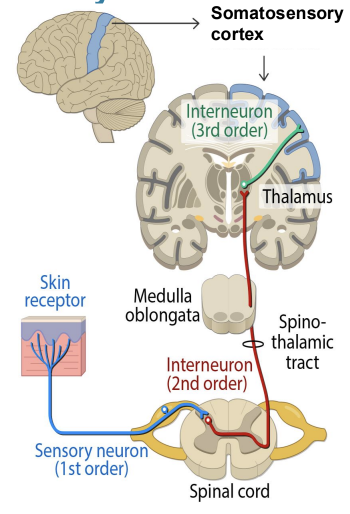
Somatosensory pathways conduct impulses through chains of __ successive neurons through the spinal cord and various parts of brain
3
what is the First-order neuron of Somatosensory Pathway
sensory neuron that carries sensory information from
• skin (cutaneous receptors)
• muscles (Proprioceptors) of the body wall, Head, neck, and limbs (general sensory receptors)
all conscious sensation come from which cortex? where is this cortex located
the primary somatosensory cortex located in the post central gyrus
Where is the cell body of the of the 1st order neuron located?
dorsal root ganglion

what is the second order neuron of Somatosensory Pathway?
Interneuron in spinal cord or brainstem that receives information from first-order neuron and will cross to opposite side of CNS (decussation) to transmit impulses to thalamus or to cerebellum

what is the 3rd order neuron of the somatosensory pathway
Intereuron in thalamus that must receive information from second-order neuron and Relay impuses to somatosensory cortex of cerebrum For the sensation to reach our awareness

Where are the cell bodies of second order neurons detecting nociception located?
dorsal gray horn
Where are the cell bodies of second order neurons detecting fine touch located?
nuclei of the medulla oblongata

Where are the cell bodies of second order neurons detecting proprioception located?
nuclei of the medulla oblongata

Where are the cell bodies of second order neurons detecting vibration located?
nuclei of the medulla oblongata

where will the second order neuron for nociception, temperature, and course touch cross?
the midline of the spinal cord
where will the second order neuron for fine touch, vibration, and conscious proprioception cross?
the midline of the medulla oblongata

Where are the cell bodies of most third order neurons located?
thalamus
funiculus
large bundle of nerve fibers (white matter) in the spinal cord comprising multiple tracts

Fasciculus
smaller, more specific bundle of nerve fibers within a funiculus that shares a common origin, function, and destination
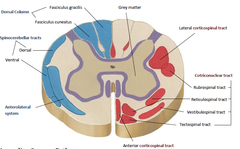
spinothalamic pathway contains which tracts?
anterior and lateral spinothalamic tracts

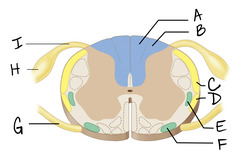
identify F
anterior spinothalamic tract

identify e
lateral spinothalamic tract
Anterior spinothalamic tract contains ascending sensory axons of what senses?
crude touch and pressure

describe the spinothalamic pathway involving the anterior spinothalamic tract
1. sensory neuron (first order neuron) picks up sensation of crude touch and pressure
2. second order neuron synapses with the first order neuron at the dorsal gray horn and crosses over to the opposite side the spinal cord to the anterior spinothalamic tract
3. the anterior spinothalamic tract carries ascending sensory info to the thalamus where it will synapse third order neuron
4. the third order neuron will carry the information the corresponding area of the primary somatosensory cortex to be processed
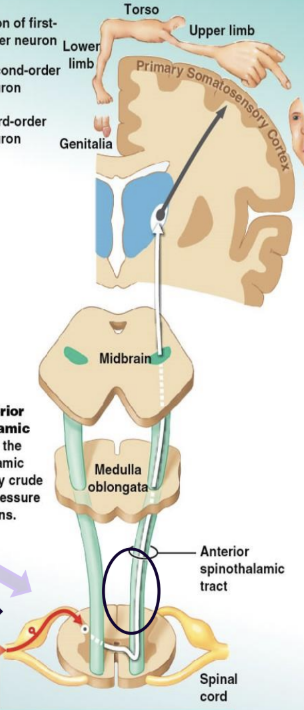

what pathway is this? what information is it carrying?
Anterior spinothalamic pathway relaying crude touch and pressure
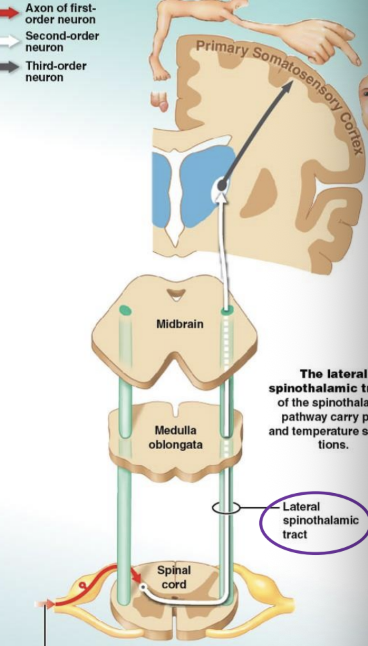
lateral spinothalamic tract contains ascending sensory axons of what senses?
temperature and pain


what pathway is this? what information is it carrying?
lateral spinothalamic pathway transmits both temperature and pain information
describe the spinothalamic pathway involving the lateral spinothalamic tract
1. sensory neuron (first order neuron) picks up sensations of pain and temperature
2. second order neuron synapses with the first order neuron at the dorsal gray horn and crosses over to the opposite side the spinal cord to the lateral spinothalamic tract
3. the lateral spinothalamic tract carries ascending sensory info to the thalamus where it will synapse third order neuron
4. the third order neuron will carry the information the corresponding area of the primary somatosensory cortex to be processed
what is referred pain? what abnormality of this be of?
the feeling of pain in an uninjured part of body when pain originates at another location. Visceral pain can manifest as pain in body surface. Example: a heart attack is frequently felt in the left arm. The spinothalamic pathway can cause this.
the PCML Pathway has ascending tracts in which fasciculus?
gracile and cuneate fasciculus


identify b
cuneate fasciculus

identify a
gracile fasciculus
the pcml pathway carries which sensations?
highly localized fine touch, vibration, pressure, and conscious proprioception (the sense of body position).
the pcml pathway involving the ascending tracts of the gracile fasciculus will have sensations originating where?
sensations of highly localized fine touch, vibration, pressure, and proprioception originating from the sacral and lumbar regions (leg) will travel through the gracile fasciculus

the pcml pathway involving the ascending tracts of the cuneate fasciculus will have sensations originating where?
sensations of highly localized fine touch, vibration, pressure, and proprioception originating from the thoracic and cervical regions (upper body) will travel through the cuneate fasciculus

describe the pcml pathway involving the gracile fasciculus
1. the sensory neuron (first order neuron) picks up sensations of highly localized fine touch, vibration, pressure, and conscious proprioception from the lower body and travels up through the gracile fasciculus
2. second order neuron synapses with the first order neuron at the gracile fasciculus and crosses over in the medulla oblongata to the medial lemniscus
3. medial lemniscus carries ascending sensory info via second order neuron to the thalamus where it will synapse to the third order neuron
4. the third order neuron will carry the information the corresponding area of the primary somatosensory cortex to be processed

describe the PCML pathway involving the cuneate fasciculus
1. the sensory neuron (first order neuron) picks up sensations of highly localized fine touch, vibration, pressure, and conscious proprioception from the upper body and travels up through the cuneate fasciculus
2. second order neuron synapses with the first order neuron at the cuneate fasciculus and crosses over in the medulla oblongata to the medial lemniscus
3. medial lemniscus carries ascending sensory info via second order neuron to the thalamus where it will synapse to the third order neuron
4. the third order neuron will carry the information the corresponding area of the primary somatosensory cortex to be processed
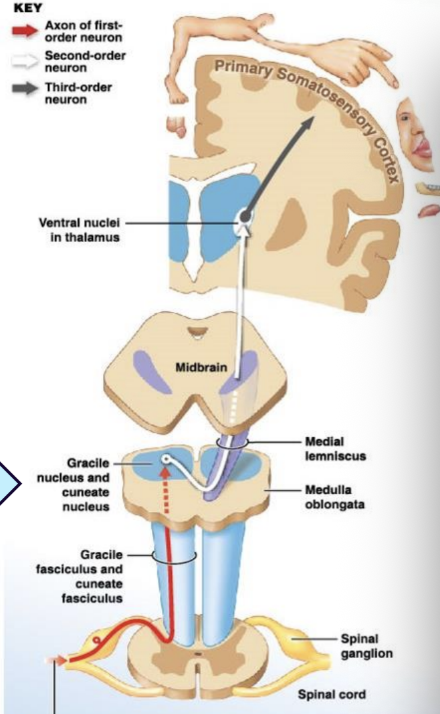

what pathway is this? what information is it carrying?
pcml pathway Carries sensations of highly localized fine touch, vibration, pressure, and proprioception(the sense of body position).
the spinocerebellar pathway has which tracts?
posterior and anterior spinocerebellar tracts

identify c
anterior spinocerebellar tracts

identify d
posterior spinocerebellar tracts
the spinocerebellar pathway sends what type of information to where?
sends information about body position and balance from sensory receptors in skeletal muscles, joints, and the inner ear to the cerebellum. This is unconscious proprioception.

what pathway is this? what information is it carrying?
spinocerebellar pathway transmits unconscious proprioception
what are the 3 main somatosensory pathways?
spinothalamic pathway, posterior column-Medial Lemniscus pathway (PCML), and spinocerebellar pathway
what are Somatic motor pathways?
the descending tracts in the central nervous system that control voluntary skeletal muscle movement.
how many neurons are in the somatic motor pathway? what are they called?
it involves two motor neurons; Upper motor neuron
and Lower motor neuron
how are upper motor neurons transfixed in the cns?
the cell body originates in the pyramidal cells of primary motor cortex. Axons descend into brainstem and spinal cord and Synapse on lower motor neurons that control skeletal muscles
where is the cell body and axon of a lower motor neuron located
• Cell body lies in a nucleus/grey matter of brainstem or spinal cord. Only the axon extends outside C N S
what are the 3 main somatic motor pathways?
Corticospinal pathway, Medial pathway, and Lateral pathway
basal nuclei function
Controls muscle activity and posture; largely inhibits unintentional movement when at rest
cerebellum function
coordination of voluntary movements and balance. Perfects the technique
corticospinal pathway contains which tracts of the spinal cord?
lateral and anterior corticospinal tracts
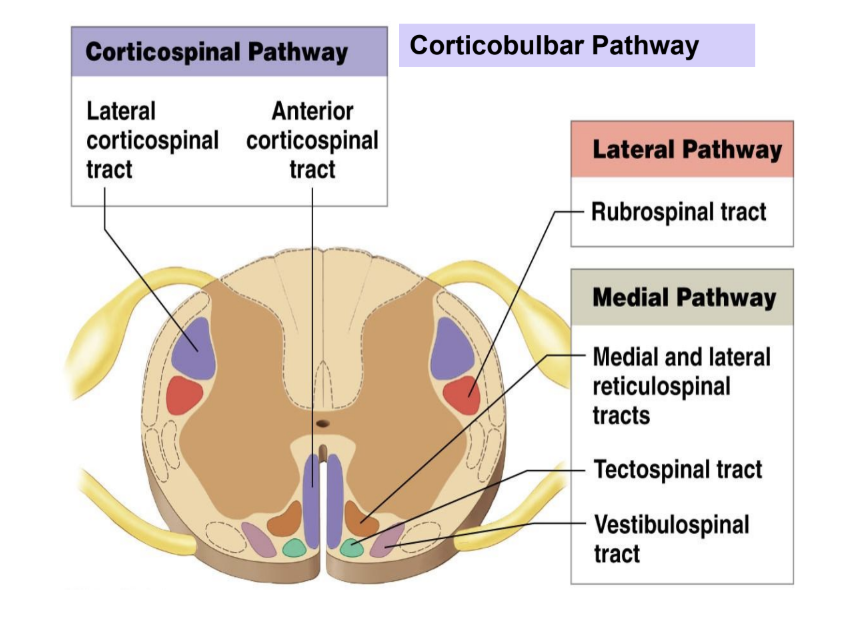
the Corticobulbar tracts provides what type of control?
provides voluntary control over the muscles of the face, head and neck which control Swallowing, Movement of the tongue, Facial expressions
describe the corticospinal pathway involving the corticobulbar tract
1. the upper neuron receives signals from the primary motor cortex and descend down the corticobulbar tract
2. the upper neuron will synapse with the lower neuron in the midbrain or medulla oblongata which provide voluntary innervation to the the muscles of the face, head and neck
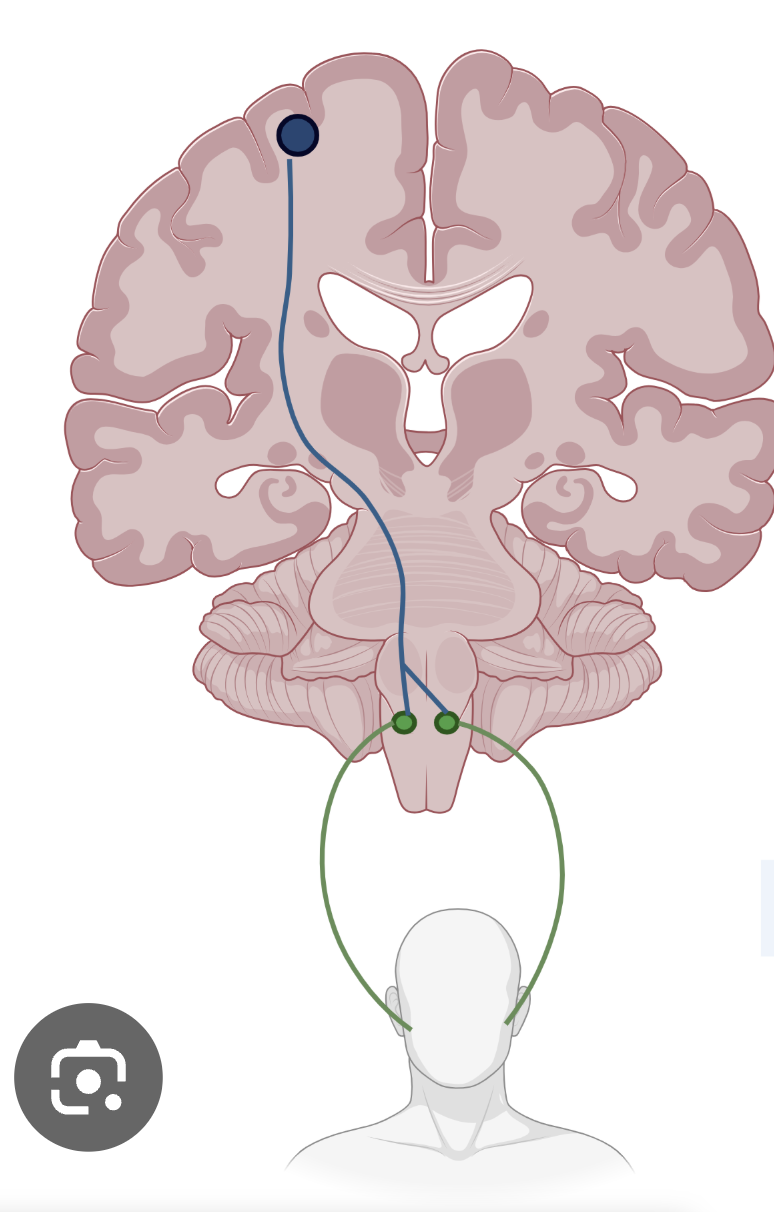
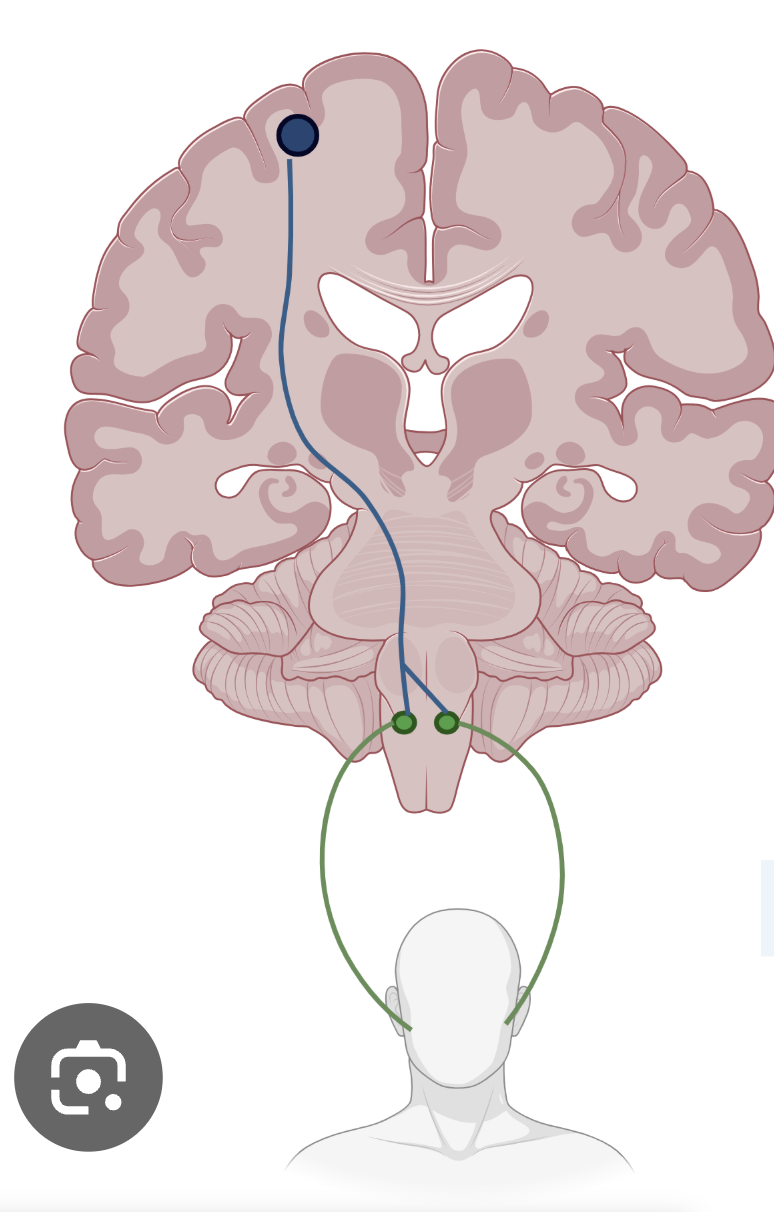
what pathway is this? what information is it carrying?
corticobulbar pathway carries motor control over the muscles of the face, head and neck.
The Anterior Corticospinal tracts provides what type of muscle control? what type of movements would this involve
motor control of the of axial (trunk) and proximal (shoulder) muscles which enable posture and gross movements such as walking and running

identify O
Anterior Corticospinal tracts

identify L
lateral Corticospinal tracts
The lateral Corticospinal tracts provides what type of muscle control? what type of movements would this involve
Voluntary control of distal muscles (hand, fingers, feet) which enables fine motor skills.
describe the lateral corticospinal pathway
1. first order neuron (UPMs): fibers originate in primary motor cortex and descend via cerebral peduncles of midbrain and pyramids of medulla
2. cross midline in medulla oblongata (pyramidal decussation)
3. crossed fibers descend in spinal cord in lateral corticospinal tract in posterior portion of lateral white columns
4. Synapses with lower motor neurons in the anterior horn of the spinal cord on the contralateral side at all levels (opposite side of the body).


what pathway is the red line? what information does it carry?
Lateral Corticospinal Tract voluntary control of distal muscles (hand, fingers, feet) enabling fine motor skills.
describe the anterior corticospinal pathway
1. first order neuron originates in cerebral cortex descends through the brainstem and spinal cord.
2. first order neuron decussate at the spinal cord level and Synapses with lower motor neurons in the anterior horn of the spinal cord on the ipsilateral and contralateral side to control movements of the body trunk on both sides
