12.2.Lac and Trp Operon
 Call Kai
 Learn
 Practice Test
 Spaced Repetition
 Match
 Flashcards
 Knowt Play
1/33

There's no tags or description
Looks like no tags are added yet.
34 Terms

What term describes genes that are always expressed (on)?
A) Inducible expression
B) Constitutive expression
C) Repressible expression
D) Dynamic expression
B) Constitutive expression

Inducible expression
gene expression is off until actively turned on

Repressible expression
gene expression is on until actively turned off
Gene Regulation Tool Kit
Activator: a regulatory protein that promotes gene expression
Repressor: a regulatory protein that prevents gene expression
Inducer: a small molecule (or environmental condition) that promotes gene expression
Co-repressor: a small molecule that prevents gene expression (typically works with a repressor)
Signaling molecule: a small molecule that transmits signals to regulatory systems (cell communication)
Regulatory sequence: sequences on DNA/RNA that control gene expression
Positive Regulation
when gene gets expressed cause there is no repressor but an activator = transcription

Negative Regulation
when genes don't get expressed cause there is no activator but a repressor instead = no transcription

Ways to regulate gene activity
Block or alter transcription rate (Transcriptional)
Block or change translation (Translational)
Change mRNA life-span aka stability (Translational)
Modify proteins to activate or inactivate (chemical modifications)
β-Galactosidase is the bacterial gene that cleaves lactose into glucose and galactose. It shows
sequence and functional similarity to human lactase, but there is no evidence that this is the same gene that evolved from a common ancestral gene in the eukaryote-bacteria ancestor. What term is used to describe the relationship between β-Galactosidase and lactase?
A) Homolog
B) Paralog
C) Ortholog
A) Homolog
Homolog
Genes related by descent from a common ancestral DNA sequence
Any degree of similarity makes sequences homologous
Ortholog
Genes in different species that evolved from a common ancestral gene by speciation
Usually have similar function
Paralog
Genes related by duplication within a genome
Paralogous genes evolve new functions, even if these are related to the original one
Operon
multiple genes with one promoter (prokaryotes)
a subset of polycistronic transcripts: multiple genes on a single RNA
ex: lactose, contains genes needed for lactose metabolism under a single regulated promoter
Not an operon
Retrotransposons and retroviruses are also polycistronic transcripts
Animal miRNAs can be polycistronic
Glucose is easy energy
all organism prioritize ___ because
All other energy sources require more ATP input and/or fewer ATP output
E. coli
growing in medium with both glucose and lactose
Eats glucose first
THEN eats lactose
lac operon
both positive and negative control
catabolite activating protein (CAP) when glucose levels are low
lac repressor
is negatively regulated (repressed) when lactose is absent


What part of the mRNA molecule is the Operator in?
a) Intron
b) Exon
c) 5’ UTR
d) 3’ UTR
c) 5’ UTR
lac repressor
blocks the transcription start site
binds to the operator sequence with very high affinity
When bound, RNA polymerase cannot “see” the transcription start site
Low lac, Low glc
Repression: (lac repressor protein) —> repressed
Activation: (Catabolite activating protein) —> activated
High lac, Low glc
Repression: (lac repressor protein) —> not repressed
Activation: (Catabolite activating protein) —> activated
Low lac, High glc
Repression: (lac repressor protein) —> repressed
Activation: (Catabolite activating protein) —> not activated
High lac, High glc
Repression: (lac repressor protein) —> not repressed
Activation: (Catabolite activating protein) —> not activated

Which are the cis and trans regulatory sequences for the lac operon?
A) cAMP activator protein and allolactose are cis while the lacO operator and lacl regulator sequence are trans
B) cAMP activator protein and allolactose are trans while lacO operator and lacl regulator sequence are cis
C) cAMP activator protein and lacl regulator are cis while lacO operator and allolactose are trans
D) cAMP activator protein and lacl regulator are trans while lacO operator and allolactose are cis
B) cAMP activator protein and allolactose are trans while lacO operator and lacl regulator sequence are cis
Trp (Tryptophan) Operon
where enzymes synthesize ___ in E. coli
normally “on” in bacteria in the absence of its repressor
has only negative regulation (repressible expression)
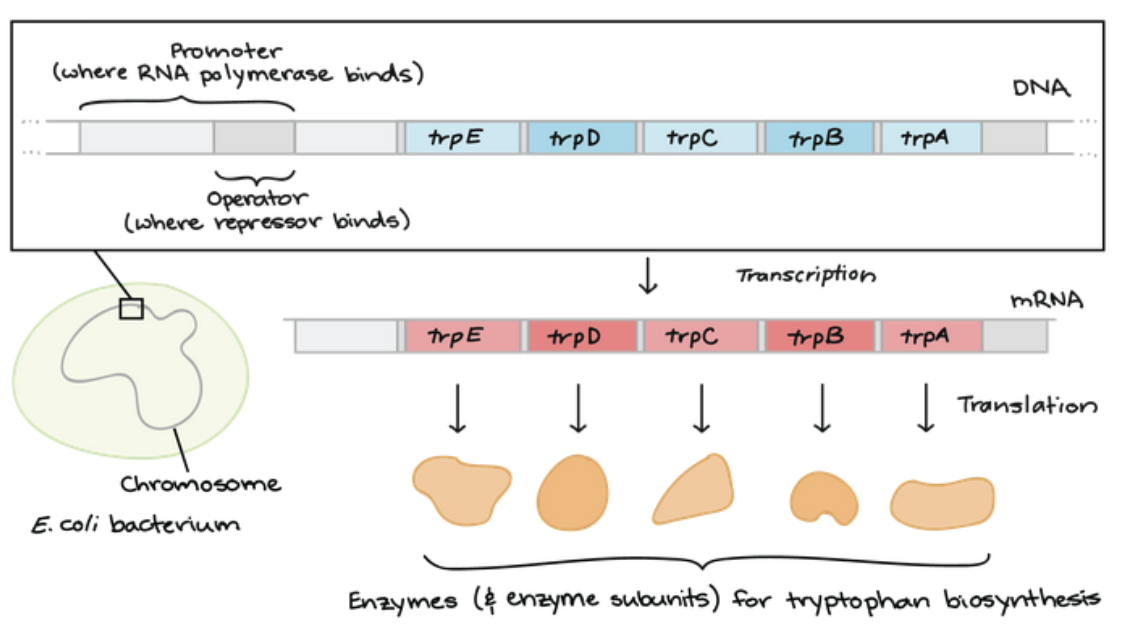
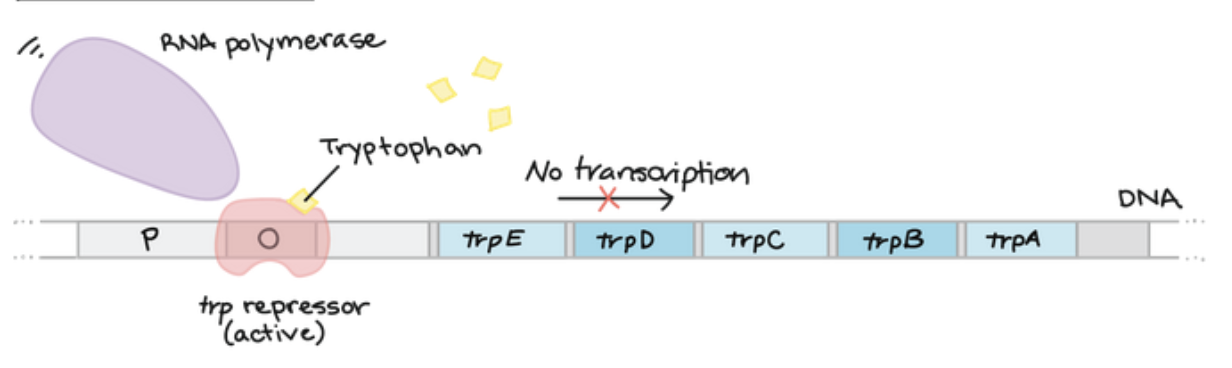
High tryptophan concentration
will bind to the trp repressor protein, changing its shape and allowing it to bind to the repressor region in the promoter blocking RNA polymerase
Proteins changing shape for activation or other signaling is common
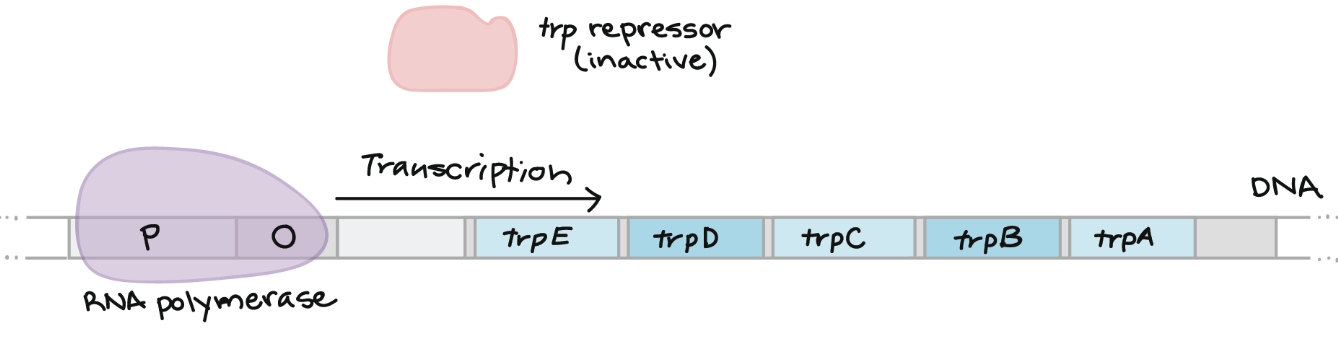
Low tryptophan concentration
will release from the repressor, allowing RNA polymerase to bind to the promoter and activate transcription
Trp operon is also controlled through attenuation
When tryptophan levels are high: rapid translation of the leader peptide causes the ribosome to cover regions 1 and 2, allowing regions 3 and 4 to form a transcription-termination hairpin that halts transcription
when tryptophan levels are low: stalled ribosomes over the trp codons block region 1, forcing an alternative pairing between regions 2 and 3 that prevents the terminator structure and allows transcription to continue

attenuation
aka negative feedback loop, the trp operon effectively creates the condition for its own silencing
Negative Feedback loops
include scenarios where turning a gene on leads to a scenario where it will be silenced, this can include intermediate genes
ex: GeneA turns on GeneB which turns on GeneC which turns off GeneA
Positive Feedback loops
are also common, and are the reverse scenario where activation of a gene will lead to increased activation of that gene in the future
ex: GeneA turns on GeneB which turns on GeneC which turns on GeneA
DNA changes shape when expression changes
Often proteins binding to cis-regulatory sequences causes the DNA to bend in such a way that the protein interacts with the proteins assembled at the promoter
For bacterial genomes these sequences are often fairly close
Eukaryotic cis-regulatory sequences
The mediator protein complex guides communication between the promoter and distant enhancers
Proteins that do not directly bind DNA, but are part of the complex are called “co-activators” or “co-repressors”
Which of the following transcriptional regulatory mechanisms is NOT available to eukaryotes?
A) Inducible expression through a single protein binding to an enhancer
B) Repressible expression through multiple proteins binding to repressor sequences millions of base pairs away
C) Attenuation through limited amino acid and charged tRNA availability
C) Attenuation through limited amino acid and charged tRNA availability