Blood Bank: Rh Blood Group Review
 Call Kai
 Learn
 Practice Test
 Spaced Repetition
 Match
 Flashcards
 Knowt Play
1/42

There's no tags or description
Looks like no tags are added yet.
43 Terms
Chromosome 1
The RHD and RHCE genes are located on…
Chromosome 6
RHAG gene is located on…
Rh associated glycoprotein
An ammonia transporter protein, similar in structure to the Rh proteins and within the RBC membrane forms complexes with the Rh polypeptides; must be present for expression of Rh Ag
Rh null hemolytic anemia (RHN) (Rh deficiency syndrome)
Defects in the RHAG gene would cause…
Haplotype
A set of DNA variations that are usually inherited together
Phenotype
Trait that is visible; physical test results from specific antisera
Genotype
Genetic makeup of an individual; is not visible; cannot be absolutely determine without family or DNA studies, but can be “inferred” from phenotyping, based on published frequency of genes in a population
Fisher-Race
(Rh nomenclature) genetic inheritance of 3 closely linked genes that produce Ags
Wiener
(Rh nomenclature) genetic inheritance of 1 gene that produces the Ags
Rosenfield
(Rh nomenclature) disregards genetics and assigns numbers to various Ags
ISBT
(Rh nomenclature) Disregards genetics and assigns numbers to the specific blood group and to its corresponding various Ags
Rh0
rh’
rh”
hr’
hr”
What are the 5 major Rh Ags (longhand) in Wiener nomenclature?
R0 = Dce
R1 = DCe
R2 = DcE
Rz = DCE
r = ce
r’ = Ce
r” = cE
ry = CE
Describe the Weiner shorthand nomenclature (8)
Rh1 = D
Rh2 = C
Rh3 = E
Rh4 = c
Rh5 = e
Describe the Rosenfield nomenclature (5)
D > c > E > C > e
List the Rh antigens from most to least immunogenic
Cation transport
Membrane integrity
Regulates cell volume
List some functions that the Rh antigens have in the RBC membrane (3)
Weakened expression
Gene position effect
Mosaic effect (incomplete/partial D)
How can weak D Ag be inherited (3)
African Americans
10,000-33,000
200-1,983
Weakened expression of D is more common in (——), where the normal number of epitopes is (——) but people with weakened expression of D have (——) epitopes
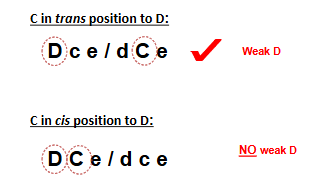
trans
Steric hindrance
D positive
(Weak D) the gene position effect only occurs when the C allele is in (——) position to the D allele; (——) causes the anti-D reagent to weakly attach (C Ag crowds the D Ag); in this case, (——) blood can be given to the patient
RhCE
In incomplete/partial D, parts of RhD are replaced with (——)
If anti-D negative at IS, pt cells and reagent incubated 37°C for 15 min, centrifuge, read reaction
If negative, wash 3x, add AHG
If negative, add CC and report Rh neg
If positive, report weak D positive or D positive
Describe how to do the weak D/Du test (4)
Rh6 (f)
(cis product Ag) c and e inherited as a haplotype (cde or cDe)
Rh7 (rhi)
(cis product Ag) C and e inherited as a haplotype
Rh27
(cis product Ag) c and E inherited as a haplotype
Rh22
(cis product Ag) C and E inherited as a haplotype
C or D
Genes that code for (—2—) also code for G; anti-G mimics anti (—2—), where one antibody cannot be separated from the other
Cw
Low frequency Ag found in only 2% of Caucasians and rare in African Americans; most individuals who are C+ are also positive for this; Abs to these Ags can be naturally occurring and may play a role in HDFN and HTR
More common
mutation in RHAG
RHD and RHCE
Rhnull
For the regulator type Rh deficiency, it is (——) than amorph type, and is caused by a (——); can transmit normal (——), and is designated as (——)
Mutation in RHCE gene, deletion in RHD gene
RHAG
double bar over rr
For the amorph type Rh deficiency, it is caused by (——), (——) gene is normal, and is designated as (——)
Anti-Rh29 (anti-total Rh)
Rhnull individuals can form the antibody (——), which us why they must be transfused with other Rhnull blood
RHAG
Rhmod inherited characteristic associated with severely reduced Rh Ag expression; involves a mutation in the (——) gene with partial suppression of Rh Ags; expression varies
Transfusion or pregnancy
anti-E and anti-Cw
Most Rh Abs occur from immunization due to (—2—), except for rare examples of (—2—) which may be naturally occurring
Extravascular destruction
Rh Abs do not bind C’; for C’ to be bound, 2 closely attached IgGs must exist, but Rh Ags are not close enough; Rh Abs “coat” the RBC which leads to (——)
R2R2
Of the following, which one reacts more strongly with anti-D due to higher density of D Ag on the cell? R1R1 or R2R2?
Anti-f
Generally weak reacting Ab that is found with other Abs; reacts when both c and e ags are present on the same haplotype (cis), e.g., rr; has been called the “compound" Ag”; transfuse c or e negative blood
Anti-G
Reacts to most D and C Ag positive cells; is most frequently developed in rr phenotypes; transfuse D and C negative blood
Anti-E
Most frequently encountered Ab followed by anti-c where anti-c can sometimes fall below detectable levels
Anti-e
Rarely encountered as only 2% of the population is ag negative'; some autoimmune diseases can create an Ab that shows this specificity
Anti-Rh17
Ab created in individuals found to be D deleted phenotypes (D- -)
High protein
(Rh antisera) IgG and anti-D potentiated with high percent of bovine albumin and other macro molecules to ensure agglutination at IS; causes false positives with RBCs coated with Abs, autoagglutinins, abnormal serum protein, Abs to additives, using unwashed RBCs; can be used for weak D test
Monoclonal anti-D
(Rh antisera) Prepared from blend of monoclonal IgM and polyclonal IgG suspended in a low percent of bovine albumin diluent (IgM react at IS, IgG at AHG (Du test)); most frequently used reagent; negative control not needed unless patient AB positive
Saline/low protein
(Rh antisera) Prepared from predominantly IgM Abs, scarce due to difficulty obtaining raw material; reserved for individuals giving false positives with high protein; require incubation at 37°C; cannot be used for weak D test
Chemically modified
(Rh antisera) IgG converted to saline agglutinin by weakening disulfide bonds at hinge region, greater flexibility, and increases span distance; stronger reactivity than IgM Abs; can be used for weak D; negative control unnecessary unless AB positive