LS7A AoL #1
 Call Kai
 Learn
 Practice Test
 Spaced Repetition
 Match
 Flashcards
 Knowt Play
1/73

There's no tags or description
Looks like no tags are added yet.
74 Terms
Describe the structure of an atom
An atom is made up of three different subatomic particles: protons, neutrons, and electrons. Each of these three different subatomic particles have their own charges.
Protons:
positively charged (+1)
has a mass of 1
located in the dense, central nucleus
Neutrons:
electrically neutral particles
mass of 1, located in the nucleus
Electrons: negatively charged
negligible mass
move around nucleus in a space called an orbital. Their exact location any instant is unpredictable.
Protons and neutrons are located together in the center of the atom, known as the nucleus. Surrounding the nucleus in a sort of cloud are the electrons.
Explain how non polar and polar covalent bonds are formed between atoms
Non-polar covalent bonds: In this bond, two atoms share the bonding electron pair almost equally. Molecules with these bonds are important in cells because they do not mix well with water.
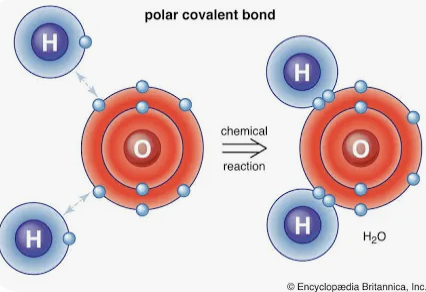
Polar covalent bonds: these bonds are formed between atoms that share electrons unequally. While part of the molecule has a slightly positive charge, the other part has a slightly negative charge. This unequal sharing of electrons is due to a difference in electronegativity, which refers to the tendency of an atom to attract shared electrons toward itself.
Higher electronegativity: bigger electron hows and pulls electrons closer to nuclei. The atom with this higher electronegativity will adopt a partial negative charge. The atom with a lower electronegativity will possess a partial positive charge.
What type of bond does water have?
Polar covalent bond
What type of bond does hydrogen gas (H2) have?
Nonpolar covalent

What two elements in BIOLOGICAL SETTINGS (H, O, C, N) have a nonpolar covalent bond?
Carbon and Hydrogen (Lower electronegativities)
Oxygen and Nitrogen (Higher electronegativities)
What are the four most abundant atoms in life?
hydrogen
carbon
oxygen
nitrogen
How do ionic bonds form?
This bond is formed by the complete transfer of valence electrons between atoms. It is a type of chemical bond that generates two oppositely charged ions. In ionic bonds, the metal loses electrons to become a positively charged cation, whereas the nonmetal accepts those electrons to become a negatively charged anion.
An atom steal an electron from another atom. These are then attracted to one another (opposites attract)
How many electrons does hydrogen have to share?
one electron pair
hydrogen can form 1 covalent bond

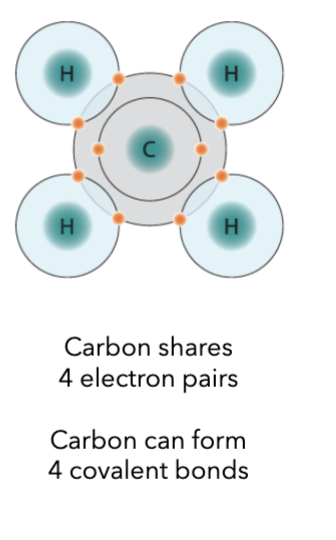
How many electrons does carbon have to share?
Shares 4 electron pairs
Can form 4 covalent bonds
How many electrons does nitrogen have to share?
shares 3 electron pairs
can form 3 covalent bonds

How many electrons does oxygen have to share?
shares two electron pairs
can form two covalent bonds

How can you remember how many bonds H O N C can each make?
Hungry Owls Need Cookies
Hungry = hydrogen = 1
owls = oxygen = 2
need = nitrogen = 3
cookies = carbon = 4
How many electrons are shared in a double bond?
4 electrons
How many electrons are shared in a triple bond?
6 electrons
What is the approximate energy of the system when two atoms are very far apart?
When two atoms are very far apart, the energy of the whole system is going to be 0. Therefore, as you increase the internuclear distance, the potential energy is going to get closer to zero. Think of this analogy: when you have to people minding their own business on the street, there is no attraction between them. They are free to do their own things, so no energy is involved between the two of them.
What does internuclear distance mean?
The distance between the center or the nuclei of two atoms
What is a “bound state” / bond energy?
this is the energy minimum and the bond length of an atom. this is the “perfect” little distance between them. Think of when two friends come together, when you are really close to each other, its takes less effort (less energy) to stay together.
The protons of one atom are going to be attracted to the electrons in another. So they come together and share electrons.
The lower the potential energy of a bond, the stronger the bond, the harder it is to separate them. Thus, in order to separate them, you must use more energy. THINK OF IT THIS WAY: when two friends share a perfect bond with one another, it takes minimal energy to be around one another. it is easy to be there. BUT if you want to separate those two friends, you’re going to have to put in a lot of effort because their bond is just that strong.
What happens to the energy when atoms are very close to each other?
Since the nucleus of the atoms contain a positive charge. As the nuclei are brought closer to one another, you are going to have proton-proton repulsion. These protons will then fill a force that wants to accelerate them in the opposite direction. Same happens with electrons.
Define bond length
the perfect distance between two atoms for a bond.
INTRAmolecular forces and examples
forces that hold atoms together within a molecule. These forces are stronger than intermolecular forces
Examples:
Polar covalent bonds
Nonpolar covalent bonds
Ionic bonds.
INTERmolecular forces and examples
forces that exist between molecules. These are weaker than intramolecular forces.
Examples:
Hydrogen bonding
van der Waal forces
What is a hydrogen bond?
A hydrogen bond is the result of an unequal charge distribution on a molecule. These molecules are polar. This bond is between molecules. They are represented by dotted lines
A bond that forms when a partial positive hydrogen atom interacts with O or N (or any other electronegative atom).
Requirements:
One molecule with hydrogen bonded to F, O, or N
A second molecule with F, O, or N
Define van der Waals forces
Electrostatic interactions between atoms that have a TEMPORARY PARTIAL CHARGE. Although these forces are weak, enough of them combined are strong enough to allow for heavy objects to stick to a vertical wall
Define and relate the terms electronegativity, polarity, hydrophilic, and hydrophobic
High electronegativity: atoms are more greedy with electrons. They want to hog them away from atoms with a lower electronegativity
Polarity: refers to the way electrons are shared between two atoms. can be nonpolar (equal sharing) or nonpolar (unequal sharing of electrons due to differences in electronegativites).
Polar molecules are hydrophilic. They love and readily dissolve in water.
Nonpolar molecules are hydrophobic, meaning “water fearing.” Nonpolar compounds do not have regions of positive and negative charge, so they arrange themselves to minimize their contact with water.
Relative Strengths of bonds and electrostatic interactions
Strongest
Covalent Bonds
Ionic bonds (in H2O)
Hydrogen bonds
Van Der Waals interactions
Weakest
As bonds become stronger, it will take more PE to break them.
Determine whether a region of a molecule is likely to be hydrophilic or hydrophobic based on its ability to form hydrogen bonds with water.
A region of a molecule is likely to be hydrophilic if it is able to form hydrogen bonds with water. This is because hydrogen bonds can only form between polar molecules (because one of them must have a partial positive charge while the other must have a partial negative charge).
If a region of molecule is unable to form hydrogen bonds with water, that means it must be hydrophobic. It does not like to interact with water.
Determine whether a given molecule could exist in nature, based on your knowledge of the number of electrons each element can share.
A molecule can exist in nature when its atoms follow the usual bonding rules.

Can this molecule exist in nature?
Yes, because it satisfies the usual bonding rules.

Can this molecule exist in nature?
No because it does not satisfy the usual bonding rules.
Prokaryotic VS Eukaryotic Cells
Prokaryotic:
small and simple
unicellular
nucleus is absent
circular DNA
lacks membrane-bound organelles
Eukaryotic Cells:
large and complex
unicellular or multicellular
nucleus is present
linear DNA
has membrane bound organelles
BOTH:
have plasma membranes
have cytoplasm
have ribosomes
have DNA
Define organelle
Compartments that divide cell contents into smallerf spaces specialized for different functions
Define cytoplasm
The entire contents of a cell other than the nucleus (if present)
Define cytosol
The jelly-like internal environment of the cell that surrounds the organelles inside the cell membrane
Describe the function of mitochonria
It is involved in cellular respiration. The many folds on the mitochondria allow for more surface area for ATP (energy) production. This is the “powerhouse” of the cell.
Describe the function of endoplasmic reticulum
The ER is involved in both protein and lipid synthesis. There are two types: the rough ER and the smooth ER.
Rough ER: synthesizes transmembrane proteins (proteins that end up in the interior of organelles and those destined for secretion).
Smooth ER: site of fatty acid and biosynthesis. Where lipids are made.
Define the function of the nucleus
The nucleus is the storehouse for a cell’s genetic information and site or RNA synthesis
Describe the function of the Golgi Apparatus
It modifies and sorts proteins and lipids as they move to their final destinations in or out of the cell. It essentially is a mail room. It is “packaging up” proteins and lipids to be delivered elsewhere.
Describe the function a lysosome
A specialized vesicle that contains enzymes. These enzymes break down macromolecules (proteins, lipids, carbohydrates, nucleic acids) that are damaged/not needed. Lysosomes are also involved in cell death (apopsis).
Describe the function of a vacuole.
These are storage structures. They have multiple functions, including:
Isolating materials that might be harmful or a threat to the cell
Store and contain waste products
Store Water
Describe the function of cholorplasts
Chloroplasts capture the energy of sunlight to synthesize simple sugars. It is used in the process of photosynthesis.
Describe the function and structure of a triglyceride lipid
Used for energy storage. It is made up of three fatty acids joined to glycerol. A fatty acid is a long chain of carbon atoms attached to a carboxyl group (-COOH).
What are the roles of lipids
make up cell membranes
store energy
act as signaling molecules
Describe the structure of phospholipids
Made up of a glycerol backbone attached to a phosphate group and two fatty acids.
The phosphate head group is hydrophilic (water loving) because it is polar, enabling it to form hydrogen bonds with water.
The two fatty acid tails are hydrophobic (water fearing) because they are nonpolar and do not form hydrogen bonds with water.
Phospholipids are AMPHIPATHIC (they are molecules with both hydrophilic and hydrophobic regions in a single molecule).
Describe the structure of a fatty acid
A long chain of carbon atoms attached to a carboxyl group (-COOH) at one end.
Describe the structure and function of cholesterol
It is amphipathic
Hydrophilic region: hydroxyl group (-OH)
Hydrophobic region consists of four interconnected carbon rings with an attached hydrocarbon chain.
Structure allows a cholesterol molecule to insert itself into the lipid bilayer to that its head group interacts with the hydrophilic head group of phospholipids, while the ring structure participates in van der Waals interactions with the fatty acid chains.
Acts as a “buffer” for membrane fluidity
doesn’t itself have an effect of making a membrane more fluid/rigid
Makes changes less extreme

Saturated VS Unsaturated fats
Saturated fatty acids lack double bonds, resulting in phospholipids with a straight structure that favors tight packing. The fatty acid is saturated/full of hydrogens.
Unsaturated fatty acids have one or more double bonds that introduce kinks into the phospholipids, reducing the tightness of packing. This allows for more fluidity in a membrane.
Describe the structure of the plasma membrane and the different ways that proteins can be associated with the lipid bilayer.
The “fluid mosaic model” describes the structure of cell membranes. This describes that
Cell membranes are a mosaic, as they are made up of many different components. his includes the phospholipid bilayer, other forms of lipids such as cholesterol, proteins, and associated sugars.
The membrane is not static, meaning it is fluid and dynamic. Lipids and protein move easily in the plane (LONG) of the membrane.
Proteins can be considered “peripheral” or “integral” membrane proteins
Peripheral: proteins are temporarily associated with either the internal or external side of the membrane.
Integral: proteins that are permanently associated with the membrane. Integral membrane proteins include transmembrane proteins that span the entire membrane. These cannot be separated from the membrane experimentally without destroying the membrane itself.
Describe how visual representations (models) of biological systems can be both useful and misleading.
Pros
Visualization
Size of organelles relative to one another
Differentiate between organelles
Visualize how the structure might influence the function
Cons
Don’t get a sense of interactions in an actual biological environment bc static
Color coded - what do they actually look like?
Dumb-downed (simplified?)
There are many types of cells — cannot accurately depict what some look like because different cells look and act different from one another.
Evaluate how changing temperature, phospholipid chain length, and phospholipid saturation affects membrane fluidity
Increasing temperature increases membrane fluidity
As heat rises, there is more kinetic energy (movement) in the phospholipid tails. This causes many of the phospholipids to overcome van der waals forces keeping them together
Decreasing temperature decreases membrane fluidity
Increasing phospholipid chain length decreases membrane fluidity because there are more bonds acting between the chains of phospholipid fatty acid tails. They get closer together.
Saturated fatty acids have less membrane fluidity (saturated with hydrogens, tightly packed together)
Unsaturated fatty acids have more membrane fluidity (double bonds lead to kinks in tails → less tight packing)
Explain how the chemical properties of a phospholipid bilayer allow it to act as a semipermeable membrane
The amphipathic nature of the phospholipid bilayer allows it to act as a semipermeable membrane (selective with what it lets in and out), specifically with the polar heads (hydrophilic) and fatty acid tails (hydrophobic).
Define and relate the terms diffusion, tonicity, osmosis, hypertonic, hypotonic, and isotonic
Diffusion: the net movement of molecules from areas of higher to lower concentration as a result of random thermal motion. Diffusion is always occurring, but there can be no net change.
Tonacity: the ability of an extracellular solution to make water move into or out of a cell by osmosis.
Osmosis: the net movement of a solvent, such as water, across a selectively permeable membrane toward the side of higher solute concentration.
Hypertonic: more concentrated
Hypotonic: less concentrated
Isotonic: a solution that has an equal solute and water concentration. There is no net flow of water into or out of the cell. The cell’s volume will remain stable.
Compare and contrast the different passive and active transport mechanisms
Passive Transport - DOING SOMETHING EASY
Simple diffusion:
does not require a protein in the lipid bilayer
Net movement of molecules from high to low concentration
no energy required (DOING SOMETHING EASY)
these molecules move as a result of differences in concentration between the inside and outside of the cell
Facilitated diffusion:
requires a protein in the lipid bilayer
net movement of molecules from high to low concentration
No input of energy required (DOING SOMETHING EASY)
Two types of membrane transporters:
Channel protein: provides an opening between the inside and outside of the cell through which certain molecules can pass
Carrier protein: binds to and then transporters specific molecules. Binds, changes shape, and releases
Helping with molecules that may be too big to cross the membrane on their own or molecules that are polar.
Active Transport - DOING SOMETHING HARD
Primary Active Transport:
requires a protein in the lipid bilayer
net movement of molecules from low to high concentration
input of energy required
Uses the energy of ATP directly to drive the movement of ions or molecules.
Secondary Active Transport
Requires a protein in the lipid bilayer
Net movement of molecules from a low to high concentration
input of energy required
active transport that uses the energy of an electrochemical gradient to drive the movement. BC ions cannot cross the lipid bilayer, many cells have transport proteins that build up the concentration of a small ion on one side of the membrane. the resulting concentration gradient stores PE that can be used to drive movement
Uses ion energy down gradient to power movement of another thing against gradient.
Predict the permeability of a molecule based on its chemical properties
*This is a spectrum
Permeable
hydrophobic molecules
small uncharged polar molecules
large uncharged polar molecules
ions
Non-permeable
Predict the net movement of water based on the relative tonicity of two solutions.
Hypotonic solution: the surrounding solution has less solute than the cell
water moves into the cell
the cell swells
Hypertonic solution: the surrounding solution has more solute than the cell
water moves out of the cell
the cell shrinks
Isotonic solution: both sides have equal effective solute concentration
water moves in and out equally
there is no net movement of water
Predict the rate and direction of net movement of molecules based on their concentration gradients and the absence or presence of specific membrane transport proteins.
Molecules naturally spread from high concentration to low concentration. This is called moving down the concentration energy.
Steeper concentration gradient: generally faster net movement
Smaller concentration gradient: generally slower net movement
No concentration difference: no net movement by passive diffusion, even though molecules still move in both direction
No suitable transport pathway: little or no movement across the membrane for substances that cannot pass through the membrane directly.
REMEMBER: The bigger the difference, the faster they spread!
Define and differentiate the terms metabolism, anabolism, and catabolism.
metabolism: the chemical reactions occurring within cells that convert one molecule into another and transfer energy in living organisms. Many of these reactions are linked, in that the products of one are the reactants of the next, forming long pathways and intersecting networks.
Anabolism: the set of chemical reactions that require an input of energy, usually in the form of ATP
Catabolism: the set of chemical reactions that break down molecules into smaller units
REMEMBER: both processes involve both breaking and forming of bonds. For catabolism, the energy released from forming the new bonds is greater than the energy required to break the old ones, resulting in net energy released. Anabolism is the opposite, with the energy needed to break bonds and build the products being greater than the energy released when the new bonds form.
Define the terms kinetic and potential energy
Kinetic energy: the energy of motion. This is associated with any kind of movement, such as a person running. Other forms of kinetic energy include light energy (movement of photons), electricity (movement of electrons), and thermal energy (movement of molecules)
Potential energy: Stored energy. PE depends on the structure of the object or its position relative to a field, and it is released by a change in the object’s structure/position.
Explain the first law of thermodynamics
It is only ever possible to transform energy. That is, energy can neither be created nor destroyed. It simply changes from one to the other, from potential energy to kinetic energy (and vice versa)
Explain the second law of thermodynamics
Transformations of energy lead to an increase of disorder of the universe. When you transform energy from one type to another, not all the energy goes to that second type. Some of it moves around more freely.
For a spontaneous process (exergonic), entropy (disorder of the universe) is going to increase
natural systems tend to go towards a state of disorder
EX: if you dont put in energy to cleaning your room, it will naturally begin to get messy. However, if you put energy into cleaning the room, it will become more orderly and organized.
Define and relate the terms free energy, enthalpy, exergonic, and endergonic
Free energy: the amount of energy available to do work. G tells us about the spontaneity of a process
Enthalpy (H): the total amount of energy in a system (heat absorbed or released) (all the potential energy associated with bonds)
Entropy (S): The degree of disorder in the universe
Exergonic: release of energy (-delta g), spontaneous
Endergonic: input of energy (+delta g), nonspontaneous
What does it mean if delta G = 0
The forward and reverse reactions happen at equal rates. There is no net change in the amounts of reactants and products. System is at equilibrium
What does it mean if delta g is negative
Forward direction is favorable (exergonic)
What does it mean if delta g is positive
Reverse direction is favorable
Discuss how an endergonic reaction can be “coupled” to an exergonic reaction
Coupling means connecting two reactions so that the energy released by one helps drive the other. The key rule is that you add the two delta Gs together.
Define and relate the terms substrate, active site, activation energy, transition state, and reaction rate
Substrate: a molecule that an enzyme acts upon during a chemical reaction
Active site: the specific region on an enzyme where a substrate binds and undergoes a chemical reaction
Activation energy: the minimum initial energy input required to start a chemical reaction. Even reactions that release energy overall (exergonic reactions) need a “push” to break existing chemical bonds before new bonds can form
Enzymes catalyze/speed up reactions by lowering the activation energy. Enzymes do not change delta G at all.
Transition state: as reactants absorb activation energy, they reach an unstable, high-energy configuration called the transition state before turning into products. This is found at the peak of the graph.
Reaction rate: the higher the activation energy, the slower the chemical reaction will be. The higher the barrier is, the fewer molecules that will have enough energy to make it over at any given moment. It’ll take a long time to get significant numbers of molecules over the barrie if they’re going just a few at a time.
Describe in general terms how enzymes are able to alter the rate of chemical reactions
Enzymes lower the activation energy needed for a reaction to occur. Since lower activation energy means faster reactions, enzymes speed up reaction rates.
Explain how small molecules (e.g. drugs or regulatory molecules) are able to increase or decrease the activity of an enzyme.
Small molecules can act as inhibitors or activators of enzymes.
Inhibitors: decrease the activity of enzymes. They are often used in drugs in medicine to treat infection. In one type of enzyme inhibitor, the inhibitor competes with the substrate for the active site of the membrane (competitive inhibitor). Noncompetitive inhibitors bind to a different site (not the active site), but this causes the active site to change shape.
allosteric inhibitor:
Activators: increase the activity of enzymes
Allosteric Regulation: Most activators bind to a site other than the active site (an allosteric site). This changes the 3D shape of the ezyme to make the active site fit the substrate better. It’s basically changing the shape of the enzyme to actually function and receive the substrate.
Predict whether a reaction will be exergonic or endergonic based on delta H and delta S
+H, -S = endergonic
+H, +S = need more info about temperature
-H, +S = exergonic
-H, -S = need more information about temperature
Determine whether two reactions can be successfully coupled based on their changes in free energy.
???
Evaluate how changing cellular conditions will change the free energy of a reversible reaction.
Changing cellular conditions warrants the use of this new equation.
When you increase the concentration of products (have more products than reactants), lnQ will be positive. The reaction will become less spontaneous
When you more reactants than products, lnQ will be negative. The reaction will become more spontaneous

What is feedback inhibition?
The final product of a pathway inhibits an enzyme that acts earlier in that same pathway.
The pathway starts making the product
the product builds up because the cell has enough
the product binds to an early enzyme and slows it down
the pathway makes less product, preventing unnecessary waste of energy and materials.
THIS IS ALLOSTERIC INHIBITION
Relate the pH scale to the concentration of hydrogen ions (aka H+ or “protons”) in a solution
pH scale is inversely related to the concentration of hydrogen ions
acidity: as you add more protons, the solution becomes more acidic and the pH of a solution goes down (closer to 0)
basicity: as you remove protons, the solution becomes more basic and the pH number goes up (closer to 14)
Evaluate environmental effects (e.g. pH, temperature) on enzyme catalyzed reaction rates
Different enzymes have different optimal temperatures and pH levels. Changes to those conditions can speed up or slow down a reaction.
temperature increase: often increases reaction rate, but if it gets too high, the enzyme can denature (decreasing the rate)
Each enzyme has an optimum pH where it works best. Changing the pH will slow down the reaction.
Relate anabolic and catabolic pathways to overall changes in free energy.
anabolic assembles thing
endergonic bc u need energy.
The energy required to break old bonds is greater than the energy released when forming new ones
catabolic breaks things down
exergonic
in an overall energy-releasing reaction, the energy released when new bonds form is greater than the energy required to break the old bonds.
the products end up at a lower energy level than the reactants.