Chem Unit 3 Test
 Call Kai
 Learn
 Practice Test
 Spaced Repetition
 Match
 Flashcards
 Knowt Play
1/24

Earn XP
Description and Tags
Chapters 5 and 6
25 Terms
Hunds Rule
electrons only pair up in an orbital only when there is an even number of electrons in the sublevel
Pauli exclusion principle
if two electrons occupy the same orbital they must have opposite signs
Aufbau principle
a. based on where a single electron is placed, the lowest potential energy electron is an atom found in the 1s sublevel
b. electrons will occupy a p-orbital only after the previous s-orbital is completely full
c. electrons can begin to occupy energy levels with the next highest integer designation (eg., 2 vs 1, 3 vs. 2) only after all of the orbitals on the energy level below it are occupied.
electronic configuration of copper (Cu)
1s² 2s² 2p⁶ 3s² 3p⁶ 3d¹⁰ 4s¹
electronic configuration of chromium (Cr)
1s² 2s² 2p⁶ 3s² 3p⁶ 3d⁵ 4s¹
energy level
the fixed, specific amounts of energy that electrons can have when orbiting the nucleus of an atom (ex: the 2 in 2p⁶)
sub-level
a secondary tier, division, or layer that sits beneath a primary level or is part of a larger, broader structure (ex: the designated level like s, p, d, or f ,2p⁶)
orbital
a mathematical region of space around an atomic nucleus where an electron is most likely to be found, orbitals are categorized by their shape and energy, designated by letters (ex: 2p⁶, the orbital is the small 6)
ground state
The lowest possible energy level that an atom or electron can occupy, it is the most stable and natural state of an atom, follows rules like the Aufbau Principle
excited state
Any energy state higher than the ground state, it is unstable and temporary; the electron quickly falls back down to a lower state, occurs when an electron absorbs extra energy (such as heat, light, or a collision) and jumps to a higher, vacant energy level further from the nucleus
periodic law
when chemical elements are arranged in order of increasing atomic number, their physical and chemical properties show a predictable, recurring pattern
groups (on the periodic table)
The periodic table is organized into 18 vertical columnscalled groups (or families), where elements share similar chemical properties and valence electron counts.
periods (on the periodic table)
A period isa horizontal rowon the periodic table
characteristics of metals
Silvery color, Luster (shiny), Conduct electricity (and heat), Malleable (bendable)
characteristics of metalloids
have some properties of metals and some properties of nonmetals
characteristics of non-metals
Not silvery (many different colors), Dull, not shiny, Poor conductor of electricity and heat, Brittle, not malleable
Zeff and how to find it
effective nuclear charge is the net positive charge experienced by an electron in a multi-electron, Zeff=Z-S (Z=protons, S=core electrons), increases going left to right (in order of 1, 2, 3, etc) and stays the same going up and down
atomic radius+its trend on the periodic table
a measure of the size of an atom, largest at the bottom left corner of the table
ionic radius+its trend on the periodic table
the distance for a charged atom (ion) in a crystal structure
Cations (positive ions) are smaller than their neutral atoms. Losing valence electrons reduces electron-electron repulsion and often removes an entire outer shell, pulling the remaining electrons closer to the nucleus. [1, 2, 3, 4]
Anions (negative ions) are larger than their neutral atoms. Gaining valence electrons increases electron-electron repulsion, causing the electron cloud to expand
ionization energy+its trend on the periodic table
the minimum amount of energy required to remove the outermost valence electron from an isolated gaseous atom, ion, or molecule, it’s largest in the upper right corner of the periodic table
electronegativity+its trend on the periodic table
the tendency of an atom to attract shared electrons (or electron density) toward itself when forming a chemical bond, largest in the top right of the table
diagram of s orbital

diagram of p orbital
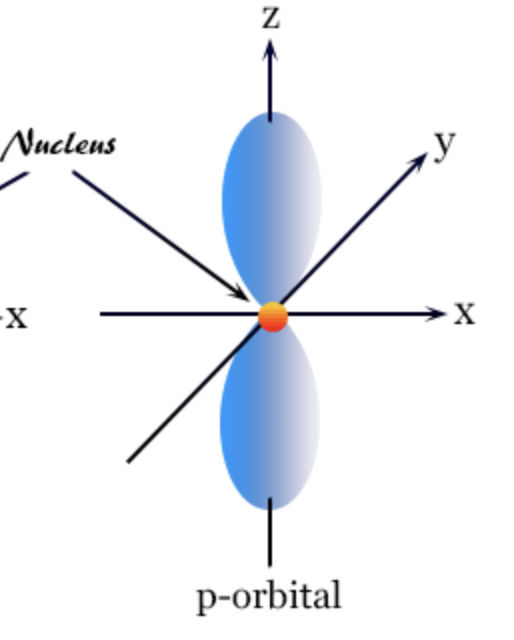
diagram of d orbital

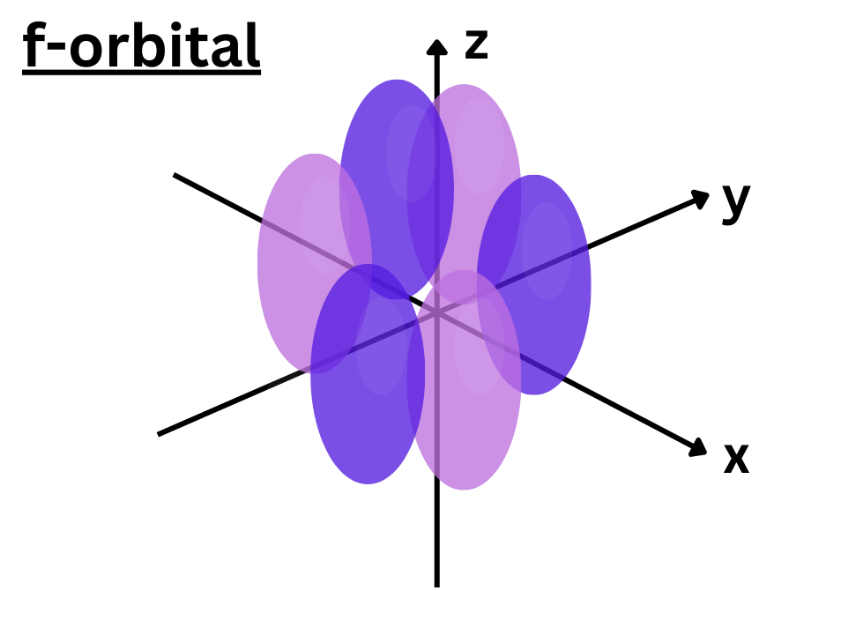
diagram of a f orbital