LO11+12: Cell Division- Process and Mechanism
 Call Kai
 Learn
 Practice Test
 Spaced Repetition
 Match
 Flashcards
 Knowt Play
1/8

There's no tags or description
Looks like no tags are added yet.
9 Terms
Without checkpoints during the cell cycle, what might happen?
mitosis before DNA synthesis is done
DNA synthesis without sufficient biochemical preparation
insufficient cells in G0 for normal functioning
daughter cells with the wrong number of chromosomes
All of the answer choices are correct.
All of the answer choices are correct.
Which of the following occurs in mitosis but NOT in meiosis?
Cells genetically identical to parents are made.
centrioles divide
crossing over
independent assortment of chromosomes
pairing up of similar chromosomes during prophase
a tetrad
Cells genetically identical to parents are made.
Many diploid organisms produce haploid gametes for reproduction. Which of the following best describes how the diploid number of chromosomes is restored in the offspring of these organisms?
DNA replication creates homologous chromosomes
independent assortment in meiosis allows random combinations of chromosomes
synapsis during prophase of meiosis I creates random combinations of alleles
fertilization combines chromosomes from each parent into resulting zygote
fertilization combines chromosomes from each parent into resulting zygote
Which of the following statements correctly describes one of the cells shown?
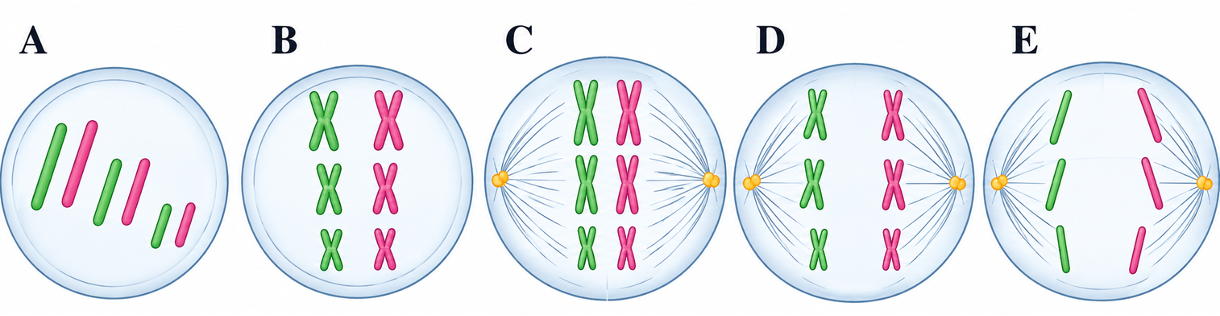
Cell A contains 6 chromosomes and 12 chromatids because each homologous pair consists of two chromosomes.
Cell B contains 12 chromosomes because DNA replication has doubled the chromosome number.
Cell C represents metaphase I of meiosis, with three homologous pairs aligned at the metaphase plate.
Cell D represents anaphase I of meiosis, during which sister chromatids separate toward opposite poles.
Cell E represents anaphase of mitosis, during which homologous chromosomes separate toward opposite poles.
Cell C represents metaphase I of meiosis, with three homologous pairs aligned at the metaphase plate.
In a species with normal genome of 20 homologous pairs of chromosomes, sexual reproduction requires formation of gamete cells that have____ chromosomes,
so fertilization will result in cells with ____ chromosomes.
20, 20
40, 40
20, 40
40, 80
20, 40
Diploid cells may undergo either mitosis or meiosis. Can haploid cells?
Haploid cells can undergo both mitosis and meiosis.
Haploid cells can undergo mitosis but not meiosis.
Haploid cells can undergo meiosis but not mitosis.
Haploid cells can undergo neither mitosis nor meiosis.
Haploid cells can undergo mitosis but not meiosis.
If a cell with 20 homologous pairs of chromosomes undergoes one round of mitosis and cytokinesis, the result will be:
Two cells, each with 20 chromosomes
Two cells, each with 40 chromosomes
Four cells, each with 20 chromosomes
Four cells, each with 40 chromosomes
Two cells, each with 40 chromosomes
Prophase I of meiosis is generally the longest phase of meiosis. Why might this be?
D N A replication
synapsis and recombination
independent assortment
gamete formation
separations of homologous chromosomes and sister chromatids
synapsis and recombination
By now we know that 50% of our genetic information comes from mom, and 50% comes from dad. Based on what you learned in this module, rate the following statement as true or false:
"Every woman gets exactly 25% of her genetic information from each of her biological grandparents:
- 25% from her maternal grandma
- 25% from her paternal grandma
- 25% from her maternal grandpa
- 25% from her paternal grandpa"
Ture
False
False