Environmental Impact Assessment
 Call Kai
 Learn
 Practice Test
 Spaced Repetition
 Match
 Flashcards
 Knowt Play
1/105

There's no tags or description
Looks like no tags are added yet.
106 Terms
EIA Trigger
Serious adverse impact of a natural system that will cause damage
Impact that requires an EIA be done
EPBC Act refferal can triggern an EIA
Environmental Impact Assessment (EIA)
Done before decision making
Process of identifying, predicting, and reducing impacts of a project
Can be required at state, commonwealth, level or both
Accounts for economic, social, cultural, and health impacts
Systematic evaluation
No EIA is the same
History of EIAs
1970 → Qld created EIA laws
1970s → Commonwealth EIA laws
1999→ EPBC Act, MNES
EIA steps
Screening
REF
Scoping
Investigation and report planning
Review
Decision
Monitoring and Compliance
Guidelines for EIA content
Description of proposed activity
Description of existing environment
Interactions between activity and env
Justification of activity
Mitagations of impacts
Alternatives
Consequences for not doing activity
Screening stage
Proponent has idea
Do we need an EIA?
Planning
Review of Environmental Factors (REF)
Inital environmental investigation
Internal public assessment
For low risk activities
Do we need an EIA? (now with more info)
General public notice
Scoping stage
Identify key issues
How to avoid and mitigate these issues
Public participation
Identify boundary
Investigation and report planning stage
Where impact assessment is done
Fieldwork
Can take a long time
Review stage
EIS goes out for public review
Independant evaluation is done
Decision stage
EIS can be approved (with conditions likely) or denied
Monitoring and compliance stage
Ongoing assessment to make sure project is complying with EMP and to identify unforseen impacts
Must meet and maintain conditions
Notify the department of any breaches
Needs to be continuous (can’t stop and resume)
Public participation
Mandatory in scoping and review stages
Optional in other stages
Early engagement is important
Inform public
Get input
Public representation
EIA vs EIS
EIA → overall process, umbrella
EIS → actual report, legal document output, statuatory
EIA triggers EIS
EIA may require REF or EIS
Environmental Assessment Levels
REF → lower importance, thorough, no public review
PER → med importance, must notify/ advertise to public
EIS → Highest importance, global public notification
Pubic Environmental Review (PER)
Impact Assessable application
Has a public review period → 15 business day notice
For medium teir developiments
Produces Assessment report/ approval
Nathan Dam Project
Dam provided water for cotton
Will pollute GBR
Was approved, minister could only assess direct effects
After this, minister could assess indirect effects in approvals
Toondah Harbor Development
In Moreton Bay Ramsar wetland
Lots of migratory birds
UNEP EIA process
Screening (includes REF)
Scoping
Impact Analysis
Mitigation and Impact Management
EIA Report
Review
Decision
Implementation and follow up
Mai Po Harbor Development
China
Lots of migratory birds
In Ramsar wetland
Zoned for “wise use”
Planning Act 2016 (Qld)
Informs requests for development application
Public notification for impact assessable developments
Development Assessments → include EIA?
Environmental Protect Act 1994 (Qld)
Relevant for mining
Contains EIS process for Environmental Authorities
After public comment → ammend EIS
State Development and Public Works Organisation Act 1971 (SDPWO) (Qld)
Created coordinated projects for large projects which require EIS
Public comment
Overrides EIA process under Planning Act and EPA
Linked to EPBC through Bilateral Agreement
Environmental Protection and Biodiversity Conservation Act 1999 (EPBC) (Cth)
Contains 5 EIA procedures for assessing controlled actions (including EIS)
Bilateral Agreement
Federal government can use state EIA to approve at federal level
3 ways of thinking
Gov’t silos →lots of info on our act, doesn’t talk about interaction with other acts
Textbook Style → categories, too simple
Jigsaw approach → ID relevant bits and it comes together
How to read legislation
Find relevant law, understand relevant gov’t structure
Skim read the act
Interpret relevant part, read in context, cross reference definitions
Search for relevant court decisions
Risk assessments in EIAs
Starts in scoping and screening → runs through entire EIA
What can go wrong? How likely? Consequences? How to mitigate?
Gets updated as you go
Can use GIS
Risk
Likelihood, consequences, hazard
Effect of uncertainty on objectives
Balance with payoff (benefit must outway risk)
Skunk near you
Uranium mine → drinking water contamination, env impacts
Hazard
Thing that can cause harm
Skunk behind glass
Uranium mine → injury, spillage, exposure
Human induced or natural
Risk matrix
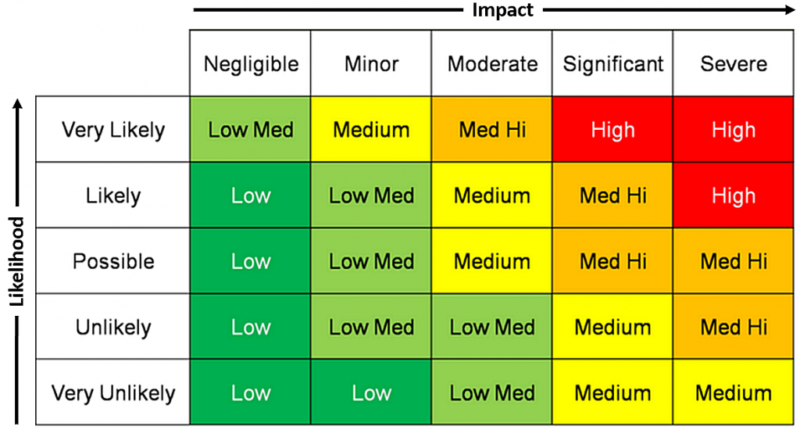
Components of risk assessment
Risk formulation → context
Risk analysis → characterise hazards
Risk evalutation → severit and mitigation
Communication → graph or statement
Risk management → recommendations
Risk formulation
Specific
Define sources
Define endpoint receptors
Explain relationship
Endpoint receptors
Chemical or physical entities attected
Plants are endpoint receptors for fire
Bugs are endpoint receptor for insecticide
Conceptual models
Show links and pathways for factors
Stessors, source, receptor, effect
Characterising hazard
Frequency/ probability of occurence
Intensity/ severity
Duration/ time is lasts
Extent/ spatially confined or dispersed
Risk analysis
Links hazard to likelihood and consequence
Quantitative → data driven
Qualititative → descriptive, broad risk ID
Semi-quantitative → cause-effect models
Leeching
Soaks down from surface
Recharges freshwater
Perculation
Comes up from ground
Salt, saltlands
Risk management
Must try to mitigate and reduce likelihood
Reduce impacts through contingency plan
Elimintate → remove target from hazard
Variability Uncertainty
Effect of change on a system
Chance of flood in a natural system
Measured with frequencies or probability
Always there
Weather
Epistemic Uncertainty
Knowledege is imcomplete
Can it be observed to learn
Incomplete data
Coastal Zone management in Woollongong
Damage to assets from sea level rise
Beach will recede
Hurt infrastructure
Incorporate risk assessment guidlines
Chile Copper Pipeline
Leaked into river, health impacts
Landslides, engineering, and vandalism risks
Risk evaluation said low risk (low likelihood and hazard)
Risk assessment positives
Incorporate uncertainties
Identifies threats and endpoints
Communicates quanititative comparisons → risk matrix
Risk assessment negatives
Linkage to decisions and stakeholders
Relies on subjective info
High data requirements
Socio-economic Impact Assessment (SEIA)
How project affects people, communities, and economic activity
Money and people generating money (econ + social interconnected)
Money, labour, profits, down payments,
Specialised assessment → can use in EIA
Mine town → creates community, needs schools, hospitals
Pop change, social (people leavin), econ (losing biz and workers)
Why do an SEIA?
Determine the consequences to money and people
Cost and benefit analysis
Provide evidence for decision making and policy
Econmic and social impacts are interconnected
SEIA boundary
What could change? → pos/neg, can you pay them, influx of people
Who could get affected? → Those who move to mining town, families
What to do about it? → Cost and benefits, mitigate effects
Steps for SEIA
Scoping →boundaries, budget needed
Profile baseline conditions → whats in boundary, responsibilities
Predicting impacts → what will change look like
Identify mitigation → how to manage
Evaluate significance → materiality, list
Apply mitgation and monitor → what actually happens
Valued Socio-Economic Components (VSECs)
Social and economic conditions important to people and could be affected by project
Fisheries → fishery access, income
Forest → hunting, cultural heritage
Agr → farm income, farm size
Infrastructure → housing, employment
Socio-Economic Indicators
Measurable characteristics that help understand the social and economic conditions around a project
Once you do a project, these things will change
Need to decide first → what we need to measure
Ask what has changed? Who? Where? What impacts?
Choose only relevant indicators
Can look at framework
Marine Protected Area (MPA)
Can’t fish here
Will impact fishing communities → short term economic loss
Will improve fish pop and biodiversity → more fish to surrounding areas (spillover effect0
Long term benefit
Marine Protected Area SEIA scoping
Boundary → Marine Park
Impacts → income, employability (fisherman and tourism affected)
Less income affects wider community
Possible solution for boundary → find other income for family
Look for missing information
Defines what we need to investigate
Marine Park baseline
Established evidence needed to assess future change
Collect current/ historical info (for trends)
Current fishing activities
Gives reference point for magnitude of change
Past data helps ID trends
Marine Park predicting impacts
Goal is to determine waht could change
Collect additional evidence
Qualitative/ Quantitative
Primary/ Secondary
Direct effects → income (econ), family activities (social)
Indirect effects → less household spending in local economy
Primary Evidence
New data created for EIA
Survey, interview, observation, experiment
May have bias
Time consuming and costly
Secondary Evidence
Data already exists
Lit review, gov’t database
May be collected for different reason
May be outdated
Triangulating evidence
Using different sources of data
Can cross-check to identify gaps, errors
Timing bias
Data collected in the wrong season may miss important activities
Surveying fishes in off season
Data limitations
Exisiting data may be outdated, at wrong spatial scale, or collected for other purpose
Sampling and selection bias
Who participates matters
May overrespresent or miss groups
Marine Park identifying mitigation
Reducing specific impacts
Help locals get income from other sources
Support access to other fishing spots
Transition support
Economic Impact Assessment
Profits - costs for a project
$ value
Investments, cost of labour, cost of mitigation
From company perspective
Compare alternatives
Economic Impact Assessment methods
Cost benefit analysis
Multi-criteria analysis
Model economic effects
Cost-benefit analysis
Assess all costs and benefits of project in $
Translates impacts into monetary value
Net benefits = Total benefits - total costs
Economic Impact Assessment limitations
Some things are hard to explain as $
Uncertainty
Discount rate
Equity → not all will benefit equally
Bias
Time and experise → costs $
Why manage natural resources?
They’re finite
Limit consumption
Equitable distribution
Preventing overexplotation
Natural Systems
Dynamic, complex and uncertain
Rarely have perfect info
Often time and money constraints
Often competing stakeholder objectives
Adaptive Environmental Management (AEM)
Learn as you go and change responsibly
Originated in 1970s
Needs monitoring → evaluate, learn and adjust
Not trial and error, based on science and start with info
Feedback loop: monitor → evaluate → adjust → monitor
Goal is better management through better understaning
When to use Adaptive Environmental Management
When system is dynamic
When plan is flexible
When outcomes are uncertain
When monitoring is possible
When future decisions can change
Where does Adaptive Environmental Management go in an EIA?
Phase 1: Implementation → in Mitigation and Impact Management
Phase 2: Follow-up → after approval
Plan it before approval
EIA predicts, AEM tests predictions and responds
Designing an Adaptive Environmental Management plan
Get info
System → see whole picture
Plan → hypothesis, Phase 1
Implement
Monitoring
Phase 1 of Adaptive Environmental Management
Deliberative
Set up decision problem
Establish what we are trying to do and how we think system works
Establish stakeholders, objectives, alternative, models, monitoring
Before intervention
Phase 2 of Adaptive Environmental Management
Manage and learn
Understanding evolves through evidence
Decide → implement → monitor → assess → update → adapt
Repeat cycle
What does Adaptive Environmental Management ask?
What happened?
Why?
Was it predicted?
What did we learn?
What do next?
Technical Learning Loop
Fix the immediate problem
Are our management actions working?
Do we need to change the action?
IE Fix wall
Social/ Institutional Learing Loop
Question the systems that produced the action
Are we managing the right problem in the right way
Bigger picture
Cater to the change in the rest of the system
IE shift entire wall project
Double-Loop learning
Using both technical learning and social/ instituional loops together
Improve both the intervention and the decision system
Problems with Adaptive Environmental Management
Expensive → need to monitor for awhile, upfront costs
Working with uncertainty → risk
Short-term management priorities (not good for short term projs)
Needs stakeholder involvement
Need insititutional support → slow process
Theory is good → implementation bas
May be confused with monitoring
Process barrier for Adaptive Environmental Management
Most common
Bad objectives
Weak monitoring
Unclear responsibilities
Lack of funding
Don’t understand adaptive environmental management
Bad stakeholder involvement
Ecosystem barrier for Adaptive Environmental Management
Less common problem
Lack of original knowledge
Complexity
Unexpected events → fires, floods
Scale mismatch
Goverance barrier for Adaptive Environmental Management
Inflexible legislation
Political constraints
Institutional structure
Accountability confusion
Climate change and Adaptive Environmental Management
System changing while we are learning about it
Need to define boundaries to not get overwhelmed
What does good Adaptive Environmental Management need?
Structure and resources
Collaboration → stakeholder engagement
Learning
Legal and institutional capacity
Alabama Hydropower Damn
Trying to balance hydropower, fish biodiversity and recreation
Considered alternatives and made predictions
Created damn → chose a flowpath
Monitored
Adapted → annual updating of info as they monitor
When to NOT use Adaptive Environmental Management
When there’s low uncertainty
When you can’t monitor
When management can’t change
When costs excede potential learning benefits
Biodiveristy lag effects
Once you break a threshold, species can slowly degrade
Period of time until extinction
Environmental Management Plan (EMP)
Details how env management will be implemented before and after the project
Avoid, reduce, offset
Dynamic and adaptive to allow for future knowledge and tech
Part of EIS
Look at future and how to mitigate
Statement of Environmental Effects (SEE)
Proposals with lower env impact
Physical environmental changes
Alter landscape, air, water bodies, dust
Cumulative impacts
Combined effects of multiple projects occuring over time
Often overlooked
In Impact Prediction and Assessment stage
Sunscreen + waste + fertiliser on GBR
Transboundary impacts
Affect neighboring regions or countries
Requires cooperation
Limitation of EIS
Changes of law
Need good data (reliable, no gaps)
FIFO
Can harm regional towns
No new job creation
Property price increases
South Africa Case Study
Fisheries were present, migration route for whales
Shell did EIA for oil exploration→ was overturned
Project was approved before EIA was done
Issues with EIA and public participation
Shell created negative reputation for themselves and other developers
Issues with Shell’s EIA in South Africa
No study on impacts of disasters on community → spills and blowouts
Ignored coastal protection laws
Climate change impacts not properly assessed → sea level rise
No cross boundary assessment → illegal nationally and internationally
Public wasn’t shown key emergency plans (spill management plans) **
Reasons Shell’s EIA was overturned in South Africa
Procedural shortcomings
Lack of public engagement
Insufficient env evaluation
Reinforcement of env law
Critiques for Shells’s EIA in South Africa
Data gaps
Marine life overlooked
Transparency concerns
Purpose for EIA
Prevent env harm
Promote sustainable development