candice are you still with us??
 Call Kai
 Learn
 Practice Test
 Spaced Repetition
 Match
 Flashcards
 Knowt Play
1/65

There's no tags or description
Looks like no tags are added yet.
66 Terms
rain in equator
max at the equator, dry and wet season
deserts
30 S/N , little rainfall, sinking air
savannas
moderately dru, shrubs and booshes
15 S/N
rainforest
wetest, warm reigion
equator
ITCZ
biomes
rainfall pattern creates different ecosystems
temperate forests
grow in midlatitude climates , wet all year
Syracuse
boreal forest
higher latitudes, mild summer, colder winter, fairly wet conditions
northern hemisphere bc land doesnt reach as far poleward
tundra
frozon earth
has gotten greener bc of co2 fertilization and longer growing season (gives plants more time)
precipitation
hadley celss in the tropics
low pressure everywhere else
biomass
convert co2 and water
material what plants are made from
when theres enough water - co2 increases biomass
when theres not enough water - more co2 doesnt help
winter
releases co2 out - bacteria and other organisms consume them and convert biomass into co2
38 gtco2
mauna loa
isolated - far from human activity
vegetation is at the least in the spring, most in september
each year co2 increases with seasonal uptake
fossil fuels, increases
sawtooth pattern
vegetation
doesnt cause upward trend in co2
changes how much co2 is in the air at partocular times of the year
we release
41 gtco2
36 (burning fuels) + 5 (clearing land)
fate of emissions
20 gtco stays in the atmosphere
raises co2 concentration and warms climate
12 (dissolves in ocean)
9 goes into plants and stays there
leaf area index
how much of surface is covered by leaves
leaf area
increased, world got greener by 25 to 50 percent while vegetated land decresed
feedback look
deforest rainforest —> lest transpiration —> less rain—> drought (kill forests through water stress, fire)
co2 fertilization
more co2 = more biomass
explains the increase of leaf area — 9gtco
water recycling
caused by vegetation
plants increase the amount of water
transpiration
decreased when forests get cleared

transpiration
evaporation of water from plants
makes air moister, moves air west
earths water
97 percent is from oceans
3 percent is freshwater found in glaciers/ice sheets and in lakes/rivers
continental divide
line that roughly follows the highest elevations of the rockies
goes through rivers into oceans
water reaches the ocean
groundwater and runoff (fastest)
equation
P-E=water left
precipitation
water added to land,
becomes runoff or stored as groundwater
saturation humidity
most water vapor in the air can contain
7 degrees
rises with remp
relativie humidity
stays the same, actual amount of WV in the air
soil moisture
water stored in soil
depends on P and E
if P > E , soil moisture rises
if P < E , soil moisture falls
2 degrees C
evaporation and precipitation rises
as temp rises
gap between saturation humidity and absolute himidity rises (actual amount)
high temp = more evaporation
factors that effect runoff
if land is steep = more runoff
more vegitation = less runoff
type of surface — soil = less runoff , pavement = more runoff
more intense precipitation = more runoff
drought
period of water with less water availiable than normal
12 regions
southwest - driestbecause low rain and high evap, atmosphere takes more water
southwest
drought- less rain + warmer temps
climate change - dries out soil
lake mead
has gone down, less rain = less water
warming = evaporation
rivers
rain runs off when it falls faster than the ground going downhill
controlled by p-e
discharge
Discharge rises as the runoff reaches the river, drains into ocean
how much water flows through rivers
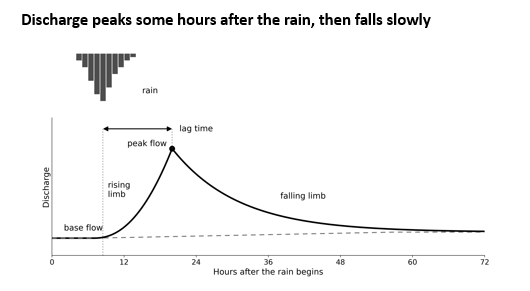
rivers and discharge
discharge of a river depends on the size and speed
controlled by:
width and depth determine the volume of the discharge
speed of water
Q = V(A)
changes the shape
rivers carry
dissolved - minerals, invisbile
suspended - soil, clay, help up by moving water
bedload - gravel and cobble -
determined by the discharge
erosion
flowing water picks up material
deposition
material is carried by water drops out onto the surface
how material goes to ocean
production - slope is steep, material picks up, erosion
transport - river carries whats picked up, erosion and deposition are balanced
deposition - river flattens out, slows down , drops material

incision
river carries away its bed and the channel deepns
eriosion is faster
canyons - grand canyon
if river energy supports more material — incision
aggradation
river drops sediment and the bed rises
depo is faster than erosion - river drops materials such as soils and rocks
if river is carrying more material than its energy level can support — aggradation
steep river
steeper river = more energy, how much material could carry
graded river
when erosion and deposition happen at the same rate
carries material, doesnt gain or loose
more material
If energy > material carried = incision
If energy < material carried = aggradation
feedback loops aggradation and incision
Aggradation → downstream river gets steeper → river energy increases → stops aggregation
Negative feedback
Incision → river gets less steeper → river energy drops → incision stops
Negative feedback
ocean
covers 2/3 of earths serface
deepest point is about the size of the troposphere
salinity
density
salinity and temp
temp drops —> density rises
density
determines if water sinks or rises
Na water
top layer
mixed layer 10-500
affected by wind and sun (warms water)
deep ocean
most of the ocean, freezing
ocean currents
wind driven by coriois
density driven
temp
ekman transport
moves more right
max is 90
trade winds

melting ice
increases sea level
melting ie doesnt raise sea level — same level
ice during the seasons
melts faster during the summer
less ice every year
sea ice
not the same thickness
thick - lose a lot of ice without exposing ocean
thin - melted the most
arctic is warming faster
ice albedo feedback — .7 c faster
antarctica
ice sheet gets smaller when it touches the warm water ocean
its below sea level , which can melt the bottom of the ice sheet
high sea levels
more flooding
caused by melting ice , thermal expanision , ice melting from greenland and anartica
thermal expanision
warm water takes up more space
sea level rise will continue
slowly, will affect people 50 - 100 years from now
GHGs will stay in the atmopshere making ice sheets melt
potential evaporation
how much water would evaporate if the supply of water were unlimited
depends on temp - higher if warm