CLRS 321 EXAM 4 SELF MADE CARDS
 Call Kai
 Learn
 Practice Test
 Spaced Repetition
 Match
 Flashcards
 Knowt Play
1/44

There's no tags or description
Looks like no tags are added yet.
45 Terms
What is the N-type/side?
Extra electrons, move toward the anode (positive charge because electron donor has lost its electrons), is known as donor impurity
What is the P-type/side?
Extra holes, move toward the cathode (negative charge because electron acceptor impurity has lost its holes), is known as acceptor impurity
What is the Depletion Layer?
The combining of conduction electrons and holes causes no free charge carriers and this is maintained by the electric field created by the positive and negative charges
The application of reverse bias
When the anode is at the n side and the cathode is at the p side and they will attract the electrons and the holes respectively, increasing the size of the depletion layer
Why do semiconductors have better energy resolution than crystals?
Semiconductors have better energy resolution because conversion of radiation energy to ion pairs requires less energy which results in higher energy resolution
What is a neoprobe?
A handheld intraoperative probe used to detect radiation during surgery in areas that are hidden/non palpable
What is a sentinel node biopsy?
The most common use of neoprobes, used to see where cancer has spread through lymph nodes (lymphoscintigraphy)
What are the daily QC's?
Battery check, background determination, constancy check
What QC is done quarterly/semiannually?
Calibration
What are the NEMA Recommendations?
All done annually, sensitivity in air and scattering medium, energy/spatial/angular resolution, volume sensitivity, count rate capabilities
What is the basic concept and use of liquid scintillation detectors?
Basic Operation: Solvents dissolve radioactive samples (often purposely radiolabelled) into vials, radioactivity scintillates a set of solutions in the vials, PMTs detect light from the "scintillation cocktails" in the vials
Uses: In laboratories to count beta emitters, not really seen anymore
What is the basic concept and use of collar dosimeters?
Basic Operation: Al2O3 crystalline material becomes luminescent under selected laser frequencies. Luminescence is proportional to the amount of radiation exposure
Uses: To monitor radiation exposure at the chest level
What is the basic concept and use of ring TLD's?
Basic Operation: Uses a lithium fluoride chip that absorbs the energy of ionizing radiation, then heated at characteristic temperatures that cause it to emit the absorbed energy as visible light. The amount of exposure is determined by the light intensities
Uses: To monitor radiation exposure of the dominant hand
What is the concept of background?
Present in all radiation detection, refers to detected counts that do not come from the source being measured, determined by making a measurement with no source present, should be less than 1% of the source count rate
What is noise?
Any undesired fluctuation that appears superimposed on a signal source, arrives from many sources, accounted for through statistics
What is Poisson distribution?
Counts whole non-negative integer events occurring within a fixed interval or space, discrete, range of probabilities for the mean based on standard deviations from the measurement
What is Gaussian distribution?
Measures physical or continuous quantities that can take any real value (including decimals and negative numbers), continuous, range of probabilities for a measurement based on standard deviations from the mean
What is the relationship between the standard deviation and the mean of a Poisson distribution?
Standard Deviation: The independent variable, based on measurements
Mean: Depends on the SD from the measurements, range of probabilities
What is the probability of 1 SD?
68.3% probability of falling in here
What is the probability of 2 SD?
95.45% probability of falling in here
What is the probability of 3 SD?
99.7% probability of falling in here
What is the calculation for the coefficient of variation?
CV = √N/N x 100%
CV = 100%/√N

What is the principle of add in quadrature for standard deviations?
Means that the standard deviation compounds with multiple measurements
What is the purpose of chi-square testing?
Done quarterly to ensure count variation follow the expected random (Poisson) pattern, test to see if system is compliant with the laws of nuclear radiation statistics
Define the results of chi-square testing:
Normal Variation: Detector stable, p = 0.5
Too much Variation: Instability or noise, p < 0.1
Too little Variation: Possible systematic error, p > 0.9
What is dead time?
The minimum time separation of two radiation events required to detect them as two distinct events
How to calculate % DT losses?
% DT Losses = [(True count rate - observed count rate)/true count rate] x 100
What is a paralyzable system?
Each event, counted or not, introduces a dead time creating an extendable period of detector paralysis, in a graph the observed count rate reaches a maximum then decreases
What is a non-paralyzable system?
When an event occurring during dead time is ignored, in a graph observed count rate approached a maximum value and stays there
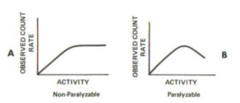
What do paralyzable and non paralyzable graphs look like?
Paralyzable reaches a peak then declines, non-paralyzable reaches a peak and stays there
In a gamma energy spectrum, counts are where?
The y-axis
In a gamma energy spectrum, energy levels are where?
The x-axis
What is the photopeak?
Photopeak represents energy level at which most pulses fall on the voltage scale
Name the parts of a gamma energy spectrum from left to right:
Scatter compton edge, backscatter and Pb x-ray, iodine escape peak, photopeak
What is compton edge?
The upper limit of how much energy a photon can transfer to a compton electron
What is the emax?
Maximum possible energy given to an electron by a photon's backscatter interaction
What is backscatter peak?
Reverse of compton, when the gamma ray is scattered in the source of the surrounding structure such that the scattered photon is then absorbed in the scintillation crystal, now it is the scattered photon rather than the compton electron depositing its energy in the crystal
What is the emin?
Minimum possible energy of the backscattered photon on the detector
What is efficiency also known as?
Sensitivity
What is the impact of crystal thickness?
The thicker the crystal, the more likely a gamma photon will deposit energy (becomes more efficient)
How to calculate absolute peak efficiency?
Absolute Peak Efficiency: (Counts/units of time)/((disintegrations/unit time) x (mean number/disintegration)) x 100
How to calculate efficiency factor/determine dpm from cpm?
Efficiency Factor: net cpm of standard/net dpm of standard
Dpm (sample) = net cpm (sample)/efficiency factor
Dpm = (net cpm/efficiency factor) x (gamma rays/disintegration (std))/(gamma rays/disintegration (sample))
What is impacted by different volumes in a well counter geometry wise?
Higher volumes have less activity interaction with the crystal
Some gamma energy also attenuated by source
Can affect count rate for well and probe
How can probe-thyroid positioning impact geometry?
Needs to be consistent for each measurement with distance
Needs to be centered on the thyroid
What happens with attenuation from the source itself?
Higher volumes mean some gamma energy is being attenuated by the source and less of the activity interacts with the crystal
Photons can be attenuated before detection within the source itself or within the medium between the source and the detector