2.7 Finding Patterns: The Periodic Law and the Periodic Table
 Call Kai
 Learn
Learn Practice Test
 Spaced Repetition
 Match
Match Flashcards
 Knowt Play
1/16

There's no tags or description
Looks like no tags are added yet.
Name | Mastery | Learn | Test | Matching | Spaced | Call with Kai | Chat |
|---|
No analytics yet
Send a link to your students to track their progress
17 Terms
periodic law
when the elements are arranged in order of increasing mass, certain sets of properties recur periodically
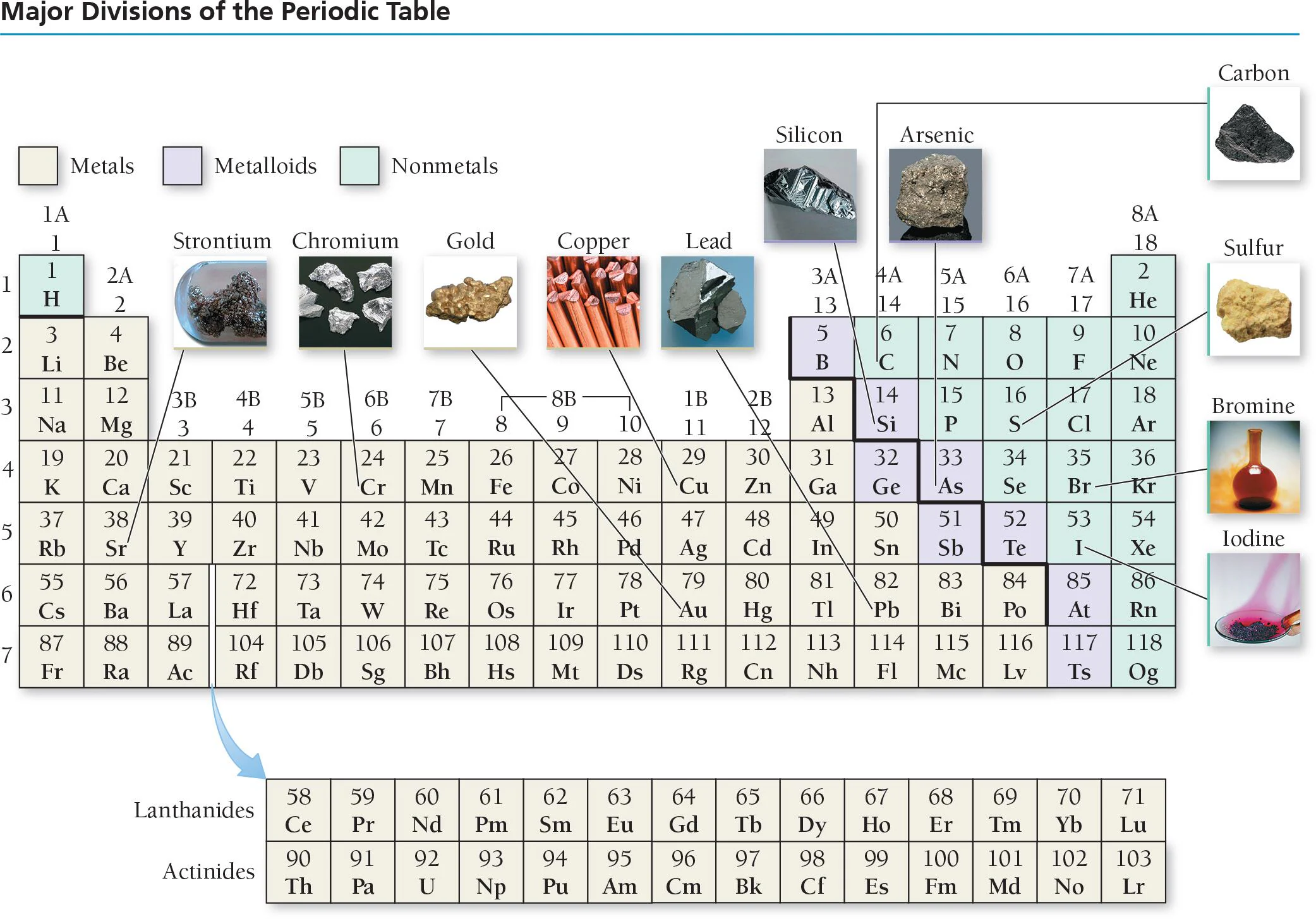
metals
class of elements that are generally good conductors of heat and electricity, malleable, ductile, and lustrous, and tend to lose electrons during chemical changes
located on lower left side and middle of the periodic table
e.g. chromium, copper, strontium, gold, lead

nonmetals
class of elements that tend to be poor conductors of heat and electricity, not malleable, not ductile, and usually gain electrons during chemical reactions; varied properties, can be solid/liquid/gas at room temperature
located on the upper right side of the periodic table
e.g. oxygen, carbon, sulfur, bromine, iodine

metalloids
aka semimetals, the class of elements found on the boundary between the metals and nonmetals of the periodic table, with properties intermediate between those of both groups
e.g. silicon, arsenic, antimony
metalloids
Several __________ (metals/metalloids/non-metals) are classified as semiconductors due to intermediate and highly temperature-dependent electrical conductivity.
semiconductors
a material with intermediate electrical conductivity that can be changed and controlled
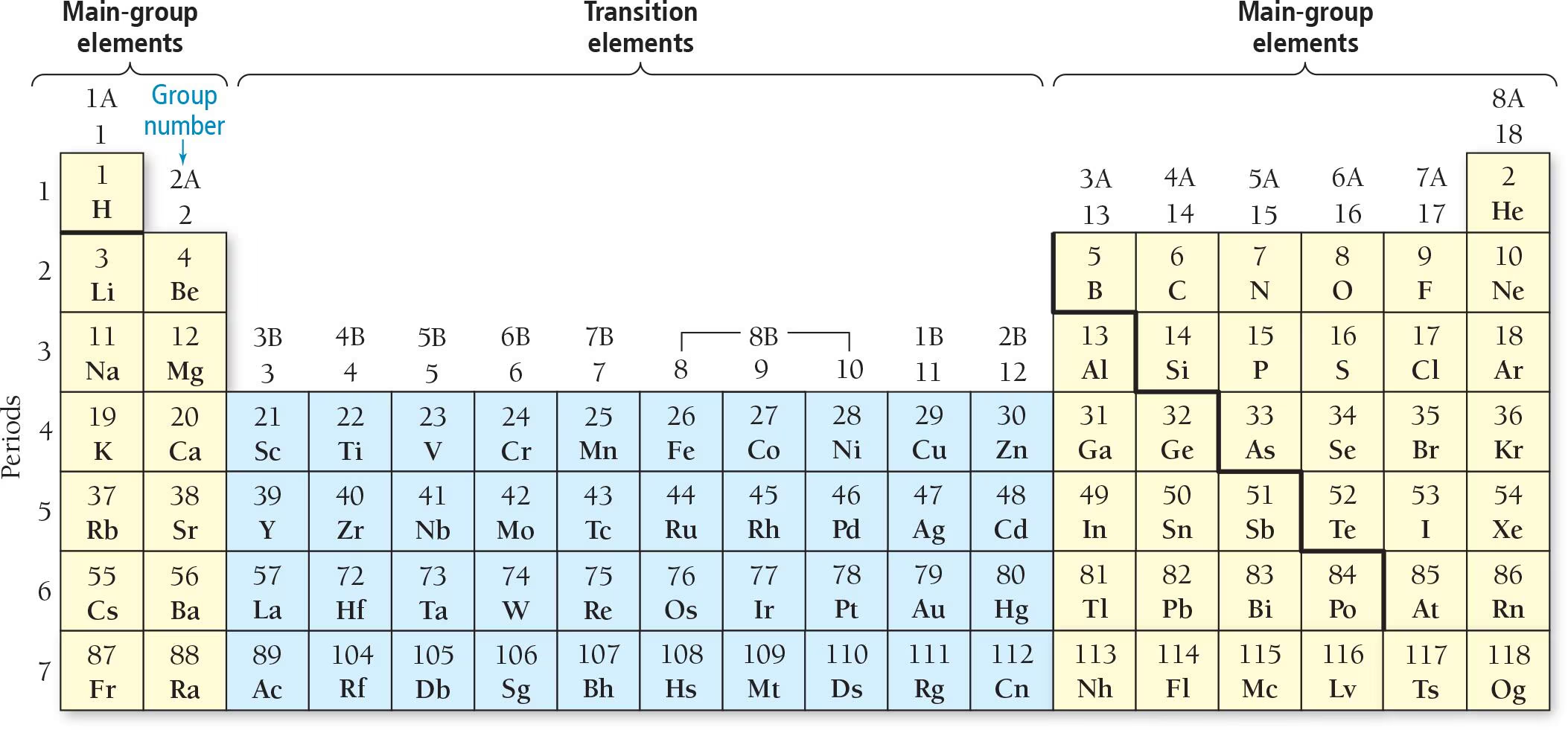
main-group elements
elements found in the s or p blocks of the periodic table, whose properties tend to be predictable based on their position in the table

transition elements
aka transition metals, elements found in columns labeled with a number and the letter B in the periodic table whose properties tend to be less predictable based simply on their position in the table
family
aka group, elements within the same column of the periodic table
similar
Elements within a group/family usually have _______ (similar/different) properties.
alkali metals
highly reactive metals in group 1A of the periodic table, more reactive as going down column; lithium, sodium, potassium, rubidium
alkaline earth metals
fairly reactive metals in group 2A of the periodic table, not as reactive as alkali metals; magnesium, calcium, strontium, barium
halogens
highly reactive nonmetals in group 7A of the periodic table, less reactive as going down column; fluorine, chlorine, bromine, iodine
noble gases
group 8A elements which are largely unreactive (inert) due to their stable filled p orbitals, chemically stable; helium, neon, argon, krypton, xenon
chemically stable
does not combine with other elements to form compounds
lose
A main-group metal tends to ____ (lose/gain) electrons, forming a cation with the same number of electrons as the nearest noble gas.
gain
A main-group metal tends to ____ (lose/gain) electrons, forming an anion with the same number of electrons as the nearest noble gas.