syntax PT 2
 Call Kai
 Learn
Learn Practice Test
 Spaced Repetition
 Match
Match Flashcards
 Knowt Play
1/67

There's no tags or description
Looks like no tags are added yet.
Name | Mastery | Learn | Test | Matching | Spaced | Call with Kai | Chat |
|---|
No analytics yet
Send a link to your students to track their progress
68 Terms
Constituent
A group of words that acts together as a unit within a sentence
How Do We Find a Constituent?
Grammaticality judgments
AND
Constituency tests
There is_______Constituency tests
4
If a group of words behaves like a single unit, it is probably a _________.
constituent
Constituency Test #1: Replacement
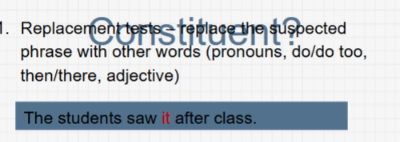
Take the suspected phrase and replace it with another word/expression ((pronouns, do/do too, then/there, adjective)
If the sentence still works appropriately, that can show that the words acted as a unit
Constituency Test #1: Replacement
Example:
The students saw a movie after class.
Replace:
a movie → it
➡ The students saw it after class.
That works.
So a movie behaves like a constituent
Replacement trick:
Ask:
Can I replace the whole group with ONE appropriate word?
If yes → evidence that it is a constituent.
IMPORTANT: Meaning Matters!
You can't just replace words and say:
"It is grammatical, so it must be a constituent."
You have to pay attention to:
1. Grammaticality
Does the new sentence sound grammatically correct?
2. Meaning
Does the replacement represent the same thing/idea?
Pay attention to both grammaticality and meaning when doing replacement tests.

Constituency Test #2: Movement
Move the suspected group somewhere else in the sentence.
If you can move the group without changing the sentence's meaning or grammaticality, that is evidence that it is a constituent.
Constituency Test #2: Movement
EXAMPLE
Elizabeth bought a hat at that fun little shop.
Move:
at that fun little shop
➡ At that fun little shop, Elizabeth bought a hat.
It still works.
So:
at that fun little shop = constituent
But:
❌ At that fun Elizabeth bought a hat little shop.
That doesn't work.
Why?
Because at that fun is not acting as one constituent.
Constituency Test #3: It-Cleft
Itake the string of words and put them after the words It was (or It is/It’s), then put the remaining part of the sentence after the word that
t-cleft structure:
It is/was ______ that ______.
Take the suspected group and put it after:
It was...
Then put the rest after:
that...
Constituency Test #3: It-Cleft
Example
Example:
Original:
The cat was sleeping on the desk.
Suspected constituent:
on the desk
Try:
It was on the desk that the cat was sleeping.
✅ Grammatical
Therefore:
on the desk = constituent
Example:
Original:
The cat was sleeping on the desk.
Try to use:
on the
➡ It was on the that the cat was sleeping desk.
❌ Doesn't work.
Therefore:
on the ≠ constituent
If the cleft IS grammatical →
you can be sure the phrase is a constituent
Constituency Test #4: Answering a Question
Can suspected constituent stand alone as the answer to a question based on the sentence?
Constituency Test #4: Answering a Question
example
Original:
The cat was sleeping on the desk.
Question:
Where was the cat sleeping?
Answer:
On the desk.
✅ on the desk = constituent
Because the entire phrase can answer the question
Constituency Test note
This is mainly practice, so just ask chat gpt to ask if something is contituent
What are functional categories?
This categoty often have purely grammatical meanings or uses
How does functional categories differ from lexical categories?
lexical categories classify words based on their grammatical AND semantic behavior.
Functional categories:
Determiners
Pronouns
Auxiliaries
Modal auxiliaries
Prepositions
Others: degree words, numbers, conjunctions
Determiner Short version for trees:
Determiner=
Det
What is a determiner?
a word that comes at the beginning of a noun phrase to show which specific noun you mean, how much of it there is, or who owns it.
A determiner is usually the ______ word in a noun phrase
first
You can usually have ________ determiner in a noun phrase
ONLY ONE
What is the basic noun phrase pattern with a determiner?
Det + N
Examples:
the dog
a dog
this dog
every dog
Unlike adjectives, you ______ normally have multiple determiners together.
cannot
You can have:
the big red dog ✅
But not:
the this dog ❌
because the and this are both determiners
What are the 4 types of determiners?
Definite article
Indefinite article
Demonstratives
Some quantifiers
What is the definite article?
the
What is the determiner in “the dog”?
the
What is the indefinite article?
a / an
What is the determiner in “a dog”?
What is the determiner in “an apple”?
a; an
What are demonstratives determiners?
this, that, these, those
What are some quantifiers that can function as determiners?
every, some, each, most, etc
Pronouns
Short version for trees:
Pronoun=
Pron
What do pronouns do?
Pronouns can replace a whole noun phrase
Examples:
Emily → she
the students → they
the book → it
First person singular (pronoums)
I
me
my
First person plural (pronoums)
we
us
our
Second person singular/plural (pronoums)
you
you
your
Third person singular inanimate (pronoums)
it
it
its
Third person singular feminine (pronoums)
she
her
her
Third person singular masculine (pronoums)
he
him
his
Third person animate singular/general plural (pronoums)
they
them
their
Auxiliaries Short version:
Auxiliary
Aux
What are auxiliaries?
Helping verbs that occur alongside a lexical main verb.
Can auxiliaries be present or past tense?
Yes
Can auxiliaries show agreement?
Yes
What is one important rule about auxiliaries?
They always occur alongside a lexical main verb.
She is running.
is = Aux
running = lexical/main verb
Why? Because is is helping the main verb running.
What are the 3 auxiliaries listed in the slides?
have, be, do
Modal Auxiliaries
Short version for trees:
Modal Auxiliaries=
modal
Modal Auxiliaries
Two things to remember
They cannot be used as main verbs
They do NOT agree with the subject
Modal auxiliaries from the slides:
will
would
can
could
may
might
shall
should
must
Have, be, do → can sometimes be main verbs
Auxiliary
Will, would, can, could, may, might, shall, should, must → CANNOT be main verbs
Modal Auxiliary
Prepositions Short version for trees:
preposition=
p
Prepositions definition
Express location or grammatical relations
Prepositions are almost always followed by a ________.
noun phrase (NP)
A preposition often connects something to a noun phrase
EXAMPLE
on the table
with that person
beside the house
for the student
on
up
beside
above
to
with
for
of
PREPOSITIONS
PP =
Prepositional Phrase
Shows degree/amount
Degree
Degree example
very, way
Shows number/amount
Numbers
Numbers example
one, five, many, few
Connects words or parts
Conjunctions
Conjunctions examples
and, or, but
num
numbers
dregree
degree
Conjunctions
conj
Co-occurrence
which words need to occur together (or with certain other words) to make a sentence grammatically correct