12: Hearing and Equilibrium (Lab)
 Call Kai
 Learn
Learn Practice Test
 Spaced Repetition
 Match
Match Flashcards
 Knowt Play
1/72

There's no tags or description
Looks like no tags are added yet.
Name | Mastery | Learn | Test | Matching | Spaced | Call with Kai | Chat |
|---|
No analytics yet
Send a link to your students to track their progress
73 Terms

consisting of the pinna and the external auditory canal
Outer ear

entire outside part
Pinna(auricle)

External acoustic canal

the bottom piece
Lobule

blue arrow
Tympanic membrane

the chamber between the eardrum and cochlea that has the bones and auditory tube
Middle ear

ossicles

hammer, connects directly to the tympanic membrane
Malleus

anvil, black arrow
Incus

stirrup, green arrow
Stapes

red outline
Auditory tube

Very easy, just for clarity, green section
Inner ear

What structure is underneath the structure pointed at?
Oval window

blue circle
Round window

Blue section
Round window

the hard shell surrounding the entire thing, has perilymph fluid inside
bony labyrinth

soft shell, has endolymph inside
Membranous labyrinth

yellow arrow
Vestibulocochlear nerve(VIII)

for hearing
Cochlear nerve branch

for balance
Vestibular nerve branch

the entirety of the circled area
Vestibular apparatus

Rings
Semicircular canals

The clear section, has endolymph inside
Semicircular ducts

The thin blue section
Semicircular ducts

light blue bulb
Ampulla

Inside the ampulla, the hill that goes up (has the star)
Cristae ampullaris

What is the microscope pointing to? (the whole mass)
Cristae ampullaris

What is A pointing to?
Cupula

Yellow boxed arrow
Cupula

What is B pointing to
(Crista) Hair cells

Its obvious but just so you know, the hair cells are right before the cupula
(Crista) hair cells

Purple arrow (think "south")
Saccule

Red arrow (think "up")
Utricle

Inside the Utricle and saccule
Maculae
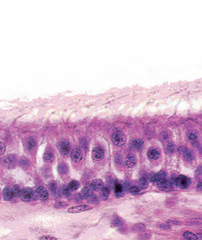
what is this in histology?
Maculae

Red highlighted area
Otolithic membrane
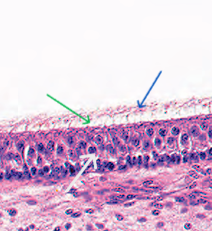
Green arrow, the white area
Otolithic membrane
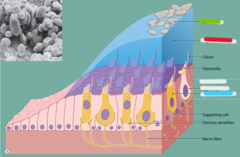
Green highlighted area
otoliths

Blue arrow, the pink little dots
Otoliths

Blue highlighted area
(maculae) hair cells

White arrow, all of the cells in this layer
(Maculae) hair cells

Snail
Cochlea

Vestibular duct(scala vestibuli)

Vestibular duct(scala vestibuli)

Tympanic duct(scala tympani)

Tympanic duct(scala tympani)

Cochlear duct(scala media)

Cochlear duct(scala media)

Vestibular membrane

Vestibular membrane
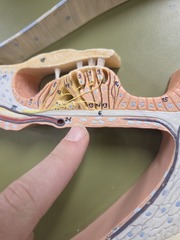
Basilar membrane

Black arrow(without the O), flat pink layer
Basilar membrane

Spiral organ(Organ of corti)

The entirety of the specific area being pointed at
Organ of corti

Tectorial membrane

Blue arrow
Tectorial membrane

(Organ of corti) Hair cells

Green arrow
(Organ of corti) Hair cells

What test uses a tuning fork that you place on your head to see if you have hearing loss in one ear?
Weber test

Which test uses a tuning fork that you place behind your ear, then in front of your ear to see if you can still hear it?
Rinne test

Which test do you spin in a chair to test vestibular ocular reflex and see if someone has nystagmus? (Nystagmus is a normal response, NO nystagmus is an abnormality)
Barany test
What is nystagmus?
Involuntary rapid eye movement

What test is used to check for equilibrium/balance by having the patient close their eyes and stand still?
Romberg test
What areas of the inner ear contain perilymph?
Vestibular duct (Scala vestibuli), Tympanic duct (Scala tympani), inside bony labyrinth
What areas of the inner ear contain endolymph?
Cochlear duct (Scala media), inside membranous labyrinth
What does it mean if someone does the weber test and one ear hears the frequency louder/quieter than the other?
Potential conductive (loud) or sensorineural (quiet) hearing loss, need to preform the Rinne test to determine which.
What does it mean on a Rinne test if the sound you hear when you touch the bone is louder than when it is in front of the ear?
Conductive hearing loss in the ear, need to test other ear if it is the same.
What does it mean on a Rinne test if the sound you hear when you touch the bone is quieter than when it is in front of the ear?
Normal hearing, need to test both ears and preform the weber test again to rule out if it sensorineural.
After conducting a Rinne test with no abnormalities, you perform the weber test again to check what?
To check if the patient has sensorineural hearing loss. This would be indicated by uneven hearing when preforming the weber test after no abnormalities with the Rinne test
function of OHC
cochlear tuning
function in ICH
what we hear as sound/vibration
conductive deafness
any condition that interferes with the transmission of vibrations to the inner ear
sensorineural deafness
death of hair cells or any of the nervous elements from the cochlear nerve to brain tissue that is concerned with hearing (VIII)