Microbiology Exam 3
 Call Kai
 Learn
 Practice Test
 Spaced Repetition
 Match
 Flashcards
 Knowt Play
1/62

There's no tags or description
Looks like no tags are added yet.
63 Terms
Define “normal flora”. What are some of their benefits to the human host? What are some of their potential detriments to the human host?
Normal flora are those microorganisms that live in the non-sterile areas of our body that generally have a neutral or beneficial relationship with us.
Benefits include: discouragement of colonization of non-sterile areas by pathogens (since they deprive them of essential nutrients), aid in digestion by producing degradative enzymes and production of essential nutrients and vitamins within the intestine.
The major detriment is that some microorganisms found in normal flora are pathogens, which can infect the individual or his or her neighbors during periods of susceptibility.
Define a “parasite”.
It is an organism that lives on another host organism.
Define a “pathogen”.
A pathogen is a parasite that brings about damage or harm of its host.
Define “infection”.
Infection is the colonization and growth of a pathogen on its host.
Define “pathogenicity” and “virulence”.
Pathogenicity is the ability of a pathogen to harm its host.
Virulence is typically a measure of pathogenicity (often how many microorganisms are required to achieve an active infection or cause death of a particular host when delivered by a particular route of transmission).
What is unusual about the normal flora of teeth?
Despite the presence of oxygen in our mouths, these flora consist of anaerobic Gram positive bacteria that create their own anaerobic microenvironment by making plaque from ingested sucrose.
What is an adhesin? What types of macromolecules comprise an adhesin?
An adhesin is the macromolecule that the microorganism utilizes as its receptor to bind to susceptible host cells. A variety of macromolecules are possible: a protein, polysaccharide, glycoprotein, or glycolipid, to name common adhesin molecules.
How do certain microbial pathogens affect blood clotting? Why?
Some pathogens produce fibrin degrading enzymes (e.g. streptokinase of Streptococcus pyogenes) in order to facilitate their spread from sites of injury, while other pathogens produce fibrin-clotting enzymes (e.g. coagulase of Staphylococcus aureus) in order to wall themselves off from the immune system in structures like boils and pimples.
Name two different categories of cytolytic toxins. How do their biochemical activities differ?
Enzymes like phospholipases digest phospholipids, thereby destroying membrane integrity.
Other enzymes like pore-forming toxins insert themselves into the membrane to create a permeable channel that destroys the selective permeability of the membrane.
What is the AB family of exotoxins?
It is a large family of exotoxins that contain two subunits: the A subunit is the toxin itself, while the B subunit facilitates toxin binding and entry.
Describe the action of diphtheria toxin.
Diphtheria toxin binds to cells of the upper respiratory tract utilizing its B subunit that facilitates entry of the toxin into the cell cytoplasm. The A subunit is an ADP-ribosylase that specifically utilized NAD+ to ADP-ribosylate translation elongation factor eEF-2, which halts host protein synthesis. This shuts down cellular translation, resulting in cell death.
Describe the action of botulinum toxin.
The B subunit of this toxin binds to presynaptic nerve terminal membranes at the neuromuscular junction. This allows entry of the A subunit that blocks release of exocytotic vesicles that carry the neuro-transmitter acetyl choline. This results in the blockage of neurotransmission across the synapse, leading to a flaccid paralysis of muscles and often death by asphyxiation.
Describe the action of tetanus toxin.
The B subunit of this toxin binds to presynaptic terminals of inhibitory neurons. This allows entry of the A subunit that blocks release of exocytotic vesicles that carry glycine that normally blocks neurotransmission required for muscle relaxation. Thus an action potential in these intoxicated, bifurcated nerves leads to contraction of both opposing muscles, inducing a rigid paralysis that results in death.
Describe the action of cholera toxin.
The B subunit of this toxin binds to GM1 glycolipids on intestinal epithelial cells that allows entry of the A subunit into the cellular cytoplasm. The A subunit binds to and activates host adenyl cyclase, leading to the blockage of sodium ion uptake into these cells. The build-up of luminal sodium ions leads to the exit of chloride ions accompanied by massive amounts of water from intestinal epithelial cells into the lumen of the small intestine, resulting in watery diarrhea. Sickness and death is caused by dehydration and electrolyte shock (i.e. loss of electrolytes from the diarrhea).
What is an enterotoxin?
Enterotoxins are toxins that affect the intestine and generally induce diarrhea.
What is an endotoxin? How does it work?
An endotoxin is literally any cell-associated toxin, but it has become synonymous with the lipopolysaccharide (LPS) polymer present on the outer leaflet of the outer membrane of Gram negative bacteria. LPS binds to LPS receptors present on leukocytes such as the macrophage, and triggers the release of pro-inflammatory cytokines (of the IL1, IL6, IL12, TNFalpha family) that globally activates the immune system.
What is a superantigen toxin? How does it work?
A superantigen toxin binds to Class II MHC and helper T cell receptors, promoting receptor bridging and helper T cell activation. Such bridging nonspecifically activates a large population of helper T cells that release pro-inflammatory cytokines that cause immune system activation and dysfunction. Activated macrophages and T cells damage host tissue in the area of the infection. In other cases cytokines can induce smooth muscle contraction, creating vomiting in diarrhea in the case of food poisoning.
Distinguish between innate immunity and acquired immunity in terms of (a) specificity of action, (b) response time, and (c) ability to amplify the response. Answer with a chart
Property | Innate Immunity | Acquired Immunity |
Specificity of action | Low specificity | Highly specific |
Response time | Rapid (seconds to minutes) | Delayed (~1 week) |
Amplification ability | Low (~one order of magnitude) | High (~three orders of magnitude) |
Describe the role of physio-chemical and biological/microbiological barriers in promoting innate immunity.
The epidermal layer is continuous and sealed. Mucosal membranes contain antimicrobial secretions such as lysozyme and phospholipase and produce antimicrobial peptides called defensins. The stomach is highly acidic, preventing the growth of most microorganisms. In addition, the nonsterile areas of the body are colonized with normal flora, which by being adapted to their niches and utilizing available nutrients, prevent colonization by pathogens.
Indicate two ways in which complement functions to destroy microbial infections.
The C3b component of complement can be covalently attached to microbial surfaces during complement activation, marking them for opsonization and destruction by phagocytes like the macrophage or neutrophil, which possess C3b receptors and phagocytic ability. In addition, the terminal components of complement (C5b, C6, C7, C8, and C9) can form the membrane-attack complex (MAC), which is a pore-forming toxin that inserts into microbial membranes, depolarizing and killing cells.
What is the basic function of macrophages in innate immunity? How does it destroy its “prey”?
Macrophage are important sentries that patrol peripheral tissues for pathogens as well as dead cells.
They utilize phagocytosis to ingest these targets. Fusion of the phagosome containing the ingested invader or dead cell with the lysosome results in the destruction of the contents of the phagolysosome. Such lysosomes are acidic and contain a variety of degradative enzymes, toxic oxygen, and antimicrobial peptides.
What is the basic function of neutrophils in innate immunity? How does it destroy its “prey”?
Neutrophils are phagocytic cells similar to macrophages, but they are normally present in the bloodstream, and only enter peripheral tissue if an infection is detected by cytokines. They are short-lived cells, that are more lethal than macrophages because the contents of their granules are more toxic.
They utilize the same phagocytosis and phagosome-lysosome/granule fusion mechanism to destroy their prey.
How do macrophages and neutrophils differ in their function in innate immunity?
Macrophages are long-lived phagocytitic cells that are found in peripheral tissues that they patrole.
By contrast, neutrophils are normally found in the bloodstream and only exit to peripheral tissues if an infection is detected. They are short-lived cells that die once the contents of their granules (modified lysosomes) are used up. In addition, neutrophils are more lethal than macrophages, given the more toxic contents of their granules.
What is the basic function of natural killer (NK) cells in innate immunity? How does it kill its “prey”?
NK cells are important for killing virally-infected cells as well as cancer cells. Binding of an NK cell to its cell target leads to a polarized secretion of its granule contents, which contain perforin, a pore-forming toxin, allowing entry of proteases called granzymes that induce apoptosis of the target cell.
What is the basic function of mast cells in innate immunity?
Mast cells are sentinels that are posted throughout the body, typically lying in mucosa and connective tissue along blood vessels. They contain granules full of inflammatory mediators such as histamine and other vasoactive amines as well as more potent and long-lived inflammatory mediators called leukotrines. Activation of mast cells by mechanical damage, invasion, or allergens leads to degranulation and release of these inflammatory molecules. Not only do these molecules produce inflammation (e.g. redness and swelling) and symptoms of allergies (coughing, sneezing, red and watery eyes, mucous production, smooth muscle contraction), but they are also toxic to invaders.
What is the basic function of eosinophils in innate immunity?
Eosinophils are another granulated cell type similar to mast cells, but they are much less abundant. They are important for killing parasites that are too big for ingestion by macrophages. Triggering of the release of the content of their granules, which contain highly toxic molecules, results in parasite killing.
Describe the organization of the lymphatic system and the role of lymph nodes in innate immunity.
The lymphatic system is an interconnected series of vessels throughout the body that are periodically interrupted by lymph nodes. As plasma leaks out of the circulatory system, it is collected by the lymphatic system and flows through the lymphatics in a passive manner by the action of bodily movement. It is returned to active circulation via the left subclavian vein. The plasma is filtered by lymph nodes, that act as one-way filters to remove particulate matter—including pathogens.
Cells of the immune system, such as macrophages, dendrites, B cells, and T cells are concentrated within lymph nodes where they can encounter filtered antigens. This organization greatly facilitates the chances of appropriate encounter between pathogens and cells of innate and acquired immunity.
What is the function of B cells in acquired immunity?
B cells can differentiate to produce specific antibodies to a given pathogen. In addition, B cells also differentiate into memory B cells that are responsible for immunologic memory.
What are the different functions of T cells in acquired immunity?
Cytotoxic T cells are important for killing virally-infected cells as well as cancer cells. Helper T cells are important for producing a variety of cytokines: some involved in growth and activation of B cells and T cells, others involved in activation of macrophages and cell killing, and yet others important for suppressing the immune response once the infection has been cleared.
Draw a picture of a typical antibody and label the (a) light chain(s) and heavy chain(s), (b) the variable and constant regions, (c) the region(s) that binds antigen, and (d) the region(s) that binds complement or Fc receptors on the surface of macrophages.
Appropriate diagrams are contained in your text book. In addition, a diagram is provided below. Note that the light and heavy chain variable regions create the antigen-binding site, which is not shown well in this particular diagram.

Distinguish between IgM, IgG, IgA, and IgE in terms of their roles in humoral immunity.
IgM is a pentameric antibody that is the first antibody produced in an immune response. Although it tends to have lower antigen affinity then IgG, the fact that it has 10 antigen-binding sites gives it good avidity for it antigen target. It is also good at activating complement.
IgG is produced later than IgM. It tends to have higher affinity for its antigen target, and being a monomer, it is able to penetrate infected tissues better to reach the antigen.
IgA is a secretory antibody, a dimer, that is found on mucosal membranes and within mother’s milk. It is important for mucosal immunity as well as immunity in infants.
IgE is present bound to the surface of mast cells, where it determines host specificity to particular allergens. Allergen binding to IgE causes triggering, and the release of mast cell granule contents that are responsible for the pharmacological response to allergens.
Indicate three different mechanisms that antibodies utilize to help fight infections.
Antibodies can bind to the pathogen, to directly neutralize it (prevent it from infecting by binding to the pathogen’s adhesin).
Antibodies can bind to the pathogen, which marks it for opsonization by phagocytes like the macrophage and neutrophil, which have Fc receptors that bind to the antibody-antigen complex and ingest it.
Finally, antibodies that have bound antigen can also activate complement. The C3b component of complement then marks the antigen for opsonization by macrophages and neutrophils, whereas the membrane attack complex can kill the pathogen directly by poking a hole in its membrane.
Distinguish between cytotoxic and helper T cells in terms of their function in acquired immunity.
Cytotoxic T cells kill virally-infected cells as well as cancer cells. By contrast, Helper T cells are important for producing a variety of cytokines: some involved in growth and activation of B cells and T cells, others involved in activation of macrophages and cell killing, and yet others important for suppressing the immune response once the infection has been cleared.
Distinguish between TH1 and TH2 classes of T cells in terms of their function in acquired immunity.
TH1 helper T cells produce pro-inflammatory cytokines (IL1, IL6, IL12, TNF-alpha class) that globally activate the immune system. They tend to cooperate with macrophages to activate them, helping them get rid of intracellular bacteria. These cytokines and chemokines help to recruit neutrophils into the infected area. Some of these cytokines also have a global affect, such as induction of fever. TH2 helper T cells produce different cytokines (e.g. IL4, IL5, IL15) that are required for activation of antigen-bound B cells to differentiate and become antibody-producing plasma cells or memory B cells involved in immunological memory.
What is a cytokine? List the different cytokine families in terms of different overall functions.
They are a large group of hormone-like proteins that are involved in cell-cell signaling. They are secreted by leukocytes and bind to and activate other leukocytes in order to provide two-way communication between innate and acquired immunity.
Families include: growth cytokines, pro-inflammatory cytokines, toxic cytokines, regulatory cytokines, and (optional) chemokines, that are a separate but related family.
What is a chemokine?
Chemokines are cytokine-like proteins that help to control the movement of leukocytes.
Why is a mild fever beneficial to its mammalian host?
Because pathogens like viruses and bacteria are somewhat temperature sensitive for their replication, and thus replicate poorly at elevated body temperatures.
Draw a picture of the T cell receptor and label (a) the alpha and beta chain, (b) the variable and constant regions, (c) the region(s) that binds antigen, and (d) the region that provides membrane anchorage.
An appropriate labeled figure is shown below.

What are MHC receptors? What is their role in acquired immunity?
Be specific. MHC receptors are receptors that capture either intracellular or extracellular peptide antigen, and allow its presentation to T cells via the T cell receptor. Their role is to present peptide antigen to T cells so that T cells are able to potentially detect extracellular or intracellular infection via this presentation system and respond appropriately.
How do antibodies and T cell receptors differ in terms of their ability to recognize their cognate antigen?
Antibodies directly recognize and bind their antigen, and that antigen can by any type of large molecule or macromolecule. By contrast, the T cell receptor only recognizes peptide antigens that are bound to MHC receptors.
Distinguish between class I and class II MHC receptors in terms of the origin of the peptide that they present to the T cell.
Class I MHC receptors bind to peptides of intracellular (cytoplasmic) origin, while Class II MHC receptors bind to peptides of extracellular origin.
Discuss the genetics of MHC loci and describe why this locus is the most genetically diverse in the human genome.
The MHC locus is found on human chromosome six. It consists of three copies of Class I receptor genes (HLA-A, HLA-B, and HLA-C) and three copies of Class II receptor genes (HLA-DP, HLA-DQ, and HLA-DR). Since there are two copies of chromosome 6 in humans, an individual has 6 Class I MHC receptors and 6 Class II MHC receptors. However, many different alleles for each MHC gene exist, giving rise to thousands of different possibilities for MHC receptor peptide-binding specificity. This diversity is due to the constant selection in humans by disease, where one needs MHC receptors that are good at presenting a given pathogen’s peptides to the immune system, as well as the fact that pathogens are constantly co-evolving with their human hosts and their changing immunological systems.
What is the function of dendritic cells in acquired immunity?
Dendritic cells are an important antigen-presenting cell in initially activating T cell function. They are phagocytic cells that can capture peptides on both Class I and Class II MHC receptors. Once they encounter antigen, they up-regulate their MHC receptors and migrate to lymph nodes where they present antigen to the appropriate type of T cell within the node.
What is the clonal selection hypothesis? How does it explain the origin of an antigen specific immune response?
This hypothesis posits that the human body contains B cell and T cell populations with billions of different B cell receptor (BCR) or T cell receptor (TCR) specificities. However, any given B cell or T cell has identical receptors on its surface. A specific antigen will bind to only a limited number of BCR or TCR for which there is good affinity. This binding will cause activation, expansion, and differentiation of the appropriate B or T cell population to produce effector cells that either secrete antibody of the appropriate specificity or take on T cell function as cytotoxic or helper T cells. This simple, but elegant hypothesis, utilizes the specificity of the surface bound BCR or TCR to explain the activation of that cell with the appropriate antigen receptor specificity.
What are memory B cells and what is their role in the immune system?
Memory B cells are B cells that have been activated by antigen binding to their BCR and have received appropriate T cell-produced cytokines. However, they do not differentiate into antibody-producing plasma cells. Instead, they are held in reserve as immunological memory cells, which can quickly differentiate into antibody-producing cells upon subsequent encounter with the specific antigen.
What are memory T cells and what is their role in the immune system?
Like memory B cells, there are memory helper T cells and memory cytotoxic T cells that are antigen stimulated, but which do not take on effector function. Rather, they are held in reserve for subsequent antigen encounter, since they can quickly develop into the appropriate antigen-specific effector cell type.
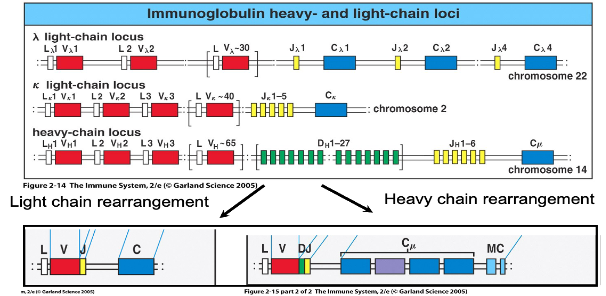
How is the human genome that contains fewer than 100,000 genes able to produce a vast array of antibodies with billions of different antigen-binding specificities?
This feat is done by genetic rearrangement of the immunoglobulin gene loci, which is initially in the germline configuration prior to B cell development. In particular, there are multiple copies of variable and joining cassettes along with the constant region cassette (lambda or kappa) that make up the light chain gene locus, and multiple copies of variable, diversity, and joining cassettes along with the constant region cassette that make up the heavy chain gene locus. During B cell development, a unique cassette of each type is chosen at random and then joined to make a complete light chain or heavy chain gene. Since the joining mechanism is imprecise at cassette junctions (involving the non-template driven enzyme, terminal transferase), additional variability is introduced into the process at each DNA junction during the joining reaction. Finally, since any given light chain can associate with any given heavy chain, additional variability is created (i.e. the multiplicative sum of the two single probabilities). A diagram of this immunoglobulin gene rearrangement process is shown below.