WEEK 5 TESTBANK CH 13: Transition to Parenthood
 Call Kai
 Learn
 Practice Test
 Spaced Repetition
 Match
 Flashcards
 Knowt Play
1/18

Earn XP
Description and Tags
* not important
19 Terms
*Loutzenhiser, McAuslan, and Sharpe (2015) performed a study regarding maternal and paternal fatigue and factors associated with fatigue across the transition to parenthood. Which evidence-based conclusion is made regarding fatigue and the transitioning parents?
1. Levels of prenatal and postnatal fatigue are associated.
2. Postnatal fatigue remains consistent for a period of 1 year.
3. Poor sleep quality in fathers is related to depressive symptoms.
4. The length of couple relationship strongly impacts parenteral fatigue.
ANS: 1
the study that was conducted for maternal and paternal fatigue has shown that high prenatal fatigue is associated to higher levels of postpartum fatigue for both mom and dad
*As a result of the previously mentioned research study, the nurses in a postpartum facility will implement which evidence-based change?
1. Continue to assess the level of fatigue for the mother during postpartum period.
2. Assist fathers in recognizing and managing stress and depressive symptoms.
3. Encourage the father to go home and rest while the mother is hospitalized.
4. Promote strategies to decrease fatigue during both prenatal and postnatal periods.
ANS: 4
since the study has shown that there is increased fatigue in relation to both pre and post-natal, it is important the the nurse procide strategies to decrease fatigue
*The nurse is aware that some parenting skills are acquired through the process of intentional learning. Which activity does the nurse associate with intentional learning?
1. The couple observes other individuals who are mothers and fathers.
2. The couple attends hospital classes addressing newborn and infant care.
3. The couple discusses with each other how they were parented.
4. The couple watches media containing parenting roles.
ANS: 2
attending hospital classes is a sign that the parents are learning intentionally
The nurse on a postpartum unit is focused on providing care that will assist the mother and father in making the transition to parenthood. For which reason does the nurse review the prenatal and labor records?
1. Pregnancy and birth experiences, which can either enhance or impede the process of becoming a mother.
2. Awareness of prenatal classes that will help identify and focus on learning needs of both parents.
3. Identification of preexisting maternal conditions that may interfere with parenting transitions.
4. Knowledge regarding questions and concerns the mother and father may have about neonate issues.
ANS: 1
(1) pregnancy and birth experiences is something that the nurse revciews the pregnancy records to LOOK FOR COMPLICATIONS during pregnancy, labor, or birth
*The nurse is researching for evidence-based practice related to a mother's response during the postpartum period. Based on research by Rubin and Mercer, which finding will the nurse be able to easily implement to change the culture of the unit?
1. Satisfaction questionnaires
2. Alterations in terminology
3. Decrease nurse/patient ratios
4. Soliciting paternal expectations
ANS: 2
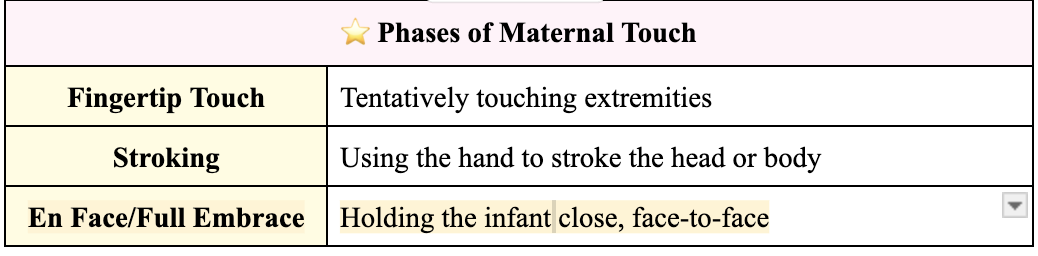
Rubin and Mercer change terminologies (e.g.m maternal phase → maternal touch | maternal role attainment → becoming a mother) which helps in promoting a change in the unit culture
The postpartum nurse is planning a home visit to a mother who delivered her baby 1 week ago. Which finding indicates to the nurse a possible problem with mother-infant bonding?
1. The mother is pleased to have the nurse visit her home and baby.
2. The baby's grandmother is present and involved with mother/baby care.
3. The mother focuses the visit on her physical recovery and concerns.
4. The baby's father is on "paternity leave" and involved with the baby.
ANS: 3
(3) “taking hold” phase starts 48 hours postpartum. if its been a week and the mom is still focused on her own physical recovery, the nurse must assess the pt. since this is a sign of inefficient mom and baby bonding

*Dayton et al. (2016) performed qualitative research regarding expectant fathers' beliefs and expectations. The nurse identifies which theme as emerging from this research?
1. Men felt that the role of being a father can be learned.
2. Men described fathering as an extremely difficult task.
3. Men rely on other men to support the fathering role.
4. Men believe that the nurturing role is always the mother's.
ANS: 2
Dayton’s research has shown the men has described being a father as a difficult task
The nurse on a postpartum unit focuses on how to assist the father in identifying his role with the neonate. Which intervention by the nurse is most helpful?
1. Encourage the couple to identify mutual expectations of the fathering role.
2. Critique the father's methods of providing physical care for the neonate.
3. Provide written materials about the physical and emotional role of a father.
4. Observe for a competitive attitude between the parents about providing baby care.
ANS: 1
(1) mutually agreed fathering expectations that is shared by mom and dad, can decrease level of stress in the relationship.
the nurse is providing postpartum care for an adolescent mother and her family. which factor is most important for the nurse to consider when planning teaching about neonatal care?
grandparent decided they want to be involved
the parents need to discuss their expectations of each other
the mother is determined the father should be involved
information must be presented on an age-appropriate level
ANS: 4
a nurse teaching neonatal care has needs to prioritize sharing to the parents the information should be age-appropriate. learning styles and teaching strategies vary IF THE PARENT IS AN ADOLESCENT OR AN OLDER ADULT.
which behavior does the nurse identify as a demonstration of unidirectional bonding between a parent and infant?
the parents respond to the baby’s cry
the parents call the baby by name
the baby responds to comforting measures
the parents stimulate and entertain the baby

ANS: 2
(2) a parent calling the baby by name is unidirectional. the baby doesn’t know it’s name yet, so this is just one-sided form of bonding
The nurse is observing a new mother interact with her baby and notices the mother holding the baby close to her body. However, the nurse also notices that the mother does not hold the baby in an enface position. Which question is most appropriate for the nurse to ask?
1. "Can I help you with a nice position in which to hold your baby?"
2. "What can you tell me about your family's beliefs with new babies?"
3. "Is there some reason that I have not seen you look into your baby's eyes?"
4. "Your baby is so expressive, have you looked into his eyes yet?"
ANS: 2
(2) asking about family beliefs w/ new babies is a good way for a nurse to assess on why the mom is not doing the “en-face” phase of having a new baby.
a new mother expresses frustration about how to know what her baby wants. the mother states “I don’t know what I expect, but then , the baby doesn’t know either.” which situation does the nures use as an example of neonate communication?
1. The baby is content to lie still on the mother's abdomen.
2. The baby is easily awakened if irritated by loud noises.
3. The baby resists eye contact if bored or disinterested.
4. The baby roots for the breast when the cheek is stroked.
ANS: 4
rooting is a sign for THE NEED TO EAT. this is a good one to teach the mom so she understands the neonate’s method of communication of hunger
*The nurse is interested in promoting coparenting because of the high likeability that at some point, both parents will be working outside the home. After reading research by Davis, Schoppe-Sullivan, Mangelsdorf, and Brown (2009), the nurse learns that which factor impacts coparenting the most?
1. Infant temperament
2. Father's interest
3. Strength of support systems
4. Mother's expectations
ANS: 1
infant temperament was observed for the father to decrease in coparenting behavior in a span of 3.5 months
The nurse is providing care for a new mother during a follow-up visit 6 weeks after a vaginal delivery. The mother begins to cry and reports difficulty with eating and sleeping. The nurse identifies postpartum blues and cites which reason as the most likely cause?
1. Fatigue related to a "fussy" baby
2. Frustration over physical appearance
3. Changes in hormonal levels
4. Stress related to new mother role
ANS: 3
hormonal level changes

The nurse on a postpartum unit is acutely aware that cultural influences impact the patient’s process of “becoming a mother.” For which cultural influences does the nurse assess? Select all that apply.
1. What amount of time the mother spends in each phase
differences in the mother’s expectation related to ability to rest
how the mother physically recovers from labor and delivery
mother’s involvement in decision making for the first few months
whether the mother seems interested in how to care for her baby
ANS: 1, 2, 4, 5
(1) “the phase of becoming a mom” can be influenced by culture
(2) prioritizing mom’s rest than care of baby is also part of some cultures
(4) to be involved or not involved in decision making on the first few months of infant’s life
(5) interest in learning how to care for baby. in some cultures, other family members are the one’s that provide care for the infant for the several months. it is important for the nurse to assess if this is based culturally of there are some other issues.
then nurse is counseling a lesbian couple who have decided to have a child. which considerations does the nurse present with regard to which partner will become pregnant? select all that apply
Consider the age and health of each partner
evaluate each partner’s career goals
decide which partner has better insurance
determine who will be on the birth certificate
identify which woman desires to be pregnant
ANS: 1,2,3,5
(1) age and health of each partner is important to establish to choose a biological mom
(2) patient career goals can help with determining which partner has a stronger need to be a coparent instead of a biological mother
(3) better insurance is necessary to help with covering for the pregnancy and birth
(5) desire to be pregnant can determine who will be the biological mom. if both want to be pregnant, determine who will go first
The nurse in a postpartum unit evaluates new parents for risk factors that can indicate problems with bonding/attachment. Which situations does the nurse recognize as a cause for bonding/attachment problems? Select all that apply?
the mother experienced eclampsia in the third trimester of pregnancy
the neonate is being treated for meconium aspiration syndrome
the mother experienced dystocia in the second phase of labor
the father of the neonate is in the military and not yet home on leave
the mother’s mother lives next door and is available to help wth the baby
ANS: 1,2,3
(1) eclampsia in 3rd trisem is at risk for bonding/attachment due to condition experienced during labor
(2) neonate being treated for meconium aspiration syndrome is a cause of bonding problems due to separation of infant from mom
(3) mom experiencing dystocia can cause bonding problems, since both parents wil experience EXHAUSTION due to the long labor
The nurse uses research from Greenberg and Morris (1974) as a guideline for identifying the presence of engrossment in a new baby by the father. Which behaviors exhibit paternal–infant bonding related to engrossment? Select all that apply.
1. Seeing the baby as attractive
2. Perceiving the baby as being perfect
3. Having a desire to touch the baby
4. Indicating an increasing sense of self-esteem
5. Positively commenting about the baby’s features
ANS: 1,2,3,4,5

Engrossment phase shows that the father perceives the following:
baby is attractive
baby is perfect
want to touch baby
increased self-esteem w/ having a baby
positively commenting baby features
When providing care to a multiparous mother, the nurse needs to assess for the presence of ____________________ between the older children and the new baby.
ANS: sibling rivalry